

Chinese Companies Going Global: The Right Way to Build an E-commerce Site
E-Commerce, e-commerce Platforms
11 February 2026
1. Introduction: Why Independent eCommerce Sites Are Becoming Essential for Chinese Enterprises Going Global
In the past, Chinese enterprises often started their global expansion with third-party platforms: first selling products, first testing the market, first scaling up. This model was effective in the early stages, but by 2025–2026, more and more companies face a practical issue:
Platforms can generate orders, but they rarely provide long-term competitive advantage.
Rising traffic costs, frequently changing platform rules, and platforms controlling brand and customer relationships mean that as enterprises scale, they lose control over market insights and data.
For this reason, independent eCommerce sites are gradually evolving from an “optional choice” into a core infrastructure for Chinese enterprises going global. They are not just sales tools, but long-term assets integrating brand, customers, data, and systems.
2. Common Paths for Chinese Enterprises Going Global
From practical experience, there is no single “standard success path” for global expansion. Enterprises of different industries, sizes, and organizational maturity often follow different paths. However, these paths are not random; they can be clearly categorized into several typical models.
Understanding these differences helps enterprises assess: Is the current choice suitable? Does it allow room for future upgrades and transformation?
Path 1: Starting with Third-Party Platforms (Market Validation Stage)
This is the most common and lowest-entry method for going global. Enterprises use existing eCommerce platforms to quickly launch products in overseas markets.
Typical Features
- Fast launch speed
- Low technical and system requirements
- Relatively controllable initial investment
Suitable for Enterprise Stage
- First attempt at overseas markets
- Need to quickly validate products and demand
- Organization and IT capabilities are not yet ready for an independent site
Potential Limitations
- Customer relationships and data are controlled by the platform
- Limited room for brand differentiation
- Traffic costs and platform commissions increase year by year
The essence of this path is “leveraging platform infrastructure for speed,” but it is not suitable as a long-term core model.
Path 2: Platform-First Sales with Independent Site as Support (Transitional)
Once enterprises achieve some success on the platform, they begin to realize the importance of brand and customer management and simultaneously launch an independent site.
Stage Positioning
- Brand showcase website
- Marketing campaign landing page
- Supplementary channel for specific markets or products
Suitable for Enterprise Stage
- Already have stable international revenue
- Starting to focus on brand and long-term management
- Still highly dependent on platform orders
Common Issues
- Independent site treated as "just another website"
- System architecture not designed for future transaction scale
- Content, transactions, and data operate in silos
This is a necessary but high-risk transitional path. Without a clear long-term plan, the independent site can easily remain in a “present but ineffective” state.
Path 3: Independent Site as Core, Platform as Supplement (Mature Stage)
As enterprises expand their international business and markets grow, more and more companies elevate the independent site to a core position, while the platform takes on a supporting role.
Model Positioning
- Independent site handles brand, customers, and data
- Platform used for specific markets, clearing inventory, or short-term exposure
Suitable for Enterprise Stage
- Operations across multiple markets and languages
- Clear brand positioning and long-term global strategy
- Need to integrate ERP, CRM, marketing, and data systems
Key Challenges
- Significant increase in system architecture complexity
- Requires higher governance and integration capabilities
- The cost of wrong technology or platform choices is greatly amplified

This path represents the true “enterprise-level eCommerce model.”
Path 4: Independent Site First, Platform Later (Brand-Oriented)
A few brand-oriented or DTC enterprises choose to use the independent site as the main channel from the start, with the platform only as a supplement or not used at all.
Typical Features
- Emphasizes brand storytelling and direct customer relationships
- High control over pricing, experience, and data
- Extremely high requirements for systems and marketing capabilities
Suitable Enterprise Types
- Established brand with differentiated products
- Strong marketing and content capabilities
- Can withstand a longer initial market cultivation period
Main Risks
- High initial traffic acquisition costs
- Extremely high requirements for organizational execution
Path 5: Multiple Paths in Parallel but Lacking Overall Planning (High-Risk)
This is a path that many enterprises unconsciously take during rapid growth: platforms, independent eCommerce sites, and regional sites coexist, but lack a unified architecture and governance.
Common Phenomena
- Different systems used for each market
- Data cannot be integrated
- Content and pricing strategies are inconsistent
Long-Term Consequences
- Maintenance costs rise rapidly
- Systems constrain each other, making upgrades difficult
- The larger the global operations, the more issues arise
Summary: There is no right or wrong path in itself; what’s wrong is “not thinking about upgrades.”
From an enterprise-level perspective, most successful companies don’t necessarily choose the right path from the start, but rather:
- Clearly understand the current stage they are in
- Reserve space in advance for the next stage
- Do not mistake “temporarily feasible” for “long-term correct”
The choice of eCommerce path ultimately comes down to one question:
Does the enterprise plan the independent site as a long-term asset?
This is exactly the focus of the next section.
3. The Core Role of Independent eCommerce Sites in Chinese Enterprises’ Global Expansion
In an enterprise context, an independent site plays at least four key roles:
Brand Hub
The independent site is the core space for brand storytelling, product value, and trust-building, rather than a highly homogenized product page on a platform.
Customer Relationship Center
Through the independent site, enterprises can truly control membership, behavioral data, and customer lifecycle, instead of being fragmented by platforms.
System Integration Hub
The independent site can integrate with ERP, CRM, CDP, and marketing automation systems, becoming the central node for global operations.
Long-Term Asset Carrier
Platform accounts are "rented assets," whereas the independent site is an asset that the enterprise truly owns and can sustainably accumulate value from.
4. System Architecture Approach for Enterprise-Level Independent eCommerce Sites
When enterprises start treating the independent site as the core of long-term operations rather than a short-term sales tool, the system architecture must be designed from the start for scalability, multi-market operations, and integration.
The goal of an enterprise-level architecture is clear: when business becomes complex, the system should not become an obstacle.
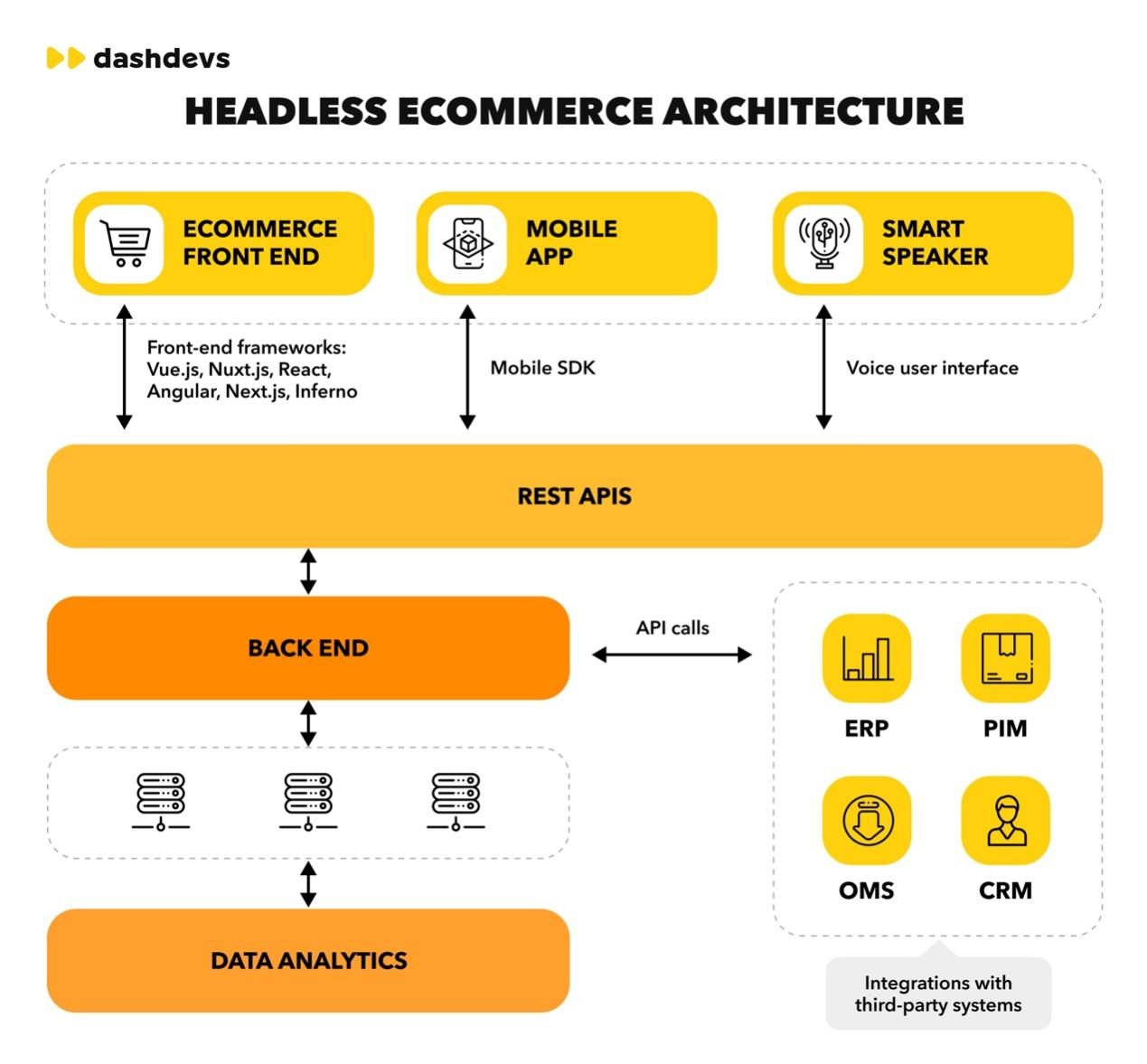
Decoupling Front-End Experience and Transaction Logic
Enterprise-level independent sites typically adopt a headless/API-first approach:
- Front-end handles brand experience and localized presentation
- Back-end focuses on transactions and business rules
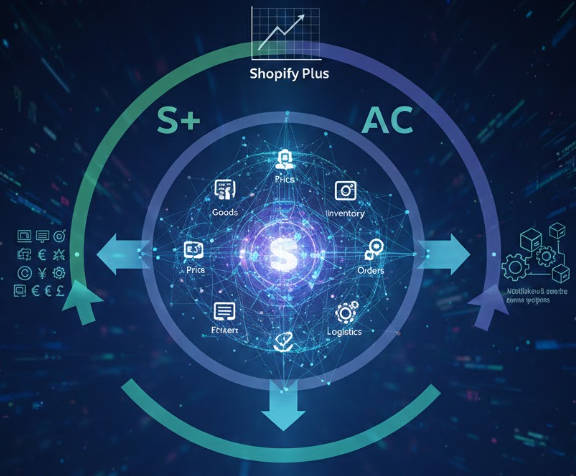
Stable and Scalable Transaction Core
The transaction core handles key functions such as products, pricing, inventory, orders, payments, and logistics. Whether an enterprise chooses Shopify Plus or Adobe Commerce, the key considerations are:
- Does it support multiple sites, currencies, and rules?
- Can it scale continuously as the business grows?
- Can it integrate with other enterprise systems?

Content and Multi-Market Governance Capabilities
The challenge of content for independent sites is not translation, but governance. An enterprise-level content architecture should support:
- Unified management across languages and markets
- Localized adjustments instead of redundant maintenance
- Clear permissions and workflow controls
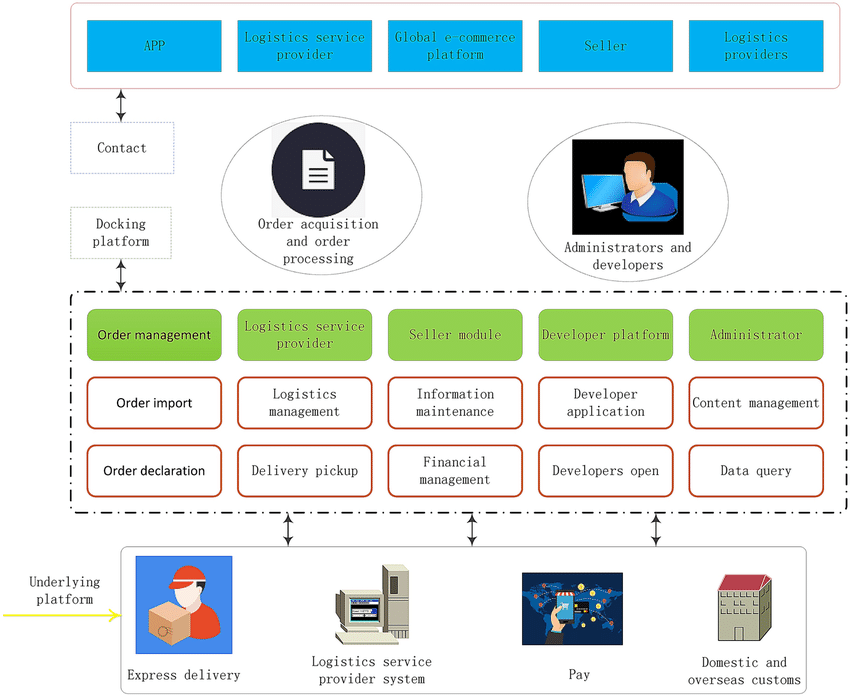
System Integration and Data Foundation
A mature independent site must be able to collaborate with existing enterprise systems, including:
- ERP (orders, inventory, finance)
- CRM/CDP (customers and data)
- Marketing and analytics tools

Governance and Security as a Prerequisite for Scalability
As markets and teams grow, an enterprise-level architecture must include:
- Permission and role management
- Data protection and compliance design
- Controlled upgrade and change mechanisms
5. How Independent Sites Support SEO and New Search Methods (GEO)
For many enterprises, doing eCommerce internationally involves SEO, aiming to gain long-term, stable organic traffic. In practice, common experiences include:
- Producing plenty of content, but results are inconsistent
- Keyword competition is increasingly fierce
- Relying on just a few pages makes it hard to maintain long-term advantage
This does not mean SEO is unimportant, but the search environment itself has changed.
SEO Is Still Important, But No Longer Just “Target a Few Keywords”
In overseas markets, search remains a key entry point for users to discover brands and products. What has changed is that search systems increasingly value the overall quality and consistency of the site, not just individual pages.
This means that to truly realize SEO value, the focus for enterprise independent sites has shifted to:
- Having clear content topics and categorization
- Continuously publishing valuable information over the long term
- Helping search systems understand your expertise
The core of SEO is moving from “optimizing pages” to “managing the site.”
Changes in Search Methods Bring New Content Requirements (GEO)
Beyond traditional search results, more users now see “organized answers” directly rather than clicking through individual pages.
In this context, enterprises must consider more than “ranking position”; the key question is:
Is the content clear enough to be understood and referenced?
This is the focus of GEO. For independent sites, content with the following characteristics is more likely to perform well in new search environments:
- Clear and focused topics
- Concise conclusions rather than just information dumping
- Consistent content and stable presentation
In short, content written for humans must also be understandable to systems.
Why Independent Sites Are Better for SEO and GEO
Compared with third-party platforms, independent sites have natural advantages for search:
- Content structure is controllable and not restricted by platform templates
- Brand information is complete, with context
- Content can accumulate over time rather than being one-off
Platforms are better for “transaction efficiency,” while independent sites are better for building content and search assets.
6. How Content, Transactions, and Data Work Together
Successful enterprise independent sites do not rely on “eCommerce systems alone,” but rather coordinate across three layers:
Content Layer
Responsible for brand storytelling, localized communication, and trust-building.
Transaction Layer
Handles complex business logic such as pricing, inventory, orders, payments, and logistics.
Data Layer
Integrates behavioral, transaction, and marketing data for analysis, personalization, and decision-making.
When these three layers are fragmented, the independent site degenerates into “just another website”; when they work together, the site becomes a true growth engine.
7. Common Reasons for Failure of Chinese Enterprises’ Independent Sites Abroad
From numerous enterprise cases, failures are often not technical issues, but issues of awareness and planning:

Treating the independent site as a short-term sales channel

Choosing the wrong platform or architecture from the start

Over-reliance on plugins and patches

Insufficient content and multi-market governance capabilities

Data cannot be integrated and fails to drive decisions

Lack of enterprise-level governance and long-term planning
These issues usually only become fully apparent 1–2 years after launch, but the cost of correction is very high.
8. Common Traits of Successful Enterprise Independent eCommerce Sites
Conversely, successful enterprises often share the following traits:
- Plan the independent site from the start with a “long-term asset” mindset
- System architecture reserves space for expansion and integration
- Unified planning for content, transactions, and data
- Clear division of roles between platforms and independent sites
- Continuous optimization, rather than one-time launch
They do not ask “how quickly will it pay back,” but rather “will it continue to grow in three years?”
9. Summary: Treat the Independent Site as a Long-Term Asset, Not Just a Channel
The essence of Chinese enterprises going global is not just selling products overseas, but building the capability to sustainably operate in global markets.
An independent eCommerce site is the key foundation for this capability. It is not a replacement for platforms, but a long-term asset truly owned by the enterprise.
If you are planning a global expansion or independent site strategy for a Chinese enterprise, visit our Contact Us page to discuss your business stage and system blueprint with our consulting team.
You can also learn more about our enterprise-level eCommerce and digital experience solutions, helping you establish a solid and scalable global expansion foundation for the next 3–5 years.
Further Reading
Reference Links
Related Articles
Enterprise AI MarTech Trends Analysis 2024-2029 Outlook Report
From AI content productivity tools to a core engine for revenue growth and marketing transformation
*The PDF will be sent directly to your inbox.