
MarTech Trends 2026: A Complete Guide to AI, Personalization, Zero-Party Data, and Customer Journey Automation
AI, MarTech
29 December 2025
- Why Enterprises Should Follow MarTech Trends
- Trend 1: AI Fully Integrated
- Trend 2: Real-Time Personalization
- Trend 3: Zero- & First-Party Data as Core
- Trend 4: Customer Journey Automation Matured
- Trend 5: Intelligent Content & CMS
- Trend 6: Privacy, Compliance & Governance
- Building Your 2026 MarTech Strategy
- Conclusion and Further Reading
- Why Enterprises Should Follow MarTech Trends
- Trend 1: AI Fully Integrated
- Trend 2: Real-Time Personalization
- Trend 3: Zero- & First-Party Data as Core
- Trend 4: Customer Journey Automation Matured
- Trend 5: Intelligent Content & CMS
- Trend 6: Privacy, Compliance & Governance
- Building Your 2026 MarTech Strategy
- Conclusion and Further Reading
In 2026, MarTech (Marketing Technology) is defined by one core keyword: execution.
Companies are no longer pursuing “more tools at any cost.” Instead, they care more about whether data is usable, journeys actually work, personalization delivers results, AI truly improves efficiency and conversion, and long-term operations can be sustained under privacy and compliance requirements.
This article summarizes the most important MarTech trends for 2026 and provides planning approaches that enterprises can directly adopt to help build a clear and actionable MarTech roadmap.
1. Why Enterprises Should Follow MarTech Trends
When trends change, enterprise investment priorities, data strategies, content production methods, journey design, and measurement frameworks all change accordingly.
The value of following MarTech trends for enterprises includes:
- Avoiding wasted purchases and misguided implementations (tool overload with unclear results)
- Creating a more focused roadmap driven by use cases and outcomes
- Filling data and architecture gaps early so personalization and AI can be successfully implemented
- Building sustainable, long-term growth under privacy and compliance requirements
2. Trend 1: AI Fully Integrated
In 2026, AI is no longer “an additional AI tool.” Instead, it is embedded into every layer of the MarTech stack. Data, content, journeys, and analytics will all include AI-driven capabilities.
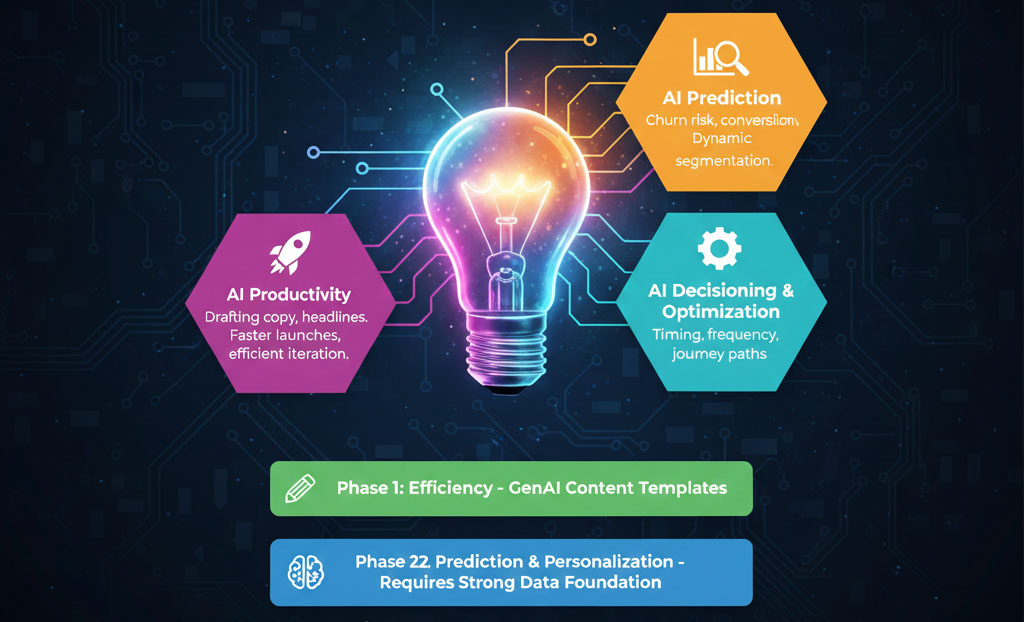
Three Directions for AI Integration in MarTech
- AI Productivity
- Drafting copy, headlines, EDM content, and creative variations
- Helping marketing teams launch faster and iterate more efficiently
- AI Prediction
- Churn risk alerts, conversion propensity, and LTV potential
- Evolving segmentation from static rules to dynamic predictions
- AI Decisioning and Optimization
- Recommending the next best content or product
- Optimizing engagement timing and frequency
- Automatically adjusting journey branches
Implementation Recommendations for Enterprises
- Phase 1: Start by applying AI to efficiency improvements, such as content templates combined with GenAI
- Phase 2: Expand into prediction and personalization, supported by a stronger and more complete data foundation
- Avoid launching fully automated AI marketing too early, as insufficient data often leads to failure
3. Trend 2: Real-Time Personalization
Personalization is no longer limited to EDMs or advertising audience targeting. It must be consistent across channels and capable of responding to user behavior in real time.
What Is Real-Time Personalization?
After a user action occurs on a website or app, the system can complete the following within a short time frame (minutes or even faster):
- Identity recognition and segment updates
- Dynamic content or recommendation delivery
- Journey triggers (e.g., push notifications, EDM, SMS)
Common Real-Time Personalization Use Cases
- Homepage banners or CTAs that change based on interests or lifecycle stage
- Product page recommendations that better match user intent for the “next step”
- Forms or workflows that reduce steps based on known identity data
- Key behavioral events triggering journeys in real time (add to cart, viewing key pages, cart abandonment)
Key Requirements for Execution
- Complete event tracking specifications (event taxonomy)
- A clear identity strategy (identity resolution)
- Strong integration between the CDP/data layer and the content layer (otherwise, personalization remains only partial)
4. Trend 3: Zero- & First-Party Data as Core
Privacy trends and platform restrictions are pushing enterprises to rely more heavily on their own data.
The focus of data strategy in 2026 is to transform data from being fragmented to usable, and from simply collected to truly operational.
What Is Zero-Party Data?
Data that users proactively and intentionally provide, such as:
- Preferences, interests, and budget ranges
- Preferred notification frequency
- Product needs and use cases
- Self-selected tags (Preference Center)
The Value of Zero-Party Data:
Common KPIs can be viewed across three layers:
- High compliance and trustworthiness
- Typically stronger personalization performance
- Reduced reliance on third-party tracking
Enterprise Implementation Recommendations (Highly Practical)
At a minimum, enterprises should:
- Establish a Preference Center
- Design clear “value exchanges” by offering content, benefits, or membership privileges in return for preference data
- Write preference data back into the CDP and journey rules to create actionable audiences
5. Trend 4: Customer Journey Automation Matured
Many enterprises began implementing automated journeys in 2023–2024, but the key differentiator in 2026 is whether journeys have complete mechanisms for governance, frequency control, testing, measurement, and iteration.
Journey Automation in 2026 Will Place Greater Emphasis On:
Journey Governance
- Who is allowed to modify journeys? Who can send messages? Who approves changes?
- Journey version control and rollback mechanisms
Frequency Capping
- Avoid multiple journeys bombarding the same user at the same time
- Maintain consistency in the customer experience
Experimentation and Optimization
- A/B testing goes beyond subject lines to include branching logic, content combinations, and trigger timing
- Drive iteration through continuous learning rather than one-time launches
Cross-Channel Consistency
- Align messaging across web, app, EDM, SMS, and customer support
- Ensure customers feel they are interacting with one company, not multiple disconnected systems
6. Trend 5: Intelligent Content & CMS
Content operations are shifting from a page-centric model to a modular approach. Combined with AI, this enables faster content production, better control, and more measurable outcomes.
Three Key Content Trends for 2026
Content Modularization
- Break content into reusable components (hero sections, features, CTAs, FAQs, etc.)
- Make multi-site and multi-language expansion easier to scale
Content Supply Chain
- Cover planning, review, production, publishing, and performance tracking
- Establish workflows and permission governance to reduce communication costs
GenAI-Assisted Content Production
- Start with templates and guidelines, then use AI to generate first drafts
- Emphasize human review, brand voice, and compliance
- Avoid allowing AI to publish content directly without controls
7. Trend 6: Privacy, Compliance & Governance
In 2026, many enterprises will realize that compliance is not a “cost,” but a prerequisite for sustaining personalization and AI initiatives over the long term.
Essential Governance Areas
- Data classification and access control (PII, sensitive data, general behavioral data)
- Consent management and traceability
- Data retention and deletion policies
- Approval workflows for audiences and journeys
- Data quality monitoring (QA, latency, missing values)
When governance is done well, AI and personalization become sustainable capabilities rather than short-term experiments.

8. Building Your 2026 MarTech Strategy
Below is a roadmap that enterprises can apply directly and adjust based on their level of maturity:
Phase 1: Foundation (0–3 Months)
- Define 2–4 high-value use cases (welcome, cart, lead nurturing)
- Establish event tracking specifications and KPI measurement methods
- Audit data sources and define the identity strategy (ID design)
- Build core audiences and a foundational journey MVP
Phase 2: Expansion (3–9 Months)
- Expand into additional journeys (retention, repeat purchase, re-engagement)
- Implement frequency capping, governance, and version management
- Introduce more comprehensive content modules and templates
- Strengthen analytics dashboards (by journey, channel, and audience)
Phase 3: Maturity (9–18 Months)
- Real-time personalization (web/app with real-time journey triggers)
- AI-driven prediction (churn, conversion, LTV)
- Integrate GenAI into the content supply chain to improve efficiency
- Establish continuous experimentation and iteration mechanisms (optimization operating model)
9. Summary and Further Reading
The central theme of MarTech in 2026 is clear: AI integration, real-time personalization, first-party and zero-party data, the maturation of customer journey automation, and long-term sustainable operations under privacy and compliance requirements.
For enterprises, the key is not chasing every new buzzword, but building the right roadmap. Start by laying a solid foundation of data and governance, then drive results through high-value use cases, and finally deepen and stabilize AI and personalization capabilities.
If you are planning your MarTech roadmap for 2026, or looking to evaluate how to implement CDP, marketing automation, personalization, and AI, feel free to contact us. We can help you begin with use-case and data assessments and define a practical, executable implementation and optimization path.
Further Reading
- What is MarTech? Complete 2026 Guide to Marketing Technology
- What Are MarTech Tools? The Most Complete List of 30 Marketing Technology Tool Categories for 2026
- What do MarTech companies do? How to choose the right MarTech consultant
- What Is AI MarTech? How AI Is Reshaping Marketing Technology
- How Can Enterprises Adopt MarTech? A Complete Guide to Process, Budget, and Success Factors
Related Articles
Enterprise AI MarTech Trends Analysis 2024-2029 Outlook Report
From AI content productivity tools to a core engine for revenue growth and marketing transformation
*The PDF will be sent directly to your inbox.
Email Error
Please enter a valid email address.
Thank You!
The whitepaper has been sent to your inbox. If you don’t see it, please check your spam or promotions folder.