
Website Security Testing Case | Reduce Website Risks & Improve Security
Company Background
The company in this case is a medium-to-large enterprise serving both consumer and business customers. Its website handles brand presentation, product information, member login, form submissions, content queries, and customer service. As the website's functionality grew, it became more than just a brand showcase—it became a critical gateway connecting customers, content, data, and business processes. Any security vulnerabilities, unauthorized access, data breach risks, or system weaknesses could impact the company's reputation, customer trust, and daily operations. Before optimization, the website was functioning normally, but after multiple feature updates, third-party integrations, and content management adjustments, the company wanted to conduct a comprehensive security test before a major release to identify potential vulnerabilities and reduce security risks.
1. Challenges Before Optimization
Before security testing and optimization, the website faced the following issues:
Increasingly Complex Website Features & Integrations
As the website expanded, the system included multiple functional modules such as content management, form submissions, member login, API integration, third-party tracking tools, and external system integrations. The more features, the larger the potential attack surface, requiring more systematic checks of every entry point.
Lack of Comprehensive Security Testing Baseline
Previously, the website mainly focused on functional testing and user experience testing. Security testing was mostly reactive, triggered after issues occurred, lacking fixed processes for vulnerability scanning, penetration testing, security configuration checks, and remediation verification.
Potential Risks in Forms & Login Processes
The website contained multiple forms and login-related functions involving user input, data submission, and backend validation. Without sufficient input validation, access control, anti-bot mechanisms, or error handling, risks such as data injection, brute force attempts, duplicate submissions, or sensitive information exposure could arise.
Third-Party Tools & External Resources Increasing Risk
The website introduced multiple third-party tools such as analytics, marketing tracking codes, chat tools, embedded content, and API services. While these tools support business operations, insufficient permissions, loading strategies, or security header configurations could increase security risks.
Security Configurations Not Fully Standardized
Some environments lacked fully standardized HTTP Security Headers, Cookie security attributes, TLS settings, error message handling, and admin backend access restrictions. While not immediately causing incidents, these issues increased opportunities for attacks or scanning exploitation.
2. Optimization Goals
The main goals of this security testing and optimization included:
- Identify potential security vulnerabilities and high-risk entry points
- Check compliance with common Web security best practices
- Reduce risks related to forms, login, API, and backend management
- Assess risks from third-party scripts and external resources
- Optimize HTTP Security Headers and Cookie security settings
- Reduce sensitive information exposure and error message leakage
- Establish vulnerability remediation, verification, and regression testing processes
- Improve security confidence and operational stability before go-live
3. Security Testing Strategy
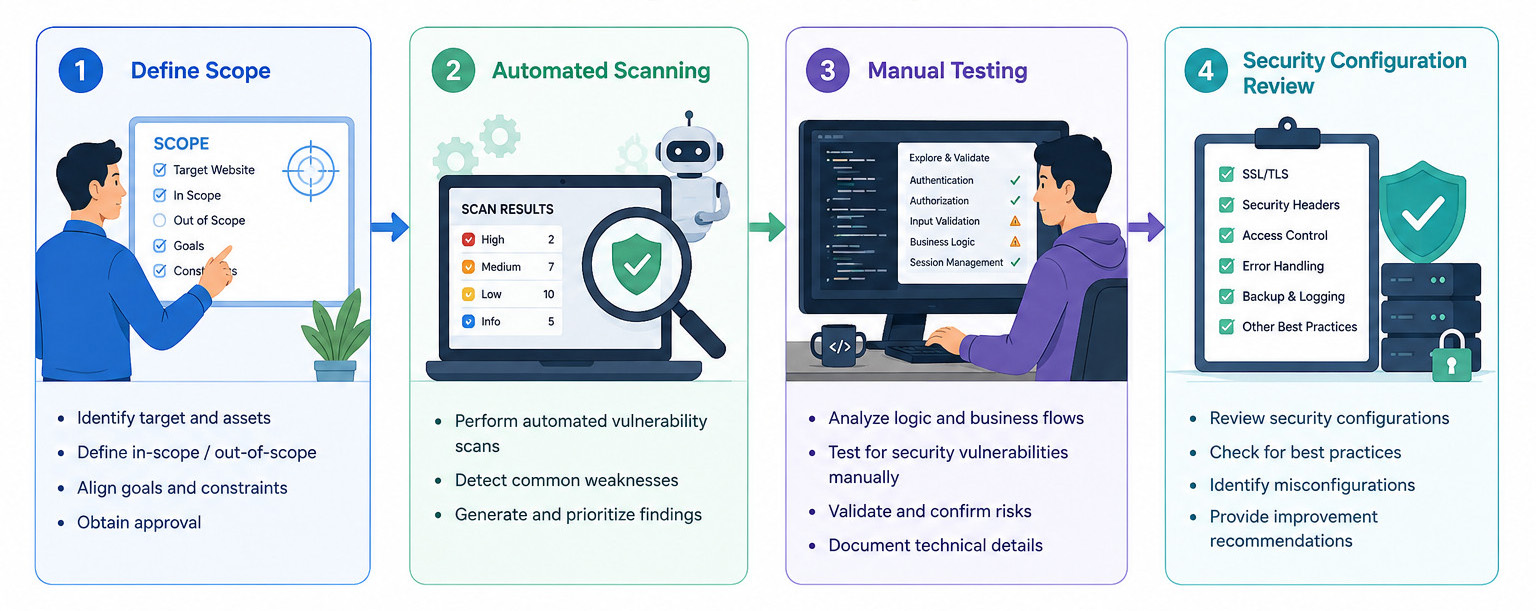
We adopted a systematic security testing approach, from scope definition and automated scanning to manual testing and security configuration checks, to comprehensively assess the website’s security posture.
3.1 Defining Security Testing Scope
We first defined the security testing scope based on website architecture, functional modules, and data flows, including: homepage and public content pages, product or service detail pages, search functionality, form submission pages, login and member-related pages, API endpoints, admin backend entry points, file upload/download functions, third-party tools and external resources, Cookie/Session and authorization mechanisms, HTTP Security Headers and server configurations. Clearly defining the testing scope prevents only checking surface pages while ignoring truly high-risk interactive features and backend interfaces.
3.2 Vulnerability Scanning & Automated Detection
We used security scanning tools for preliminary detection to quickly identify common risks, including: missing security headers, weak Cookie settings, suspicious error messages, insecure form submission methods, potential XSS risks, potential SQL Injection risks, insecure redirects, unnecessary service or endpoint exposure, outdated packages or third-party dependency risks. Automated scanning quickly establishes a risk inventory but cannot replace manual analysis. Therefore, we performed manual verification based on scan results to avoid false positives or missed detections.
3.3 Manual Testing Based on OWASP Risks
For core website functions, we referenced OWASP Web Application Security Testing common risk categories for manual testing, focusing on: authentication and session management, access control, input validation and output encoding, cross-site scripting XSS, injection attack risks, file upload security, sensitive data transmission, error messages and information exposure, security configuration errors, third-party component risks. This step helps enterprises understand website risks from a real attack path perspective rather than just reading tool reports.
3.4 Form & API Security Testing
Forms and APIs are typically the focus of website security testing. We tested the following items: form field input validation, special character and malicious string handling, duplicate submission protection, CSRF protection, API permission validation, API Rate Limiting, illegal parameter handling, whether error messages expose internal information, whether APIs can be called directly bypassing frontend restrictions, whether unauthorized data access risks exist. These tests effectively reduce form abuse, data injection, and malicious API manipulation risks.
3.5 Security Configuration & Environment Checks
In addition to application-level testing, we also checked website security configurations, including: HTTPS and TLS settings, HSTS settings, Content Security Policy, X-Frame-Options, X-Content-Type-Options, Referrer-Policy, Permissions-Policy, Cookie Secure/HttpOnly/SameSite settings, error page and error message handling, admin backend access restrictions, whether unnecessary Debug or test information is exposed. These configurations effectively enhance basic website protection and reduce common attack risks.
4. Security Optimization Strategy
Based on test results, we systematically remediated and strengthened identified vulnerabilities and risks.
4.1 Remediate High & Medium Risk Vulnerabilities
Based on test results, risks were prioritized to address high and medium severity issues first, including fixing data exposure, strengthening login and session management, enhancing API permission checks, correcting insufficient input validation, fixing XSS risks, improving error message handling, closing unnecessary endpoints, and removing outdated third-party components.
4.2 Strengthen Input Validation & Output Encoding
Enhanced frontend and backend validation for forms, search, query parameters, and API inputs, including limiting input format and length, filtering high-risk special characters, re-validating critical fields on the backend, avoiding reliance solely on frontend validation, and properly encoding output content.
4.3 Strengthen Authentication & Access Control
Enhanced authentication and access control for login, member, backend, and API functions, including checking login failure handling logic, strengthening session timeout, setting Cookie Secure/HttpOnly/SameSite, preventing unauthorized API access, and restricting backend entry point access.
4.4 Optimize Security Headers
Optimized HTTP Security Headers based on website architecture and content requirements, including Content-Security-Policy, Strict-Transport-Security, X-Frame-Options, X-Content-Type-Options, Referrer-Policy, Permissions-Policy, helping browsers block common attacks.
4.5 Third-Party Script & External Resource Governance
Governed and controlled risks for third-party tools used on the website, including inventorying all third-party scripts, removing unused tools, checking resource loading sources, restricting loadable external domains, and controlling data scope accessible by third-party tools.
4.6 Establish Remediation Verification & Continuous Check Mechanisms
After vulnerability remediation, verification and regression testing were performed to ensure issues were resolved without introducing new problems. Continuous check mechanisms were established, including pre-release security testing, regular vulnerability scanning, third-party component version checks, security header checks, and form/API security regression testing.
5. Optimization Results
After security testing and optimization, the website showed significant improvements in vulnerability risks, configuration security, form protection, and go-live confidence. The following results were observed approximately 1-2 months after optimization:
| Metric | Before | After | Improvement |
|---|---|---|---|
| High-risk vulnerabilities | 5 | 0 | 100% fixed |
| Medium-risk vulnerabilities | 18 | 3 | ~83% reduction |
| Security header completeness | ~45% | ~95% | ~50 percentage points |
| Form & API risk items | 12 | 2 | ~83% reduction |
| Unnecessary third-party scripts | 9 | 3 | ~67% reduction |
| Security test pass rate | ~72% | ~96% | ~24 percentage points |
Results Summary
Through this security testing and optimization, high-risk vulnerabilities decreased from 5 to 0, and medium-risk vulnerabilities decreased from 18 to 3. Security header completeness improved from ~45% to ~95%, and form/API-related risk items decreased by ~83%.
At the same time, unnecessary third-party scripts were removed, reducing external resource risks. Overall security test pass rate improved from ~72% to ~96%, significantly enhancing security confidence before website release.

6. Key Success Factors
The success of this case study comes from systematic testing methods and continuous security management awareness.

6.1 Risk-Based Prioritization
Security issues cannot be judged solely by quantity but must consider actual business impact. This case prioritized remediation based on risk level, exploitability, and impact scope, addressing issues that could cause data exposure, unauthorized access, or business interruption first.

6.2 Automated Scanning with Manual Verification
Automated tools can quickly identify common issues but may produce false positives or miss certain risks. Through manual verification and attack path analysis, we more accurately determined whether risks truly existed and whether remediation methods were effective.

6.3 Addressing Both Application & Configuration Layers
Website security comes not only from code but also from environment configurations, HTTP Headers, Cookie settings, third-party scripts, and access controls. This case improved overall protection through multi-layered checks.

6.4 Beyond Reports: Complete Remediation & Verification
The value of security testing is not just listing vulnerabilities but helping enterprises understand issues, complete remediation, re-verify, and ensure that fixes do not affect existing functionality.

6.5 Establish Continuous Security Check Processes
Websites are continuously updated, and security risks evolve. Therefore, establishing regular scanning, pre-release security checks, and vulnerability tracking mechanisms is essential for maintaining long-term website security.
7. Conclusion
This case study demonstrates how enterprise websites can reduce vulnerability risks, strengthen protection capabilities, and improve security confidence before system go-live through security testing and optimization.
For enterprise websites carrying brand image, customer data, form submissions, member logins, and business processes, security is not just an IT technical issue—it directly impacts corporate reputation, customer trust, and operational stability.
Through vulnerability scanning, penetration testing, form and API security checks, Security Headers optimization, third-party script governance, and continuous monitoring, enterprises can effectively reduce website security risks while maintaining higher security and reliability as they support business growth.
If your website is about to undergo a major release, feature update, campaign launch, or system integration, and you want to identify security vulnerabilities and potential risks in advance, learn about our Website Security Testing & Optimization Services. LeadsTech can assist enterprises with vulnerability scanning, penetration testing, OWASP risk checks, form and API security testing, Security Headers optimization, and third-party script risk checks to identify critical issues affecting website security, data protection, and operational stability, providing actionable remediation recommendations and optimization plans.
Related Cases

Enterprise AI MarTech Trends Analysis 2024-2029 Outlook Report
From AI content productivity tools to a core engine for revenue growth and marketing transformation
*The PDF will be sent directly to your inbox.