
- Introduction: Why System Architecture Comes First in Cross-Border eCommerce
- Overall Approach to Enterprise Cross-Border eCommerce Architecture
- Responsibilities of Content, Commerce, and Data Layers
- Key Design Considerations for Multi-Site, Multi-Language, and Multi-Currency
- Integration with ERP / CRM / CDP Systems
- Scalability and Governance in Architecture Design
- Common Architecture Mistakes
- Conclusion: Building an Architecture for Long-Term Growth
- Introduction: Why System Architecture Comes First in Cross-Border eCommerce
- Overall Approach to Enterprise Cross-Border eCommerce Architecture
- Responsibilities of Content, Commerce, and Data Layers
- Key Design Considerations for Multi-Site, Multi-Language, and Multi-Currency
- Integration with ERP / CRM / CDP Systems
- Scalability and Governance in Architecture Design
- Common Architecture Mistakes
- Conclusion: Building an Architecture for Long-Term Growth
1. Introduction: Why System Architecture Comes First in Cross-Border eCommerce
When companies start cross-border eCommerce initiatives, the most common questions are:
- Which platform should we choose?
- How long will it take to launch?
- What is the required budget?
However, in real-world projects, success or failure is rarely determined by these questions. Instead, it depends on a commonly overlooked factor:
Whether the system architecture is designed for enterprise-scale operations.
In the early stages, system issues are often masked by traffic and growth.
But once the business expands into multiple markets, sites, and teams, architectural problems begin to surface:
- Disconnected systems
- Inconsistent data
- Changes in one area affecting the entire system
- Fear of making changes due to system fragility
This is why mature enterprises often start by mapping out a “cross-border eCommerce system architecture” before choosing a platform.
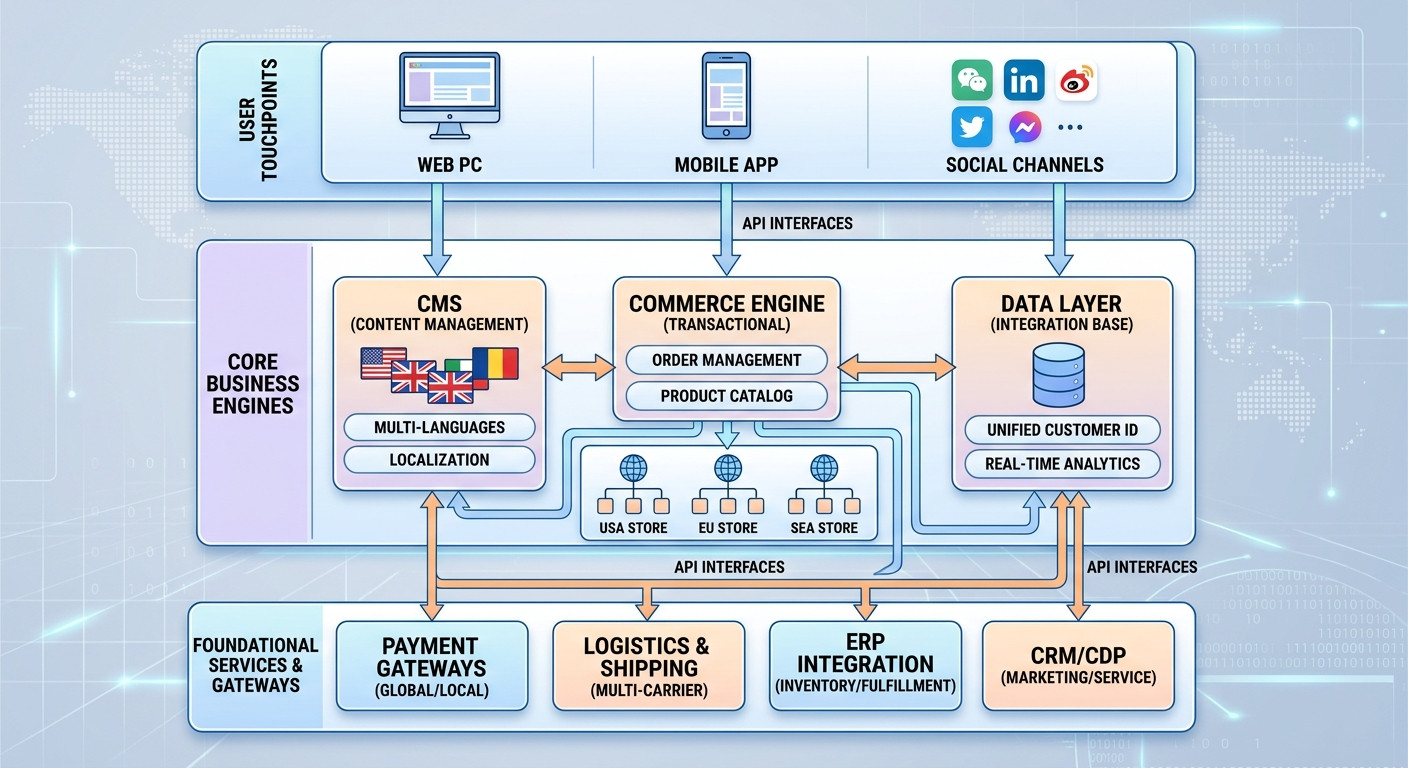
2. Overall Approach to Enterprise Cross-Border eCommerce Architecture
Enterprise-grade architecture is not about stacking systems together, but about achieving one core goal:
Ensuring the system remains scalable, governable, and evolvable as markets, operations, and organizations grow more complex.
From a practical perspective, a well-designed architecture typically has the following characteristics:
- Clear layering with defined responsibilities
- Loose coupling between systems through APIs
- Support for multi-market operations without duplication
- Ability to coexist with existing enterprise systems
Therefore, the most common approach in enterprise architecture is a layered architecture model.
3. Responsibilities of Content, Commerce, and Data Layers
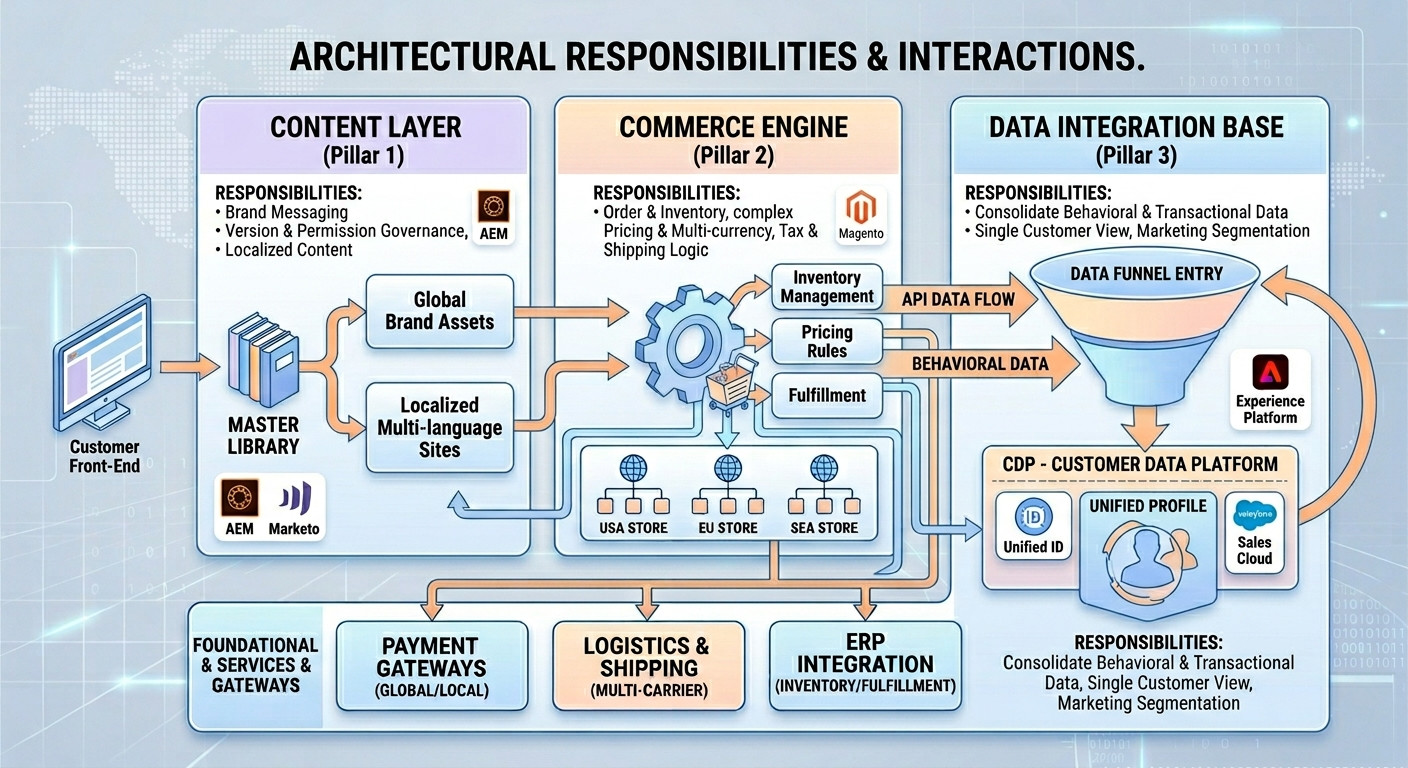
The most critical step in enterprise architecture is not selecting systems, but defining clear responsibility boundaries.
3.1 Content Layer: Foundation for Brand and Market Communication
The content layer is not just about page display, but about:
- Brand messaging and value communication
- Multi-language and multi-market content management
- Content versioning and governance
In cross-border scenarios, the challenge is not translation, but:
- Whether content can be reused across markets
- Whether localization is controllable
- Whether content updates follow structured workflows
Without a well-designed content layer, maintenance costs quickly spiral out of control.
3.2 Commerce Layer: Core of Business Complexity
The commerce layer is the “heart” of the system, responsible for:
- Product and pricing rules
- Inventory and order management
- Payments, taxation, and logistics
- Market-specific and customer-specific business logic
In enterprise scenarios, platforms such as Shopify Plus or Adobe Commerce are often used as the core commerce engine.
The key is not the brand itself, but:
- Whether it supports complex business rules
- Whether it integrates well with other systems
- Whether it can serve as a long-term transaction backbone
3.3 Data Layer: The Foundation Connecting All Systems
The value of the data layer is often underestimated.
In enterprise cross-border eCommerce, the data layer integrates:
- Content interaction data
- Transaction and order data
- Customer and membership data
- Marketing and touchpoint data
Without a unified data layer, companies end up with fragmented systems and decision-making driven by assumptions rather than data.
4. Key Design Considerations for Multi-Site, Multi-Language, and Multi-Currency
Multi-site is not about duplicating websites—it reflects architectural capability.

4.1 Key Questions for Multi-Site Design
Companies must answer:
- Should sites be structured by market, brand, or customer type?
- Which capabilities should be standardized, and which can vary?
- How should content, pricing, and inventory be shared or isolated?
Without architectural clarity, these issues must be resolved manually later.

4.2 Multi-Language and Localization
A mature architecture should:
- Decouple language from content
- Allow localization without affecting the core architecture
- Support independent publishing and approval workflows per market
Otherwise, multi-language becomes a maintenance burden rather than an advantage.

4.3 Multi-Currency and Taxation
Cross-border complexity is often concentrated in:
- Pricing strategies
- Tax compliance
- Settlement and financial reconciliation
If these capabilities are scattered across multiple systems or plugins, long-term risks increase significantly.
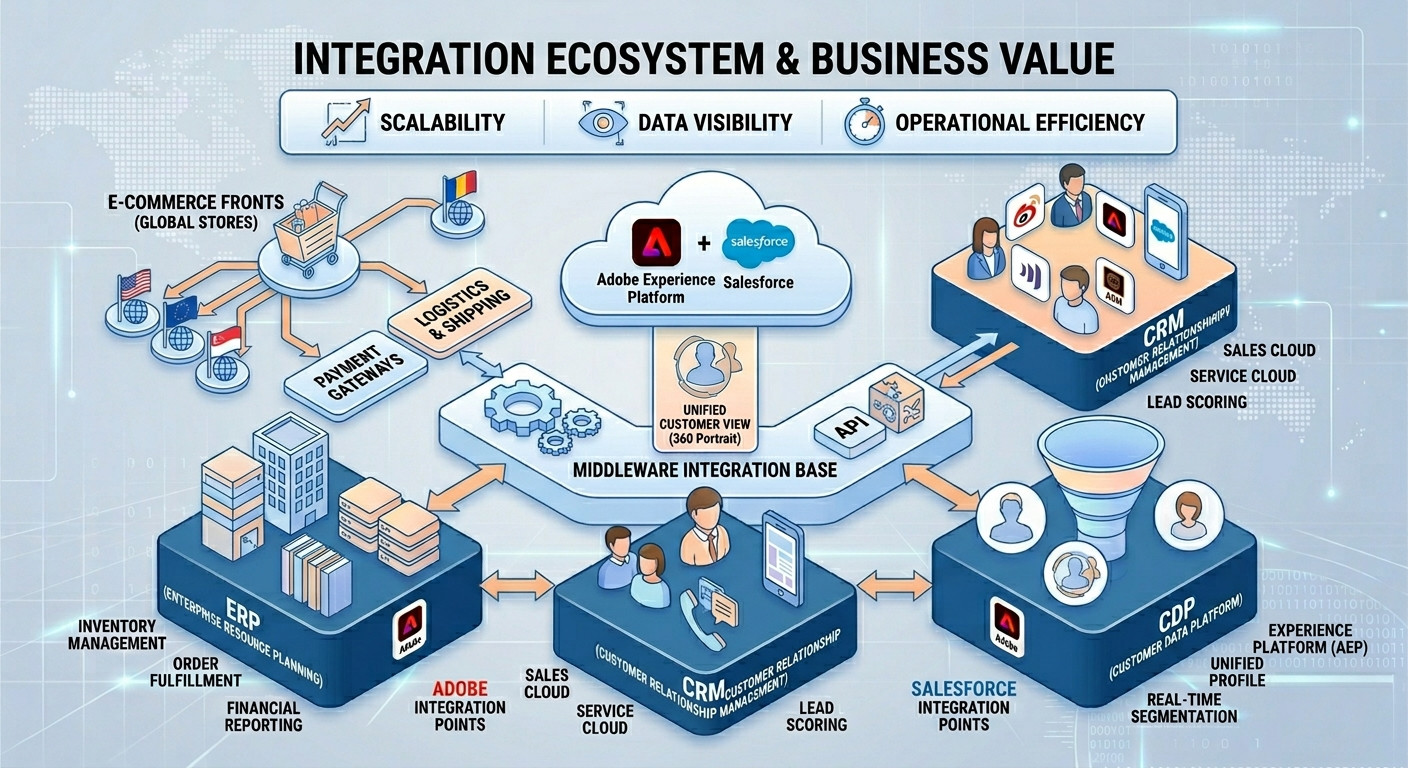
5. Integration with ERP / CRM / CDP Systems
Enterprise cross-border eCommerce cannot operate in isolation.
5.1 ERP: Core of Orders, Inventory, and Finance
ERP manages real-world operations:
- Actual inventory
- Procurement and replenishment
- Financial accounting and settlement
Clear boundaries between ERP and eCommerce systems are essential to avoid inventory discrepancies and reconciliation issues.
5.2 CRM: Customer and Relationship Management
CRM focuses on the customer lifecycle:
- Customer data
- Sales and service records
- Interaction history
In B2B or high-value transactions, CRM integration is especially critical.
5.3 CDP: Unified Data and Insights
CDP consolidates data across systems for:
- Behavior analysis
- Personalization
- Marketing automation
Without a unified data layer, true data-driven operations are difficult to achieve.
6. Scalability and Governance in Architecture Design
Many architectures work in the early stage but fail as they scale. The issue is often governance, not technology.
6.1 Scalability: Designing for the Unknown
Enterprises should be able to answer:
- What systems need changes when entering a new market?
- Can existing capabilities be reused for new brands?
If every expansion requires major restructuring, the architecture is flawed.
6.2 Governance: The Key to Scaling
Governance includes:
- Access and role management
- Release and change workflows
- System upgrade strategies
- Compliance and risk control
Many system issues are fundamentally governance issues.
7. Common Architecture Mistakes
Common pitfalls include:
- Putting all capabilities into the eCommerce platform
- Using plugins instead of proper system design
- Building separate systems for each market
- Lack of unified data standards
- Architecture exists only in slides but not in implementation
These issues may not be obvious early on but become costly at scale.
8. Conclusion: Building an Architecture for Long-Term Growth
Cross-border eCommerce architecture is not about looking sophisticated—it’s about answering a practical question:
Can this system support continuous growth over the next 3–5 years?
Mature enterprises typically:
- Define the architecture first
- Then select appropriate platforms and systems
- Treat systems as long-term assets, not one-time projects
If you are planning your cross-border strategy or facing system limitations, visit our Contact Us page to discuss your architecture roadmap with our consultants.
Further Reading & References
Further Reading
- Enterprise Global Expansion: Building Cross-Border DTC Websites
- When Shopify Is Not Enough: Enterprise Upgrade Roadmap
- Shopify vs Adobe Commerce (Magento): Which Should Enterprises Choose?
References
Related Articles

Enterprise AI MarTech Trends Analysis 2024-2029 Outlook Report
From AI content productivity tools to a core engine for revenue growth and marketing transformation
*The PDF will be sent directly to your inbox.
Email Error
Please enter a valid email address.
Thank You!
The whitepaper has been sent to your inbox. If you don’t see it, please check your spam or promotions folder.