
What Is B2B Lead Generation? A Complete Guide to High-Quality Leads
Lead Generation
27 February 2026
Introduction: Why B2B Lead Generation Is Critical to Business Growth
In most B2B companies, growth does not depend solely on how good the product is, but on whether the business can consistently reach the right prospects.
Unlike B2C markets, where mass exposure and impulse purchases can drive conversions, B2B sales cycles are typically longer, more complex, and heavily dependent on trust and professional evaluation. A single deal often involves multiple decision-makers, budget assessments, and extended comparisons. This makes “where customers come from” one of the most critical—and most unstable—factors in business operations.
Many companies still rely heavily on:
- Existing sales relationships
- Trade shows, business card exchanges, and event lists
- Client referrals
- Occasional outbound prospecting
These methods are not without value. The challenge is that they are unpredictable, difficult to scale, and hard to replicate.
As competition intensifies and growth pressure increases, companies realize that customer acquisition cannot rely on luck or individual performance. It must be managed systematically. This is why B2B lead generation has become a core driver of business growth.
What Is B2B Lead Generation?
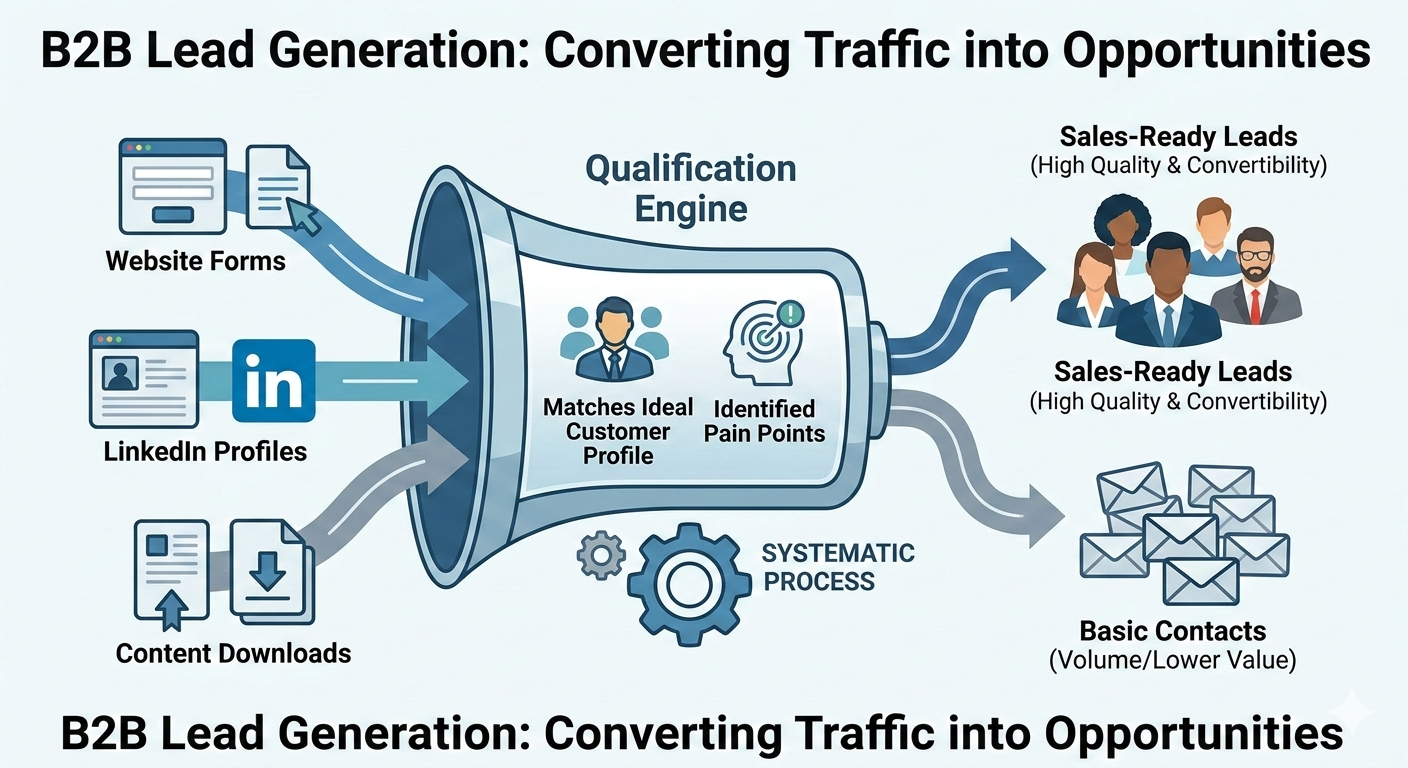
B2B lead generation refers to a structured and repeatable process through which businesses identify, attract, and qualify potential corporate buyers, converting them into sales-ready leads for follow-up.
One important concept must be clarified:
Lead generation is not the same as collecting contact lists.
True B2B lead generation focuses not on how many people leave their contact information, but on:
- Whether they match your ideal customer profile
- Whether they have real business needs or pain points
- Whether they are likely to enter the sales pipeline
In other words, the core value of lead generation lies in quality and convertibility—not volume.
When businesses consistently generate qualified leads, sales teams can focus their time on real opportunities, improving efficiency and forecast accuracy.
Key Differences Between B2B and B2C Lead Generation
Many companies mistakenly apply B2C marketing logic to B2B strategies, often with limited results. The two models differ fundamentally.

1. Decision structures differ
B2C purchases are usually made quickly by individuals. In contrast, B2B buying decisions often involve multiple stakeholders, including end users, technical evaluators, managers, and procurement teams—each with different priorities.

2. Sales cycles differ
B2B cycles are typically longer, often spanning weeks or months from initial contact to contract signing.

3. Information needs differ
B2B buyers prioritize expertise, credibility, and problem-solving capabilities over simple pricing or promotions.
Therefore, B2B lead generation requires long-term nurturing, precise targeting, and structured processes rather than short-term campaigns.
What Is a High-Quality Lead? Common Misconceptions
One of the most common misconceptions is treating “leaving contact information” as successful lead generation.
In reality, not all leads have equal value.
High-quality B2B leads typically:
- Belong to your target industry and company size
- Show clear interest or pain points related to your solution
- Hold influence or participate in decision-making
If lead sources are unstructured and qualification criteria are unclear, even large volumes of contacts can waste sales resources and create frustration.
That is why more companies are shifting their focus from lead quantity to lead quality.
Main Channels and Methods for B2B Lead Generation
There is no single solution that works for every business. Common approaches include:
- Content marketing and thought leadership
- Website forms, whitepapers, and gated resources
- Industry communities and business platforms
- Trade shows, seminars, and offline events
- Outbound prospecting
The key is not which channel you use, but whether you can integrate leads from multiple sources into a unified qualification and management process to ensure consistency and quality.
From Traffic to Opportunities: The Complete B2B Lead Generation Process
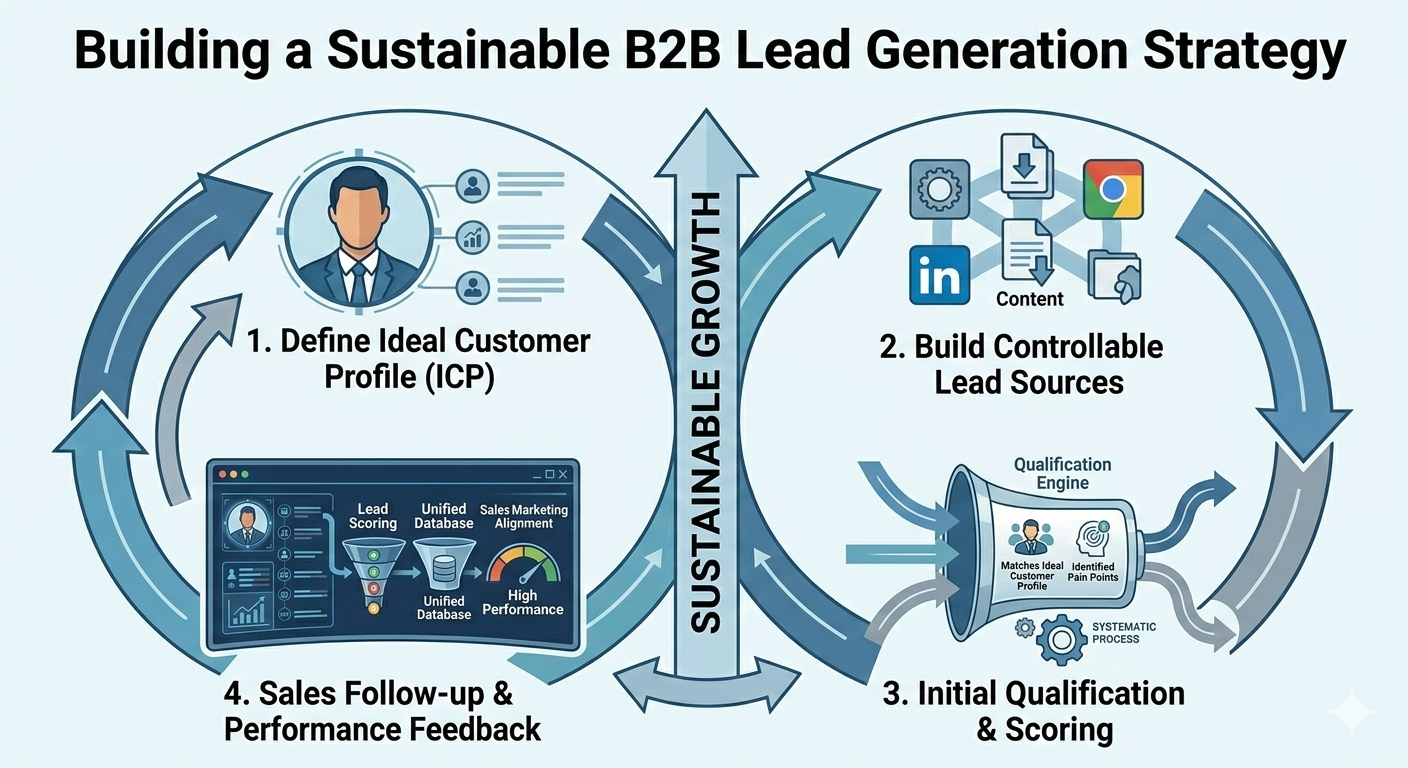
A mature B2B lead generation framework typically includes:
First: defining the ideal customer profile
Clearly identify which companies and roles deserve resource investment.
Second: building controllable lead sources
Establish diversified yet stable channels for generating leads.
Third: initial qualification and scoring
Not every lead should go directly to sales; proper segmentation improves conversion rates.
Finally: sales follow-up and performance feedback
Use data insights to continuously optimize the process.
This is an ongoing cycle—not a one-time campaign.
Three Common Challenges in B2B Lead Generation
Most companies face three recurring challenges:
1. Many leads, but few real conversations.
2. Misalignment between marketing and sales on what defines a “qualified lead.”
3. Lack of data visibility to determine what truly works.
These issues are usually not caused by individual capability gaps, but by the absence of a structured and trackable framework.
Why Manual Processes Can No Longer Support B2B Customer Acquisition
As data volume increases and markets move faster, managing leads manually through spreadsheets or disconnected tools is no longer sustainable.
Businesses face practical challenges:
- More lead sources, but inconsistent quality
- Sales time consumed by repetitive tasks
- Decisions based on intuition instead of measurable data
This is why more B2B companies are turning to systems and structured processes to improve acquisition efficiency.
Building a Sustainable B2B Lead Generation Strategy
A successful B2B lead generation strategy is not a short-term push, but a scalable and continuously optimized system.
It enables companies to maintain stable lead inflow across changing market conditions while building long-term customer assets and market insights.
Conclusion: From “Finding Contacts” to “Creating Opportunities”
The key to B2B lead generation is not how many contacts you obtain, but whether you consistently provide sales teams with leads worth investing time in.
When businesses adopt a systematic approach to lead generation, customer acquisition transforms from a cost center into a predictable and optimizable growth engine.
If you would like to learn how a lead generation platform and professional services can help build a stable, high-quality B2B lead pipeline, feel free to connect with our team.
👉 Contact Us: Discuss your B2B lead generation strategy with our consultants
👉 Product Page: Learn how the LeadsTech Lead Generation Platform supports systematic customer acquisition
Further Reading & Resources
Related Articles