
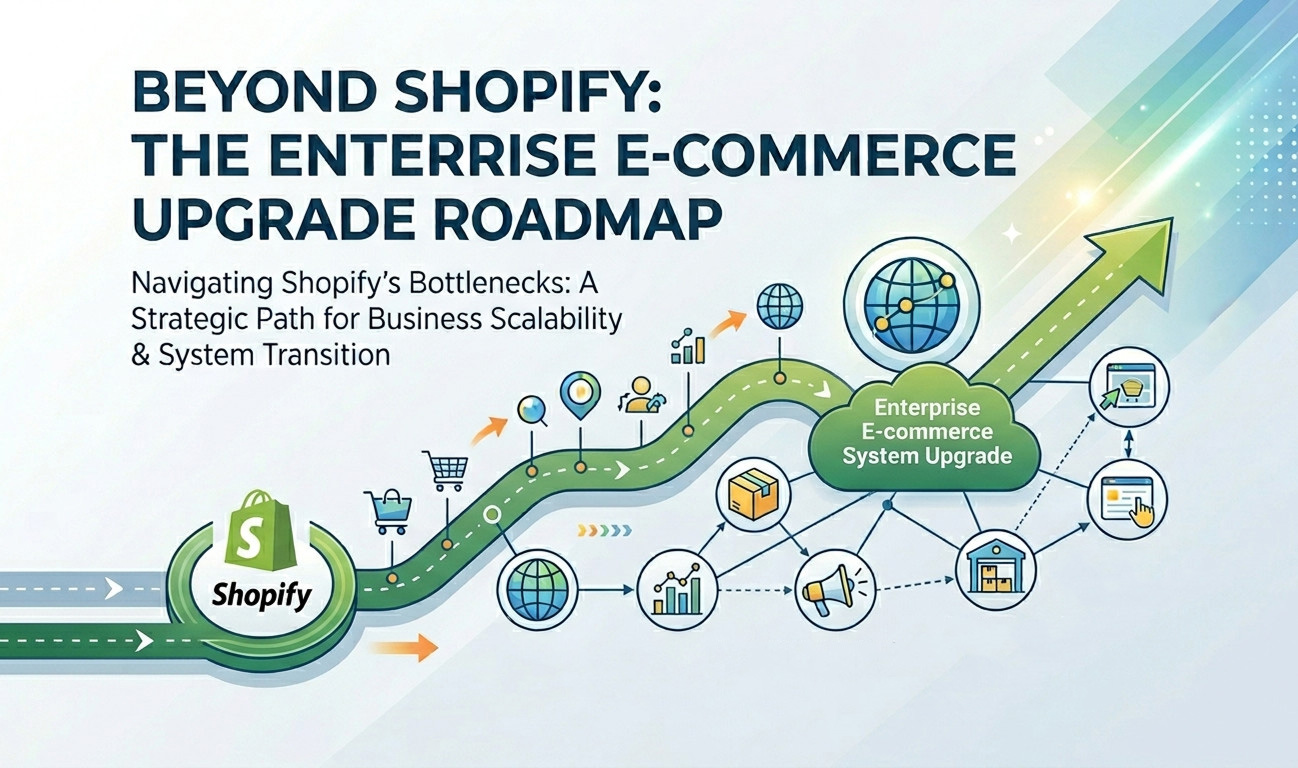
When Shopify Isn’t Enough: Enterprise E-commerce Upgrade Roadmap
Adobe Commerce (Magento), e-commerce Platforms, Shopify
25 March 2026
1. Introduction: When Does Shopify Start to Feel “Stuck”?
In the development of cross-border e-commerce for many companies, Shopify is often a very correct starting point.
It helps businesses quickly launch, validate the market, establish order and fulfillment processes, and allows teams to focus more on marketing and growth.
However, as the business continues to grow, some companies begin to experience similar feelings:
- The features are all there, but implementation becomes increasingly complicated
- More and more plugins are installed, and maintenance costs rise significantly
- Managing different markets and multiple sites becomes increasingly complex
- Making a change in one part of the system raises concerns about affecting the entire system
This does not mean Shopify is “bad” or “not capable,” but rather signals a very practical reality:
The business has entered a new stage of growth, while the system remains in the previous stage.
2. Key Turning Points in Enterprise E-commerce Growth
From an enterprise perspective, whether an e-commerce system is “sufficient” often depends on whether several key turning points have been reached.
Turning Point 1: From a Single Market to Multiple Markets
When a company begins operating across multiple countries or regions, differences in pricing, language, logistics, and compliance quickly amplify system complexity.
Turning Point 2: From a Single Brand to Multiple Brands / Multiple Sites
As brand portfolios, channel sites, and regional sites operate in parallel, governance challenges begin to emerge.
Turning Point 3: From “Selling Products” to “Managing Customers”
Membership systems, customer segmentation, long-term repurchase behavior, and data accumulation become increasingly important.
Turning Point 4: From “Frontend Growth” to “Backend Collaboration”
E-commerce systems need to deeply integrate with ERP, CRM, content systems, and data platforms.
Once these turning points appear, the core question shifts from “Can it be done?” to “Can it be done sustainably?”
3. Common Scalability Bottlenecks of Shopify
Shopify’s strengths come from standardization, but in more complex stages, that same standardization also introduces certain limitations.
3.1 Increasing Dependence on Plugins
To meet new requirements, businesses continuously introduce plugins:
- Pricing plugins
- Multilingual plugins
- Membership plugins
- Reporting and analytics plugins
Dependencies, conflicts, and upgrade issues between plugins gradually become hidden costs.
3.2 Complex Business Logic Requires “Workarounds”
For example, complex pricing, customer tiers, and regional rules often need to be implemented through combinations of plugins or external systems, leading to fragmented logic and difficult maintenance.
3.3 Increasing Difficulty in Multi-site Governance
As the number of sites grows, permissions, configurations, content consistency, and publishing processes become harder to manage in a unified way.
3.4 Longer System Integration Chains
As integrations with ERP, CRM, logistics, and data systems increase, any issue in one part of the chain can affect the entire process.
These issues are not obvious in the early stages but tend to surface as the business scales.
4. What Problems Can Enterprise E-commerce Systems Solve?
When companies seriously consider upgrading, it is usually not about “changing platforms,” but about addressing the level of complexity that Shopify can no longer effectively support.
Enterprise e-commerce systems, represented by Adobe Commerce, typically deliver value in the following areas:

4.1 Stronger Capability to Handle Complex Business Logic
Support complex pricing structures, customer segmentation, regional rules, and contract logic, allowing complexity to be managed within the system over the long term, rather than relying on patches.

4.2 Native Multi-site and Governance Capabilities
Manage multiple brands and regional sites under a unified framework, reducing long-term operational and collaboration costs.

4.3 Better Fit as a Core Integration Hub
Enterprise systems are better suited to act as the central hub connecting ERP, CRM, content platforms, and data platforms, rather than being passive integration endpoints.

4.4 A Scalable Architecture for Long-term Evolution
The real goal of upgrading is to create room for the next 3–5 years of growth, rather than just solving immediate problems.
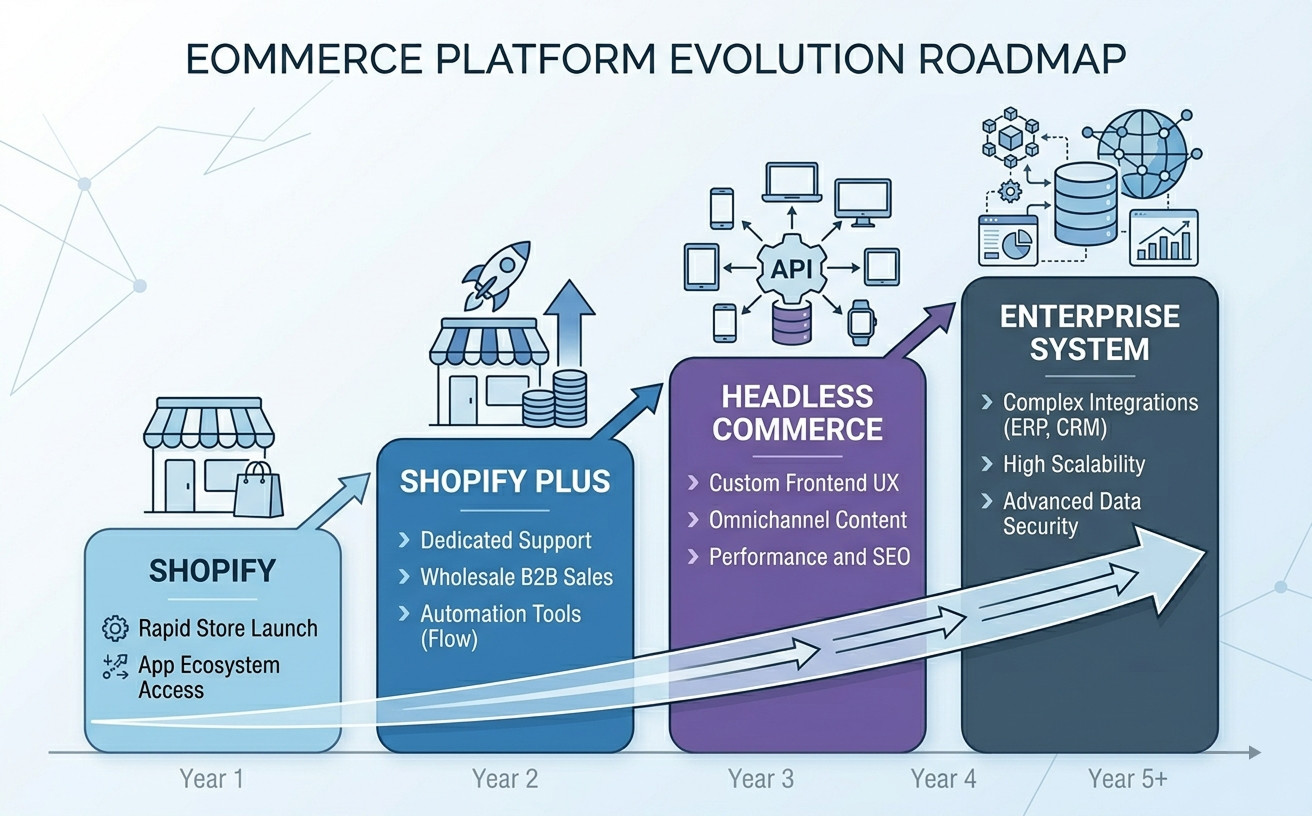
5. Typical Upgrade Paths for E-commerce Systems
Upgrading an e-commerce system does not have to be a one-step process.
Path 1: Shopify + External System Enhancements
In the short term, external systems can be used to handle complex logic and extend Shopify’s lifecycle.
Suitable scenarios:
- The upgrade strategy is not yet mature
- More time is needed to validate whether complexity will persist long term
Path 2: Gradual Introduction of Enterprise Systems
Gradually migrate complex operations, specific markets, or new business lines to an enterprise e-commerce system.
Advantages:
- Risks are controllable
- Phased validation is possible
Path 3: Full Core System Upgrade
When business complexity has become well established, a full upgrade is often the more stable long-term choice.
Key prerequisites:
- Clear business and architectural planning
- An experienced implementation and governance team
6. Risks and Considerations During the Upgrade Process
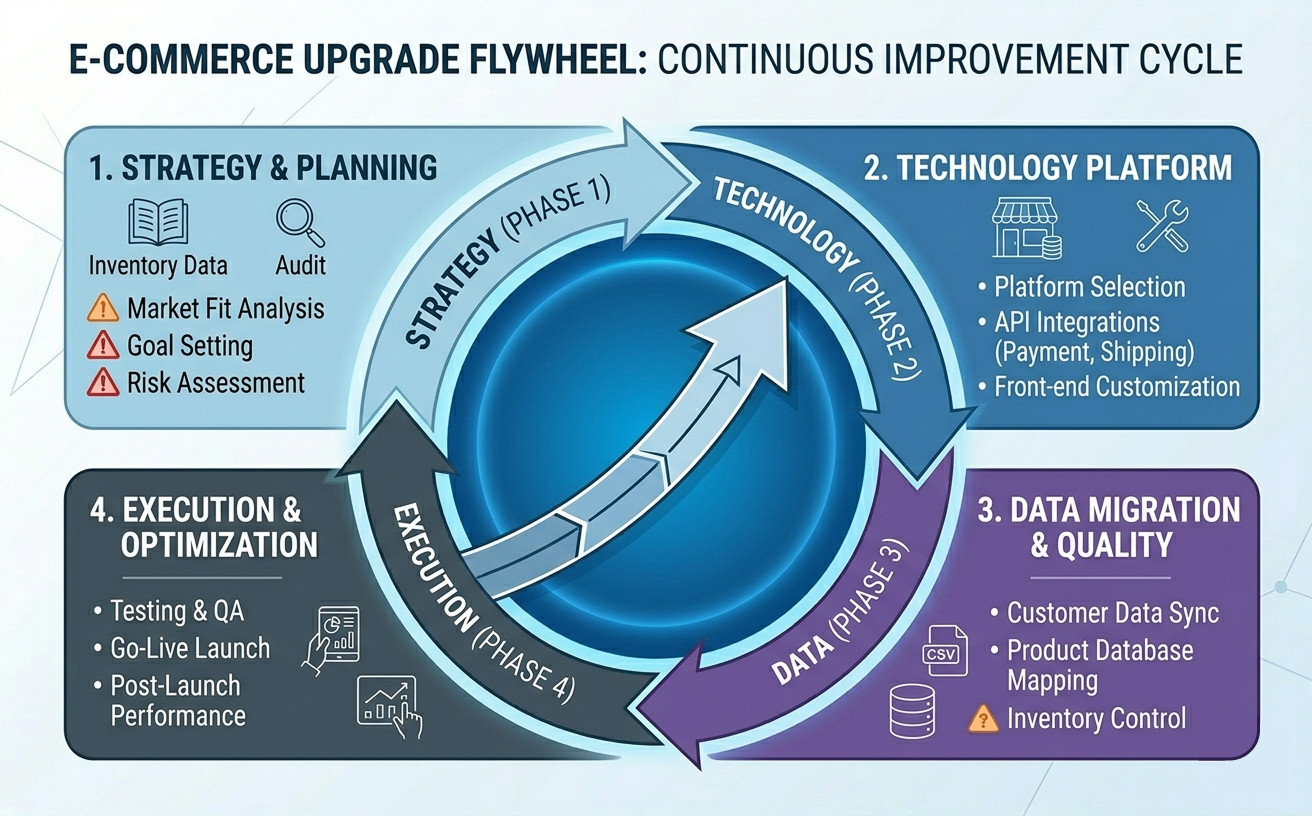
System upgrades are not just technical projects, but collaborative efforts across business, organization, and systems.
6.1 Avoid Overturning Everything to Solve Local Problems
The goal of upgrading is to absorb complexity, not to negate past success.
6.2 Clearly Define Which Problems Should Be Solved by the System
Some problems are process-related rather than system-related.
6.3 Do Not Underestimate Data and Content Migration Costs
Orders, customer data, content, and SEO assets are long-term accumulations and require careful migration planning.
6.4 Do Not Overlook Organizational Readiness
Even the most powerful system requires a capable team and governance structure.
7. Common Practices Among Successfully Upgraded Enterprises
From successful cases, several common patterns can be identified:
- Upgrades are planned proactively, not reactively
- Clear goals and phased approaches are defined
- Architecture and governance are prioritized over features
- Perfection is not pursued in one step; continuous evolution is emphasized
- Existing systems’ valuable experience and assets are preserved
These companies typically view upgrades as an evolution of capabilities, rather than simply a platform replacement.
8. Conclusion: Upgrading Is Not Starting Over, but Evolving
When companies feel that Shopify is “no longer sufficient,” the real issue is often not the platform itself, but:
The business has grown into a stage that requires new capabilities.
The purpose of upgrading an e-commerce system is not to replace tools, but to determine:
- Whether it can support future complexity
- Whether it can enable long-term scalability and governance
- Whether it can become part of the company’s digital ecosystem
If you are evaluating whether to upgrade your e-commerce system, or are unsure whether Shopify still fits your current stage, feel free to visit the Contact Us page to discuss your business situation and upgrade roadmap with our consulting team.
Further Reading & References
Further Reading
- “Shopify vs Adobe Commerce (Magento): Which Should Enterprises Choose?”
- “Enterprise Global Expansion: The Right Way to Build Cross-border Independent Sites”
- “Cross-border E-commerce System Architecture: Enterprise-level Practical Analysis”
References
Related Articles

Enterprise AI MarTech Trends Analysis 2024-2029 Outlook Report
From AI content productivity tools to a core engine for revenue growth and marketing transformation
*The PDF will be sent directly to your inbox.