
What Is AI MarTech? How AI Is Reshaping Marketing Technology (Complete 2026 Analysis)
AI, Martech
26 December 2025
As generative AI and machine learning rapidly mature, marketing technology (MarTech) is entering a new era.
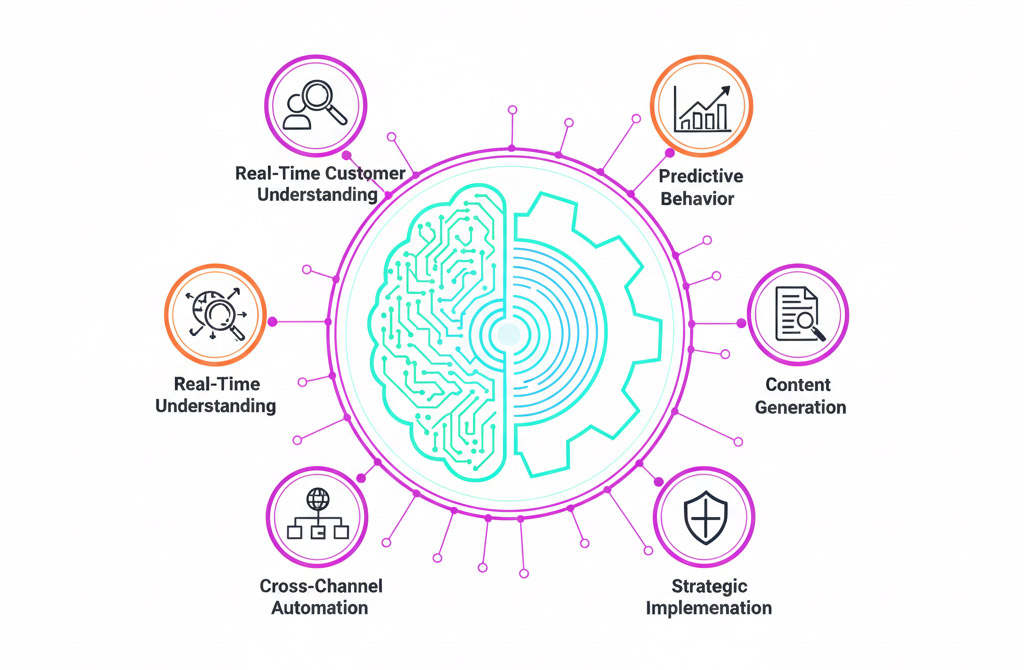
Businesses are no longer simply “using tools to do marketing.” Instead, through AI MarTech, they can understand customers in real time, predict behavior, generate content, and automatically execute cross-channel personalized marketing.
This article provides a structured overview of:
- What AI MarTech is
- The role AI plays in MarTech
- Core AI MarTech use cases
- Key differences between AI MarTech and traditional MarTech
- What businesses should prepare before adopting AI MarTech
- How AI MarTech is practically implemented in organizations
Helping businesses prepare for an AI-driven marketing model before 2026.
1. What Is AI MarTech?
AI MarTech (Artificial Intelligence Marketing Technology) refers to the deep integration of artificial intelligence and machine learning into the MarTech stack, enabling marketing systems to:
- Automatically analyze large volumes of customer data
- Predict customer behavior and intent
- Generate personalized content in real time
- Continuously optimize marketing journeys and performance
Compared with traditional MarTech, the key difference of AI MarTech is that:
The system does not simply execute predefined rules, but actively learns, predicts, and optimizes.
2. Why Is AI Becoming the Core of MarTech?
The complexity of the marketing environment is increasing rapidly:
- More touchpoints (web, apps, email, SMS, social media, physical stores)
- Customers expect real-time, personalized experiences
- Data volumes far exceed what humans can manually process
In this context, AI becomes central to MarTech for several reasons:
- AI handles data volumes beyond human capacity
AI can analyze millions of behavioral data points in real time to uncover patterns. - AI predicts rather than just reviews
It not only tells you what happened, but also forecasts what will happen next. - AI dynamically adapts marketing content
Content, recommendations, and messages change in real time based on behavior and context.
3. Core AI MarTech Use Cases
Below are the most common and easiest-to-implement AI MarTech applications for enterprises:
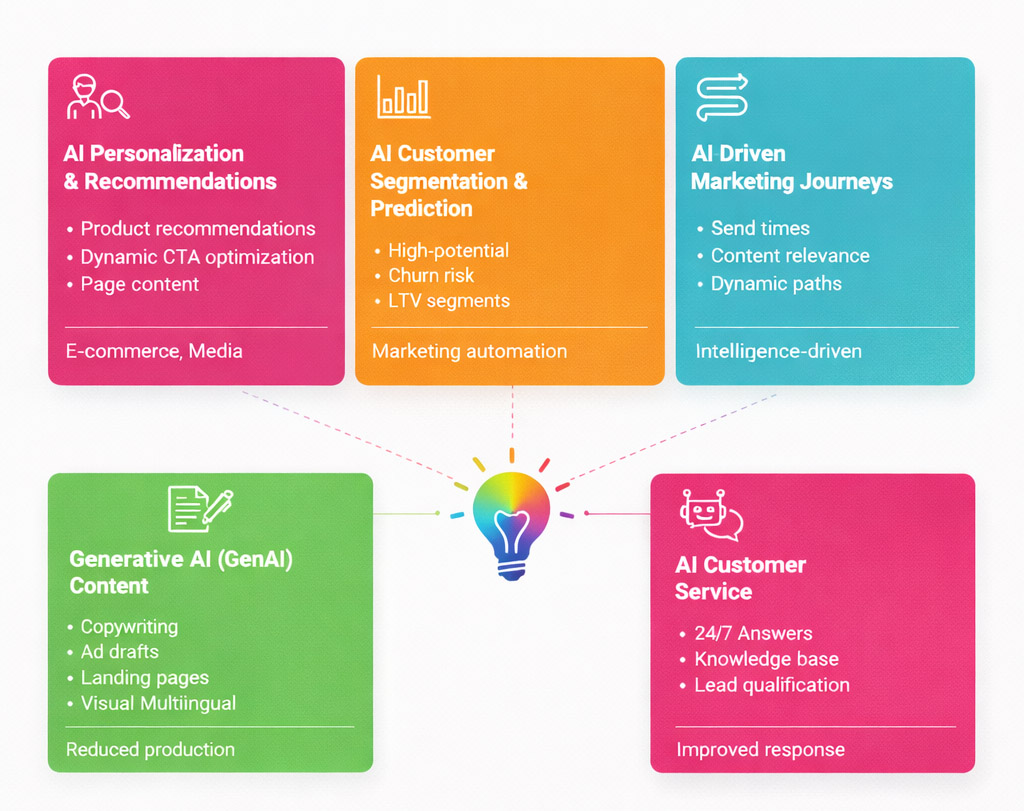
AI Personalization and Recommendations (Personalization)
- Product recommendations
- Content recommendations
- Dynamic CTA optimization
- Different audiences see different page content
AI Customer Segmentation and Behavior Prediction
AI can automatically create dynamic segments based on behavioral patterns, such as:
- High conversion potential customers
- Customers at risk of churn
- High lifetime value (LTV) segments
AI-Driven Marketing Journeys (Journey Automation)
AI not only triggers journeys, but can also:
- Recommend optimal send times
- Suggest the most relevant content
- Dynamically adjust journey paths
Generative AI (GenAI) Content Creation
Generative AI is widely used for:
- EDM subject lines and copywriting
- Ad copy
- Landing page drafts
- Banners and visual assets
- Multilingual content translation and localization
AI-Powered Customer Service and Conversational Experiences
AI chatbots can:
- Answer customer questions 24/7
- Integrate with knowledge bases and CRM systems
- Assist with initial sales lead qualification
4. Key Differences Between AI MarTech and Traditional MarTech
| Aspect | Traditional MarTech | AI MarTech |
|---|---|---|
| Logic | Rule-based | Learning- and prediction-driven |
| Segmentation | Manually defined | AI-driven automatic segmentation |
| Content | Static content | Real-time personalization |
| Journey | Fixed workflows | Dynamically adjusted |
| Optimization | Manual analysis | Continuous AI optimization |
5. Key Preparations Before Adopting AI MarTech
AI MarTech is not a “plug-and-play” solution. Enterprises must first establish the following foundations:
A Strong Data Foundation
- Integrated data sources (web, app, CRM, transactions)
- High data quality and consistency
- Clear data access control and governance
An Integratable MarTech Architecture
AI must be able to seamlessly integrate with:
- CMS
- CDP
- Marketing automation
- Analytics
Clear Business and Marketing Objectives
AI is a means, not the goal.
Enterprises must first define whether they aim to:
- Increase conversion rates
- Reduce churn
- Improve content efficiency
6. A Practical AI MarTech Architecture (Reference)
A typical AI MarTech architecture used by enterprises includes:
- CMS (AEM / Headless CMS): Content and experience management
- CDP (Real-Time CDP): Data integration and segmentation
- AI Engines (Personalization / GenAI): Recommendations and content generation
- Journey / Automation: Cross-channel execution
- Analytics: Performance tracking and optimization
This architecture ensures that AI is not just a showcase of technology, but delivers real business impact.
7. How AI MarTech Impacts Organizations and Processes
After adopting AI MarTech, enterprises typically experience the following shifts:
- Marketing teams focus more on strategy rather than repetitive tasks
- Closer collaboration between IT and marketing teams
- Decision-making shifts from experience-based to data- and model-driven
- Significant increases in content production speed and scale
At its core, AI MarTech represents an upgrade of the marketing operating model.
8. Conclusion: AI MarTech Is Becoming a Standard for Future Marketing
AI MarTech is no longer an experimental technology—it is becoming a foundational capability for marketing and operations. As customer touchpoints continue to expand and data volumes grow rapidly, an enterprise’s ability to effectively leverage AI will directly impact:
- The depth and consistency of customer experiences
- The efficiency and productivity of marketing teams
- The measurability of marketing investments and ROI
- Long-term competitive advantage in the market
Truly successful AI MarTech is not about deploying a single tool, but about the integrated alignment of data, platforms, AI, and marketing processes.
If your organization is considering:
- How to introduce AI into your existing MarTech stack
- Where to start with CDP, automation, and AI personalization
- How to turn AI from a concept into measurable improvements in conversion and efficiency
We invite you to connect with us and work with a professional MarTech consulting team to evaluate the AI MarTech architecture and implementation roadmap best suited to your business.
Contact Us
Further Reading
- What is MarTech? Complete 2026 Guide to Marketing Technology
- What Are MarTech Tools? The Most Complete List of 30 Marketing Technology Tool Categories for 2026
- What do MarTech companies do? How to choose the right MarTech consultant
- How Can Enterprises Adopt MarTech? A Complete Guide to Process, Budget, and Success Factors
- MarTech Trends 2026: A Complete Guide to AI, Personalization, Zero-Party Data, and Customer Journey Automation