
How Can Enterprises Adopt MarTech? A Complete Guide to Process, Budget, and Success Factors (2026 Practical Guide)
AI, Martech
26 December 2025
The success or failure of MarTech adoption rarely depends on tool features alone. Instead, it hinges on whether an organization has clear goals and use cases, usable data, effective cross-functional collaboration, and a sustainable operating model for continuous iteration.
This article breaks down the full MarTech adoption process in a “step-by-step, ready-to-follow” way. It outlines the deliverables, typical timelines, and common risks at each stage—so your MarTech initiative goes beyond launch and continues to deliver measurable results.
1. Common Pain Points & Triggers
Most enterprises initiate MarTech projects not to “follow trends,” but in response to clear and pressing challenges such as:
Fragmented data and no Single Customer View (SCV)
- Member data stored in the membership system
- Transaction data in e-commerce / POS systems
- Behavioral data in GA4 / apps
- Lead data in CRM
Many marketing campaigns, but no clear attribution or optimization
- You can see “traffic” but not “conversions”
- You can see “conversions” but not which channels or content actually work
- You cannot answer “why customers drop off” or “which step should be optimized”
Lack of consistency across the customer journey (each channel operates in silos)
- EDM uses one tool, SMS another platform, and app push notifications yet another
- Rules are set separately, and message frequency conflicts across channels
High content and website operation costs with slow time to launch
- Campaign pages and content updates depend heavily on IT delivery
- Multi-site and multilingual maintenance is difficult
- Poor website performance and SEO structure limit organic traffic growth
Desire to adopt personalization and AI, but lacking data and platform foundations
- No defined event taxonomy
- Unclear identity resolution strategy
- Unstable audience and segmentation outputs
2. Pre-Adoption Checklist (Recommended)
Before implementing MarTech, completing the following three steps will significantly increase the likelihood of project success.
Define Use Cases First — Not Tools
For Phase 1, it is recommended to select only 2–4 high-value use cases that can go live quickly, such as:
- Welcome Journey (new customers / new members onboarding)
- Cart Abandonment (e-commerce cart recovery)
- Lead Nurturing (B2B lead cultivation)
- Win-back (churn prediction and re-engagement)
- Web Personalization (homepage or key page personalization)
- Trigger conditions
- Audience definition
- Actions and channels (Email / SMS / App / Web)
- Success KPIs (conversion rate, repeat purchase rate, CTR, completion rate, etc.)
Set Quantifiable KPIs and Measurement Methods
Common KPIs can be structured across three layers:
- Business level: revenue, orders, MQL/SQL, LTV, retention, repeat purchases
- Journey level: reach rate, open rate, CTR, conversion rate, drop-off points
- Efficiency level: time to launch, content production time, percentage of manual effort reduced
Conduct Data Inventory and Readiness Assessment
At a minimum, review the following:
- System list and data owners
- Data types (member, transaction, behavior, customer service, leads)
- Integration methods (API, batch, webhook, database)
- Update frequency (real-time, daily, weekly)
- Data quality (missing values, duplicates, inconsistent formats)
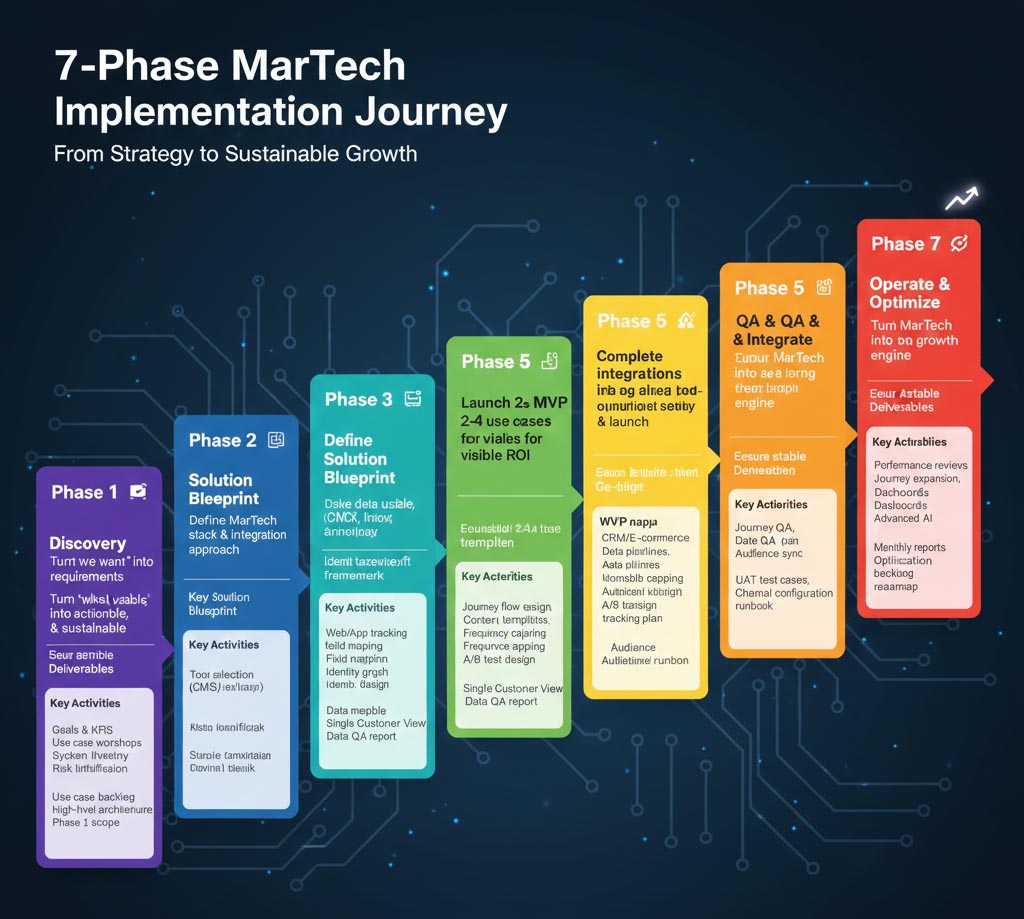
3. MarTech Implementation Process (7 Phases) & Key Deliverables
Below is one of the most widely used and proven implementation frameworks in the industry. You can use it directly as a project WBS.
Phase 1: Discovery (Requirement Interviews and Current-State Assessment)
Goal: Turn “what we want” into actionable requirements and scope
Key activities:
- Alignment on goals and KPIs (CMO / Head of Digital / IT)
- Use case workshops
- System and data inventory (as-is assessment)
- Risk and dependency identification
- Use case backlog with prioritization
- High-level MarTech architecture diagram
- Phase 1 scope and milestones
Phase 2: Solution Blueprint (Tool Selection and Architecture Design)
Goal: Define the MarTech stack and integration approach
Key activities:
- CMS / CDP / Automation / Analytics evaluation and selection
- Data flow design
- Identity strategy (identity resolution: email / phone / member ID)
- Permissions, environments, and compliance design (Dev / UAT / Prod, consent management)
- Solution blueprint (including integrations and interface specifications)
- Event taxonomy draft (v1)
- Audience and segmentation framework
Phase 3: Data Foundation (Data Integration and Data Modeling)
Goal: Make data usable, reliable, and sustainable
Key activities:
- Web/App event tracking implementation (tags / SDKs)
- Field mapping and data cleansing rules
- Dataset, profile, and identity graph setup (platform-dependent)
- Baseline audience validation (audience QA)
- Executable event taxonomy v1
- Data mapping tables and ETL / ELT specifications
- Single Customer View (SCV) definition and validation report
- Data QA report (missing data / latency / duplication)
Phase 4: Use Case MVP (Minimum Viable Use Cases)
Goal: Launch 2–4 use cases to establish visible ROI
Key activities:
- Journey flow design (journey maps)
- Message and content templates (Email / SMS / Push / Web)
- Frequency capping and suppression rules
- A/B test design (subject lines / CTAs / content)
- MVP journeys ready for launch
- Reusable templates and content components
- KPI measurement and tracking plan
Phase 5: Build & Integrate (System Implementation and Integration)
Goal: Complete required integrations and automation setup
Key activities:
- Integrations with CRM, e-commerce, membership, and customer service systems
- Real-time and batch data pipelines
- Audience sync to advertising and marketing channels (if required)
- Channel setup (email domains, SMS providers, push keys)
- Integration interface list (API / batch jobs)
- Channel configuration documentation
- Audience activation and validation report
Phase 6: QA & Go-Live (Testing, Acceptance, and Launch)
Goal: Ensure stable operation across data, journeys, content, and compliance
Key activities:
- Journey QA (triggers, branching, deduplication, frequency control)
- Data QA (event completeness, latency, identity merging)
- Permission and approval workflows
- Rollback and contingency planning
- UAT test cases and results
- Go-live checklist
- Runbook and operational handover
Phase 7: Operate & Optimize (Operations and Continuous Optimization)
Goal: Turn MarTech from a project into a long-term growth engine
Key activities:
- Monthly and quarterly performance reviews
- Journey expansion (Phase 2: additional use cases)
- Dashboards and insights generation
- Advanced AI and personalization initiatives
- Monthly performance reports with insights and recommendations
- Optimization backlog (experiments and iterations)
- Phase 2 roadmap (use cases and investment planning)
4. Architecture & Integration Priorities (Common Issues)
Event Tracking Must Be Standardized First
Common issues: inconsistent event names, missing key fields, and inability to build funnels.
Recommended approach: establish unified naming conventions and required fields (such as page_name, product_id, value, channel).
Identity Strategy Must Be Defined Upfront
Common issues: multiple IDs for the same person, leading to incorrect segmentation and journeys.
Recommended approach: define primary identifiers and merge rules (priority order for email, phone, member ID).
Audience Segmentation Must Be Sustainably Scalable
Common issues: manual audience exports and reliance on spreadsheets for every segmentation.
Recommended approach: rule-based audiences with automatic updates and channel synchronization.
Governance and Access Control Are Essential
Common issues: unclear ownership over sending permissions, journey changes, and data access.
Recommended approach: implement role-based access control and approval workflows to minimize risk.
5. Implementation Budget & Cost Structure (Estimating Tips)
Implementation costs are generally divided into four categories:
- Platform License: Depends on modules, scale, channels, and data volume
- Implementation: Data integration, development, configuration, templates, testing
- Operations: Monitoring, version upgrades, SLA, incident handling
- Content & Ops: Content production, manpower, experimentation, and optimization
Key cost drivers:
- Number of data sources and integration complexity
- Requirement for real-time data
- Number of channels (Email/SMS/App/Web/Ads)
- Multi-site, multi-language setup, and content governance complexity
- Inclusion of personalization and AI capabilities
Recommended strategy: Start with Phase 1 MVP use cases, measure tangible results first, then expand investment.
6. Common Risks & Avoidance Strategies (Risk Checklist)
A typical enterprise AI MarTech architecture may face the following risks:
- Poor data quality: Perform data QA and field standardization before discussing AI
- Cross-department bottlenecks: Establish a Steering Committee (Marketing + IT + Data) with a regular decision rhythm
- Too many tools creating silos: Define the “core platform” first, then expand tools
- No adoption post-launch: Train users and establish SOPs during the MVP phase
- Lack of compliance and consent management: Incorporate consent and permission design upfront
- No continuous optimization rhythm: Set up monthly KPI reviews and an experiment backlog
7. Keys to Success: MarTech as a Growth Engine
After implementing AI MarTech, enterprises usually experience the following transformations:
- Use Case-Driven: Each use case has a KPI
- Data First: Establish stable event and identity strategies
- Templates & Components: Reusable assets to reduce long-term costs
- Monthly Optimization: Institutionalize the optimization process
- Gradual AI Adoption: Start with segmentation and predictions, then move to personalization and generative content
8. Summary and Further Reading
The most important principle in MarTech implementation is not “doing all features at once,” but connecting data, journeys, and measurement with the right architecture and methodology, while establishing a sustainable optimization rhythm. If Phase 1 successfully implements a few high-value use cases, subsequent expansion (more channels, more journeys, deeper AI personalization) becomes manageable and predictable.
If you are evaluating MarTech implementation or upgrades (including CMS, CDP, marketing automation, personalization, and AI), we can assist you from requirements and data inventory, to roadmap creation, use case and KPI definition, and provide actionable implementation and optimization services. Feel free to contact us.
Further Reading
- What is MarTech? Complete 2026 Guide to Marketing Technology
- What Are MarTech Tools? The Most Complete List of 30 Marketing Technology Tool Categories for 2026
- What do MarTech companies do? How to choose the right MarTech consultant
- What Is AI MarTech? How AI Is Reshaping Marketing Technology
- MarTech Trends 2026: A Complete Guide to AI, Personalization, Zero-Party Data, and Customer Journey Automation