
What Are MarTech Tools? The Most Complete List of 30 Marketing Technology Tools for 2026 (Newly Updated)
AI, MarTech
16 December 2025
1. The Five Core Categories of MarTech Tools (2026 Update)
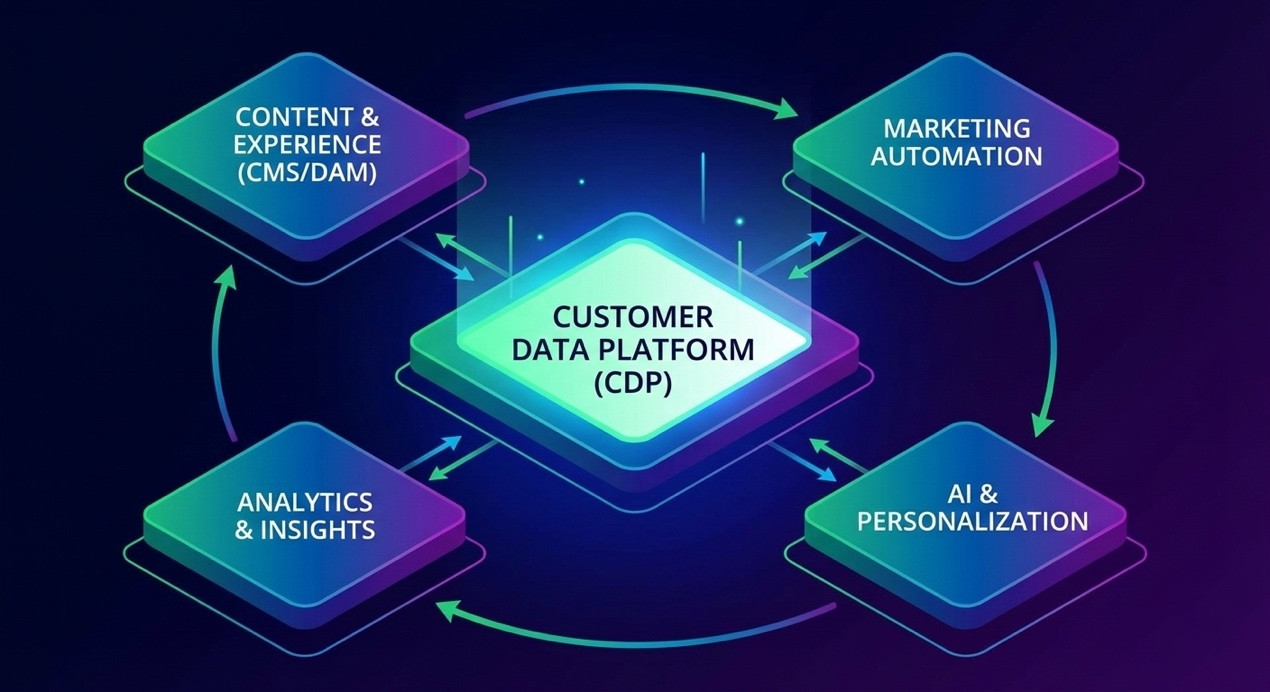
To help enterprises better understand and adopt MarTech, this article organizes marketing technology tools into five practical categories:
- Content & Experience
- Customer Data & CDP (Customer Data Platform)
- Marketing Automation
- Analytics & Insights
- AI, Personalization & Generative AI
Below, we break down each category, including its core functions, use cases, ideal business scenarios, and representative tools.
2. Content & Experience
Content and experience tools form the foundation for managing websites, apps, landing pages, content, images, videos, and personalized digital experiences.
CMS (Content Management System)
CMS platforms are the backbone of website and content operations.
Representative Tools:
- Adobe Experience Manager (AEM)
- Magnolia CMS
- Sitecore
- WordPress (SMBs)
- Building corporate websites
- Creating landing pages
- Centralized content management
- Improving site performance and structured content delivery
DAM (Digital Asset Management)
DAM systems centralize the management of images, videos, PDFs, and other digital assets.
Representative Tools:
- AEM Assets
- Bynder
- Cloudinary
- Managing large volumes of images and videos
- AI-powered tagging and metadata
- Multi-size and multi-format asset delivery
- API-based asset access for websites and apps
Personalization & Experimentation Tools
Representative Tools:
- Adobe Target
- Optimizely
- Google Optimize (discontinued but still widely referenced)
- A/B testing
- Multivariate testing
- Website and content personalization
- Behavior-triggered dynamic content
3. Customer Data & CDP (Customer Data Platform)
CDPs are a core component of modern MarTech stacks, enabling a unified, cross-channel customer view.
Real-Time CDP
Real-time CDPs integrate data across platforms to create a 360-degree customer profile.
Representative Tools:
- Adobe Real-Time CDP
- Tealium
- Segment
- Salesforce Data Cloud
- Member and customer data unification
- Website and app behavior tracking
- CRM, POS, and eCommerce data integration
- Audience segmentation and management
- Triggering personalized customer journeys
CRM & Customer Service Systems
While not pure CDPs, CRM systems are often integrated with CDPs.
Representative Tools:
- Salesforce CRM
- Microsoft Dynamics
- HubSpot CRM
- Customer relationship management
- Sales pipeline management
- B2B lead tracking
4. Marketing Automation
Marketing automation enables organizations to automate marketing workflows and deliver personalized messages based on customer behavior and segmentation.
Journey & Automation Platforms
Representative Tools:
- Adobe Journey Optimizer (AJO)
- Marketo
- HubSpot Marketing Hub
- Braze
- Mailchimp (SMBs)
- Automated email marketing (EDM)
- SMS and in-app push notifications
- Personalized customer journeys (welcome, retention, churn prevention, remarketing)
- Behavior-based triggers (e.g., cart abandonment)
Engagement & Push Platforms
Commonly used for mobile apps and eCommerce.
Representative Tools:
- Firebase Cloud Messaging (FCM)
- OneSignal
- AppsFlyer Push
- Mobile push notifications
- Segmented message delivery
- Event-based triggering
5. Analytics & Insights
Analytics tools help organizations understand customer behavior, campaign performance, traffic sources, and conversion metrics.
Analytics Platforms
Representative Tools:
- Adobe Analytics
- Google Analytics 4 (GA4)
- Mixpanel
- Amplitude
- Conversion funnel analysis
- User behavior tracking
- Campaign performance evaluation
- Custom dashboards and metrics
BI & Data Visualization Tools
Representative Tools:
- Power BI
- Tableau
- Looker Studio
- Qlik
- Data visualization
- Multi-source data integration
- Executive KPI dashboards
6. AI, Personalization & Generative AI
AI has become a core capability of modern MarTech, widely applied to content creation, prediction, and personalization.

AI Personalization Tools
Representative Tools:
- Adobe Sensei
- Dynamic Yield
- Insider
- Salesforce Einstein
- Product recommendations
- Personalized content delivery
- User behavior prediction
- Churn prediction
Generative AI (GenAI) Content Tools
Representative Tools:
- Adobe Firefly
- ChatGPT
- Jasper AI
- Midjourney (image generation)
- Ad copy generation
- Automated email content creation
- Rapid banner and key visual production
- SEO content drafting
- Multilingual content generation
AI Customer Service & Chatbots
Representative Tools:
- Zendesk AI
- Intercom AI
- Drift AI
- Botpress
- Automated customer support
- 24/7 service availability
- Reduced operational costs
- Knowledge base and FAQ integration
7. Top 30 MarTech Tools List
Content & Experience
- Adobe Experience Manager (AEM)
- Magnolia CMS
- Sitecore
- WordPress
- AEM Assets
- Bynder
- Adobe Target
- Optimizely
Customer Data
- Adobe Real-Time CDP
- Segment
- Tealium
- Salesforce Data Cloud
- HubSpot CRM
- Salesforce CRM
- Microsoft Dynamics
Marketing Automation
- Adobe Journey Optimizer (AJO)
- Marketo
- HubSpot Marketing Hub
- Braze
- Mailchimp
- OneSignal
- Firebase Cloud Messaging (FCM)
Analytics & Insights
- Adobe Analytics
- Google Analytics 4 (GA4)
- Mixpanel
- Amplitude
- Power BI
- Tableau
AI & Personalization
- Adobe Sensei
- Adobe Firefly / ChatGPT / Jasper (Content Generation)
8. How Should Enterprises Choose the Right MarTech Tools?
Selecting MarTech tools is not about quantity—it’s about fit.
9. Best Practices for Building a MarTech Stack
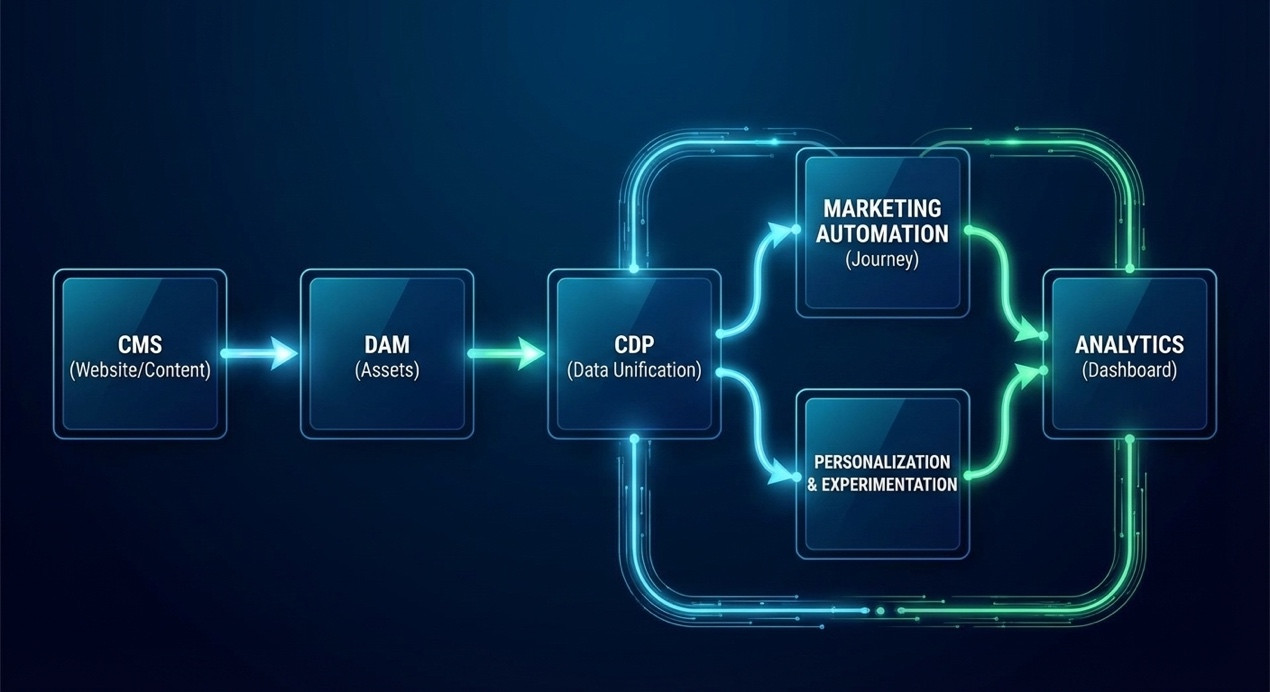
A common enterprise MarTech reference architecture includes:
- CMS (AEM) → Website and content management
- DAM (AEM Assets) → Digital asset management
- CDP (Adobe RT-CDP) → Data unification and audience management
- Marketing Automation (AJO / Marketo) → Automated journeys
- Personalization & Experimentation (Adobe Target) → Dynamic content and A/B testing
- Analytics (Adobe Analytics) → Reporting and dashboards
This setup supports:
- Customer acquisition
- Segmentation
- Personalization
- Automated journeys
- Retention and loyalty
- Data-driven insights
- AI-powered productivity
Organizations with limited internal resources can accelerate success by working with experienced MarTech consultants.
10. Summary: Choosing the Right MarTech Tools Is the Key to Growth
MarTech tools are more than technology—they are growth enablers that help organizations improve marketing efficiency, increase conversions, and reduce costs.
With the right MarTech stack, enterprises can achieve:
- More precise marketing communication
- Lower content production costs
- Higher website and conversion performance
- Stronger customer data integration
- Smarter AI-driven personalization
If you’re evaluating:
- Which MarTech tools to choose
- The right CDP, automation, or CMS for your business
- How to integrate Adobe Experience Cloud with existing systems
Feel free to contact LeadsTech. We help enterprises plan, implement, and optimize end-to-end MarTech solutions that drive measurable results.
Further Reading
- What is MarTech? Complete 2026 Guide to Marketing Technology
- What do MarTech companies do? How to choose the right MarTech consultant
- What Is AI MarTech? How AI Is Reshaping Marketing Technology
- How Can Enterprises Adopt MarTech? A Complete Guide to Process, Budget, and Success Factors
- MarTech Trends 2026: A Complete Guide to AI, Personalization, Zero-Party Data, and Customer Journey Automation