
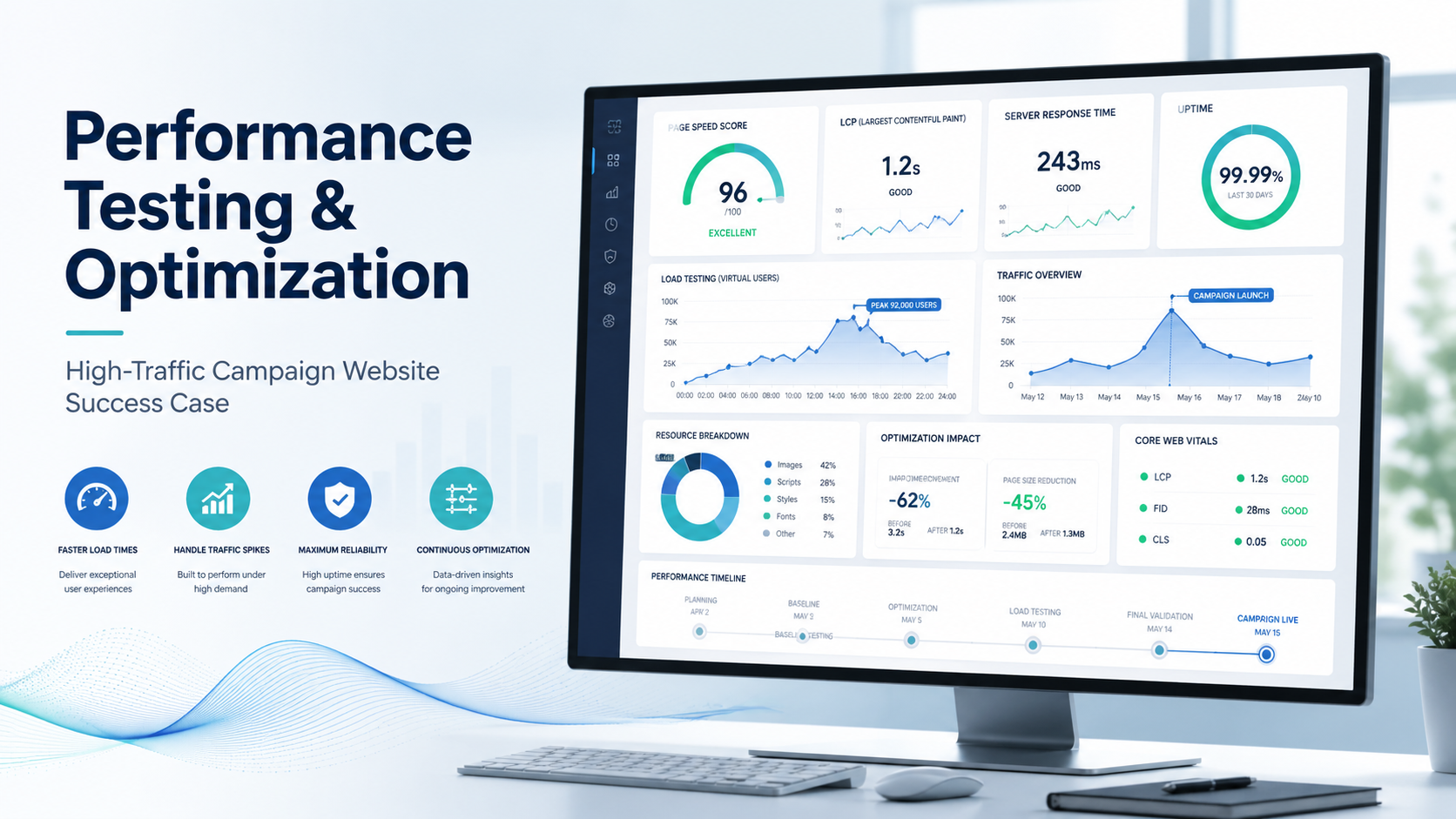
Performance Testing & Optimization Case Study | High-Traffic Stability
Customer Background
The client is a mid-to-large enterprise that focuses heavily on digital marketing and online lead generation. They frequently use paid ads, social media, email marketing, and campaign landing pages to attract users to submit inquiries or registrations.
1. Project Background
During major marketing campaigns, the website needed to handle a large surge of traffic within a short time, especially on key pages such as Landing Pages, product pages, form submission pages, and Thank You Pages. The loading speed and stability of these pages directly affect whether users complete registrations or submissions.
Before optimization, the website was stable under normal traffic. However, during large campaigns, issues such as slow loading, delayed form submissions, duplicate submissions, and failures occurred. Therefore, the company aimed to reduce technical risks before launching new campaigns through performance testing and optimization.
2. Challenges Before Optimization
Before optimization, the website faced the following issues:
High traffic spikes during campaigns
Marketing campaigns often drive traffic from ads, EDMs, social media, and partner channels simultaneously, causing users to concentrate on the same Landing Page. While normal traffic was manageable, peak traffic capacity had not been fully validated.
Slow Landing Page load speed
Campaign pages included banners, videos, interactive components, tracking codes, and third-party tools. Without proper optimization, these resources slowed down initial rendering.
Risks in form submission process
Forms are critical for conversion. The process involves front-end validation, backend APIs, database writing, and CRM or marketing system synchronization. Under high concurrency, delays in any step could cause failures or duplicate submissions.
Impact from third-party tools
Campaign pages often include analytics, ad tracking, heatmaps, chat tools, and automation scripts. If loaded synchronously or poorly optimized, they can block rendering and impact user experience.
Lack of pre-launch stress testing
Previous campaigns focused on functional testing but lacked stress testing for traffic spikes and API concurrency, making it hard to detect performance bottlenecks in advance.
3. Optimization Goals
The main objectives of this performance testing and optimization included:
- Improve loading speed of campaign landing pages
- Ensure stable website operation during marketing campaigns
- Enhance peak traffic handling capacity
- Reduce form submission failure rates
- Reduce API latency and server load
- Optimize loading of images, JavaScript, CSS, and third-party scripts
- Establish a performance testing process before campaign launch
- Improve success rate of user registration, inquiry, or data submission
4. Performance Testing Strategy
Campaign flow breakdown and test scope definition
We first analyzed the user journey and broke down the core processes that needed to be tested:
- User clicks from ads or EDM and enters the landing page
- User browses campaign content
- User clicks CTA
- User fills out the form
- System performs frontend and backend validation
- Data is written to the database or synchronized to backend systems
- User enters the Thank You page
- System triggers notifications, tracking, or follow-up marketing workflows
Establishing peak traffic test scenarios
To simulate real campaign traffic, we designed multiple stress testing scenarios:
- Normal daily traffic scenario
- Early-stage ad campaign traffic scenario
- Post-EDM traffic spike scenario
- Social media traffic surge scenario
- Form submission peak scenario
- Sudden traffic spike scenario
- Long-duration sustained traffic scenario
Form submission stress testing
Since forms are the core conversion point, we conducted dedicated testing on the form workflow, including:
- Form page loading speed
- Form submission API response time
- High-concurrency submission success rate
- Duplicate submission handling
- Required field validation
- Clarity of error messages
- Backend data write stability
- Third-party system synchronization delay
- Thank You page loading speed
- Long-duration sustained traffic scenarios
Performance monitoring metrics
During testing, we focused on the following metrics:
- Average landing page load time
- First contentful paint time
- Average form API response time
- P95 / P99 response time
- Requests per second
- Form submissions per second
- Error rate
- Form submission success rate
- CDN cache hit rate
- Server CPU and memory usage
- Third-party script loading time
- Core Web Vitals metrics
5. Performance Optimization Strategy

The main optimization strategies included:
Landing page frontend resource optimization
We optimized frontend resources of the campaign pages, including:
- Compressing images, JavaScript, and CSS
- Removing unused frontend resources
- Prioritizing first-screen content loading
- Lazy loading non-core images and sections
- Splitting large JavaScript bundles
- Reducing third-party script impact on initial rendering
- Prioritizing loading of key CTA and form sections
- Optimizing font and icon loading strategy
Image and media optimization
Since campaign pages are visually heavy, image and media optimization was a key focus. We implemented:
- Compressing large banner images to appropriate sizes
- Serving different image sizes for desktop and mobile
- Enabling lazy loading for non-first-screen images
- Using more efficient image formats
- Avoiding oversized desktop images on mobile devices
- Reducing impact of videos or animations on page loading
- Optimizing background and product image loading strategy
CDN and caching optimization
To improve stability under different regions and peak traffic conditions, we optimized CDN and caching strategies, including:
- CDN acceleration for static resources
- Caching of images, CSS, and JavaScript files
- Proper Cache-Control configuration
- Improving CDN cache hit rate
- Page-level caching strategy for high-traffic pages
- Reducing redundant origin requests
- Lowering origin server load during peak traffic
Form API and submission process optimization
For the form submission process, we carried out the following optimizations:
- Optimize form submission API response speed
- Reduce unnecessary backend queries
- Cache high-frequency data
- Improve data writing process
- Set reasonable Timeout and Retry mechanisms
- Add duplicate submission protection
- Optimize error messages and frontend validation
- Convert non-real-time necessary processes to asynchronous processing
- Ensure Thank You Page fast response
Third-party script governance
Marketing campaign pages often need to add multiple third-party tracking codes, but these scripts may also cause performance issues. Therefore, we carried out governance on third-party scripts:
- Check the actual usage of each third-party script
- Remove unnecessary or duplicate tracking codes
- Apply lazy loading to non-core scripts
- Avoid third-party tools blocking main content rendering
- Set reasonable loading priority for important marketing tracking codes
- Monitor the impact of third-party scripts on page speed
Establishing pre-campaign performance inspection process
In addition to this project optimization, we also helped enterprises establish a pre-launch performance inspection process, including:
- Campaign page Lighthouse / PageSpeed inspection
- Campaign page resource size inspection
- Form submission process testing
- Peak traffic stress testing
- CDN cache inspection
- Third-party script inspection
- Error rate and response time monitoring
- Real-time monitoring and alerting during campaigns
6. Optimization results
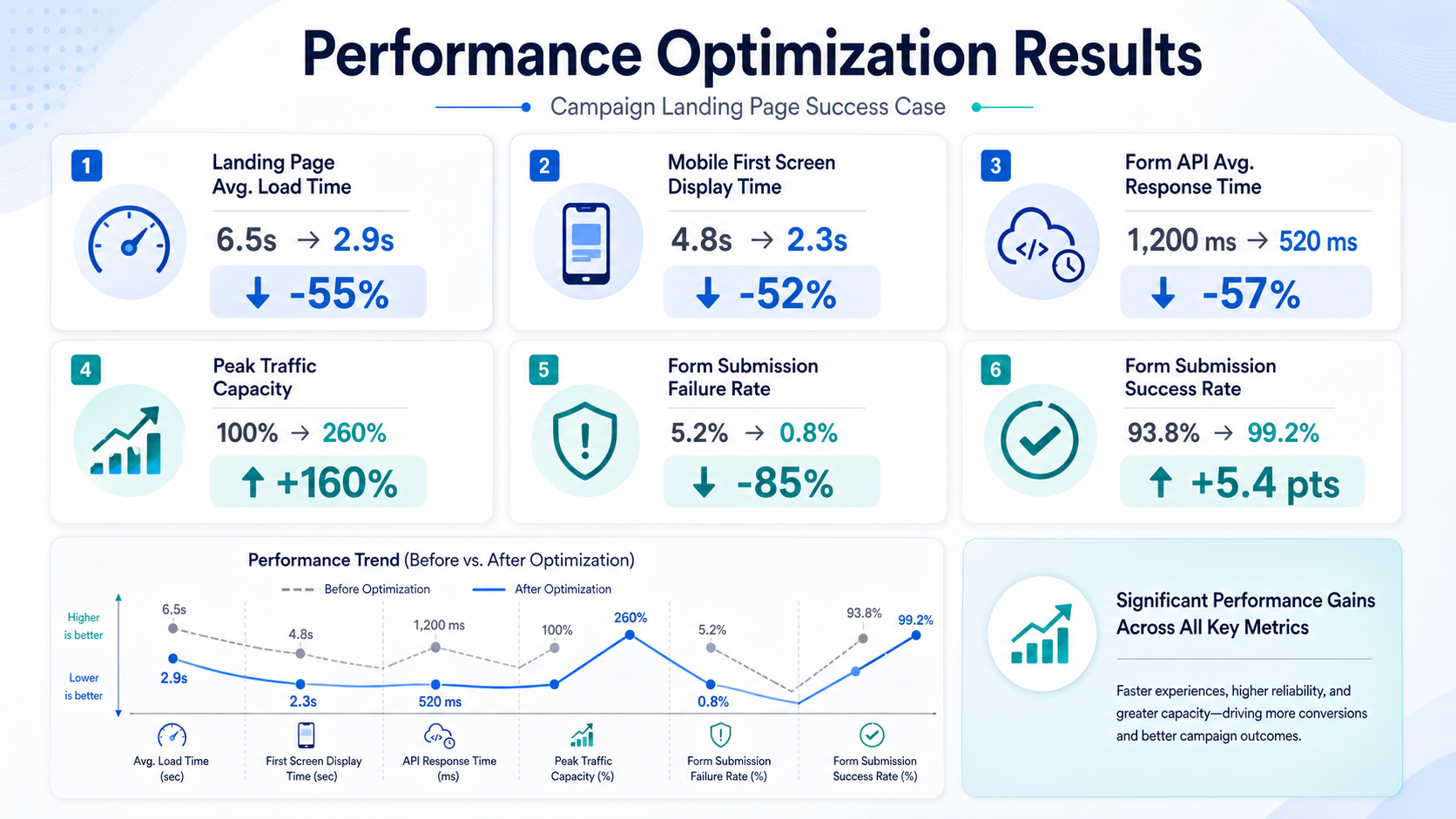
After performance testing and optimization, the campaign page showed significant improvements in loading speed, peak capacity, form submission stability, and user experience. The following are performance results over approximately 2 to 3 months after optimization:
| Metric | Before optimization | After optimization | Improvement |
|---|---|---|---|
| Average campaign page load time | About 6.5 seconds | About 2.9 seconds | Reduced by about 55% |
| Mobile first screen display time | About 4.8 seconds | About 2.3 seconds | Reduced by about 52% |
| Form API average response time | About 1,200 ms | About 520 ms | Reduced by about 57% |
| Peak traffic capacity | Baseline value 100% | About 260% | Improved by about 160% |
| Form submission failure rate | About 5.2% | About 0.8% | Reduced by about 85% |
| Form submission success rate | About 93.8% | About 99.2% | Improved by about 5.4 percentage points |
Results Summary
Through this performance testing and optimization, the average campaign page load time was reduced from about 6.5 seconds to about 2.9 seconds, Mobile first screen display time was reduced from about 4.8 seconds to about 2.3 seconds, and the form API average response time was reduced from about 1,200 ms to about 520 ms.
In terms of peak traffic capacity, the website’s supported campaign peak traffic capability increased by about 160%. At the same time, the form submission failure rate decreased from about 5.2% to about 0.8%, and the form submission success rate increased to about 99.2%.
This means the website is not only faster, but also more stable, and can more effectively handle traffic and inquiry opportunities during large marketing campaigns.
7. Key Success Factors
Campaign conversion flow as the core
This optimization was not simply testing homepage speed, but started from the complete campaign conversion flow, focusing on every step from users clicking ads, entering campaign pages, reading content, filling forms to completing submission.
This ensures performance optimization truly serves business goals rather than just improving technical metrics.
Early simulation of peak traffic
If the website becomes slow only after the campaign goes live, it often already causes potential customer loss. Therefore, this case used pre-campaign stress testing to simulate different traffic peaks and form submission peaks, allowing optimization before issues occur.
Simultaneous optimization of frontend, backend, and third-party tools
Campaign page performance issues are usually not caused by a single factor. Images, frontend scripts, CDN, APIs, form processes, and third-party tools all affect overall performance. Therefore, this optimization used a full-chain approach to ensure more stable improvements.
Focus on mobile user experience
Mobile traffic is usually higher in marketing campaigns. If mobile first screen loading is too slow, it directly affects bounce rate and form completion rate. Therefore, this optimization specifically improved mobile images, first screen content, script loading, and form experience.
Establish a reusable pre-campaign inspection process
Successful performance optimization should not only serve a single campaign. This case organized testing methods, inspection items, and monitoring metrics into a reusable pre-campaign performance inspection process, enabling enterprises to launch future campaigns with greater confidence.
8. Conclusion
This case demonstrates how enterprises can improve website capacity, campaign page loading speed, and form submission stability during high-traffic marketing campaigns through performance testing and optimization.
For businesses relying on Landing Pages, form inquiries, campaign registrations, and advertising to generate opportunities, website performance directly affects marketing ROI. If campaign pages load too slowly, forms are unstable, or the site responds slowly under peak traffic, even large advertising traffic may fail to convert into business opportunities.
Through pre-campaign stress testing, frontend resource optimization, CDN caching optimization, form API optimization, and third-party script governance, enterprises can keep websites fast, stable, and convertible under peak traffic, truly supporting marketing effectiveness.
If your website is about to run large marketing campaigns, product launches, online registrations, or advertising campaigns, and you want to confirm whether it can handle high traffic and heavy form submissions before launch, you can learn about our Website Performance Testing and Optimization Services. LeadsTech can help enterprises with performance testing, stress testing, Lighthouse / PageSpeed audits, and practical optimization to identify key bottlenecks affecting speed, stability, and conversion, and provide actionable improvement solutions.