
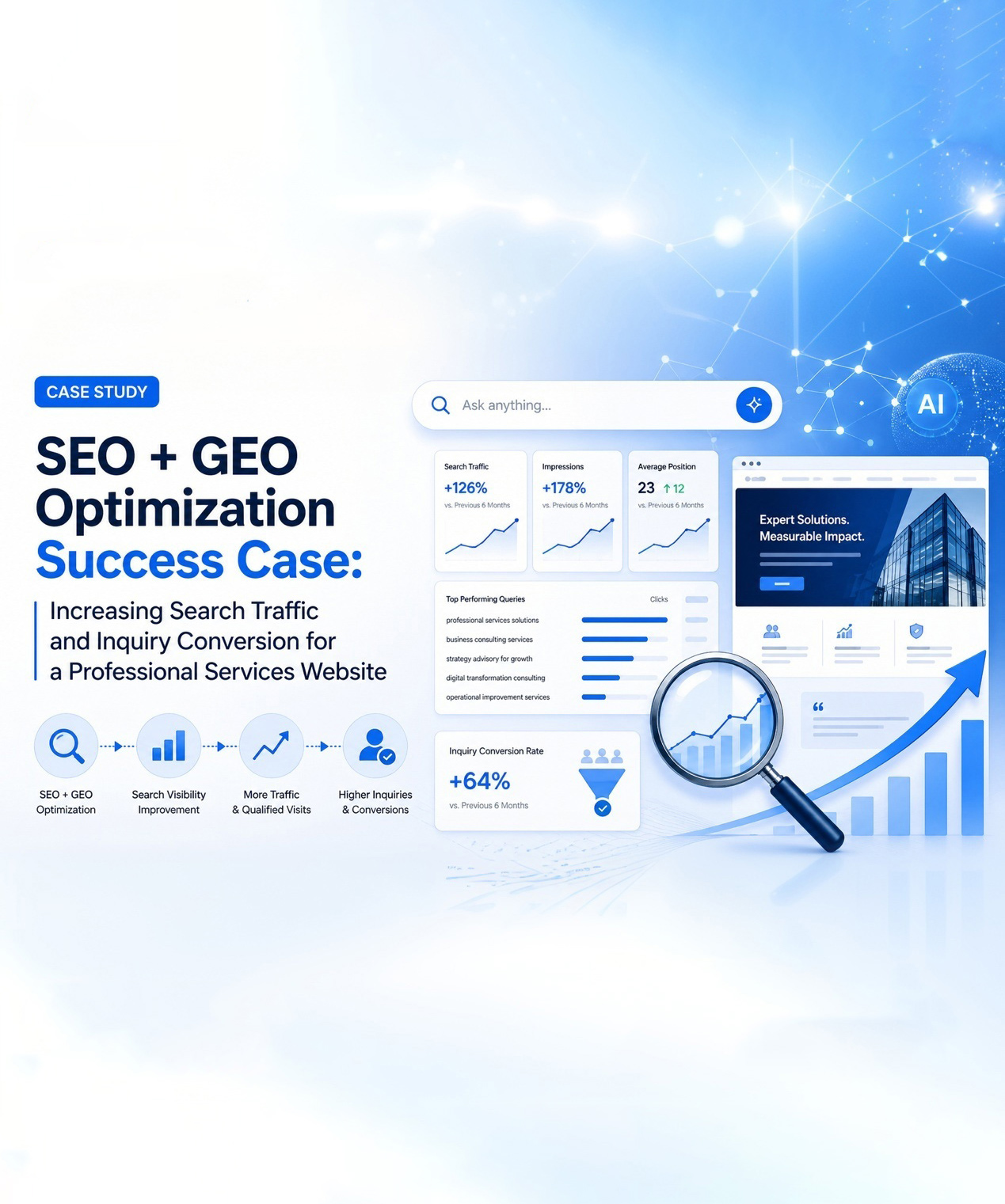
SEO + GEO Optimization Case Study | Increase Traffic, AI Visibility & Conversions
Company Background
The company featured in this case study is a professional B2B service provider that offers website development, digital operations, content optimization, system integration, and online business growth solutions for enterprise clients.
Before optimization, the company website already had a solid content foundation. However, its service pages were primarily company-focused and did not fully align with customer search intent. In addition, the website lacked a content structure optimized for AI search understanding. As a result, there was still significant room for improvement in organic search traffic, service page visibility, and inquiry conversions.
Solution
SEO and GEO Optimization
1. Challenges Before Optimization
Before implementing SEO and GEO optimization, the website faced the following key issues:
Content Was Too Company-Centric
Some pages mainly focused on introducing the company’s services, but did not sufficiently address the real concerns of potential clients, such as how to choose the right service provider, what types of businesses the service is suitable for, what the implementation or optimization process looks like, how to evaluate website optimization performance, and how the solution differs from other options.
Page Structure Was Not Search-Friendly
Some service pages lacked clear heading structures, section summaries, use cases, FAQ sections, and CTA guidance, making it more difficult for search engines and AI tools to quickly understand the main focus of the pages.
Insufficient Keyword Coverage
Although the website already contained service-related content, it did not systematically cover core keywords, long-tail keywords, question-based keywords, and location-based keywords. For example, potential customers may search for terms such as enterprise website optimization services, B2B website SEO, AI search optimization, GEO optimization services, website content optimization company, or improving website inquiry conversion rates, but related content was not fully structured across the website.
Limited AI Search Readability
As AI search tools continue to become more widely adopted, website content needs not only to be indexed by search engines, but also to be clearly understood by AI systems. Before optimization, the website lacked clear definitions, Q&A-style content, comparison-based content, and structured explanations, leaving significant room for improvement in AI search visibility.
2. Optimization Goals
The primary goals of this SEO + GEO optimization project included:
- Increase organic search traffic
- Drive more visits to core service pages
- Improve long-tail keyword visibility
- Enhance AI search engines’ understanding of website content
- Increase conversion rates for inquiry forms and contact pages
- Enable website content to better support sales and business development
3. SEO Optimization Strategies
3.1 Reorganizing Search Intent
We started by analyzing the search behavior of potential customers and restructuring the search intent behind different service pages.
The focus shifted from simply “what the company wants to introduce” to “what customers are actually searching for.”
For example:
- Customers searching for solutions
- Customers comparing different service providers
- Customers learning about service processes
- Customers evaluating costs and results
- Customers looking for experienced partners
Based on these search intents, we restructured the service page content to better align with the real customer decision-making journey.
3.2 Optimizing SEO Titles and Meta Descriptions
We rewrote the SEO Titles and Meta Descriptions for core pages to better match search intent and improve click-through rates.
Optimization strategies included:
- Adding core service keywords
- Including search contexts such as “enterprise,” “B2B,” “website optimization,” and “AI search”
- Emphasizing business value, such as “increase traffic,” “increase inquiries,” and “improve conversions”
- Avoiding internal service terminology and replacing it with customer-friendly language
3.3 Restructuring Core Service Pages
Service pages are the most important conversion entry points for B2B websites. Therefore, we redesigned the core service pages into a structure that is more suitable for both search visibility and conversions:
- Service Overview
- Customer Pain Points
- Solutions
- Target Businesses
- Implementation Process
- Performance Measurement
- Frequently Asked Questions
- Contact Us CTA
This structure better supports the needs of search engines, AI search tools, and real users.
3.4 Building an Internal Linking Structure
We redesigned the website’s internal linking structure to create clearer navigation paths between service pages, blog articles, case studies, and contact pages.
For example:
- Service pages linking to related knowledge articles
- Blog articles linking to relevant service pages
- Case studies linking to contact pages
- FAQ content linking to more advanced solution pages
- High-traffic articles guiding visitors to high-value service pages
This approach improves topical relevance while guiding users from content consumption toward business inquiries.
4. GEO Optimization Strategies
4.1 Improving AI Search Readability
The core purpose of GEO optimization is to make website content easier for AI search tools to understand, organize, and reference.
Therefore, we added more structured and clearly defined content, including:
- Service definitions
- Problem-solving explanations
- Use cases
- Implementation processes
- Performance metrics
- FAQs
- Comparison-based content
- Bullet-point summaries
This content helps AI systems better understand the website’s topics and increases the chances of being referenced or recommended in AI-generated search results.
4.2 Adding Question-Based Content
AI search tools often respond in a Q&A format, so we created FAQ sections and question-based content around common customer concerns.
Examples include:
- What is GEO optimization?
- What is the difference between SEO and GEO?
- Why do enterprise websites need AI search optimization?
- How can businesses improve visibility in AI search?
- How can SEO and GEO performance be measured?
- How can B2B websites improve inquiry conversion rates?
This type of content helps capture long-tail search traffic and improves AI understanding of the relationship between user questions and website content.
4.3 Improving Semantic Consistency
We standardized core terminology across different website pages to avoid fragmented wording for the same concepts.
For example, around the topic of “website optimization,” we consistently aligned related semantic terms such as:
- Organic search traffic
- AI search visibility
- Content optimization
- Service page optimization
- Inquiry conversion rate
- B2B lead generation
This consistency helps both search engines and AI systems better understand the website’s core themes.
5. Optimization Results
After implementing SEO + GEO optimization, the website showed significant improvements in traffic, organic search visibility, AI search exposure, and inquiry conversions. The following results were achieved within approximately 3 to 6 months after optimization:
| Metric | Before Optimization | After Optimization | Improvement |
| Overall Website Traffic | Baseline 100% | Approximately 168% | Increase of approximately 68% |
| Organic Search Traffic | Baseline 100% | Approximately 182% | Increase of approximately 82% |
| AI Search Visibility and Mentions | Baseline 100% | Approximately 160% | Increase of approximately 60% |
| Inquiry Form Conversion Rate | Approximately 1.2% | Approximately 2.1% | Increase of approximately 75% |
Results Summary
Through this optimization project, the website not only gained more organic search traffic but also improved its visibility in AI search environments. More importantly, the inquiry form conversion rate increased from approximately 1.2% to 2.1%, demonstrating that the content was not only effective at attracting visitors, but also more successful at converting potential customers into inquiries.
6. Key Success Factors
6.1 Starting from Customer Search Intent
The core of this optimization was not simply adding more keywords, but understanding how customers search, compare, and make decisions. When content genuinely answers customer questions, both search performance and conversion performance improve together.
6.2 Optimizing Both SEO and GEO
Traditional SEO improves visibility in search engines, while GEO further enhances website readability and visibility in AI search environments. Combining both strategies makes the website easier to find and easier for AI systems to understand and recommend.
6.3 Turning Service Pages into Conversion Entry Points
Service pages should not simply serve as company introductions. They should provide clear value propositions, pain point analysis, solutions, implementation processes, FAQs, and CTAs. This helps visitors move from “understanding the service” to “submitting an inquiry.”
6.4 Establishing an Ongoing Optimization Process
SEO and GEO are not one-time tasks. Websites need continuous monitoring of search performance, traffic trends, content gaps, AI visibility, and conversion rates, followed by ongoing data-driven adjustments.
7. Conclusion
This case study demonstrates how SEO + GEO can help B2B service websites improve organic search traffic, AI search visibility, and lead conversion performance.
Through search intent analysis, service page restructuring, keyword planning, FAQ optimization, internal linking, and improved AI readability, the website evolved from a simple company profile into a valuable channel that supports brand visibility, content marketing, and business growth.
For companies looking to improve website traffic, AI visibility, and sales inquiries, SEO + GEO has become an essential part of modern digital growth strategies.
Similar Cases
Enterprise AI MarTech Trends Analysis 2024-2029 Outlook Report
From AI content productivity tools to a core engine for revenue growth and marketing transformation
*The PDF will be sent directly to your inbox.