
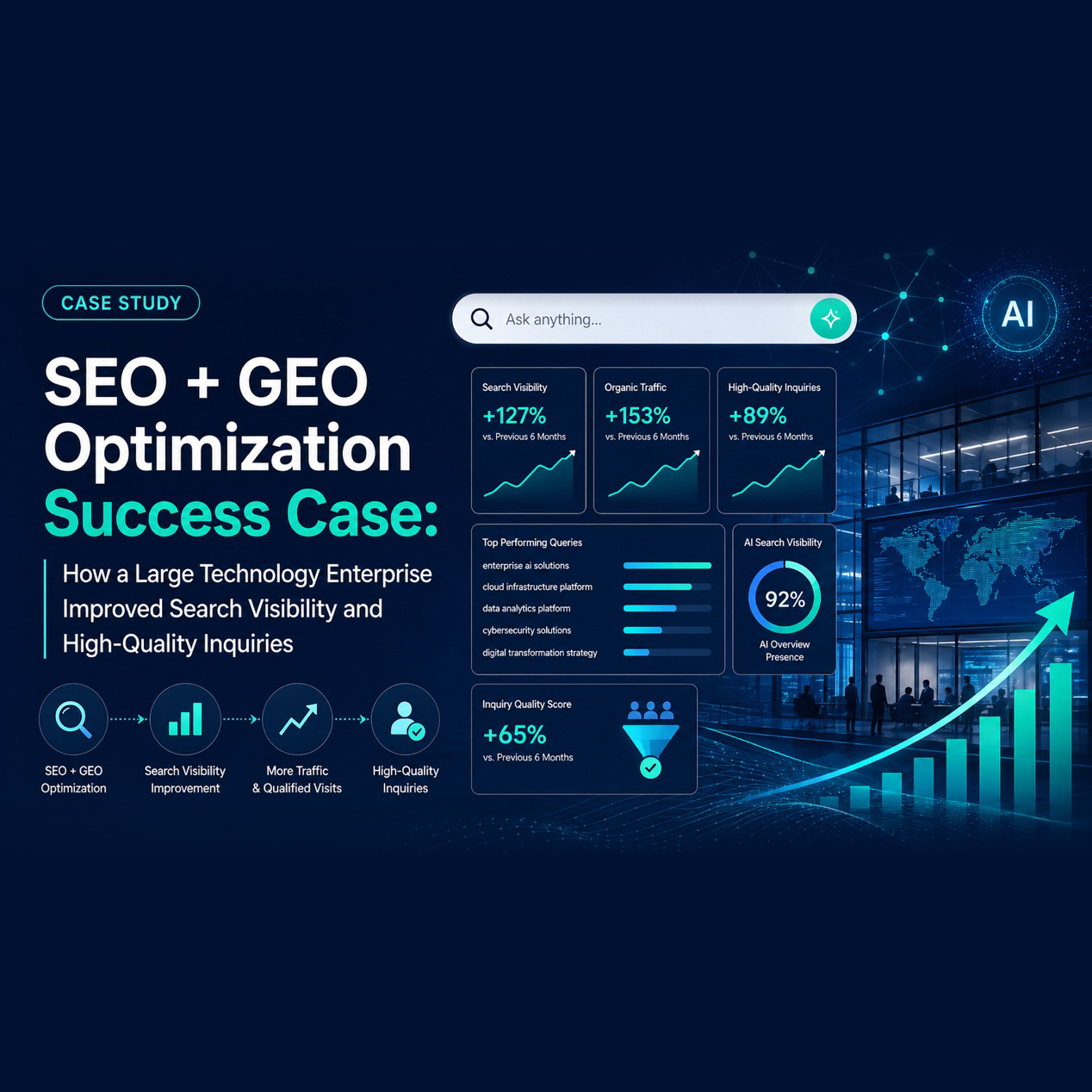
SEO + GEO Success Story | Boost Search Visibility & Lead Conversion
Company Background
The company featured in this case study is a large B2B technology enterprise. Due to the high technical complexity of its products, customers rely heavily on multi-channel research before making purchasing decisions.
As traditional search traffic declined and AI search (GEO) rapidly emerged, the company’s existing SEO strategy was no longer sufficient. Therefore, the goal was to strengthen the website’s technical authority across traditional search engines, AI tools, and vertical platforms through a dual-track SEO + GEO optimization strategy, ultimately improving brand visibility and conversion rates.
Solution
SEO and GEO Optimization
1. Challenges Before Optimization
Before the SEO and GEO optimization, the website mainly faced the following challenges:
Slowing Growth of Traditional Search Traffic
Although the website was still able to gain stable traffic from traditional search engines, the overall search market had already entered a stage of saturated competition. Exposure and clicks for some core keywords began to face pressure, especially as “zero-click searches” and AI-generated summaries became more common, reducing the likelihood that users would click through to the official website.
Large Amount of Content, but Weak Search Structure
The website already contained a large number of product introductions, technical resources, downloadable materials, and support pages, but lacked a clearly organized topic cluster structure. Some pages were technically professional but did not effectively match customer search intent, such as: how to choose the right solution, which applications different products are suitable for, how to compare different technical approaches, what real-world use cases exist, and how to obtain technical support or download resources.
Insufficient AI Search Readability
The website content was primarily designed for human users and traditional search engines. For AI search tools, some content lacked clear semantic structure, Q&A content, comparison content, scenario-based explanations, and trustworthy source signals. As a result, AI systems were not always able to prioritize understanding, citing, or recommending the company’s website content when answering related questions.
Insufficient Third-Party Platform Content Presence
During the decision-making process for technical B2B purchases, potential customers do not only visit official websites. They also refer to technical communities, Q&A platforms, video platforms, industry media, and third-party content. Before optimization, the company’s content coverage and update frequency on these platforms were relatively limited, affecting brand visibility across the broader search ecosystem.
2. Optimization Goals
The main objectives of this SEO + GEO optimization project included:
- Maintain and increase organic search traffic
- Increase search visibility for core products and technical topics
- Improve AI search tools’ understanding and citation opportunities for website content
- Build clearer content topic clusters
- Increase high-quality technical inquiries and download conversions
- Strengthen search synergy between the official website, content platforms, and third-party channels
- Transform the website from a “content repository” into a “search and demand conversion platform”
3. SEO Optimization Strategies

3.1 Building Core Topic Clusters
We first restructured the website’s content topic clusters based on the company’s product lines, application scenarios, and customer search needs.
Each topic cluster included the following content:
- Core product pages
- Application scenario pages
- Technical explanation pages
- FAQ pages
- Download resource pages
- Case study or solution pages
- Related articles and knowledge content
This structure helps search engines better understand the website’s expertise within specific topics and improves coverage for both core and long-tail keywords.
3.2 Optimizing Core Product and Solution Pages
For high-value search entry pages, we restructured the page content so that pages no longer simply introduced product features, but more clearly addressed customer decision-making concerns.
The optimized pages typically included:
- Product or solution overview
- Applicable application scenarios
- Core features and advantages
- Key technical specifications
- Common product selection questions
- Related resource downloads
- Related product or solution recommendations
- CTA to contact technical experts
This approach helped improve search rankings, page engagement time, and conversion opportunities simultaneously.
3.3 Strengthening Long-Tail Keyword Strategy
Technical B2B customer searches are often highly specific. Users may not only search for brand or product keywords, but also for application scenarios, technical issues, and comparison-related queries.
Therefore, we created long-tail content targeting:
- Application scenario keywords
- Technical problem keywords
- Product comparison keywords
- Download-related keywords
- Solution-based keywords
- Regional and market-specific keywords
Through long-tail content planning, the website gained visibility opportunities during the early, middle, and late stages of the customer research process.
3.4 Improving Internal Links and Conversion Paths
We redesigned the website’s internal linking structure to guide visitors naturally from content pages to high-value pages.
For example:
- Technical articles linking to related product pages
- Product pages linking to application scenario pages
- Application scenario pages linking to download pages
- FAQ pages linking to technical support or contact pages
- High-traffic articles directing users toward high-conversion CTAs
This helped gradually direct previously fragmented traffic toward technical inquiries, resource downloads, and sales contact opportunities.
4. GEO Optimization Strategies

4.1 Building AI-Friendly Content Structures
The core goal of GEO optimization is to help AI search tools better understand the company’s products, technical capabilities, application scenarios, and professional value.
Therefore, we added more AI-friendly content to core pages, including:
- Clear definitions
- Q&A-style content
- Technical scenario explanations
- Product comparison content
- Product selection recommendations
- Step-by-step explanations
- Structured summaries
- Trustworthy sources and external content signals
This content helps AI systems better understand the context and credibility of the company’s website content when answering related questions.
4.2 Adding FAQ and Q&A Content
AI search often uses natural language questions as entry points, such as:
- Which application scenarios are suitable for this type of product?
- How do different technical solutions compare?
- What factors should be considered during product selection?
- How can implementation risks be reduced?
- Which scenarios require higher performance or reliability?
- How can technical resources or expert support be obtained?
As a result, we added FAQ sections to product pages, solution pages, and knowledge articles, transforming previously scattered technical information into AI-friendly Q&A content.
4.3 Strengthening Third-Party Content and Trust Signals
In the AI search environment, the brand’s official website is not always the only source of information. AI systems reference multiple public sources, including industry platforms, technical communities, media content, Q&A platforms, video content, and encyclopedia-style content.
Therefore, we recommended that the company build external trust signals simultaneously, such as:
- Publishing technical articles on high-authority industry platforms
- Answering common technical questions on Q&A platforms
- Publishing product tutorials and application introductions on video platforms
- Regularly updating public information related to the brand and products
- Building exposure through third-party media and partner content
- Extending core content from the official website into a multi-platform content ecosystem
This helped improve the brand’s credibility and citation opportunities within AI search results.
4.4 Establishing a GEO Monitoring System
In addition to content optimization, we also established a GEO monitoring process to regularly review:
- Whether AI search mentions the brand
- Whether AI correctly understands products and services
- Whether AI-generated answers contain outdated or incorrect information
- Competitor visibility within AI-generated answers
- Which questions are more likely to trigger AI recommendations
- Which content requires updates or expansion
This transformed GEO from a one-time content adjustment into an ongoing search growth and optimization mechanism.
5. Optimization Results
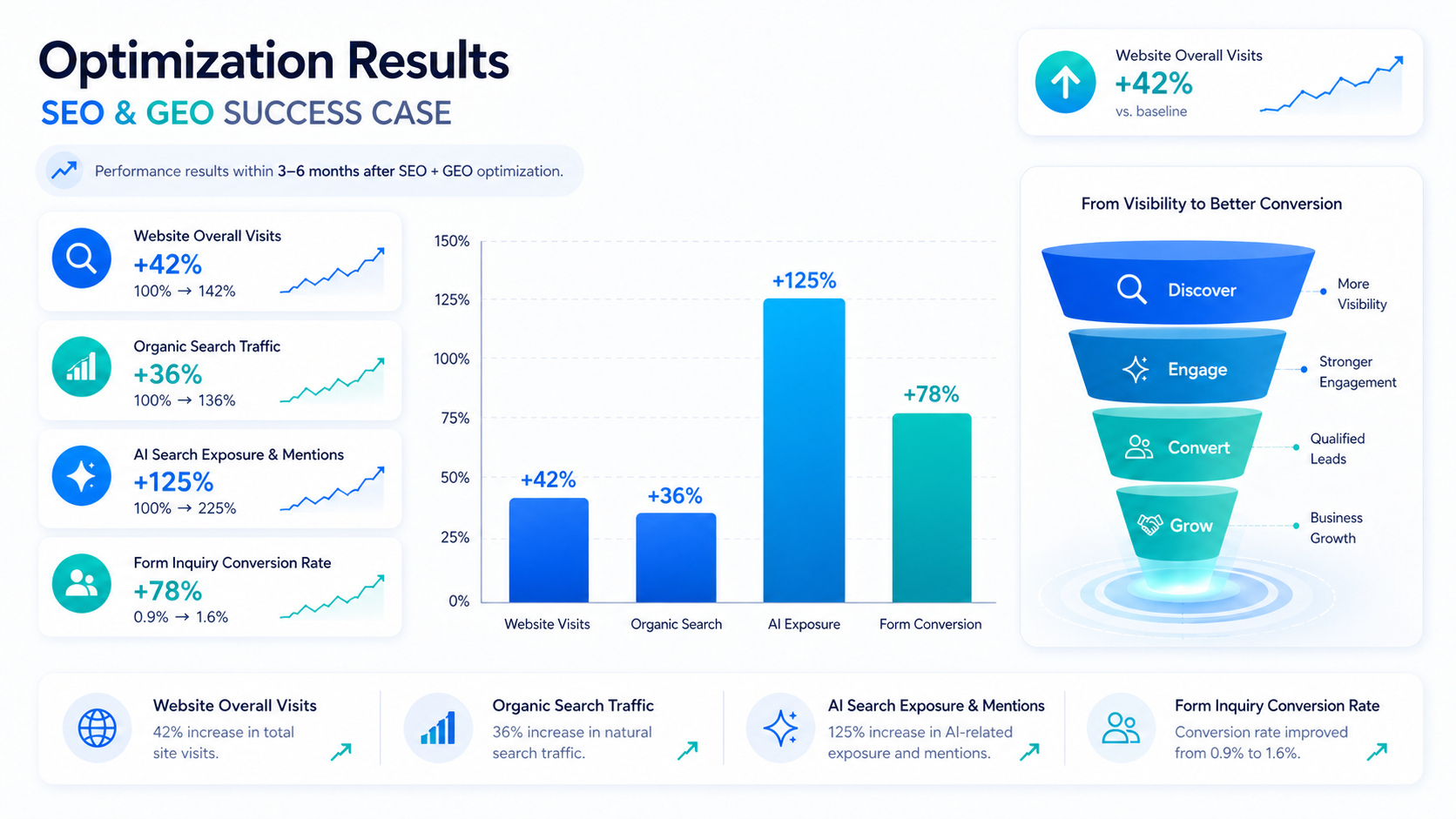
After implementing SEO + GEO optimization, the website achieved significant improvements in organic search performance, AI search visibility, and high-quality inquiries. The following results were observed approximately 3 to 6 months after optimization:
| Metrics | Before Optimization | After Optimization | Improvement |
| Overall Website Traffic | Baseline 100% | Approximately 142% | Approximately 42% Increase |
| Organic Search Traffic | Baseline 100% | Approximately 136% | Approximately 36% Increase |
| AI Search Exposure and Mentions | Baseline 100% | Approximately 225% | Approximately 125% Increase |
| Form Inquiry Conversion Rate | Approximately 0.9% | Approximately 1.6% | Approximately 78% Increase |
Results Summary
Through this optimization project, the website successfully evolved from a traditional official website SEO strategy into a collaborative growth model combining “Official Website + AI Search + Third-Party Platforms.” Organic search traffic increased steadily, while AI search-related exposure and mentions grew significantly. In addition, the form inquiry conversion rate improved from approximately 0.9% to approximately 1.6%.
This demonstrates that the website content was not only seen by more users, but was also more easily understood by AI search tools, enabling more effective conversion of potential customers into inquiries.
6. Key Success Factors
6.1 Transitioning from Traditional SEO to Full-Scale Search Presence
Traditional SEO remains important, but it is no longer sufficient to cover all search scenarios. The key to success is simultaneously building visibility across traditional search, AI search, vertical platforms, and third-party content channels, ensuring that the brand can be discovered through different decision-making entry points.
6.2 Transforming Technical Content into Understandable Content
Technical companies often possess a large amount of professional content. However, if the information is too fragmented or only written for internal experts, search engines and AI tools may struggle to understand it effectively. This optimization project reorganized technical content into definitions, scenarios, problems, comparisons, processes, and FAQs, making it easier for search engines, AI systems, and real customers to understand.
6.3 Building Topic Clusters Instead of Optimizing Individual Pages
Competition in SEO and GEO is no longer about ranking a single page, but about establishing authority across an entire topic. Through topic cluster planning, companies can build a complete content ecosystem around core products, application scenarios, and technical issues, improving long-term search competitiveness.
6.4 Continuously Monitoring AI Search Results
AI-generated search results are constantly changing. Companies need to continuously monitor whether AI systems correctly understand their brand, products, and technical capabilities, while continuously updating content, correcting information, and strengthening trust signals.
7. Conclusion
This case study demonstrates how a large technical B2B enterprise improved website traffic, AI search visibility, and high-quality inquiry conversions through SEO + GEO optimization in a rapidly changing search environment.
As user search behavior gradually shifts from “typing keywords to find links” toward “asking AI questions and receiving answers,” enterprise websites must also evolve from traditional content displays into core digital assets that can be understood by both AI systems and human users.
For B2B companies with complex products, extensive technical content, and long customer decision cycles, SEO + GEO is no longer just a marketing optimization task. It is an essential long-term growth strategy for improving brand visibility, technical credibility, and business opportunities.
Similar Cases
Enterprise AI MarTech Trends Analysis 2024-2029 Outlook Report
From AI content productivity tools to a core engine for revenue growth and marketing transformation
*The PDF will be sent directly to your inbox.