
What Is AEM as a Cloud Service? A Key Step in Enterprise Content Modernization
AEM Sites, Content Management System (CMS)
29 January 2026
- Introduction
- What Is AEM as a Cloud Service?
- Core Concepts and Architecture of AEM Cloud
- Differences Between Traditional AEM and AEM Cloud Service
- Four Key Benefits of Cloud Adoption for Enterprises
- Why Do Enterprises Need AEM as a Cloud Service?
- Overall Value in Enhancing Content Management, Marketing, and Customer Experience
- Industry Applications and Enterprise Use Cases
- AEM Cloud Service and the Future of Content Capabilities
- Conclusion
- Introduction
- What Is AEM as a Cloud Service?
- Core Concepts and Architecture of AEM Cloud
- Differences Between Traditional AEM and AEM Cloud Service
- Four Key Benefits of Cloud Adoption for Enterprises
- Why Do Enterprises Need AEM as a Cloud Service?
- Overall Value in Enhancing Content Management, Marketing, and Customer Experience
- Industry Applications and Enterprise Use Cases
- AEM Cloud Service and the Future of Content Capabilities
- Conclusion
1. Introduction: Content Management Challenges in Digital Transformation
As digital transformation accelerates, content is no longer limited to website pages. It has become a core asset spanning corporate websites, mobile devices, social platforms, and multiple digital touchpoints. Rapid content growth, fluctuating traffic, and faster-changing market and customer demands have made traditional CMS architectures increasingly difficult to sustain.
Leading enterprises are realizing that a content platform must deliver stability, flexibility, and the ability to continuously evolve. Against this backdrop, Adobe Experience Manager as a Cloud Service (AEM as a Cloud Service) has emerged as a critical step in modernizing enterprise content platforms.
2. What Is AEM as a Cloud Service?
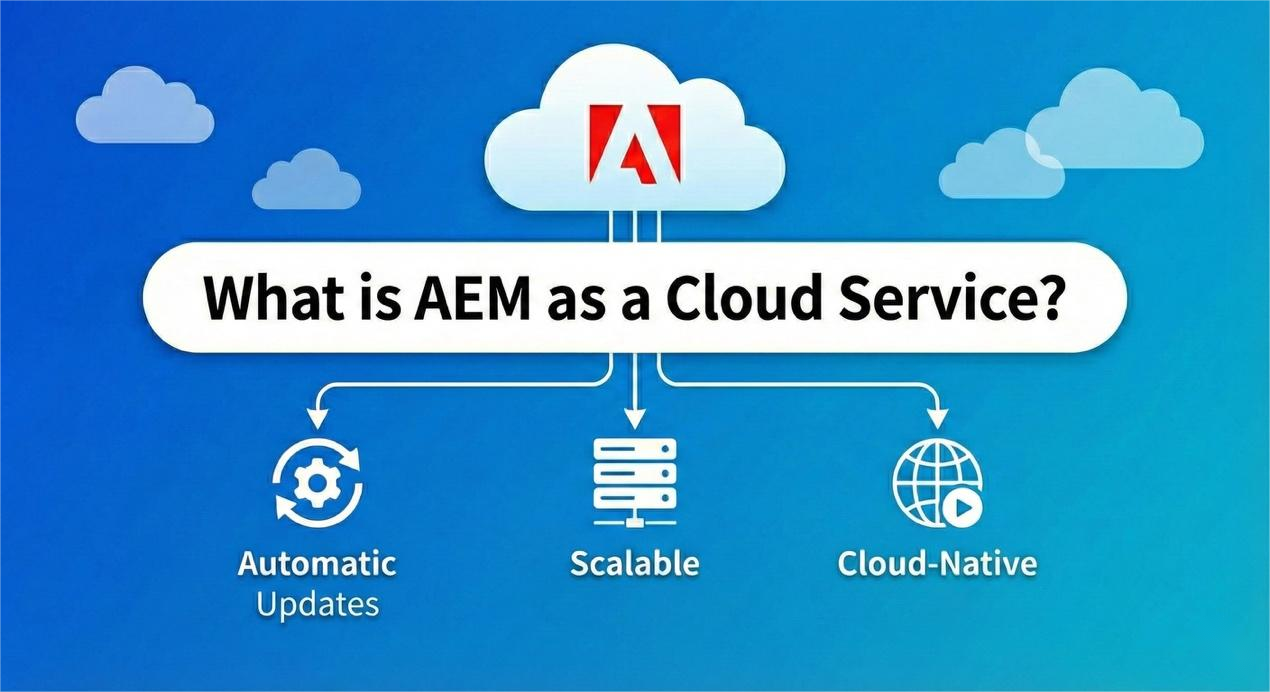
AEM as a Cloud Service (AEMaaCS) is Adobe’s cloud-native, enterprise-grade content management platform. Built on a microservices architecture with automated operations and continuous delivery, it enables organizations to manage and deliver content through a cloud service model.
Unlike traditional AEM On-Premise or Adobe Managed Services (AMS), AEM Cloud Service eliminates the need for enterprises to maintain servers, manage upgrades, or apply security patches. Adobe handles platform operations, allowing businesses to focus on content, experience, and business value.
3. Core Concepts and Architecture of AEM Cloud
AEM as a Cloud Service was designed from the ground up with a cloud-native mindset and includes the following key capabilities:
Cloud-Native and Microservices Architecture
The platform uses a cloud-native, microservices-based architecture that automatically scales resources based on real traffic demands, ensuring stable performance even during peak loads.
Cloud Manager and CI/CD Automation
Built-in Cloud Manager supports continuous integration and continuous deployment (CI/CD), along with automated testing and quality checks, enabling faster and safer releases of code and content.
Built-In CDN and Global Content Delivery
With an integrated content delivery network (CDN) and Adobe’s global infrastructure, AEM Cloud Service delivers fast and reliable content experiences across regions.
Automated Security and Performance Management
Continuous security scanning, patching, and performance monitoring reduce the operational burden related to security and system stability.
These capabilities allow developers, content authors, system administrators, and marketing teams to focus on their core responsibilities rather than infrastructure management.

4. Differences Between Traditional AEM and AEM Cloud Service
In traditional AEM On-Premise or AMS environments, enterprises are responsible for hardware provisioning, system operations, and major upgrade projects. This approach is costly and lacks flexibility in handling traffic fluctuations.
AEM Cloud Service introduces a fundamental shift:
- Infrastructure management: Fully managed by Adobe, significantly reducing IT operational overhead
- Elastic scalability: Automatic, real-time scaling prevents service disruptions during traffic spikes
- Continuous updates: Features and security updates are delivered automatically, eliminating large upgrade projects
- Cost model transformation: Shifts from capital expenditure to predictable, subscription-based operating expenses
This enables enterprises to operate content platforms in a more stable and predictable way.
5. Four Key Business Benefits of Cloud Transformation
According to Adobe, AEM Cloud Service delivers cloud-native agility for content management, reflected in four key areas:

Faster development and deployment
Automated CI/CD pipelines accelerate the release of features and content.

Automated operations and upgrades
Continuous delivery of security patches and new features reduces manual maintenance effort.

Elastic scalability and global deployment
Resources scale automatically based on demand, while CDN integration ensures consistent global experiences.

Enterprise-grade security and reliability
Built-in multi-layer security and high-availability architecture ensure long-term service stability.
6. Why Do Enterprises Need AEM as a Cloud Service?
For most organizations, the value of adopting AEM as a Cloud Service goes beyond simply “moving to the cloud.” It delivers tangible benefits such as:
- Reduced IT operational costs and complexity
- Faster content publishing and time-to-market
- Support for multi-brand and multi-market content management
- Enabling marketing and content teams to focus on value creation rather than technical constraints
These advantages make AEM Cloud Service a foundational platform for content modernization.
7. Enhancing the Overall Value of Content, Marketing, and Customer Experience
The value of AEM Cloud Service extends beyond infrastructure and directly impacts content and marketing outcomes:
Omnichannel content consistency
Centralized management of web, app, and multi-channel content
Faster response to market changes
Content updates can be deployed in a much shorter timeframe
Personalized marketing capabilities
Integration with Adobe Analytics, Target, and other solutions enables data-driven personalization
Improved conversion and engagement
Helps organizations turn marketing ideas into measurable results faster
In practice, enterprises that adopt AEM Cloud often see significant improvements in site launch speed, team productivity, and user engagement.
8. Industry Use Cases and Enterprise Scenarios
AEM Cloud Service is widely adopted across industries, including:

Retail
Driving higher conversion rates through personalized content and campaign pages

Financial services
Delivering consistent, compliant omnichannel customer experiences

Media and entertainment
Accelerating content review and publishing workflows

Manufacturing, education, and travel
Supporting multilingual and global content requirements
These examples demonstrate that AEM Cloud is not just a technical upgrade, but a strategic platform that supports enterprise operations.
9. The Role of AEM Cloud Service in Future Content Capabilities
AEM as a Cloud Service is also the foundation of the broader AEM ecosystem, enabling future capabilities such as:
- Edge Delivery Services (EDS): Enhancing content performance and accessibility
- Site Optimizer: Continuously optimizing content and experiences through data insights
- LLM Optimizer: Supporting GEO and generative AI search so content can be accurately understood and referenced by AI
These capabilities will be explored further in upcoming articles.
10. Conclusion: AEM as a Cloud Service Is the Starting Point for Content Modernization
In a rapidly evolving digital landscape, enterprise content platforms must be built for long-term evolution. Through its cloud-native architecture, automated operations, and enterprise-grade security, AEM as a Cloud Service helps organizations establish a stable, flexible, and future-ready content foundation.
This is not just a technology decision—it is a critical starting point for enterprises moving toward content modernization and the AI era.
If you would like to learn more about how AEM Sites serves as the core enterprise content management solution, supporting multi-brand, multi-market, and cross-team governance, we invite you to explore our AEM Sites product overview for a deeper look at its full capabilities.
Every organization faces unique organizational, technical, and process considerations when adopting AEM Cloud Service. If you would like to evaluate whether AEM as a Cloud Service is the right fit for your organization, or plan a migration and adoption strategy, feel free to contact us. Our consulting team will be happy to assist with assessment and planning.
→ Learn More About AEM Sites
→ Contact Us to Connect with Our Consulting Team
Further Reading
- Introduction to AEM Edge Delivery Services (EDS)
- Introduction to AEM Site Optimizer
- From SEO to GEO: How AEM LLM Optimizer Enables AI to Accurately Understand and Reference Enterprise Content
References
Related Articles

Enterprise AI MarTech Trends Analysis 2024-2029 Outlook Report
From AI content productivity tools to a core engine for revenue growth and marketing transformation
*The PDF will be sent directly to your inbox.
Email Error
Please enter a valid email address.
Thank You!
The whitepaper has been sent to your inbox. If you don’t see it, please check your spam or promotions folder.