
Enterprise Multilingual CMS for SEO-Friendly Global Websites
AEM Sites, Content Management System (CMS)
30 June 2026
- Introduction: Why Global Websites Need to Reassess Their CMS
- SEO-Friendly Technical Requirements for Multilingual Websites
- How an Enterprise CMS Should Support Content Localization
- From Page Editing to Multi-Region Content Governance
- Key Capabilities to Evaluate When Choosing a CMS
- Conclusion
- Related Reading
- Introduction: Why Global Websites Need to Reassess Their CMS
- SEO-Friendly Technical Requirements for Multilingual Websites
- How an Enterprise CMS Should Support Content Localization
- From Page Editing to Multi-Region Content Governance
- Key Capabilities to Evaluate When Choosing a CMS
- Conclusion
- Related Reading
1. Introduction: Why Global Websites Need to Reassess Their CMS
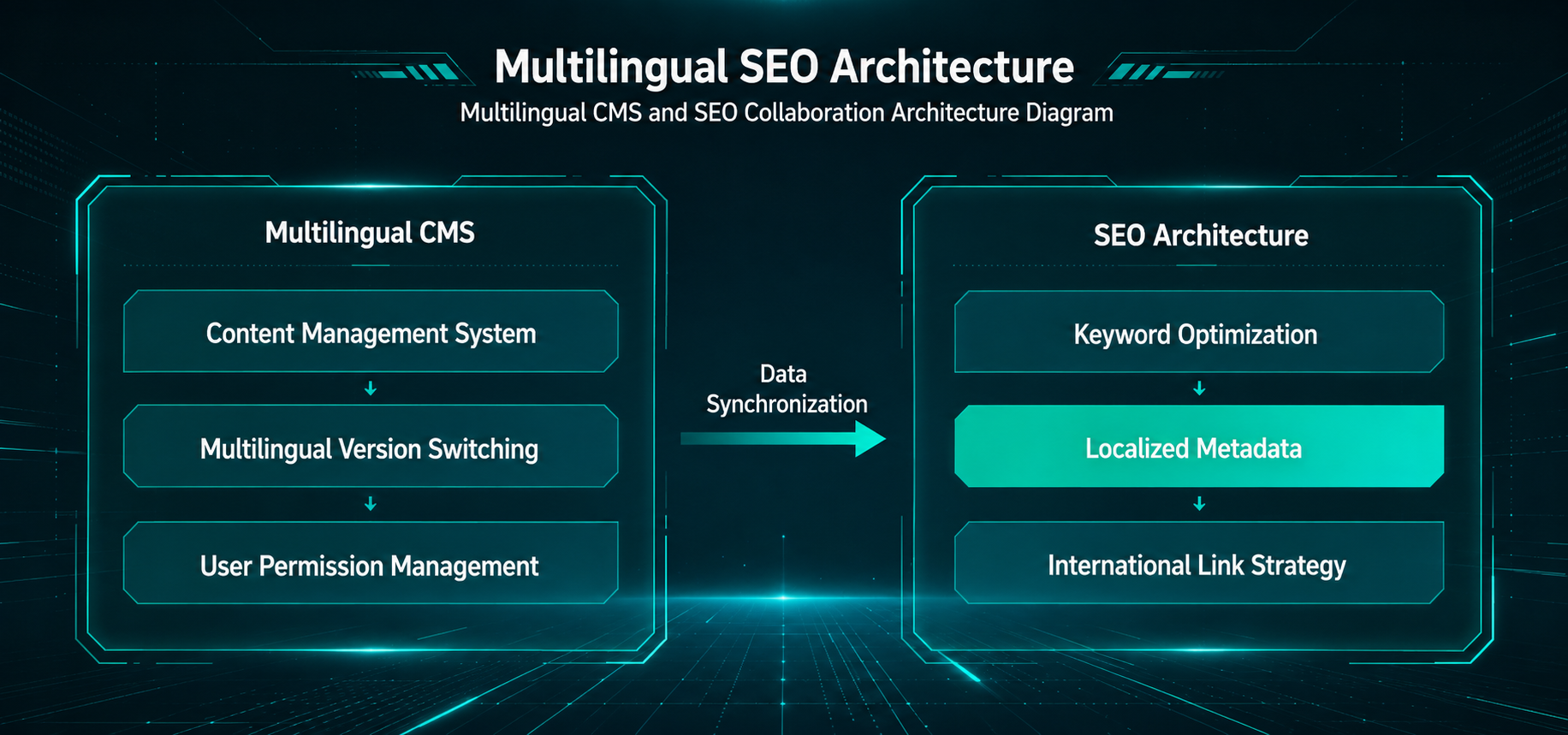
When many export-oriented or global companies build their first website, they often prioritize page design, English translation, and launch speed. But once the business expands into multiple national markets, problems gradually emerge: multilingual content updates become inconsistent, URL structures become messy, SEO titles and descriptions are missing, regional teams cannot maintain content independently, and search engines may struggle to understand the relationship between different language or regional versions. These issues can affect indexing, visibility, and click-through performance.
This is why companies need to reassess their multilingual website CMS platform. Google Search Central notes that if a website provides content for different languages, countries, or regions, it can use multi-regional and multilingual site optimization, including hreflang or sitemaps, to help Google understand the relationship between different language or regional versions.
Therefore, when building a global website, the question should not simply be “which backend is easy to use?” Instead, companies should ask whether the CMS can support stable URLs, hreflang, canonical tags, sitemaps, SEO fields, translation workflows, regional permissions, and publishing governance.
2. SEO-Friendly Technical Requirements for Multilingual Websites
A website system suitable for global SEO must first make content understandable to search engines. A basic page editor can publish content, but it may not support language-version relationships, regional permissions, translation workflows, hreflang management, structured data, or long-term SEO monitoring.
A multilingual website CMS platform should prioritize the following capabilities:
1. Clear URL Structure
- Each language and regional page should have a stable, crawlable, independent URL, such as /en-us/, /de-de/, or /fr-fr/.
- Do not rely only on automatic redirects, cookies, or scripts to switch language versions.
2. hreflang Management
- The CMS should support automatic or semi-automatic maintenance of relationships between language versions to reduce manual omissions.
- Google explains that hreflang helps it understand localized variants of a page.
3. Independent SEO Fields
- Each language page should allow independent editing of title, description, canonical, Open Graph information, and structured content.
4. XML Sitemaps
- XML sitemaps can be split by language or region, or they can indicate different language / regional versions inside the sitemap.
- As multilingual page volume grows, sitemaps need clear language or regional organization so search engines can discover pages efficiently.
5. Page Performance and Mobile Experience
- Global loading speed, image optimization, component loading, and mobile experience all affect overseas user engagement and conversion.
From this perspective, CMS recommendations for global websites should not focus only on template quantity. They should evaluate whether the system can support the underlying rules of international SEO.
3. How an Enterprise CMS Should Support Content Localization
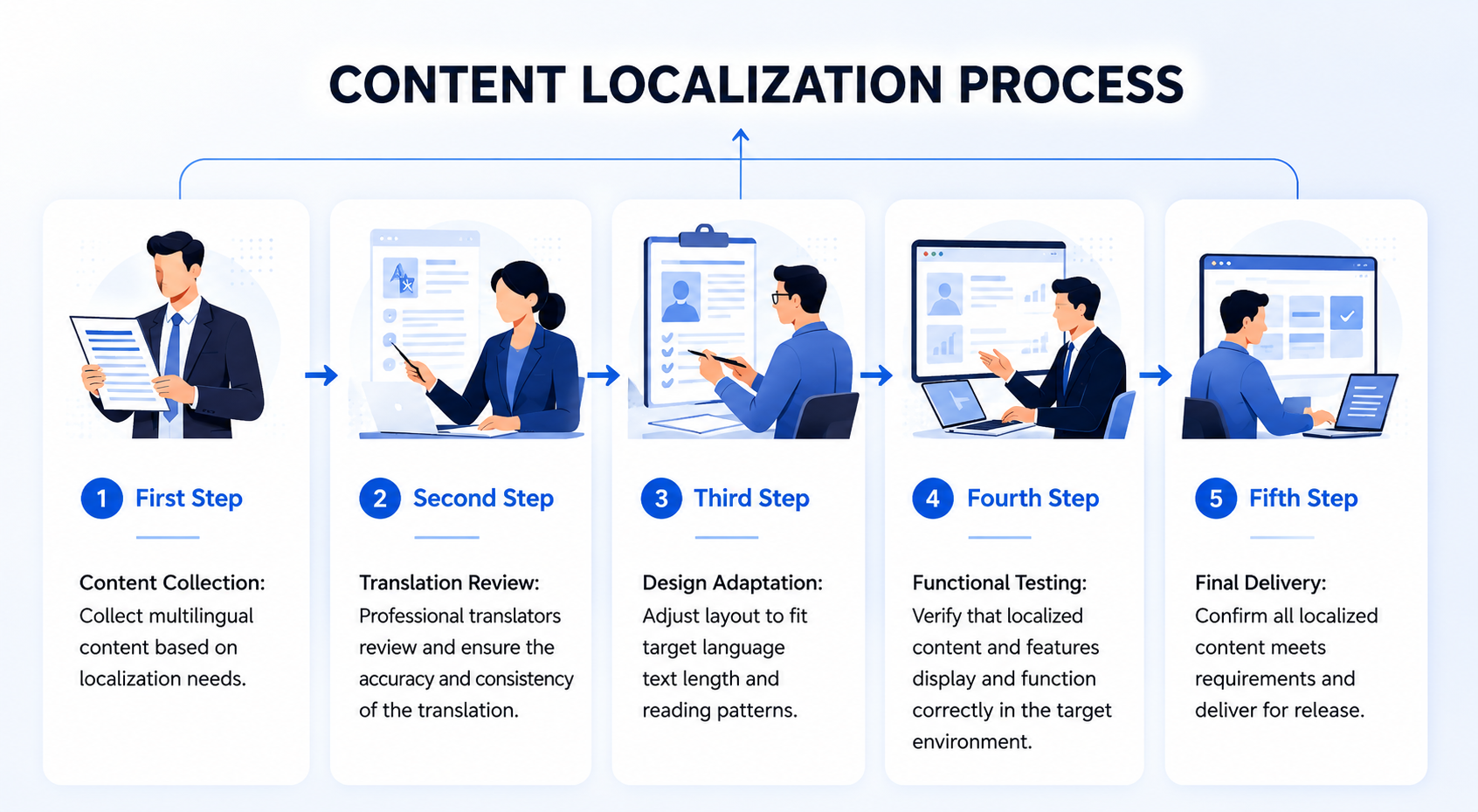
A multilingual website is not just a translation project. It is a system involving language-version structure, regional content differences, SEO signals, localized assets, approval workflows, and long-term content governance. A product page may need different case studies, certifications, CTAs, and FAQs for different markets. If the CMS can only copy pages and rely on manual edits, content can quickly become disorganized.
A multilingual website CMS platform that truly fits enterprise needs should support an operating model of “central governance + regional localization.”
For example:
- Headquarters maintains the primary-language pages and core brand information
- Regional teams adjust content for local markets
- Translation teams manage language versions
- SEO teams review keywords, titles, and page structure
- Management or brand teams control final publishing
Adobe Experience Manager’s Multi Site Manager and Translation capabilities can be used together. Through Live Copy, language copies, and translation projects, AEM supports content reuse and localized variation management across regions for multi-country and multilingual website operations.
The difference between an enterprise CMS platform and a basic website builder is that the former focuses on multilingual content models, permission governance, component reuse, translation workflows, SEO structure, and system integration, while the latter focuses more on one-time page publishing.
4. From Page Editing to Multi-Region Content Governance
For multilingual websites, companies often underestimate governance costs. When there are only English and Chinese pages, manual maintenance may still be manageable. But once the site expands to more than five markets, multiple product lines, and multiple regional teams, content versions, permissions, approvals, and update frequency all become more complex.
The value of a multilingual website CMS platform lies in embedding content governance into the backend workflow.
A mature corporate website CMS system should at least include:
1. Permission Layers
- Headquarters can manage global templates and brand content.
- Regional teams maintain only the languages or markets assigned to them.
- External agencies can access only authorized content scopes.
2. Version Management
- Record page revision history.
- Support rollback to previous versions.
- Prevent incorrect content from being published directly to overseas sites.
3. Approval Workflows
- Separate responsibilities for content editing, translation, SEO review, brand review, and publishing approval.
- Reduce publishing errors and inconsistent brand messaging.
4. Content Reuse
- Reuse product specifications, brand introductions, certifications, and case-study modules.
- Avoid maintaining the same content repeatedly across every language site.
Adobe Experience Manager Sites states that it helps enterprises scale website experiences across brands, regions, and languages while balancing consistency with local flexibility on a shared foundation.
Therefore, when selecting a corporate website CMS platform, companies should not only ask whether it “supports multiple languages.” They should ask whether it supports multilingual governance.
5. Key Capabilities to Evaluate When Choosing a CMS

When evaluating a multilingual website CMS platform, companies can assess six dimensions: SEO structure, content models, localization workflows, component-based editing, system integration, and long-term governance.
1. SEO Compatibility
- Does it support language URLs, hreflang, canonical tags, sitemaps, meta fields, structured data, and page performance optimization?
2. Multilingual Content Models
- Can it define unified content models for product pages, industry pages, case studies, and related content while supporting language-version relationships?
3. Localization Workflows
- Does it support translation workflows, regional edits, approval and publishing processes, and content synchronization?
4. Component-Based Editing
- Can marketing teams create pages with standard components instead of relying on developers every time?
5. System Integration
- Can it connect with CRM, CDP, analytics, DAM, PIM, or eCommerce platforms so the website becomes part of the full marketing and sales journey?
6. Long-Term Maintainability
- Does it support permissions, versioning, auditing, content rollback, and multi-team collaboration?
If a company only needs a simple brochure website, a lightweight CMS may be enough. But if the goal is to build a multi-country, multilingual, multi-product-line global marketing website, enterprise CMS recommendations should prioritize governance, scalability, and SEO structure.
In other words, a multilingual website CMS platform is not just a backend tool. It is infrastructure that connects content localization, international SEO, regional team collaboration, brand governance, and overseas lead generation.
6. Conclusion
Competition in global website SEO is not only about keywords. It is also about content management capability. If a company cannot reliably maintain multilingual pages, configure search signals correctly, update regional content quickly, and continuously optimize conversion paths, it will be difficult to gain long-term organic traffic and overseas leads even if the website looks visually impressive.
Therefore, a multilingual website CMS platform should be treated as a core decision in global website development. It determines whether a company can efficiently manage content across languages, whether search engines can correctly understand page versions, whether headquarters and regional teams can collaborate effectively, and whether the website can evolve from a brochure site into a global marketing asset.
If you are evaluating a multilingual website CMS, a corporate website CMS platform, or CMS options for global website development, you are welcome to learn more about our enterprise website and CMS implementation services. You can also visit Contact Us to discuss your language versions, target markets, and SEO website planning with our consulting team.
Related Reading
- 5 Localization Strategies for Global Websites and the Complete Guide to CMS Selection
Useful for understanding how multilingual websites evolve from translation to localized operations. - Global CMS Platform Comparison: Best Enterprise Solutions for Overseas Websites
Useful for comparing the selection logic behind enterprise-grade overseas website platforms. - How to Choose a CMS for Global Websites: Platform Comparison & Guide
Useful for continuing to evaluate different platform routes such as WordPress, Shopify, AEM, and Magnolia.
Related Articles

Enterprise AI MarTech Trends Analysis 2024-2029 Outlook Report
From AI content productivity tools to a core engine for revenue growth and marketing transformation
*The PDF will be sent directly to your inbox.
Email Error
Please enter a valid email address.
Thank You!
The whitepaper has been sent to your inbox. If you don’t see it, please check your spam or promotions folder.