
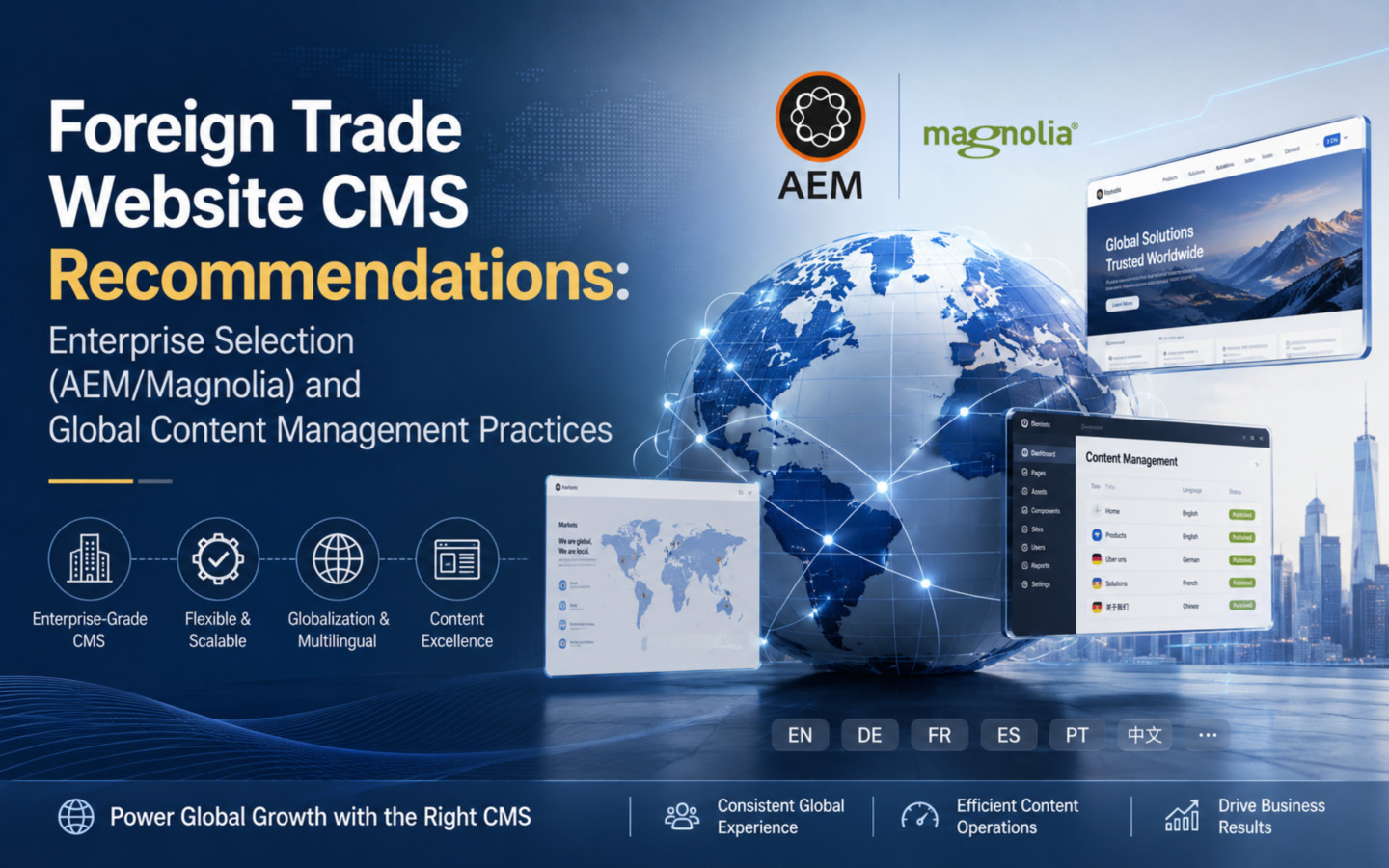
Best CMS for Global B2B Sites: AEM vs Magnolia Enterprise Content Management
AEM Sites, B2B Marketing, Content Management System (CMS), Magnolia CMS
9 May 2026
- Introduction: Why Export Companies Are Re-evaluating CMS Selection
- Core Criteria for Best CMS for Global B2B Website
- AEM vs Magnolia: Positioning Differences Between Two Enterprise CMS Platforms
- Key Content Management Capabilities for Global B2B Website Building Scenarios
- Which Enterprises Suit AEM: From Platform Capability to Implementation Collaboration
- Which Enterprises Suit Magnolia: Balancing Flexible Architecture with Development Efficiency
- How Enterprises Should Approach CMS Selection and Deployment Planning
- Conclusion
- Introduction: Why Export Companies Are Re-evaluating CMS Selection
- Core Criteria for Best CMS for Global B2B Website
- AEM vs Magnolia: Positioning Differences Between Two Enterprise CMS Platforms
- Key Content Management Capabilities for Global B2B Website Building Scenarios
- Which Enterprises Suit AEM: From Platform Capability to Implementation Collaboration
- Which Enterprises Suit Magnolia: Balancing Flexible Architecture with Development Efficiency
- How Enterprises Should Approach CMS Selection and Deployment Planning
- Conclusion
1. Introduction: Why Export Companies Are Re-evaluating CMS Selection
In the past, many companies building overseas websites focused primarily on page design, launch speed, and basic display functionality. However, as Going Global, Lead Generation, Multilingual operations, and Content Governance requirements continue to grow, the CMS is no longer just a “website backend”—it has become the core infrastructure that determines whether a global website can scale sustainably.
Especially with the expansion of brand portfolios, the increase in country-specific sites, and the need for cross-regional content team collaboration, enterprises realize that the real issue is not “can the website be built,” but “can it be continuously managed, quickly updated, and broadly expanded.” This is why more and more companies are re-evaluating Best CMS for Global B2B Website: choosing the right platform affects not only the website experience but also content efficiency, marketing collaboration, and the upper limit of future digital capabilities.
2. Core Criteria for Best CMS for Global B2B Website
When discussing Best CMS for Global B2B Website, enterprises should not look only at price or feature lists, but return to the business scenario itself. For most companies going global, at least the following dimensions should be considered.
Multilingual and Multi-Country Site Capabilities
- Does it support unified management of main sites, Regional sites, and language sites
- Can it maintain Localization flexibility while sharing templates
- Does it facilitate Headquarters governance and Regional team collaboration
Content Governance and Publishing Efficiency
- Does it support Modular content reuse
- Can it reduce cross-team editing and approval costs
- Is it suitable for continuous operations rather than one-time Delivery
Architecture Scalability
- Is it easy to integrate with CRM, CDP, marketing automation, and e-commerce platforms
- Does it support Headless, API-first, or hybrid Delivery
- Can it adapt to future expansion into new markets and business lines
Implementation and Service Capabilities
- The platform itself matters, but the implementation team is equally critical
- Enterprises often also need to consider template planning, SEO, Performance, Permissions, and training
Therefore, a truly valuable Best CMS for Global B2B Website recommendation must be a comprehensive assessment of “platform capability + business fit + implementation service.”
3. AEM vs Magnolia: Positioning Differences Between Two Enterprise CMS Platforms
From an enterprise platform perspective, both AEM and Magnolia are suitable for complex websites and multi-site operations, but the organizational stages and management styles they best fit are not exactly the same.
AEM
AEM leans more toward large enterprises and mature groups. Its strengths lie in a complete Content Governance framework, Integration capabilities with the Adobe ecosystem, and support for complex organizational collaboration. For enterprises emphasizing unified brand experience, cross-regional governance, marketing collaboration, and long-term scalability, AEM is often more suitable as a global website platform. Therefore, in many high-standard projects, companies also pay attention to the industry experience of Adobe AEM Service Providers, because platform capabilities can only realize their full value with the right Implementation methodology and content Architecture design. For enterprises with long-term digital planning, Adobe AEM Development is not just about frontend and backend configuration—it also involves template systems, content models, component governance, and operational process design.
Magnolia
Magnolia emphasizes flexibility, openness, and composable Architecture, making it suitable for enterprises that want a high degree of freedom in planning frontend and backend Integration. For organizations with mature technical teams that want to control Development pace and system Integration methods, Magnolia is a direction worth serious evaluation. Many projects entering the technical planning phase also pay special attention to experience in Magnolia CMS Development, because it usually relies more on the Development team's control over Architecture and Integration approaches.
From this perspective, Best CMS for Global B2B Website is not simply answering “Is AEM better or is Magnolia better,” but rather answering: which platform better suits your international operation model, organizational structure, and long-term investment strategy.
4. Key Content Management Capabilities for Global B2B Website Building Scenarios
For most enterprises, the website is not just a display page—it is the core hub for brand, product, content marketing, and Inquiry Conversion. Therefore, in Global B2B Website Building scenarios, the value of the CMS is amplified.
A CMS truly suitable for Global B2B Website Building typically needs the following capabilities:

Unified Content Model
Provides clear structure for product pages, industry pages, solution pages, and case pages, facilitating Multilingual reuse and scalability.

Modular Component Management
Different country sites can share components and templates, reducing redundant construction while preserving space for localized content.

Governable Permissions and Processes
Headquarters, Regional markets, and external agencies need clear division of responsibilities; otherwise, content quality and brand consistency will quickly get out of control.

SEO and Performance Collaboration
Export websites are oriented toward search-driven customer acquisition. The CMS is not just an editing tool—it must also support good page structure, content Delivery, and technical optimization.
This is why many enterprises, when evaluating Best CMS for Global B2B Website, ultimately focus on “global content management capability” rather than just “whether the backend is easy to use.”
5. Which Enterprises Suit AEM: From Platform Capability to Implementation Collaboration
AEM is better suited for enterprises that have entered the multi-brand, multi-market, or multi-team collaboration stage. Especially when Headquarters wants to unify governance of templates, components, content standards, and publishing mechanisms, AEM’s advantages become more pronounced.
Typical scenarios suitable for AEM:
Global Website and Multiple Regional Sites Operating in Parallel
Need unified management of brand sites in different countries/regions, maintaining content consistency while supporting localized operations.
Headquarters Needs Unified Brand and Content Standards
Emphasizes brand consistency and compliance, requiring centralized governance of content standards, visual standards, and publishing processes.
Integration with Adobe Ecosystem or MarTech Systems
Already using or planning to use Adobe Analytics, Target, Marketo, and other tools, requiring deep data and content linkage.
High Requirements for Security and Long-term Evolution
Enterprise-grade security compliance, Permissions management, version control, and future-oriented digital capability expansion.
In such projects, enterprises usually evaluate not only the product but also whether Adobe AEM Service Providers understand export business, global content Architecture, and Implementation governance. Because the success of an AEM project often does not lie in “can it be developed,” but in whether Adobe AEM Development is designed around future operations. Good Implementation approaches should enable marketing teams to continuously produce content, rather than re-depend on technical teams for every redesign.

6. Which Enterprises Suit Magnolia: Balancing Flexible Architecture with Development Efficiency
Magnolia’s strengths lie in openness, flexibility, and relatively lightweight composability. For enterprises that want to use the CMS as a content hub while connecting to other business systems, it provides a high degree of technical freedom.
Typical scenarios suitable for Magnolia:
Mature Enterprise Technical Team Capable of Leading Architecture Planning
Possesses strong technical capabilities and wants to autonomously control system Architecture, Integration methods, and Development pace.
Desire for Flexible Integration of Frontend Frameworks and Business Systems
Needs to connect multiple third-party systems and custom frontends, pursuing freedom in technology stack and compositional flexibility.
Complex Website Structure But Not Necessarily Requiring Adobe Ecosystem
Has complex content management needs but is not deeply tied to the Adobe product ecosystem, pursuing an open and neutral platform.
Greater Emphasis on Customization Space and Long-term Controllability
Wants source code control, to avoid Vendor Lock-in, and pursues long-term technical autonomy and cost controllability.
However, Magnolia’s flexibility does not mean the project is naturally simple. Truly mature Magnolia CMS Development still requires clear content model design, component standards, and Multilingual governance thinking. Especially when enterprises move from a single site to multiple sites, whether the experience in Magnolia CMS Development is sufficient will directly affect subsequent maintenance costs and scalability.

7. How Enterprises Should Approach CMS Selection and Deployment Planning
From a practical perspective, the best way to approach Best CMS for Global B2B Website is not to first ask “which one to choose,” but to complete the following three steps:
First Define Business Complexity
- Are you a single brand or a multi-brand group
- Are you building a single site or multi-country Multilingual sites
- Does the website need to support content marketing, Lead Generation, and system Integration
Then Assess Organizational Capability
- Is the content team mature
- Does the IT team have long-term maintenance capability
- Do you need more standardized governance or a high-freedom Architecture
Finally Evaluate Implementation Partners
- Do they have experience with international sites and enterprise-level CMS projects
- Can they simultaneously understand content, SEO, Architecture, and operations
- Can they translate platform selection into an executable Implementation roadmap
Many enterprises will eventually find that the key to Best CMS for Global B2B Website is not just technical selection, but finding a content management approach that fits the enterprise’s stage. Choosing the right platform turns the website into a global growth asset; choosing the wrong one makes every subsequent expansion a high-cost rebuild.
8. Conclusion
For enterprises planning to upgrade their overseas websites, the CMS is not an isolated technical decision, but a long-term foundation for Going Global, Content Governance, and global operations. AEM is more suitable for enterprises emphasizing standardized governance, group collaboration, and ecosystem Integration; Magnolia is more suitable for teams pursuing flexible Architecture and strong technical autonomy. Returning to the business itself, a truly valuable Best CMS for Global B2B Website recommendation should be built upon the enterprise’s organizational capabilities, market layout, and future expansion goals.
If you are evaluating whether AEM or Magnolia is right for your international website project, we welcome you to learn more about our related solutions and Implementation experience. You can also visit the Contact Us page to discuss your Website Building goals, platform selection, and global content management planning path with our consulting team.
Further Reading
- Enterprise CMS Platform Selection Guide: International Website CMS Comparison for Overseas Corporate Website Construction
- Overseas Export Website Building Is Not Just About Making a Website: How Professional CMS Supports Multilingual and Multi-Country Operations
- How to Choose a CMS for Export Website Building? In-depth Comparison and Selection Recommendations for Mainstream Overseas Website Building Platforms
Related Articles
Enterprise AI MarTech Trends Analysis 2024-2029 Outlook Report
From AI content productivity tools to a core engine for revenue growth and marketing transformation
*The PDF will be sent directly to your inbox.
Email Error
Please enter a valid email address.
Thank You!
The whitepaper has been sent to your inbox. If you don’t see it, please check your spam or promotions folder.