
AEM and Adobe Analytics Integration: Building a Content Marketing Data Loop
Adobe Analytics, Adobe Experience Cloud, AEM Sites, Content Management System (CMS), MarTech, Website Analytics
10 June 2026
- What is the AEM and Adobe Analytics content marketing loop?
- An integrated approach: from page publishing to behavioral feedback
- How to design a content data model
- How the integrated content marketing loop works
- Implementation path: technology, teams, and governance
- Common pitfalls and optimization recommendations
- Conclusion
- Further Reading
- What is the AEM and Adobe Analytics content marketing loop?
- An integrated approach: from page publishing to behavioral feedback
- How to design a content data model
- How the integrated content marketing loop works
- Implementation path: technology, teams, and governance
- Common pitfalls and optimization recommendations
- Conclusion
- Further Reading
Summary
This article explains how AEM and Adobe Analytics integration helps enterprises upgrade content marketing from a publishing-driven model to a data-feedback-driven model. Unlike basic website analytics, it focuses on how content teams can plan pages, components, and content hypotheses in AEM, capture user behavior through Adobe Analytics, and build a continuous loop of content publishing, behavioral analysis, optimization, and re-publishing.

1. What is the AEM and Adobe Analytics content marketing loop?

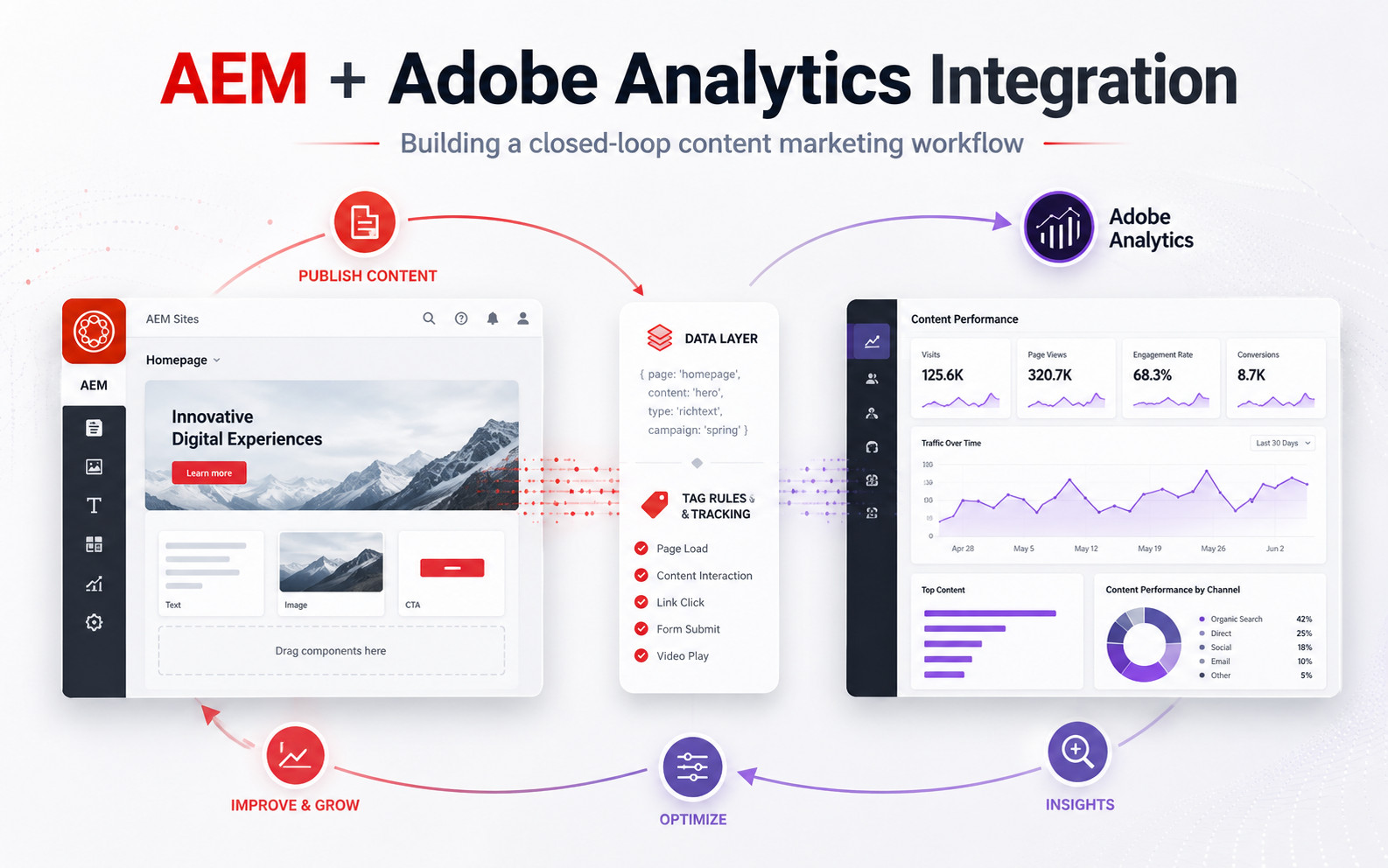
For many companies, the core challenge in content marketing is not a lack of content, but the lack of a feedback mechanism after content is published. AEM and Adobe Analytics integration connects pages, components, and content attributes in AEM to Adobe Analytics through a data layer and tag rules, so teams can analyze content performance and guide the next round of optimization. Marketing teams continuously produce blogs, product pages, industry solution pages, and campaign pages, yet often struggle to determine which content actually drives engagement, leads, and conversions. Data teams can see traffic, but content teams may not be able to translate that data into concrete optimization actions.
AEM and Adobe Analytics integration means mapping the pages, components, and content types managed in AEM to the events, dimensions, and metrics in Adobe Analytics, allowing content publishing results to be continuously measured, compared, and optimized. Adobe documentation notes that AEM as a Cloud Service can create Analytics configurations through the Touch UI and configure the Adobe Analytics extension through Adobe Experience Platform Tags (formerly Adobe Launch) to track website activity. This shows that a formal data connection can be established between content management and behavioral analytics.
This approach can also be understood as the core goal of Adobe Analytics and AEM integration: making every content release verifiable through data rather than relying only on experience or assumptions.
2. An integrated approach: from page publishing to behavioral feedback
AEM and Adobe Analytics integration is not simply adding tracking code to a website. It connects content structure, user behavior, analytics metrics, and optimization actions into a complete content operations workflow. Enterprises need to map pages, templates, components, and content types in AEM to events, dimensions, and metrics in Analytics.
For example, a solution page should not track page views alone. It should also answer questions such as:
- Whether users scroll to key content modules
- Whether they click product CTAs
- Whether they download white papers or case studies
- Whether they move from a content page to an inquiry or quotation page
Technically, AEM and Adobe Analytics integration usually involves AEM site configuration, Adobe Experience Platform Tags (formerly Adobe Launch) properties, the Adobe Analytics extension, Adobe Client Data Layer design, and event rules. Adobe documentation also notes that integration between AEM as a Cloud Service and Adobe Analytics requires IMS authentication, and that variable mapping configurations from legacy frameworks should be rebuilt in Adobe Experience Platform Tags.
This means the project cannot be treated as a front-end development task alone. Content, data, technical, and marketing teams must jointly define which behaviors are worth tracking, which metrics reflect content value, and which data can guide the next optimization step.
3. How to design a content data model

To make the content marketing loop truly work, the first step is to design a content data model. In other words, enterprises need to define what content is worth measuring before they begin tracking data.
We recommend planning across four levels:

1. Page level
- Product pages
- Solution pages
- Industry pages
- Case study pages
- Blog articles
- Campaign landing pages

2. Component level
- Hero banners
- Product recommendation modules
- Customer case modules
- CTA buttons
- Form entry points
- Download sections

3. Behavior level
- Scroll depth
- Time on page
- CTA clicks
- Video plays
- Form submissions
- Download actions

4. Business level
- Lead generation
- Content-assisted conversion
- High-intent behavior identification
- Content performance comparison across markets
Once these levels are designed consistently, AEM and Adobe Analytics integration can help content teams answer more specific questions. The focus shifts from “Does this article have traffic?” to “Does this type of content encourage the next action?”
4. How the integrated content marketing loop works
AEM and Adobe Analytics integration is well suited for building a new way of working with content: every content launch is not just a publication, but a measurable experiment.
A complete loop usually includes five steps:
Step 1: Content hypothesis
The content team first defines a hypothesis, such as “Industry solution pages are more likely to drive inquiries than generic product pages.”
Step 2: Page and component design
Teams design the page structure in AEM and clarify key modules, CTAs, and conversion paths.
Step 3: Behavior tracking
After completing the Adobe Client Data Layer, Tags rules, and Analytics variable configuration, Adobe Analytics records traffic sources, scroll depth, click behavior, download actions, and form submissions.
Step 4: Performance analysis
Teams analyze the performance of different pages, components, and content topics to identify what truly drives engagement and conversion.
Step 5: Optimization iteration
Teams return to AEM to adjust headlines, structure, CTAs, case placement, or content depth, then enter the next round of observation.
This model is different from a traditional monthly reporting review. It functions more like a continuous optimization mechanism, helping content production move from editorial experience to data-backed evidence.
5. Implementation path: technology, teams, and governance
When enterprises move forward with AEM and Adobe Analytics integration, they should not start with tool configuration. They should start with content operations goals.
1. Define content goals first
- Is the content intended to improve brand awareness?
- Is it intended to increase product inquiries?
- Or is it meant to support sales education and customer nurturing?
2. Then design the data layer
- How should page types be named?
- How should content topics be categorized?
- How should CTAs be tagged consistently?
- How should forms and downloads be recorded?
3. Configure tracking and reporting
- Manage rules through Adobe Launch
- Create content performance reports in Analytics
- Separate page metrics, component metrics, and conversion metrics
4. Establish an operating rhythm
- Review priority content every two weeks
- Evaluate content topic performance every month
- Optimize page templates and component strategies every quarter
During this process, companies often need to evaluate the capabilities of both the AEM implementation partner and the Adobe Analytics implementation partner. The former must understand content models, component governance, and publishing workflows, while the latter must understand metric frameworks, event tracking, and report design. Without collaboration between the two, integration can easily become “technically connected but unused by the business.”
6. Common pitfalls and optimization recommendations
Many companies complete AEM and Adobe Analytics integration but still fail to create a content marketing loop. Common reasons include:
Tracking pages but not components
Looking only at page visits makes it difficult to determine which content module actually influences conversion.
Creating reports but not content actions
If reports do not lead back to content adjustments in AEM, a closed loop cannot be formed.
Tracking too many metrics that teams do not use
At the beginning, teams should focus on a small number of key metrics, such as core CTA clicks, downloads, forms, and content-assisted conversions.
Content teams cannot understand data language
Analytics reports should be translated into content questions, such as whether the headline is effective, whether cases should appear earlier, or whether the CTA is clear.
No continuous optimization mechanism
The value of Adobe Analytics services is not limited to launch configuration. They should help enterprises establish metric naming, event governance, report interpretation, and continuous optimization mechanisms to keep identifying content opportunities and conversion bottlenecks.
We recommend dividing the integration project into two layers. The first layer completes data collection and reporting foundations. The second layer establishes a content review mechanism so that marketing, content, and analytics teams can act around the same set of metrics.
7. Conclusion
Competition in content marketing has shifted from “who publishes more content” to “who can understand faster whether content is effective.” AEM is responsible for content production, governance, and publishing, while Adobe Analytics handles behavioral data collection, analytics reporting, and conversion path insights. If A/B testing or personalization is required, Adobe Target can be added. If unified customer profiles are needed, CDP can also be integrated.
Therefore, the true value of AEM and Adobe Analytics integration is not just another data dashboard. It gives content teams a verifiable basis for decision-making. For companies operating multilingual websites, industry content, product pages, and global marketing campaigns, this closed-loop capability directly affects content efficiency, lead quality, and long-term growth performance.
If you are evaluating AEM content architecture, an Adobe Analytics measurement framework, or the integration path between the two, you are welcome to learn more about our AEM Sites and Adobe Analytics implementation services. You can also visit Contact Us to discuss your content marketing closed-loop design with our consulting team.
8. Further Reading
- Website Analytics Optimization: Adobe Analytics to CDP for Growth Loop
Suitable for understanding how website behavior data can become part of a broader conversion and growth framework. - How to Choose an Enterprise Data Analytics Partner: Adobe Analytics to CDP
Suitable for further understanding implementation capabilities, data governance, and service provider evaluation in Adobe Analytics projects. - Best CMS for Global B2B Sites: AEM vs Magnolia Enterprise Content Management
Suitable for understanding the role of AEM in enterprise content management from a CMS platform selection perspective.
Related Articles

Enterprise AI MarTech Trends Analysis 2024-2029 Outlook Report
From AI content productivity tools to a core engine for revenue growth and marketing transformation
*The PDF will be sent directly to your inbox.
Email Error
Please enter a valid email address.
Thank You!
The whitepaper has been sent to your inbox. If you don’t see it, please check your spam or promotions folder.