AEM MSM & i18n: Best Practices for Global Enterprise Websites
AEM Sites, Content Management System (CMS)
25 May 2026
- Introduction: Content Governance Challenges for Global Enterprises
- Common Management Issues for Multi-Site, Multi-Language Enterprises
- What is AEM MSM (Multi-Site Manager)?
- Core Concepts: How Blueprint and Live Copy Work
- AEM Multi-Language (i18n) Design and Structure Strategy
- The Role and Limitations of Machine Translation in Enterprises
- Best Practices for Multi-Site Governance
- Conclusion: Building a Scalable Global Content Operations System
- Introduction: Content Governance Challenges for Global Enterprises
- Common Management Issues for Multi-Site, Multi-Language Enterprises
- What is AEM MSM (Multi-Site Manager)?
- Core Concepts: How Blueprint and Live Copy Work
- AEM Multi-Language (i18n) Design and Structure Strategy
- The Role and Limitations of Machine Translation in Enterprises
- Best Practices for Multi-Site Governance
- Conclusion: Building a Scalable Global Content Operations System
1. Introduction: Content Governance Challenges for Global Enterprises
As enterprises expand globally, marketing teams often face a thorny challenge: how to manage massive website groups spanning dozens of countries, supporting multiple languages, while balancing “global brand consistency” with “local flexibility”?
Without standardized management tools, companies often fall into the chaos of “content silos”: headquarters releases new product information, but regional websites update at different speeds; translation work relies on manual copy-pasting, leading to errors; some regional offices even develop their own pages, causing brand image to fragment.
Adobe Experience Manager (AEM) Multi-Site Manager (MSM) and Translation Integration Framework are the standard solutions designed to address these enterprise-level challenges.
2. Common Management Issues for Multi-Site, Multi-Language Enterprises
Before implementing systematic management, global enterprises commonly face the following pain points:
-
High content duplication maintenance costs: The same press release needs to be manually copied to 30 country websites, time-consuming and error-prone.
-
Version inconsistency: Headquarters updates product specifications, but a month later some regional websites still display old information, creating compliance risks.
-
Broken translation workflows: Marketing staff manually export Word files to translation agencies, then manually paste back into the CMS, lacking context and making progress difficult to track.
-
Brand governance out of control: Local teams arbitrarily modify global navigation or brand colors for promotional campaigns.
3. What is AEM MSM (Multi-Site Manager)?
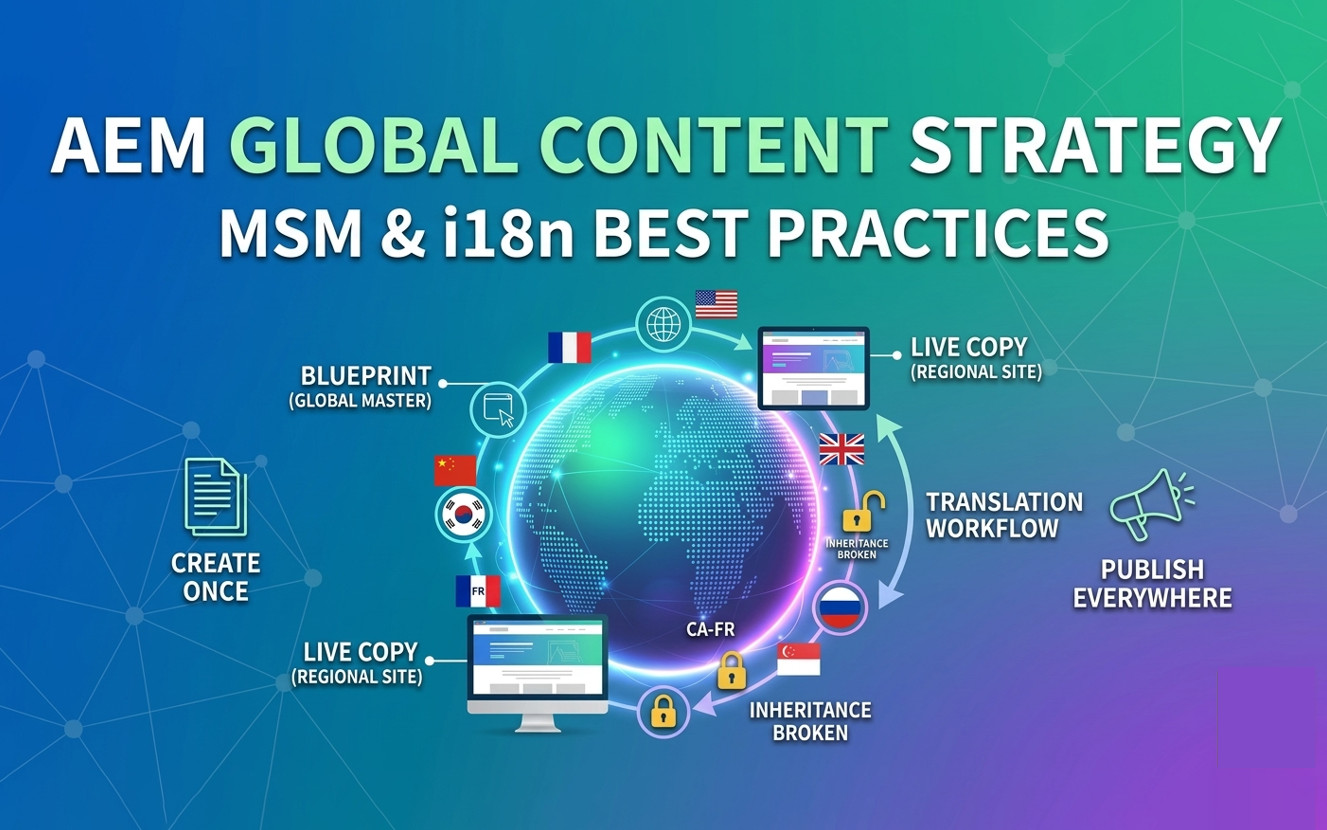
AEM MSM (Multi-Site Manager) is a core functional module of AEM Sites, specifically designed to manage the inheritance relationship between “source content” and “multiple copies.”
Its core value lies in “Create Once, Publish Everywhere” — but here “publish” does not mean simple display, but establishing a website structure with “Live Relationship.” When the source website updates, all connected sub-websites can automatically synchronize updates according to preset rules (Rollout Config), while allowing sub-websites to have some customized content.
4. Core Concepts: How Blueprint and Live Copy Work
To understand MSM, you must grasp the following two key terms:
Blueprint (Source Site)
This is the content's "Single Source of Truth." Usually the enterprise's global English site (Global Master) or specific language master. All content creation happens here.
Live Copy (Child Site)
This is a website extended from Blueprint (e.g., US site, France site). By default it locks and inherits Blueprint content, while allowing local teams to perform localization edits.
Inheritance
Live Copy defaults to locking and inheriting Blueprint content, ensuring global brand consistency.
Break Inheritance
When local teams need to modify a specific area, they can "unlock" that component, disconnect from Blueprint, and perform localization edits.
Rollout (Synchronization)
When Blueprint has new pages or content modifications, through Rollout operations, changes can be pushed to all Live Copies with one click.
5. AEM Multi-Language (i18n) Design and Structure Strategy
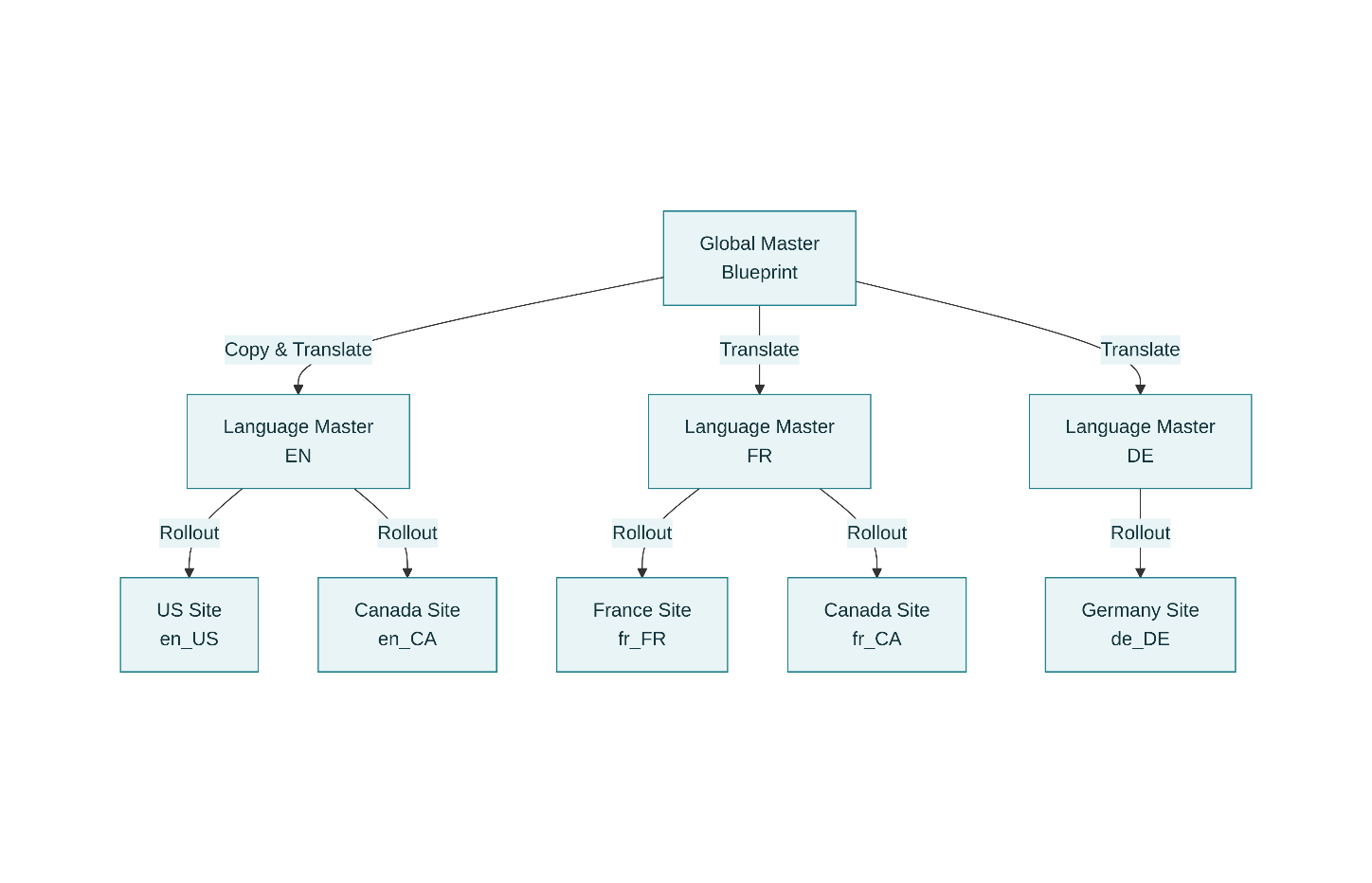
AEM’s multi-language management is not simply translation, but involves rigorous site structure design. Industry-standard recommended structures typically adopt the “Language Masters” strategy.
Standard Structure Example
/content/my-brand/language-masters
/en (English master, content creation source)
/fr (French master, translated from English, serving as source for French-speaking countries)
/es (Spanish master)
/content/my-brand/us/en (US site: Live Copy from /language-masters/en)
/content/my-brand/fr/fr (France site: Live Copy from /language-masters/fr)
/content/my-brand/ca/fr (Canada French site: Live Copy from /language-masters/fr)
This structure ensures translation only needs to be done once (at Language Master level), then distributed to each country’s Live Copy, significantly reducing translation budgets.
6. The Role and Limitations of Machine Translation in Enterprises
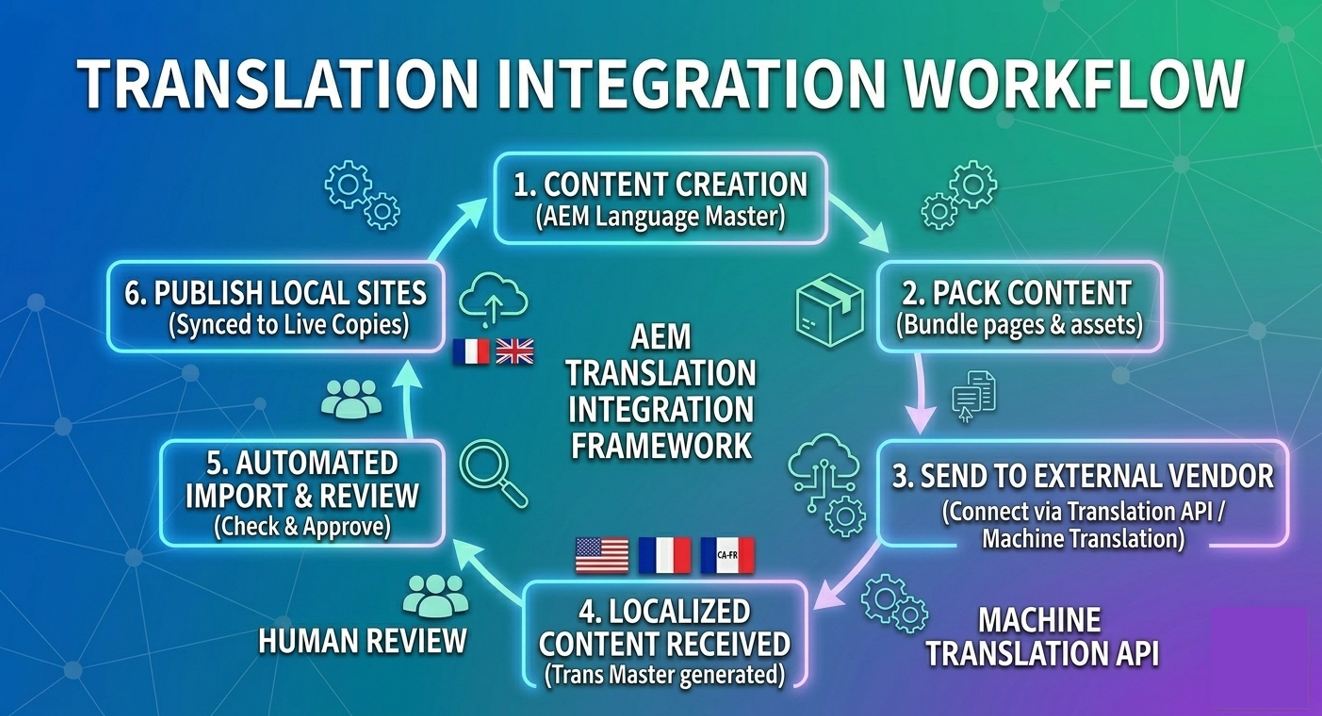
AEM has a built-in Translation Integration Framework that can directly connect to external translation services (such as TransPerfect, Microsoft Translator, SDL, Lionbridge).
-
Role: Suitable for processing large volumes of standardized content (such as product specifications, technical documents), or serving as a “pre-translate” draft before human translation.
-
Limitations: Machine translation struggles to accurately capture marketing copy tone and cultural metaphors.
-
Best Practice: Adopt a “machine translation + human post-editing” model. AEM supports creating Translation Projects, packaging content to send to translation vendors, and automatically writing back to AEM after translation is complete, all without manual copy-pasting.
7. Best Practices for Multi-Site Governance
In large enterprise environments, successful multi-site management usually relies on clear governance strategies. Here are common best practices:
Establish Clear Blueprint Architecture
Define which content is managed by headquarters and which can be modified by regional teams.
Standardize Website Structure
Maintain the same page architecture across different languages, reducing maintenance complexity.
Establish Content Update Workflows
Important content updates need to be synchronized across all markets, with clear publishing processes established.
Manage Translation Versions
Regularly check language synchronization status to avoid large gaps between language versions.
Through these governance strategies, enterprises can keep global websites maintainable and consistent in the long term.
8. Conclusion: Building a Scalable Global Content Operations System
In global competition, content management efficiency directly affects market response speed. AEM MSM and i18n are not just technical features, but strategic assets for enterprises to achieve digital transformation. Through standardized architecture and governance processes, enterprises can significantly reduce operating costs and ensure customers receive consistent, high-quality brand experiences no matter where they are.
If you would like to further evaluate how AEM Sites can help your enterprise integrate global website architecture, or need professional advice on MSM governance models, please contact our consulting team.
👉 Contact Us to discuss your multi-site strategy with our consulting team
Related Articles
Enterprise AI MarTech Trends Analysis 2024-2029 Outlook Report
From AI content productivity tools to a core engine for revenue growth and marketing transformation
*The PDF will be sent directly to your inbox.
Email Error
Please enter a valid email address.
Thank You!
The whitepaper has been sent to your inbox. If you don’t see it, please check your spam or promotions folder.