
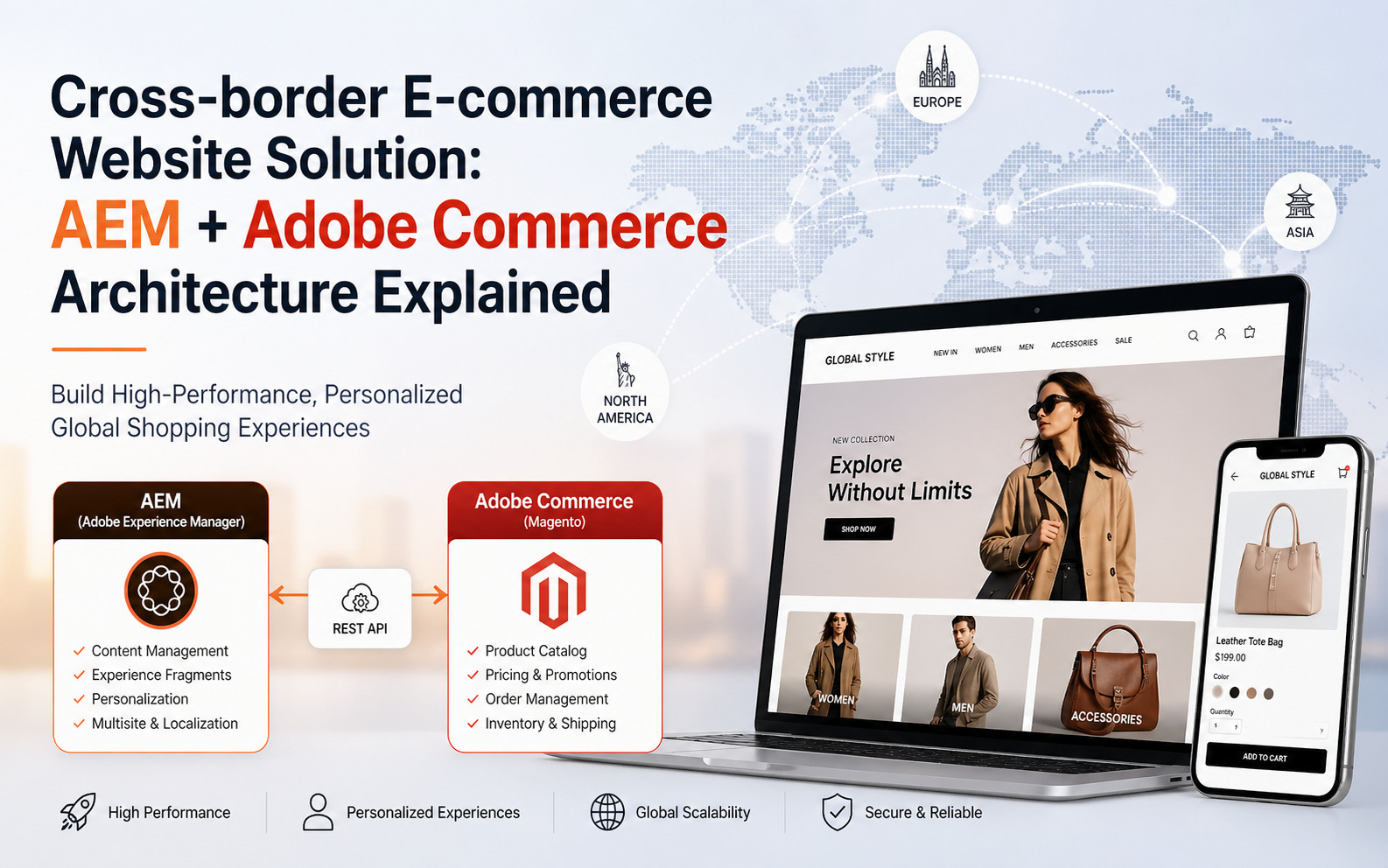
Cross-Border eCommerce Website Solution: Seamless Shopping Experience with AEM Frontend and Adobe Commerce Backend
Adobe Commerce (Magento), AEM Sites, Content Management System (CMS), e-commerce Platforms
2 May 2026
- Why Cross-Border eCommerce Needs a Professional Website Platform
- Limitations of Traditional eCommerce Website Architecture
- Core Architecture of Cross-Border eCommerce Website Solutions
- AEM Frontend: Building Exceptional Digital Experiences
- Adobe Commerce Backend: Powering Complex eCommerce Operations
- Business Value from Frontend-Backend Integration
- Key Capabilities for Global eCommerce Operations
- Future Trends: Convergence of eCommerce and Digital Experience
- Conclusion: Building a Global eCommerce Digital Platform
- Why Cross-Border eCommerce Needs a Professional Website Platform
- Limitations of Traditional eCommerce Website Architecture
- Core Architecture of Cross-Border eCommerce Website Solutions
- AEM Frontend: Building Exceptional Digital Experiences
- Adobe Commerce Backend: Powering Complex eCommerce Operations
- Business Value from Frontend-Backend Integration
- Key Capabilities for Global eCommerce Operations
- Future Trends: Convergence of eCommerce and Digital Experience
- Conclusion: Building a Global eCommerce Digital Platform
1. Why Cross-Border eCommerce Needs a Professional Website Platform
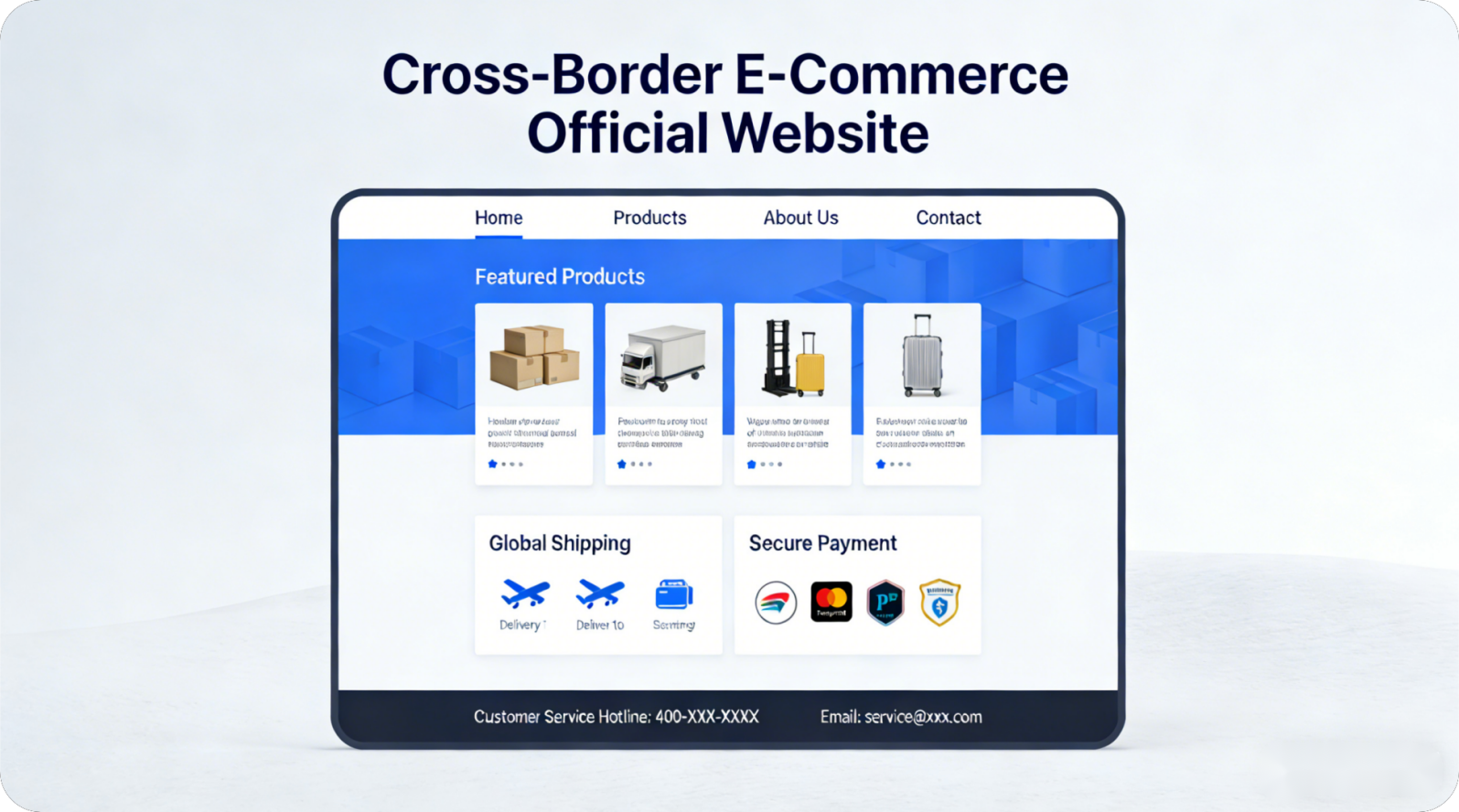
As the global eCommerce market continues to expand, more and more businesses are directly reaching global consumers through cross-border eCommerce. However, many enterprises still rely on traditional eCommerce platforms when entering overseas markets, lacking their own independent eCommerce website.
In reality, a mature cross-border eCommerce website solution can not only help businesses establish brand-owned sites but also enhance customer experience and data control capabilities. Compared to third-party platforms, businesses with their own eCommerce websites have distinct advantages:
-
Complete Brand Display Capability
-
Full Control Over Customer Data
-
More Flexible Marketing Strategies
-
Higher Customer Conversion Potential
Therefore, an increasing number of brands are adopting professional cross-border eCommerce website solutions to build their own global eCommerce platforms.
2. Limitations of Traditional eCommerce Website Architecture
In many traditional eCommerce systems, content management and eCommerce functionality are typically handled by the same system. While this architecture is simple, it gradually reveals limitations in enterprise-level scenarios. For example:
-
Insufficient Content Management Capabilities
-
Lack of Personalization in Website Experience
-
Complex Multi-Country Operations
-
Limited System Scalability
For cross-border eCommerce enterprises, these issues affect the global user experience. Therefore, an increasing number of businesses are adopting modernized cross-border eCommerce website solutions that improve system capabilities through frontend-backend decoupling architecture.
3. Core Architecture of Cross-Border eCommerce Website Solutions
Modern eCommerce platforms typically adopt an “Experience Layer + Commerce Engine” architecture. In this model:
- Frontend experiences are managed by the digital experience platform
- Backend transactions are handled by the commerce system
A typical cross-border eCommerce website solution employs the following technology combination:
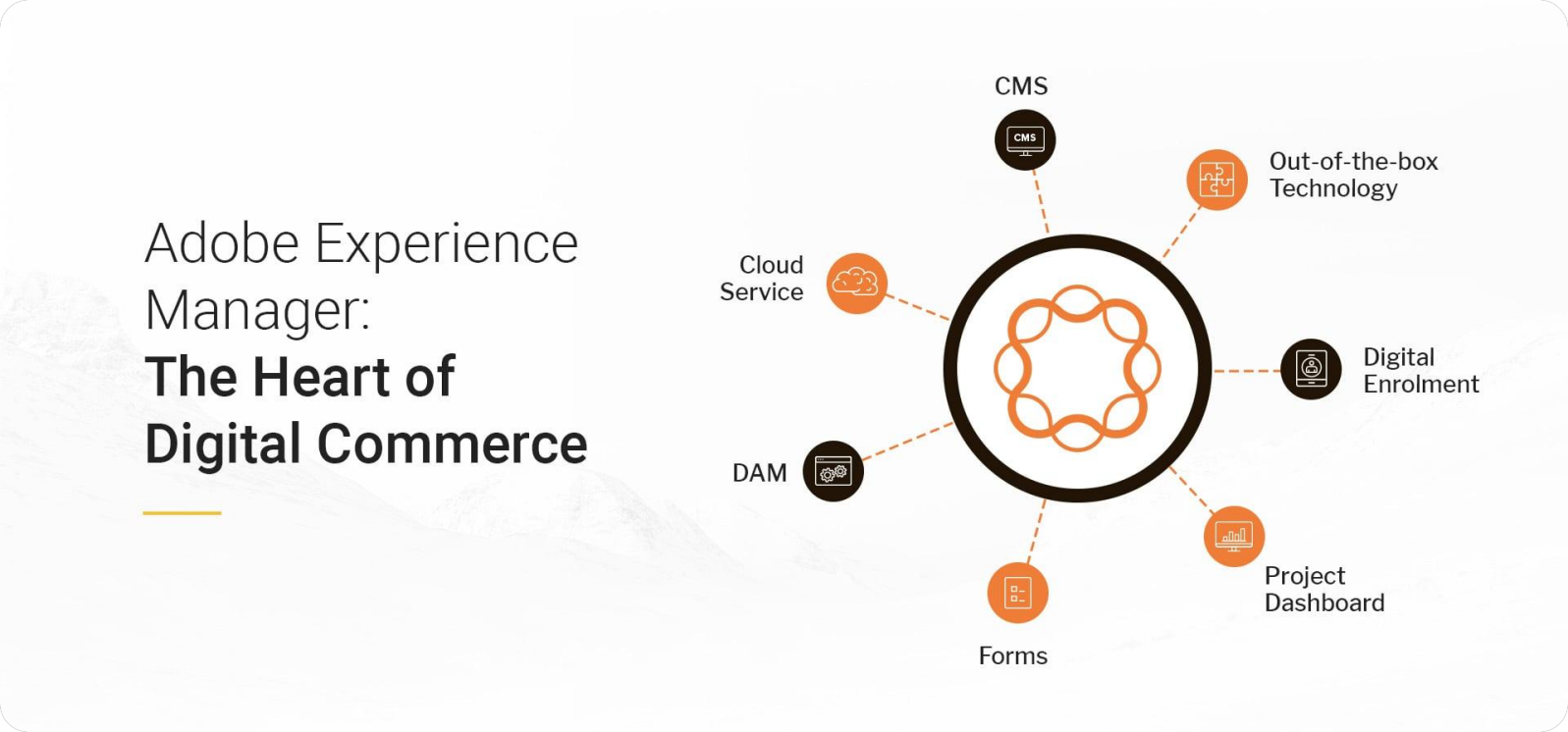
AEM (Adobe Experience Manager)
As the content and experience management platform, responsible for frontend content management, personalization, and multi-channel publishing.
Adobe Commerce
As the commerce transaction system, responsible for product catalog, shopping cart, order processing, and payment management core functions.
API Integration
Enabling frontend-backend connectivity and ensuring seamless data flow and functional coordination between the content and commerce layers.
This architecture not only enhances website experience but also improves system flexibility.
4. AEM Frontend: Building Exceptional Digital Experiences
In modern eCommerce websites, user experience has become a critical factor in determining conversion rates. As an enterprise-grade digital experience platform, AEM helps businesses build high-quality frontend experiences. AEM provides multiple key capabilities:

Modular Content Management
Through content fragments and template systems, enabling efficient creation, reuse, and management of content.

Multi-Language and Multi-Site Management
Supporting website operations across global markets and regions, ensuring accuracy and consistency of localized content.

Personalized Content Display
Dynamically adjusting content display based on user behavior and preference data to enhance user engagement.

Fast Marketing Content Publishing
Enabling rapid launch and adjustment of marketing campaigns through workflow and approval systems.
Through these capabilities, AEM typically serves as the core experience layer component in cross-border eCommerce website solutions. For example, businesses can display different product content based on user regions, or recommend related products based on customer behavior, thereby enhancing the shopping experience.
5. Adobe Commerce Backend: Powering Complex eCommerce Operations
In terms of transaction and order management, Adobe Commerce provides powerful eCommerce functionality. As an enterprise-grade commerce platform, Adobe Commerce can support complex business requirements:

Multi-Country eCommerce Operations
Supporting global multi-market eCommerce operations, including regional pricing, logistics and delivery, and localized payments.

Multi-Currency and Tax Rules
Built-in multi-currency support and automated tax calculation, simplifying financial processing for cross-border transactions.

Complex Product Structures
Supporting bundled products, configurable products, and virtual products to meet diverse business needs.

B2B and B2C Commerce Models
Simultaneously supporting business-to-business and business-to-consumer commerce models to adapt to different sales scenarios.
Through these capabilities, Adobe Commerce typically serves as the core transaction engine in cross-border eCommerce website solutions. The platform also supports rich extensions and integrations, enabling businesses to continuously expand their commerce functionality.
6. Business Value from Frontend-Backend Integration
When AEM frontend integrates with Adobe Commerce backend, enterprises can gain more complete digital commerce capabilities. This cross-border eCommerce website solution can deliver several potential business values:
-
Enhanced Brand Content Experience
-
Optimized Shopping Journey
-
Improved Customer Conversion Rates
-
Personalized Marketing
-
Increased Operational Efficiency
For example, businesses can embed product purchase入口 directly into content pages, achieving a “Content + Commerce” integrated experience. This model has become an important trend in modern brand eCommerce.
7. Key Capabilities for Global eCommerce Operations
For cross-border eCommerce enterprises, having an eCommerce system alone is not enough—they also need capabilities to support global operations. A mature cross-border eCommerce website solution typically includes the following key capabilities:
Multi-Language Website Management
Supporting content management across global language versions, ensuring localized website experience for customers in each region.
Global Content Publishing
Through a unified content management platform, enabling synchronized publishing and updates of global content while maintaining brand consistency worldwide.
Localized Marketing Strategies
Developing targeted marketing strategies based on market characteristics and customer preferences in different regions to enhance marketing effectiveness.
eCommerce Data Analytics
Integrating global operational data and providing multi-dimensional business analytics reports to support data-driven decision-making.
Personalized Customer Experience
Based on global customer data, providing personalized shopping experiences and precise recommendations to enhance customer loyalty and repeat purchase rates.
Through these capabilities, businesses can more efficiently support global eCommerce operations.
8. Future Trends: Convergence of eCommerce and Digital Experience
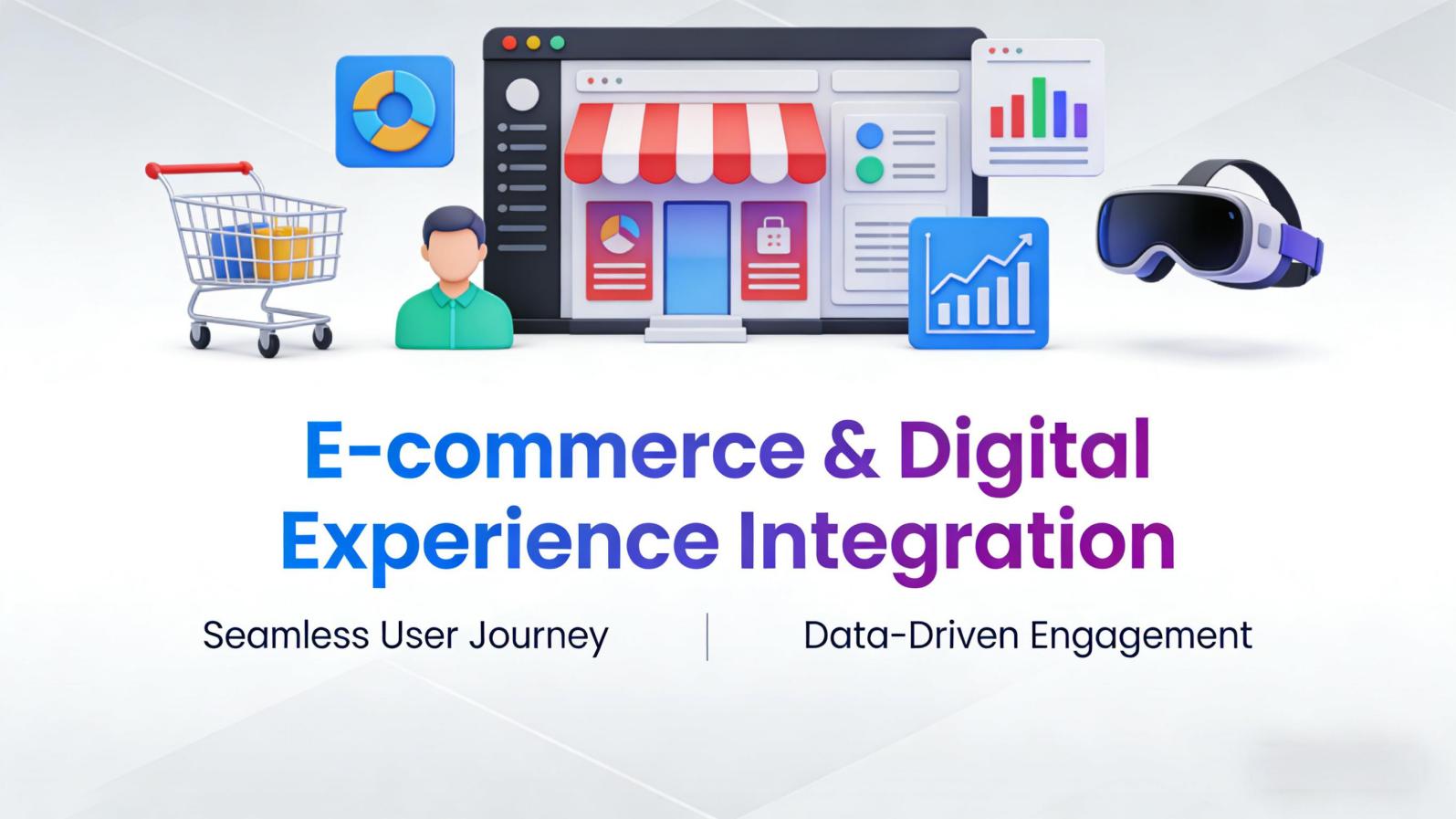
As digital transformation continues to deepen, the boundary between eCommerce platforms and digital experience platforms is gradually blurring. An increasing number of enterprises are adopting a “Content + Commerce” integrated model, letting brand content directly drive sales.
Under this trend, cross-border eCommerce website solutions will not merely be commerce systems but rather complete digital experience platforms. By integrating content management, commerce transactions, data analytics, and marketing automation, businesses can build a true global digital commerce platform.
9. Conclusion: Building a Global eCommerce Digital Platform
Against the backdrop of intensifying global eCommerce competition, enterprises need to continuously enhance their digital capabilities to meet evolving customer needs.
Through a modernized cross-border eCommerce website solution, businesses can integrate brand content, customer experience, and commerce transactions to build a more efficient global eCommerce platform architecture. For brands looking to expand into international markets over the long term, building such a digital platform will become a significant competitive advantage.
Conclusion
If your enterprise is planning a cross-border eCommerce platform or looking to upgrade your existing commerce system, adopting an advanced frontend-backend architecture can significantly enhance customer experience and operational efficiency.
Contact our expert team to learn how to build a high-performance cross-border eCommerce website with AEM and Adobe Commerce.
- Contact Us: Cross-Border eCommerce Website Solution Consultation and Implementation Services
- Product Page: Learn About AEM and Adobe Commerce eCommerce Solutions
Related Articles
- Website + eCommerce Integration Strategy: Connecting Data and Experience to Build a Dual Engine for Brand Global Expansion
- Adobe Commerce and Analytics Integration Guide: Using Data to Drive eCommerce Conversion and Customer Experience Optimization
- Enterprise Website Development Guide: Addressing Core Challenges of High Traffic, High Security, and Global Content Management
Related Articles

Enterprise AI MarTech Trends Analysis 2024-2029 Outlook Report
From AI content productivity tools to a core engine for revenue growth and marketing transformation
*The PDF will be sent directly to your inbox.
Email Error
Please enter a valid email address.
Thank You!
The whitepaper has been sent to your inbox. If you don’t see it, please check your spam or promotions folder.