
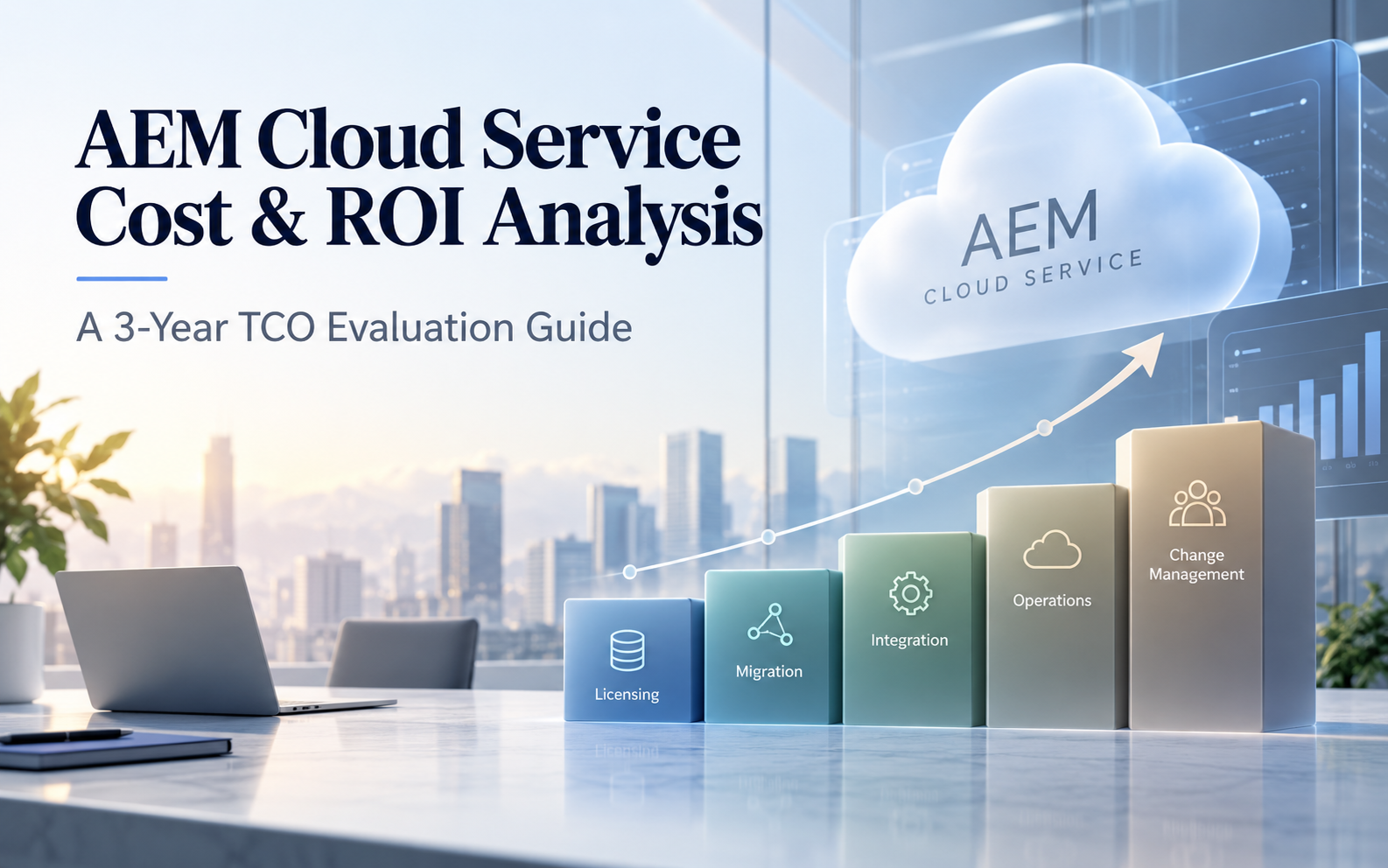
AEM Cloud Service Cost and ROI Analysis: A Three-Year TCO Guide
AEM Sites, Content Management System (CMS)
10 September 2026
- What are the five layers of AEM Cloud Service cost?
- Which factors most affect implementation and migration cost?
- How do you build a three-year TCO and ROI model?
- Scenario: how should a global brand website be estimated?
- When is it the right time to adopt?
- Implementation evaluation checklist
- Frequently asked questions
- Conclusion
- Further reading
- What are the five layers of AEM Cloud Service cost?
- Which factors most affect implementation and migration cost?
- How do you build a three-year TCO and ROI model?
- Scenario: how should a global brand website be estimated?
- When is it the right time to adopt?
- Implementation evaluation checklist
- Frequently asked questions
- Conclusion
- Further reading
The value of AEM as a Cloud Service cannot be judged by licence cost alone. Migration, integration, operations, governance, and change management all affect the investment case.
Key Takeaways (TL;DR)
Model the five cost layers, establish a baseline, validate assumptions through a controlled pilot, and extend proven results into a three-year TCO and ROI model.
1. What are the five layers of AEM Cloud Service cost?
Place formal commercial quotes within a consistent total-cost-of-ownership framework.
- Licensing and usage: product scope, environments, traffic, storage, support, and contract term.
- Migration and validation: code compatibility, content migration, asset cleanup, SEO mapping, testing, and cutover.
- Development and integration: components, templates, design systems, search, identity, commerce, analytics, and third-party APIs.
- Operations and governance: Cloud Manager processes, quality gates, monitoring, incident response, permissions, and publishing rules.
- Change and adoption: training, role changes, documentation, launch support, and multi-market rollout.
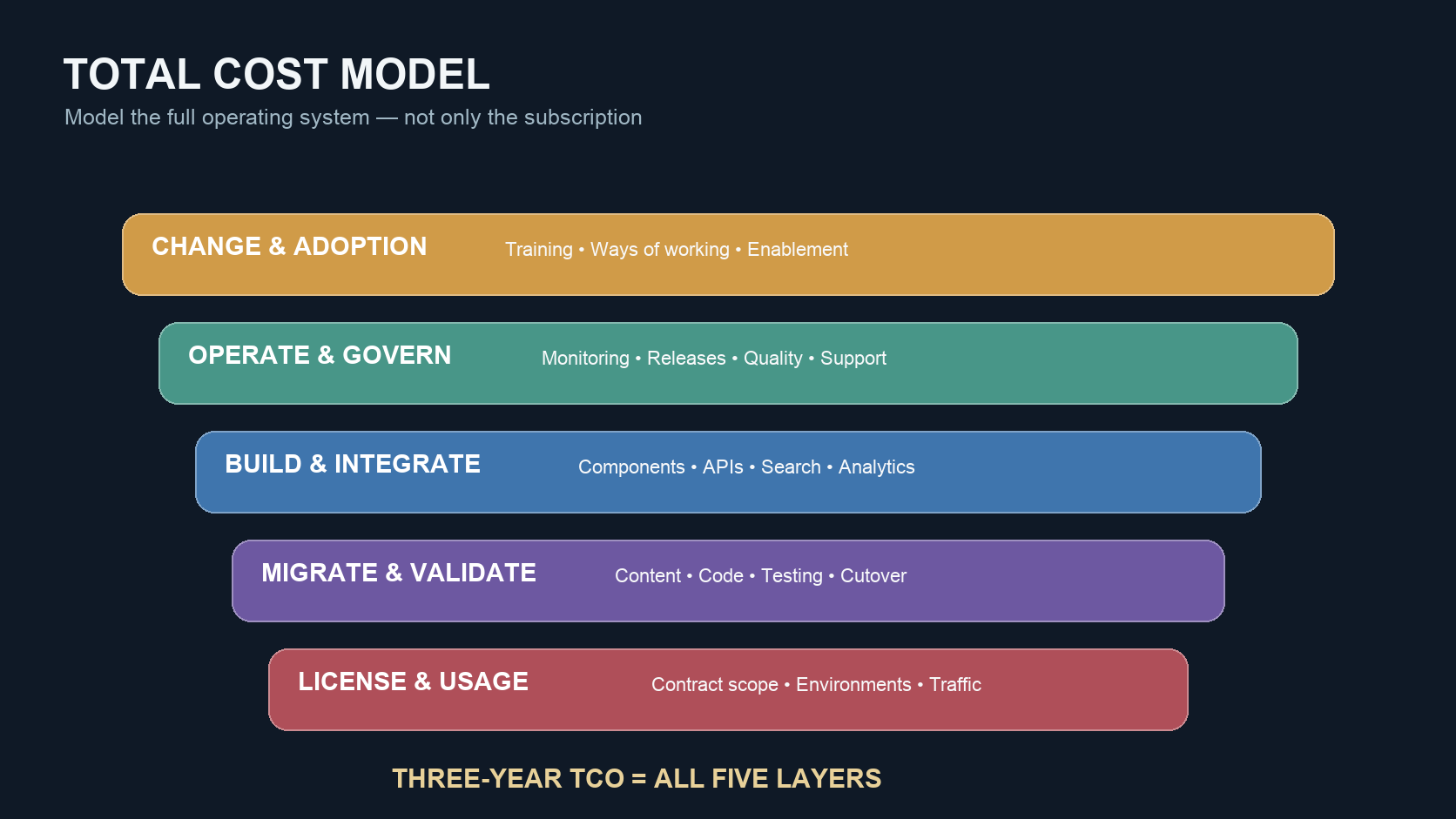
Cloud services reduce parts of the infrastructure burden, but the operating cost shifts toward product governance and continuous delivery.
2. Which factors most affect implementation and migration cost?
Legacy code and architecture gap
Assess the degree of customization in the current codebase, integration complexity, and target-architecture requirements. Larger gaps require more migration and remediation work.
Content, asset, and SEO complexity
Inventory content volume, DAM assets, metadata, redirects, and SEO requirements. Include cleanup, mapping, and validation in the scope.
Integration scope and interface quality
Identify CRM, PIM, CDP, analytics, identity, and internal-system integrations, then assess interface maturity and data quality.
Operations and change maturity
Confirm governance, publishing processes, training needs, and support arrangements; these factors shape the ongoing cost after launch.
3. How do you build a three-year TCO and ROI model?
Separate one-time assessment, design, remediation, migration, testing, and training from recurring licensing, support, operations, improvement, and integration maintenance. Record a source, assumption, and range for every line item.
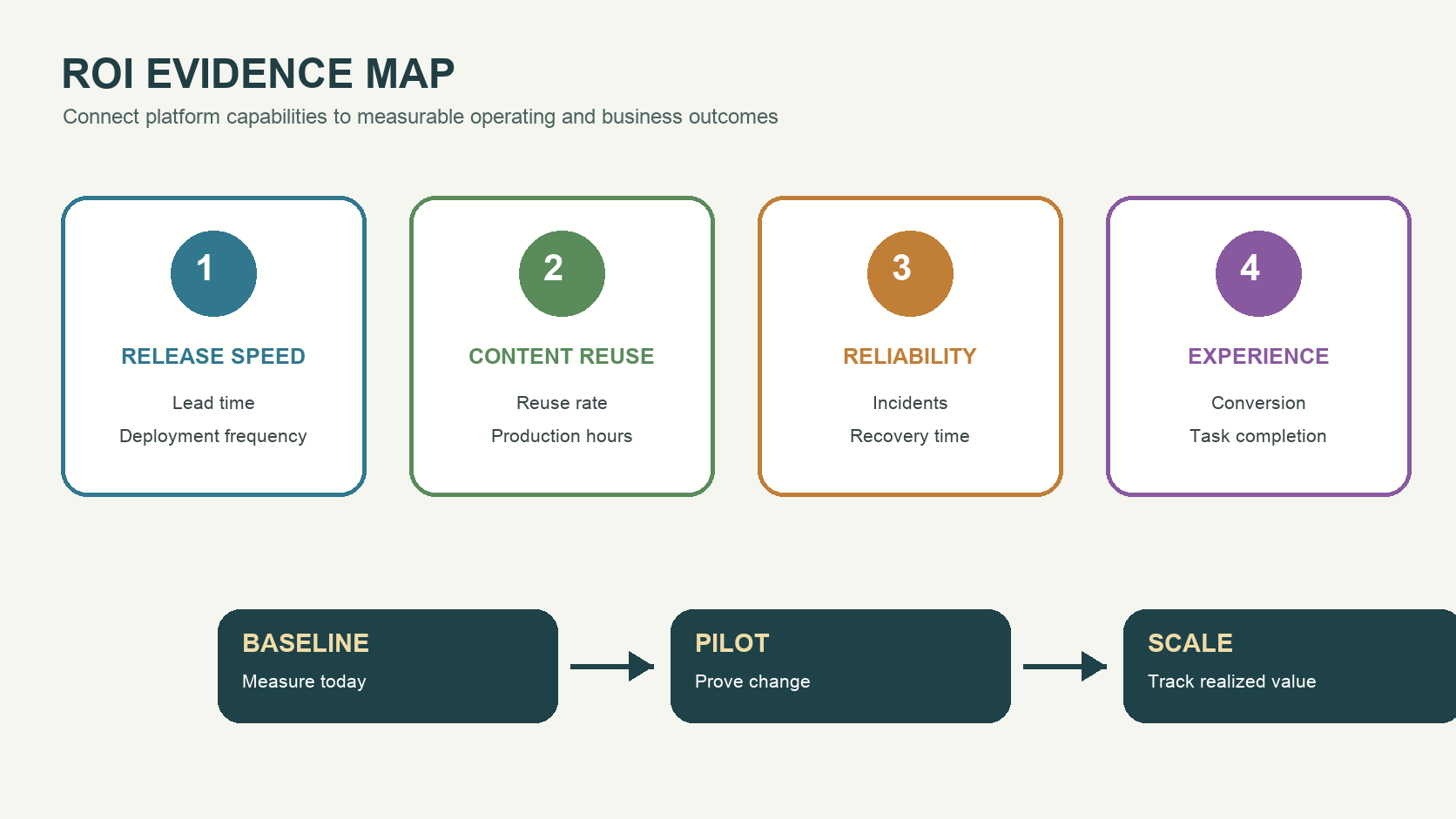
Start benefits from a baseline: publishing lead time, deployment frequency, content reuse, production effort, conversion rate, and operating cost. Do not attribute every revenue change to the CMS.
4. Scenario: how should a global brand website be estimated?
Use a medium-traffic market as a pilot. Inventory components, templates, content, assets, integrations, redirects, and author roles; scale results by reuse ratio and market complexity rather than multiplying the first-site cost.
5. When is it the right time to adopt?
AEM Cloud Service can create value for organizations with multi-site governance needs, continuous publishing, and readiness for standardized components and DevOps practices. Where ownership, identity, integration architecture, or custom code remain unresolved, improve readiness first.
6. Implementation evaluation checklist
- Obtain formal licensing quotes aligned with actual product scope.
- Inventory code, content, assets, integrations, traffic, and non-functional requirements.
- Establish cost, speed, quality, adoption, and business baselines.
- Estimate one-time migration separately from three years of operations.
- Select a representative pilot with manageable risk.
- Set thresholds for performance, SEO, content reuse, publishing speed, and adoption.
7. Frequently asked questions
How is AEM Cloud Service licensing calculated?
Licensing is typically determined by an enterprise agreement and the planned usage scope. Include licensing, support, optional modules, and expected growth in the three-year TCO.
Why are migration costs often underestimated?
Migration is not just content transfer. It includes code remediation, asset cleanup, SEO, redirects, testing, and launch assurance. Base estimates on content and integration inventories.
How can we tell whether AEM Cloud Service is delivering ROI?
Set a pre-launch baseline, validate key assumptions through a pilot, and track measurable outcomes such as publishing efficiency, operating effort, conversion, and risk reduction.
What belongs in a three-year TCO model?
Include at least licensing, migration, integration, operations, training, governance, support, and change management. Separate one-time investment from recurring cost.
When should ROI evaluation begin?
Begin during selection or budgeting. Early assumptions, baselines, and acceptance metrics make it much easier to demonstrate value after delivery.
8. Conclusion
The value of AEM Cloud Service is not in moving an existing website to the cloud unchanged. It is in building reusable content architecture, reliable continuous delivery, and a governable operating model across markets.


9. Further reading
Related Articles

Enterprise AI MarTech Trends Analysis 2024-2029 Outlook Report
From AI content productivity tools to a core engine for revenue growth and marketing transformation
*The PDF will be sent directly to your inbox.
Email Error
Please enter a valid email address.
Thank You!
The whitepaper has been sent to your inbox. If you don’t see it, please check your spam or promotions folder.