
AEM Cloud Service vs On-Premise CMS: Why Enterprises Are Moving to Cloud CMS
AEM Sites, Content Management System (CMS)
11 May 2026
- Enterprise CMS Architecture Is Changing
- What Is AEM as a Cloud Service
- What Is Traditional On-Premise CMS
- Core Differences: AEM Cloud Service vs On-Premise CMS
- Why Enterprises Are Moving to Cloud CMS
- AEM Cloud Service Benefits at a Glance
- When On-Premise May Still Be a Fit
- Frequently Asked Questions
- Conclusion: The Real Difference Is the Responsibility Model, Not Just the Feature List
- Enterprise CMS Architecture Is Changing
- What Is AEM as a Cloud Service
- What Is Traditional On-Premise CMS
- Core Differences: AEM Cloud Service vs On-Premise CMS
- Why Enterprises Are Moving to Cloud CMS
- AEM Cloud Service Benefits at a Glance
- When On-Premise May Still Be a Fit
- Frequently Asked Questions
- Conclusion: The Real Difference Is the Responsibility Model, Not Just the Feature List
1. Enterprise CMS Architecture Is Changing
Traditionally, enterprises approached CMS implementation by purchasing a software license and then having internal IT or an external systems integrator build the environment, plan the deployment architecture, and handle monitoring, upgrades, security, and scaling. This model can work, but as websites have become core operational interfaces, the CMS is no longer just a “site backend”—it is a digital platform that must sustain content governance, global delivery, stability, and continuous evolution over the long term.
Consequently, when evaluating a CMS, enterprises now care less about whether features are sufficient and more about whether the entire platform can keep pace with operational demands. Adobe designed AEM as a Cloud Service with a cloud-native architecture, continuous updates, and auto-scaling specifically to reduce the burden of infrastructure management on the enterprise. Official documentation confirms that AEMaaCS can scale up and down automatically based on demand and stays current through continuous delivery.
2. What Is AEM as a Cloud Service
AEM as a Cloud Service (AEMaaCS) is Adobe’s cloud-native AEM delivery model. It is not simply a legacy AEM instance moved to a cloud host; rather, AEM is built on a continuously updated, elastically scalable cloud operations model centered on Cloud Manager. Adobe’s official documentation notes that AEMaaCS provides auto-scaling capabilities and uses Cloud Manager as the critical gateway for deployments and updates—meaning the platform
From a product-capability standpoint, Adobe’s official description of AEM Sites highlights several cloud characteristics worth enterprise attention:
- Adobe-managed capacity elasticity and auto-scale: Capacity elasticity and auto-scaling are managed by Adobe.
- 24/7 monitoring, event response, and disaster recovery: Round-the-clock monitoring, incident response, and disaster recovery are provided.
- Default CDN optimized for Adobe Experience Manager: A default CDN optimized for AEM is included.
- Automated product updates: Platform updates are automated.
- Application-level SLA: An application-level SLA is in place.
This is why AEM Cloud Service is better understood as an “Adobe-managed platform service” rather than just “a CMS software package.”
3. What Is Traditional On-Premise CMS
The core concept of on-premise is that the enterprise deploys and manages the CMS within its own environment. According to the AEM 6.5 official documentation, on-premise means “AEM deployed and managed in your corporate environment”—that is, AEM is installed in an environment owned or controlled by the enterprise, typically with author, publish, and dispatcher instances configured and maintained by the enterprise itself.
The advantages of this model include a higher degree of environmental control, such as:
- Freedom to choose deployment locations and network topology
- Freedom to select hardware, cloud hosts, or third-party application servers
- Freedom to plan update cadence and change management
The trade-offs are equally clear. Infrastructure, monitoring, maintenance, capacity planning, upgrade projects, and disaster-recovery design remain largely the responsibility of the enterprise or its partners. For large organizations with mature IT teams, this may be acceptable; but for a growing number of enterprises that need to publish content quickly, operate across regions, and continuously optimize experiences, the burden of this model is becoming increasingly heavy.
4. Core Differences: AEM Cloud Service vs On-Premise CMS
The most fundamental difference between AEM Cloud Service and on-premise CMS is not simply “one is in the cloud and the other is on-premises”—it is who is responsible for platform-level stability and evolution. The following four dimensions illustrate the core differences:
| Comparison | AEM as a Cloud Service | On-Premise CMS |
|---|---|---|
| Platform Operations | Adobe manages more platform-level capabilities, including monitoring, updates, capacity, and parts of disaster recovery | The enterprise or its operations partner is primarily responsible for infrastructure, monitoring, redundancy, and capacity planning |
| Scalability | Automatically scales according to demand, making it better suited to campaigns, seasonal traffic, and cross-region requirements | Hardware and capacity must be planned in advance; expansion usually involves procurement, implementation, and testing |
| Update Model | Uses continuous updates and standardized processes to keep the platform current | The enterprise plans version upgrades, maintenance windows, compatibility testing, and rollback procedures |
| Deployment Process | Built around Cloud Manager, CI/CD pipelines, and automated quality checks | Deployment tools and processes are designed, integrated, and governed by the enterprise |
| CDN and Delivery | Includes a default CDN and cloud delivery architecture optimized for AEM | The enterprise selects, implements, and maintains its CDN, Dispatcher, and caching strategy |
| Availability and SLA | An application-level SLA is part of the service, supported by Adobe monitoring and incident response | Availability depends on the enterprise architecture, operations capability, redundancy design, and provider agreements |
| Environment Control | Uses a standardized cloud service model with less control over the underlying environment | Offers extensive control over network topology, hardware, system configuration, and change schedules |
| Cost and Resource Commitment | Reduces underlying platform operations, but still requires investment in application development, governance, and cloud services | Requires long-term investment in infrastructure, maintenance, upgrades, monitoring, and specialized operations teams |
Operational Responsibility
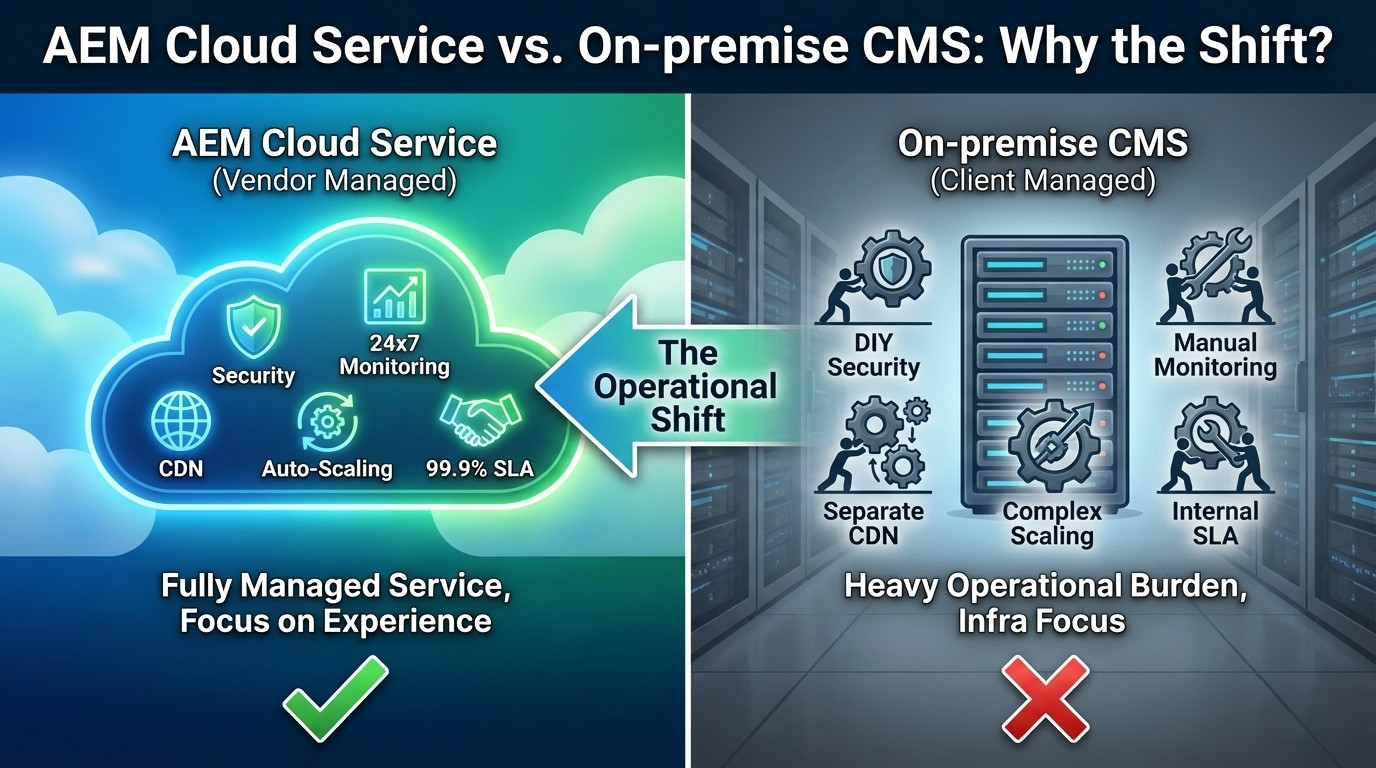
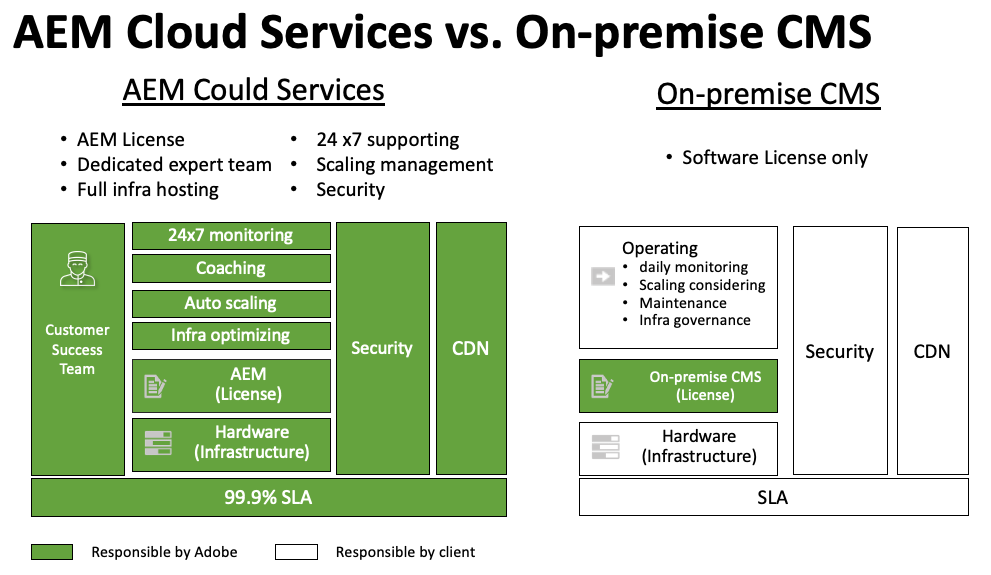
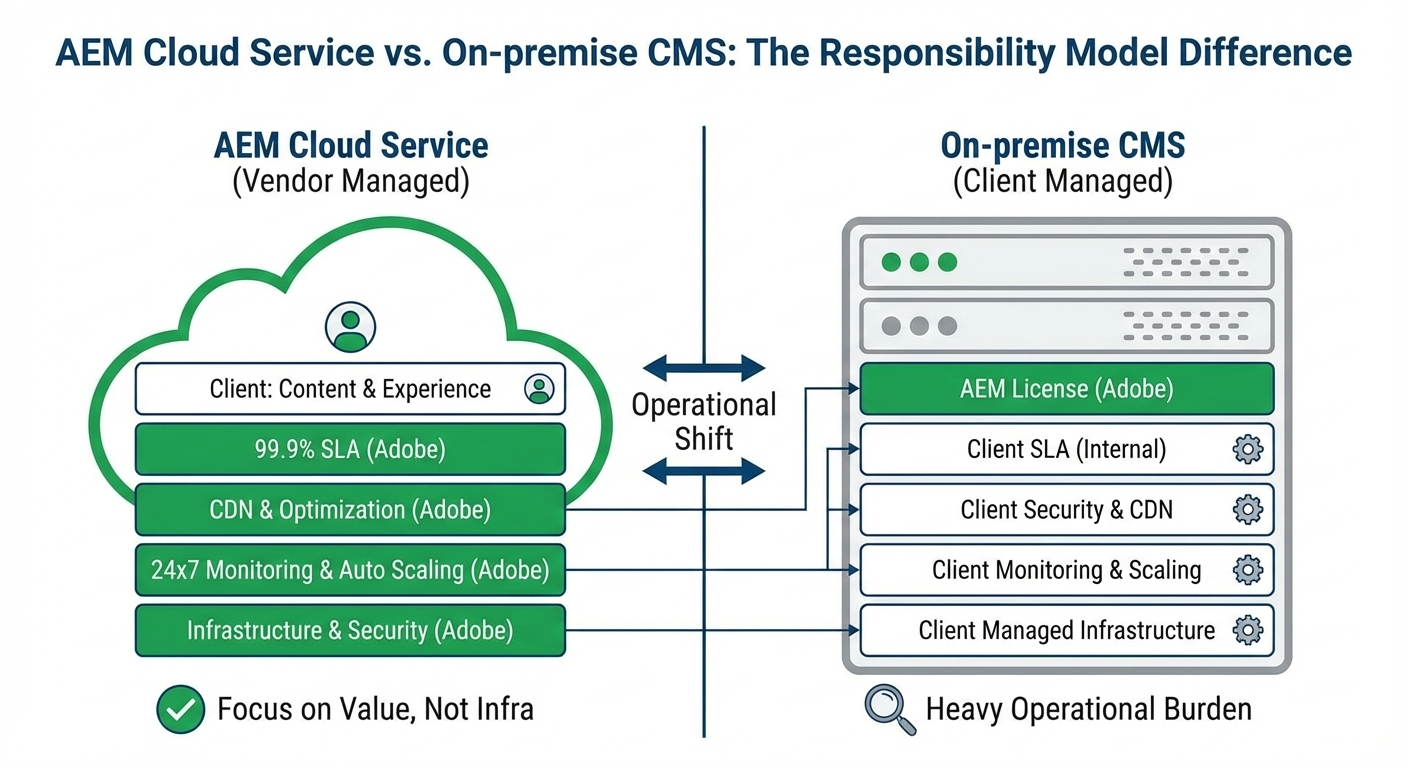
AEMaaCS consolidates platform updates, auto-scaling, monitoring, default CDN, and certain operational capabilities into an Adobe-managed service model; on-premise leaves these responsibilities primarily with the enterprise.
Update Model
Traditional on-premise often requires the enterprise to schedule version upgrades and maintenance windows; AEMaaCS follows a continuous-update model, using CI/CD and automated updates to keep production and staging on recent versions.
Deployment Method
Under the on-premise model, Cloud Manager was an optional tool; in AEMaaCS, Cloud Manager is mandatory and the only official path for deploying to dev, stage, and production.
Availability Commitment
On-premise relies on the enterprise's own architecture design and operations capabilities; AEMaaCS provides an application-level SLA, with a standard 99.9% for Sites / Forms and the option to reach 99.99% under qualifying conditions.
Therefore, when discussing availability, the article should emphasize that “Cloud turns SLA into a productized capability” rather than simply saying “Cloud is more stable.” The core of these four differences lies in how much platform responsibility the enterprise wishes to retain.
5. Why Enterprises Are Moving to Cloud CMS
Many enterprises choose to move from on-premise to AEM Cloud Service not because “features suddenly increased,” but because the platform model better aligns with today’s digital operations pace.
On one hand, the speed of content and experience updates is accelerating—markets demand that brand sites, campaign pages, product pages, and multilingual content go live quickly. On the other hand, IT teams face simultaneous pressure around security, performance, compliance, and cost. AEMaaCS lets enterprises devote more resources to content strategy, customer experience, and application integration instead of spending extensive time on底层环境维护. Adobe officially positions AEMaaCS value as: enabling developers to focus more on extension and development, reducing infrastructure maintenance for system administrators, and helping marketing and content teams realize value faster.
From a practical standpoint, AEM Cloud Service is especially well-suited to the following needs:
Enterprises Needing Faster Time-to-Market
Cloud Manager, standardized deployment pipelines, and continuous-update mechanisms reduce the frequency and risk of large-scale upgrade projects.
Brand or Group Sites with Significant Traffic Fluctuations
The AEMaaCS architecture supports demand-driven auto-scaling, making it ideal for handling campaign traffic, seasonal spikes, or multi-region visitor fluctuations.
Organizations Looking to Reduce Platform Operations Burden
24/7 monitoring, incident response, disaster recovery, default CDN, and automated updates reduce the complexity of integrating multiple tools and vendors on the enterprise side.
Digital Teams Focused on Governance and Consistency
AEMaaCS leans toward an institutionalized, governable, pipeline-centric operating model that suits multi-team collaboration and long-term scaling.
6. AEM Cloud Service Benefits at a Glance
Taken together, the core advantage of AEM as a Cloud Service is not any single feature. It is the way platform operations, delivery, and continuous evolution are combined in a more standardized service model. For enterprises running multisite, multilingual, and high-traffic digital experiences, the principal benefits include:
- Automatic scaling: Capacity adjusts to traffic and usage demand, reducing the burden of forecasting and expanding infrastructure.
- Continuous updates: A standardized update model reduces the technical debt and risk associated with major version upgrade projects.
- Cloud Manager and CI/CD: Code deployment, quality checks, and environment governance are managed through a consistent pipeline.
- Built-in monitoring and incident response: Adobe provides 24/7 monitoring, incident handling, and platform-level disaster recovery capabilities.
- Default CDN and global delivery: Enterprises face less complexity when assembling a content delivery architecture for cross-region experiences.
- Application-level SLA: Availability commitments become part of the service, supporting a clearer operating responsibility model.
These capabilities allow IT teams to invest more resources in application integration, security governance, and digital experience innovation instead of ongoing platform maintenance.
7. When On-Premise May Still Be a Fit
Although cloud CMS is the prevailing trend, on-premise has not lost all value. For some enterprises that must maintain tight control over infrastructure, network architecture, runtime environments, and change cadence, on-premise can still be a reasonable option.
Examples include:
- Highly regulated industries or special compliance requirements
- Needs for highly customized network and system control
- Existing IT teams with mature AEM operations capabilities
- Substantial prior investment in self-built platforms that make short-term migration impractical
When evaluating, however, it is advisable to also consider Adobe Managed Services (AMS). Adobe officially categorizes AEM deployment options into on-premise, Managed Services, and AEM as a Cloud Service. For some enterprises, AMS may serve as an intermediate path from self-management toward more cloud-native governance.
8. Frequently Asked Questions
1. What is the biggest difference between AEM as a Cloud Service and an on-premise CMS?
The biggest difference is the platform responsibility model. Adobe manages more updates, scaling, monitoring, and platform operations for AEM Cloud Service, while the enterprise is primarily responsible for infrastructure and operations on-premise.
2. Must every enterprise migrate from on-premise to AEM Cloud Service?
No. The decision should reflect compliance requirements, existing investments, customization, operations capability, and long-term digital strategy. Immediate migration is not the right choice for every organization.
3. Can AEM Cloud Service handle sudden traffic spikes?
Its cloud-native architecture and automatic scaling are better suited to campaign, seasonal, and cross-region traffic changes. Application performance and content delivery still need to be designed appropriately.
4. Will continuous updates affect custom functionality?
Enterprises must follow AEM Cloud Service development standards, Cloud Manager pipelines, and compatibility requirements. Existing custom code, third-party integrations, and deployment processes should be assessed before migration.
5. Is AEM Cloud Service suitable for enterprises with security and compliance requirements?
It can be considered, but the enterprise must still validate data location, access controls, auditing, integration architecture, and industry regulations, and clarify the respective security responsibilities of Adobe and the enterprise.
6. What should be assessed when comparing cloud and on-premise options?
Review site and traffic scale, the current AEM version, custom code, system integrations, compliance requirements, operations capability, upgrade costs, and future multisite or global operating needs.
9. Conclusion: The Real Difference Is the Responsibility Model, Not Just the Feature List
The key difference between AEM Cloud Service and on-premise CMS is not which has more features, but how much platform responsibility the enterprise wants to retain.
On-premise gives the enterprise greater control, but also requires it to shoulder more infrastructure, scaling, monitoring, upgrade, and operational governance work. AEM as a Cloud Service productizes more platform-level capabilities, letting enterprises obtain auto-scaling, continuous updates, default CDN, monitoring, and SLA support in a more standardized way.
Therefore, when evaluating Cloud vs On-premise, the real question is not “which has more features,” but:
Does your organization still want to bear these platform responsibilities itself?
If you are assessing whether AEM Cloud Service fits your current content platform strategy, the next step is to map it against your internal IT capabilities, governance maturity, traffic characteristics, and global operational needs. For further planning, please refer to the AEM Sites product page or contact us anytime.
Related Articles

Enterprise AI MarTech Trends Analysis 2024-2029 Outlook Report
From AI content productivity tools to a core engine for revenue growth and marketing transformation
*The PDF will be sent directly to your inbox.
Email Error
Please enter a valid email address.
Thank You!
The whitepaper has been sent to your inbox. If you don’t see it, please check your spam or promotions folder.