
DXP vs CMS vs CDP: A Guide to Enterprise Digital Experience and MarTech Architecture
Adobe Real-time CDP, AEM Sites, CDP, Content Management System (CMS), MarTech
1 July 2026
- Introduction: Why enterprises need to rethink DXP, CMS, and CDP
- What is a CMS
- What is a CDP
- What is a DXP
- DXP vs CMS vs CDP comparison table
- Three common misconceptions when enterprises plan technology architecture
- How to plan digital experience architecture by enterprise maturity
- CMS, CDP, and DXP architecture in Adobe Experience Cloud
- FAQ
- Conclusion
- Related Reading
- Introduction: Why enterprises need to rethink DXP, CMS, and CDP
- What is a CMS
- What is a CDP
- What is a DXP
- DXP vs CMS vs CDP comparison table
- Three common misconceptions when enterprises plan technology architecture
- How to plan digital experience architecture by enterprise maturity
- CMS, CDP, and DXP architecture in Adobe Experience Cloud
- FAQ
- Conclusion
- Related Reading
1. Introduction: Why enterprises need to rethink DXP, CMS, and CDP
When enterprises start planning a website rebuild, membership operations, personalized marketing, or omnichannel experiences, they often encounter three terms: DXP, CMS, and CDP. All three are related to digital experience, but they solve different problems.
If an enterprise starts only from “which system should we buy,” content platforms, data platforms, and marketing tools can easily operate in silos. The result is often new data silos and operational bottlenecks.
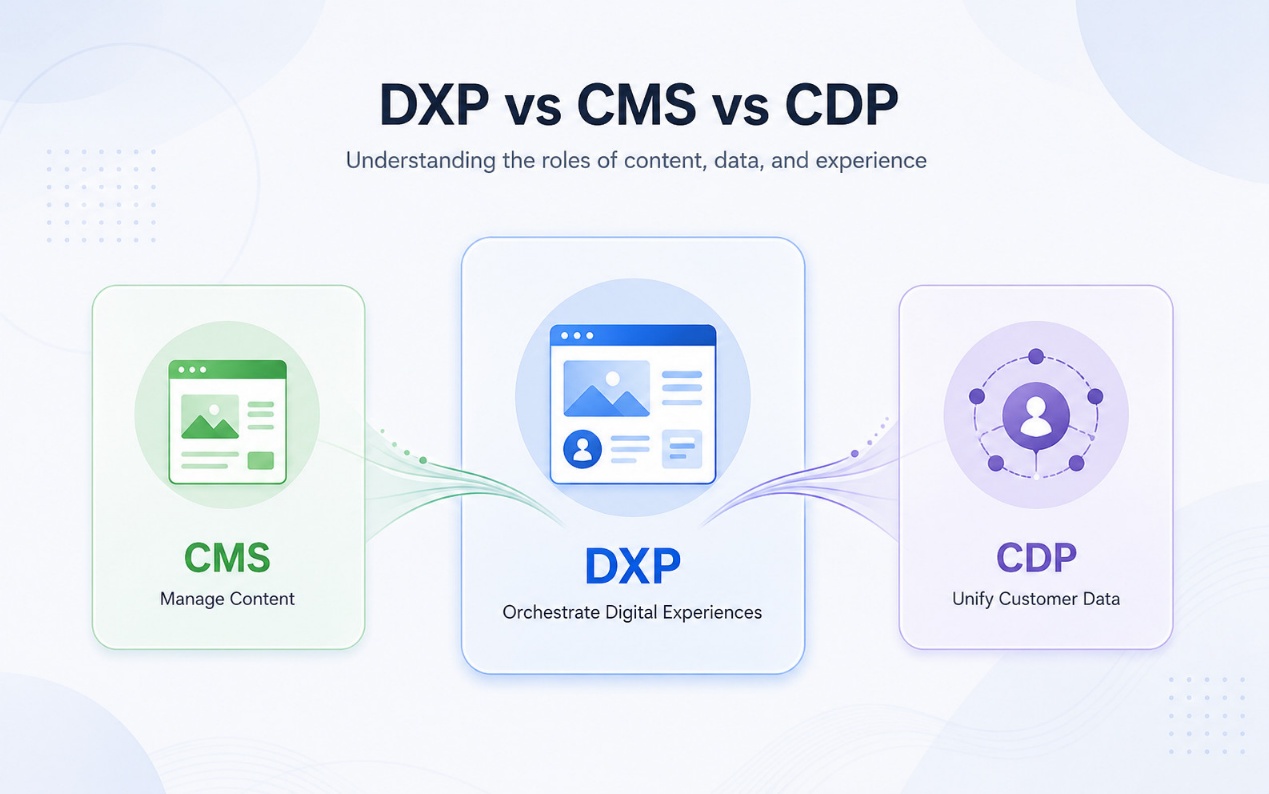
A quick way to understand the difference is this: a CMS manages content, a CDP integrates customer data and activates audiences, and a DXP integrates content, data, and channels into a consistent, optimizable digital experience. Enterprises should plan their digital experience architecture in stages based on content maturity, data maturity, and cross-channel integration needs.
This article helps business decision-makers, marketing teams, and IT teams understand the positioning of DXP, CMS, and CDP, and how to plan digital experience technology architecture according to enterprise maturity. After reading it, you will be able to judge more clearly whether your enterprise currently lacks content management capabilities, customer data capabilities, or cross-system integration and experience orchestration capabilities.
2. What is a CMS: The core foundation of content management
CMS stands for Content Management System. It is one of the most foundational systems in an enterprise digital experience architecture and is often one of the first platforms companies implement.
The core role of a CMS is to help teams create, manage, publish, and maintain content, such as corporate websites, product pages, campaign landing pages, blogs, knowledge centers, and multilingual sites.
For enterprises, a CMS is not just a “backend for editing web pages.” It is the infrastructure for brand content operations. As the number of markets grows, product lines become more complex, and content update frequency increases, a weak CMS can make marketing teams overly dependent on development resources, slowing launch speed, creating version-control issues, and weakening brand consistency.
The core value of a CMS includes:
Centralized content management
Centrally manage pages, images, videos, documents, and copy to reduce the risk of content being scattered across different systems.
Multilingual and multi-market support
Help multinational enterprises build a unified content structure while supporting localized adjustments for different markets.
Content workflow
Support writing, review, publishing, updating, and unpublishing workflows to improve content governance.
Front-end and back-end flexibility
Many enterprise-grade CMS platforms support traditional website management and can also publish structured content to apps, e-commerce sites, display screens, or other digital touchpoints through a headless architecture.
Simply put, a CMS solves the question of how content can be produced, managed, and published effectively.
3. What is a CDP: The data hub for building a unified customer view
CDP stands for Customer Data Platform. It focuses not on content itself, but on people and customer data.
When customers interact with a brand through a website, app, store, customer service, CRM, e-commerce, and advertising channels, they leave behind a large amount of behavioral and transaction data. If this data is scattered across different systems, it becomes difficult for enterprises to understand customers’ real needs, preferences, and journey stages.
The core role of a CDP is to integrate customer data from different sources, build continuously updated unified customer profiles, and activate segments into marketing, advertising, personalization, analytics, or customer service systems.
For enterprises that need membership operations, remarketing, automated journeys, and personalized recommendations, a CDP is key to data-driven experiences.
Common CDP capabilities include:
Data integration
Ingest website behavior, CRM, POS, app, form, transaction, customer service, and advertising interaction data.
Identity resolution
Under appropriate data authorization, consent management, and identity resolution rules, match anonymous visitors, member accounts, email addresses, device IDs, and other identifiers to build a more complete customer view.
Audience segmentation
Create actionable customer segments based on behavior, preferences, transaction records, and engagement status.
Cross-channel activation
Push audiences to email, SMS, advertising platforms, website personalization tools, marketing automation platforms, or customer service systems.
A CDP therefore solves the question of how enterprises understand customers and use data to drive more relevant interactions.
4. What is a DXP: An integrated architecture connecting content, data, and experience
DXP stands for Digital Experience Platform.
A DXP is not simply a larger CMS, nor is it just a bundle of multiple tools. More precisely, a DXP is a set of integrated technologies and platform capabilities centered on customer experience, helping enterprises create, deliver, personalize, and optimize experiences across multiple digital touchpoints.
If a CMS manages content and a CDP manages customer data, then a DXP focuses on connecting content, data, journeys, analytics, and personalization capabilities to form a consistent and continuously optimizable experience.
This is especially important for large enterprises, because customers do not interact with a brand only on a single website. They move across search, corporate websites, apps, member centers, e-commerce, social media, customer service, and offline scenarios.
The value of a DXP is usually reflected in the following areas:
Unified experience delivery
Help enterprises maintain consistent brand messaging and interaction quality across different channels.
Integrated architecture
Connect with existing CRM, ERP, CDP, MA, DAM, commerce, analytics, and other systems through APIs.
Personalization and optimization
Continuously adjust experiences based on customer data, content performance, and interaction behavior.
Organizational collaboration
Enable marketing, content, IT, data, and business teams to collaborate toward the same experience goals.
A DXP therefore solves the question of how enterprises continuously deliver consistent, personalized, and optimizable digital experiences across multiple channels.
5. DXP vs CMS vs CDP comparison table: Differences and complementary roles
When evaluating DXP, CMS, and CDP, the most important thing is not to treat them as mutually exclusive replacements. They are better understood as different layers of a digital experience architecture.
A CMS is the content layer, responsible for content production, management, and publishing. A CDP is the data layer, responsible for integrating customer data, building segments, and activating audiences. A DXP is the experience and integration layer, responsible for connecting content, data, and interaction channels to help enterprises build a more consistent customer experience.
You can understand them this way:
- A CMS answers: “How do we manage content?”
- A CDP answers: “How do we integrate customer data and activate audiences?”
- A DXP answers: “How do we integrate content, data, personalization, and channel delivery into a consistent digital experience?”
For enterprises just starting digital transformation, a stable CMS may be the first priority to manage corporate websites, multilingual content, and marketing pages well. For enterprises with large amounts of membership, transaction, and behavioral data, a CDP may become the next-stage priority. For enterprises that already have multiple systems and channels but lack overall experience consistency, a DXP architecture becomes critical.
| System | Core role | Main problem solved | Common capabilities | Common tools |
|---|---|---|---|---|
| CMS | Content layer | How to manage, publish, and maintain content | Content management, multilingual support, templates, components, workflows, headless content delivery | AEM Sites, Magnolia, WordPress |
| CDP | Data layer | How to integrate customer data and activate audiences | Data integration, identity resolution, audience segmentation, real-time activation, Customer 360 | Adobe Real-Time CDP, Salesforce Data 360 |
| DXP | Experience integration layer | How to integrate content, data, personalization, and channel delivery into digital experiences | Content delivery, personalization, API integration, journey orchestration, analytics feedback | Adobe Experience Cloud, AEM + RTCDP + Target + AJO + Analytics |
6. Three common misconceptions when enterprises plan technology architecture
For many enterprises adopting digital experience technology, the problem is not choosing the wrong single product, but lacking an overall architecture mindset.
Misconception 1: Treating the CMS as the answer to every problem
Some enterprises expect a CMS to handle content management, member data, personalized recommendations, marketing automation, and data analytics all at once. But the core of a CMS remains content operations. Excessive customization can create maintenance difficulties, upgrade risks, and unclear system boundaries.
Misconception 2: Implementing a CDP without data governance
The value of a CDP comes from data quality. If data sources are unclear, field definitions are inconsistent, identity resolution logic is messy, or consent management is insufficient, it is difficult to build a truly actionable customer view.
Misconception 3: Assuming a DXP means buying every tool at once
A DXP is not simply a large procurement project; it is architecture planning. Enterprises should first define customer journeys, core touchpoints, content processes, data strategy, identity resolution, and consent management.
Truly mature DXP planning is not about implementing as many tools as possible. The focus is enabling content, data, channels, and journeys to work together effectively.
7. How to plan digital experience architecture by enterprise maturity
Enterprises do not have to implement a complete DXP all at once. A more practical approach is to plan in stages according to current maturity.
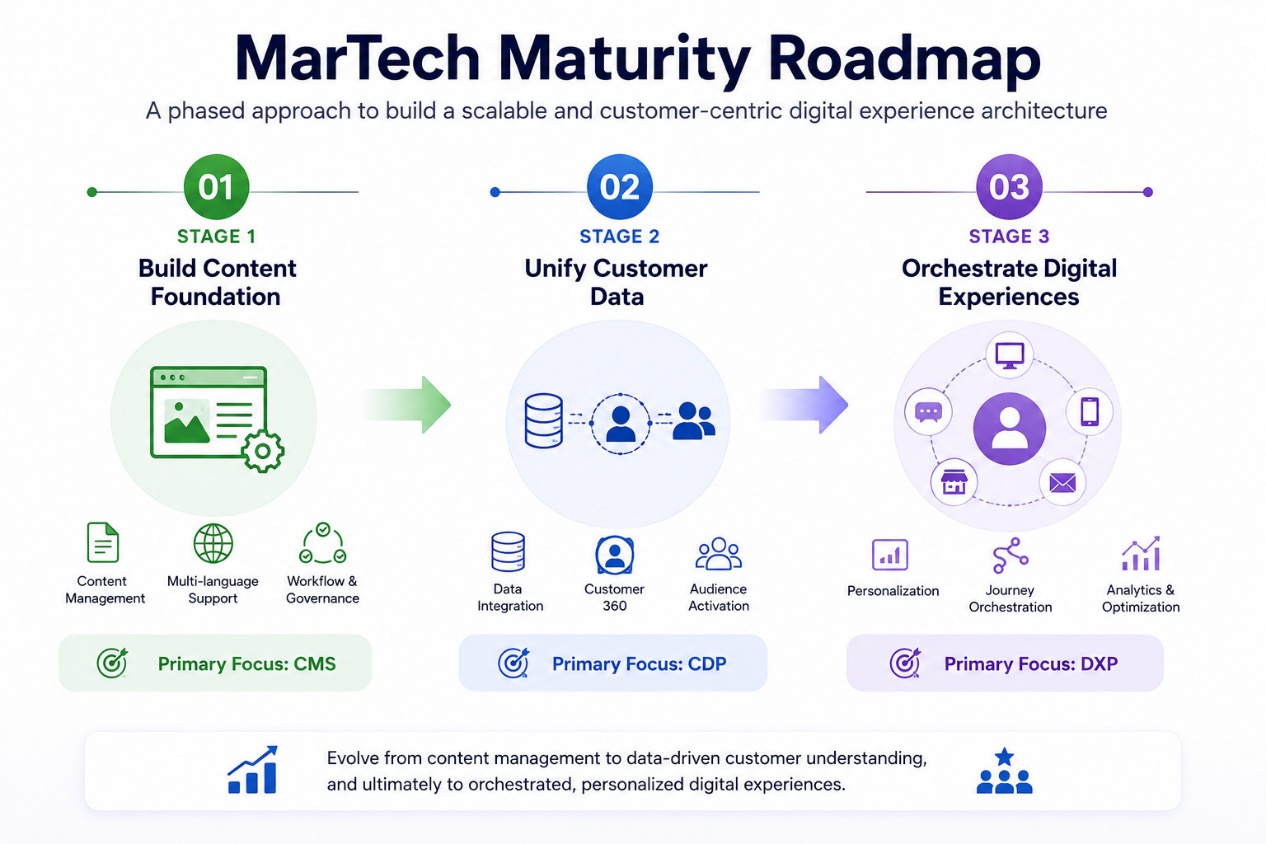
Stage 1: Build the content foundation
If an enterprise currently relies on IT to update its website, has scattered content, or lacks multilingual governance, it should prioritize strengthening its CMS.
The goal at this stage is to improve content launch speed, build reusable components, unify brand standards, and lay the foundation for later personalization and data integration.
Stage 2: Integrate data and the customer view
When an enterprise has accumulated membership, form, transaction, campaign, and website behavior data, it needs to consider a CDP or customer data architecture.
The focus at this stage is not simply collecting more data, but defining which data can support segmentation, journey triggers, and personalization use cases.
Stage 3: Move toward integrated experience orchestration
As content and data capabilities mature, enterprises can further build a DXP architecture, such as integrating CMS, DAM, CDP, analytics, personalization, journey orchestration, and commerce.
At this point, the focus shifts from individual system functions to cross-channel experience consistency, real-time connection between content and data, marketing campaign efficiency, and long-term scalability.
8. CMS, CDP, and DXP architecture in Adobe Experience Cloud
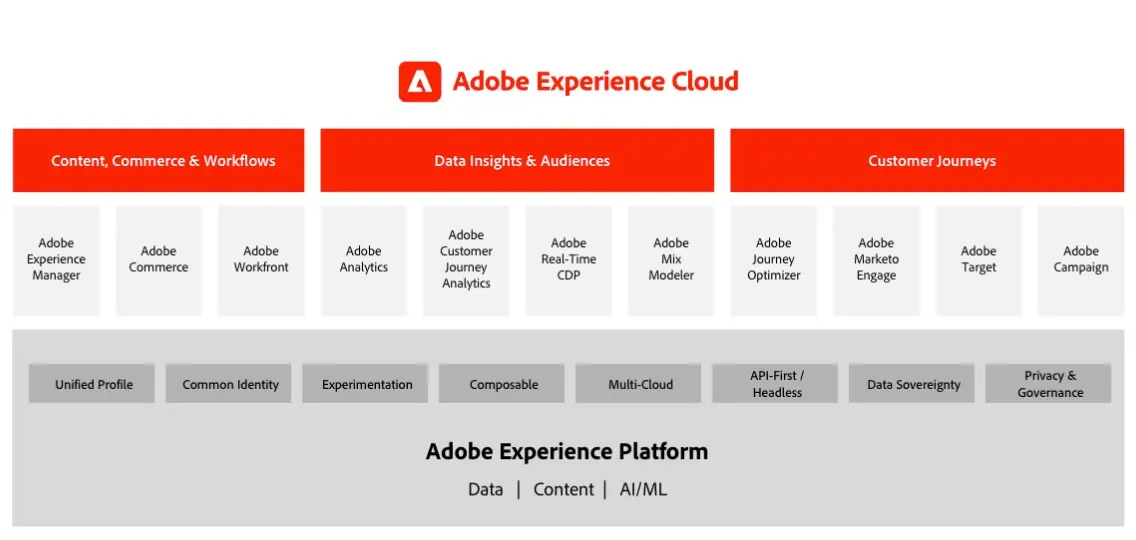
In the Adobe Experience Cloud ecosystem, Adobe Experience Manager Sites can serve as an enterprise-grade CMS, supporting website content management, multilingual and multi-brand operations, headless content delivery, and cross-channel content operations.
Adobe Real-Time CDP helps enterprises integrate customer data from multiple sources, build real-time customer profiles, and create activatable audiences.
When capabilities such as AEM, Real-Time CDP, Adobe Target, Adobe Journey Optimizer, and Analytics are properly integrated, enterprises can gradually build a more complete DXP architecture.
The focus of this architecture is not simply adopting more Adobe products. It is about using data tracking, identity resolution, audience segmentation, content models, personalization rules, and journey orchestration to create an operational connection between content, data, and customer interactions.
For example, after tracking, identity resolution, consent management, CDP segmentation, and personalization tool integration are in place, when a customer views a product page, the CDP can update that customer’s interest signals. The next time the customer returns to the website, the CMS and personalization tools can display more relevant content, and subsequent marketing journeys can be triggered based on the customer’s status.
For enterprises, the real value lies in making content interactions trackable, analyzable, and available for segment activation, while feeding data insights back into content optimization, personalized experiences, and marketing journeys.
9. FAQ
Can a CMS replace a DXP?
Not completely. The core of a CMS is content management and publishing, while a DXP emphasizes the integration of content, data, personalization, channel delivery, and experience optimization. For enterprises with small websites and simple channels, a CMS may be enough. But if an enterprise needs cross-channel experiences, personalization, and multi-system integration, it needs to further plan a DXP architecture.
What is the relationship between a CDP and a DXP?
A CDP is an important data foundation within a DXP architecture. The CDP integrates customer data, builds a unified customer view, and creates audience segments. The DXP combines that data with content, channels, personalization tools, and marketing journeys to form digital experiences that customers can actually perceive.
Does every enterprise need a DXP?
Not necessarily. Whether an enterprise needs a DXP depends on content scale, channel complexity, data maturity, and personalization needs. If an enterprise has only a single website, low content update frequency, and no clear cross-channel requirements, a CMS may be enough. But if it manages multiple brands, markets, languages, channels, and large volumes of customer data, it should start evaluating a DXP architecture.
Which should be implemented first: DXP, CMS, or CDP?
It is usually best to judge based on the enterprise’s biggest current bottleneck. If content management is chaotic, strengthen the CMS first. If customer data is scattered, plan a CDP or customer data architecture first. If both content and data foundations already exist but the experience remains fragmented, then further plan a DXP.
10. Conclusion: From point solutions to scalable experience architecture
DXP, CMS, and CDP are not three competing options. They are three key layers in an enterprise digital experience architecture. The CMS is the foundation of content operations, the CDP is the hub for customer data and segment activation, and the DXP is the experience architecture that integrates content, data, channels, and journeys.
When planning, enterprises should not only ask, “Which system do we need?” They should first ask, “Is our biggest experience bottleneck content, data, or integration?”
Once this question is clear, technology selection can truly serve business goals.
If you are planning a corporate website rebuild, multilingual CMS, customer data platform, or complete digital experience architecture, feel free to Contact Us to discuss your needs with the LeadsTech consulting team.
You can also learn more about related products and services:
11. Related Reading
Related Articles

Enterprise AI MarTech Trends Analysis 2024-2029 Outlook Report
From AI content productivity tools to a core engine for revenue growth and marketing transformation
*The PDF will be sent directly to your inbox.
Email Error
Please enter a valid email address.
Thank You!
The whitepaper has been sent to your inbox. If you don’t see it, please check your spam or promotions folder.