
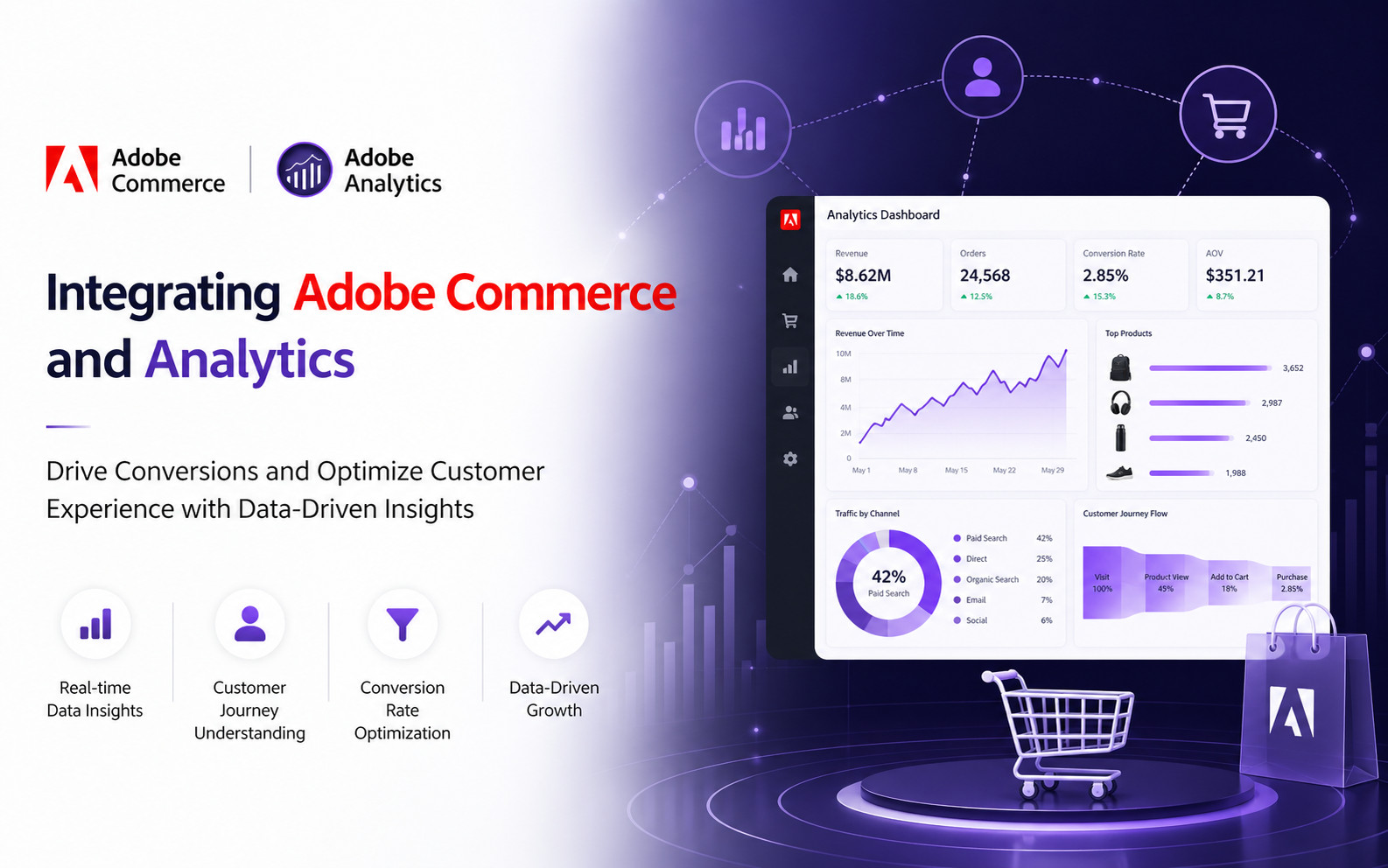
Adobe Commerce & Analytics Integration: Drive Conversions with Data
Adobe Analytics, Adobe Commerce (Magento), e-commerce Platforms, MarTech, Website Analytics
28 April 2026
- Why Modern E-commerce Must Be Data-Driven
- What is Adobe Commerce and Analytics Integration
- Core Data Capabilities After Integration
- Using Data to Optimize E-commerce Conversion Rates
- Using Behavioral Data to Enhance Customer Experience
- Implementation Steps for Adobe Commerce and Analytics Integration
- Common Challenges and Best Practices
- Conclusion: Building a Data-Driven E-commerce Growth System
- Why Modern E-commerce Must Be Data-Driven
- What is Adobe Commerce and Analytics Integration
- Core Data Capabilities After Integration
- Using Data to Optimize E-commerce Conversion Rates
- Using Behavioral Data to Enhance Customer Experience
- Implementation Steps for Adobe Commerce and Analytics Integration
- Common Challenges and Best Practices
- Conclusion: Building a Data-Driven E-commerce Growth System
1. Why Modern E-commerce Must Be Data-Driven
In today’s competitive digital business environment, companies increasingly rely on data to guide decisions. Whether it’s traffic acquisition, user conversion, or customer retention, data analytics plays a critical role in each step.
Many enterprises collect vast amounts of e-commerce data, but this data is often scattered across different systems, making it difficult to form a unified view. This is why Adobe Commerce and Analytics integration has become an important strategy for businesses looking to optimize their e-commerce operations.
Through Adobe Commerce and Analytics integration, companies can capture real-time user behavior data, enabling more precise analysis of user journeys, identification of conversion bottlenecks, and development of more effective marketing strategies.
2. What is Adobe Commerce and Analytics Integration
Adobe Commerce and Analytics integration refers to the deep connection between the e-commerce platform Adobe Commerce and the analytics platform Adobe Analytics, enabling e-commerce behavioral data to automatically flow into the analytics system.
After completing the Adobe Commerce and Analytics integration, businesses can centrally manage the following key data:
-
Product browsing data
-
Shopping cart behavior
-
Order conversion data
-
Customer behavior paths
-
Marketing campaign performance
This data integration helps businesses understand the entire customer journey from a holistic perspective.

3. Core Data Capabilities After Integration
After completing Adobe Commerce and Analytics integration, businesses gain multiple key data capabilities.

User Behavior Analysis
Businesses can clearly see how users behave on the website, for example:
Page visit sequences
Product browsing frequency
Time on page
Conversion paths
With this data, businesses can identify which pages are most effective at driving sales.

Conversion Funnel Analysis
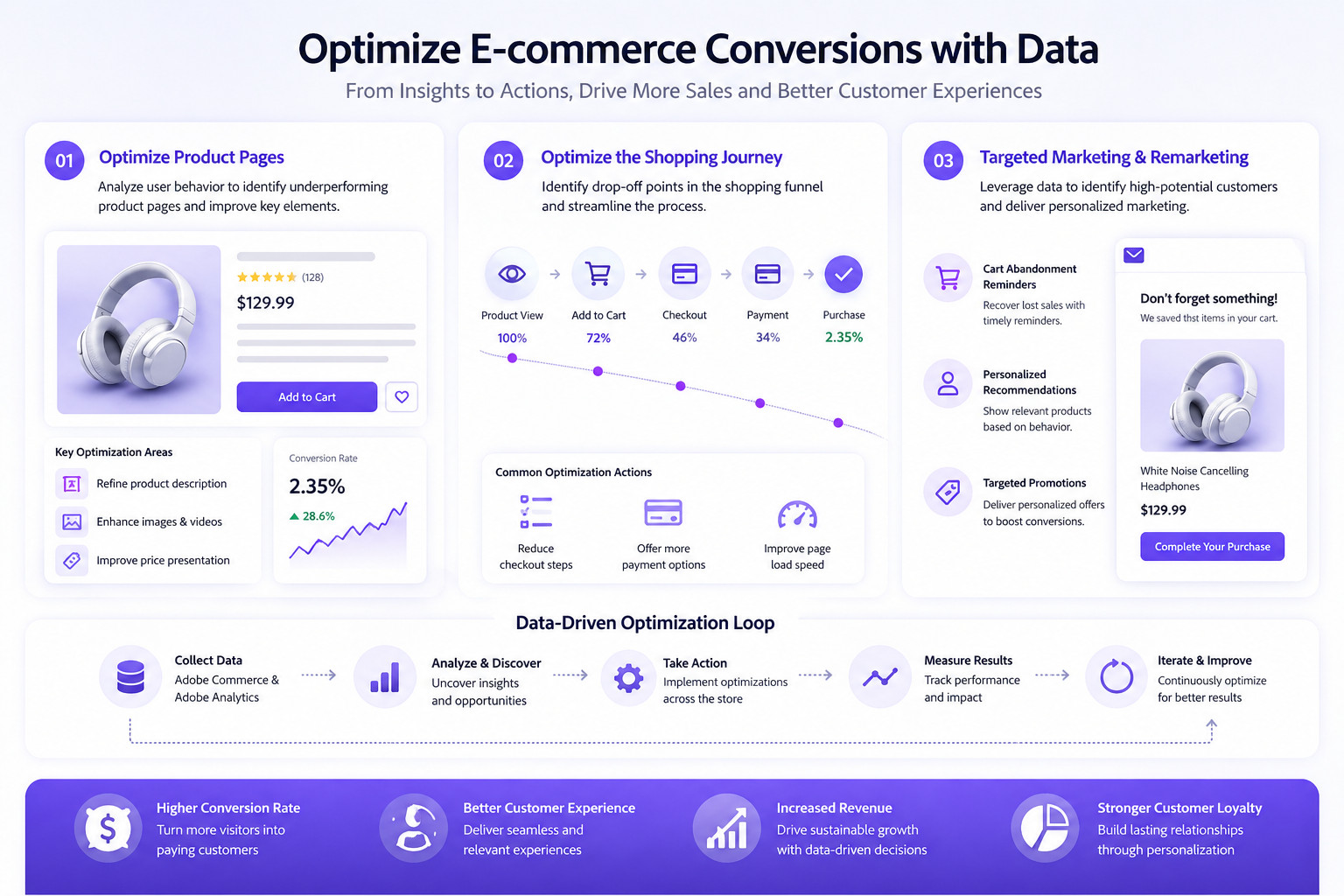
Through Adobe Commerce and Analytics integration, businesses can build a complete e-commerce conversion funnel:
Visit → Browse Products → Add to Cart → Checkout → Order Complete
Analyzing the drop-off rate at each step helps identify conversion issues.

Product Performance Analysis
Businesses can understand:
Which products have the highest views
Which products have the highest conversion rates
Which products have high bounce rates
This data helps optimize product display and marketing strategies.
4. Using Data to Optimize E-commerce Conversion Rates
The ultimate goal of data analytics is to improve business outcomes. Through Adobe Commerce and Analytics integration, businesses can take multiple approaches to increase conversion rates.
Optimize Product Pages
By analyzing user behavior, businesses can identify underperforming product pages and optimize them, for example:
-
Adjust product descriptions
-
Optimize images and videos
-
Improve price display
-
Streamline the purchase process
Data insights from Adobe Commerce and Analytics integration can reveal where users abandon the purchase journey.
Common optimization measures include:
-
Reduce checkout steps
-
Offer more payment options
-
Improve page load speed
Precision Marketing and Retargeting
Through data analysis, businesses can identify high-potential customers and launch precision marketing campaigns, for example:
-
Abandoned cart reminders
-
Personalized recommendations
-
Targeted promotional campaigns
5. Using Behavioral Data to Enhance Customer Experience
Beyond improving conversion rates, Adobe Commerce and Analytics integration can also help businesses enhance overall customer experience.
Personalized Content Display
Businesses can display different content to different users based on their behavioral data, for example:
Recommend related products
Show personalized offers
Display recently viewed products
User Journey Optimization
By analyzing user behavior paths, businesses can identify user experience issues, for example:
High page bounce rates
Complex navigation structures
Difficulty finding information
Continuous optimization can significantly improve customer satisfaction.
6. Implementation Steps for Adobe Commerce and Analytics Integration
To successfully implement Adobe Commerce and Analytics integration, businesses typically need to go through the following steps.

6.1 Data Requirements Analysis
First, clarify:
What user behaviors need to be tracked
What are the key business metrics
How will data be used for decision-making

6.2 Data Collection Configuration
Configure data collection in Adobe Commerce, for example:
Page view events
Product view events
Cart events
Order events
This data is automatically transmitted to the Analytics system through the integration.

6.3 Data Model and Report Design
After completing Adobe Commerce and Analytics integration, design data models and analytics reports so business teams can quickly gain insights.
Common reports include:
E-commerce conversion rate reports
Product performance reports
Customer behavior path reports
7. Common Challenges and Best Practices
When implementing Adobe Commerce and Analytics integration, businesses may encounter some challenges.
Inconsistent Data Standards
Different systems may use different data naming conventions, which can cause analysis difficulties.
Solutions include:
Establish unified data standards
Design clear data models
Too Much Data to Leverage
Enterprises may collect large amounts of data but lack the analytical capabilities to use it.
Recommendations: prioritize key metrics such as:
Conversion rate
Average order value
Customer lifetime value
Organizational Alignment Issues
Data analytics is not just a technical issue—it also involves organizational collaboration.
Businesses should ensure:
Marketing teams participate in data analytics
Product teams participate in experience optimization
Management prioritizes data-driven decision-making
8. Conclusion: Building a Data-Driven E-commerce Growth System
As digital commerce continues to evolve, data has become one of the most important assets for businesses.
Through Adobe Commerce and Analytics integration, businesses can:
-
Gain deeper customer insights
-
Optimize e-commerce conversion processes
-
Enhance overall customer experience
For businesses aiming for long-term growth, Adobe Commerce and Analytics integration is not just a technology upgrade—it’s a critical step toward data-driven operations.
Closing
If your business is planning an e-commerce platform upgrade, or wants to improve e-commerce conversion rates through data analytics, building a complete data analytics system is essential.
Contact our expert team to explore how the deep integration of Adobe Commerce and Adobe Analytics can build a truly data-driven e-commerce platform.
Related Articles
Related Articles

Enterprise AI MarTech Trends Analysis 2024-2029 Outlook Report
From AI content productivity tools to a core engine for revenue growth and marketing transformation
*The PDF will be sent directly to your inbox.
Email Error
Please enter a valid email address.
Thank You!
The whitepaper has been sent to your inbox. If you don’t see it, please check your spam or promotions folder.