

- Why Global Marketing Automation Fails
- Goals of Global Marketing Automation
- Three Foundations of Intelligent Marketing
- Start with the Customer Journey
- Data and User Identification
- Cross-Channel Orchestration
- Omnichannel Marketing Framework
- Marketing Automation Use Cases
- Implementation Roadmap
- Common Marketing Automation Pitfalls
- Conclusion
- Why Global Marketing Automation Fails
- Goals of Global Marketing Automation
- Three Foundations of Intelligent Marketing
- Start with the Customer Journey
- Data and User Identification
- Cross-Channel Orchestration
- Omnichannel Marketing Framework
- Marketing Automation Use Cases
- Implementation Roadmap
- Common Marketing Automation Pitfalls
- Conclusion
1. Why Marketing Automation Fails in Most Global Businesses
In many global businesses, marketing automation often ends up in an awkward situation:
- The tool has already been purchased
- The system is live
- Emails and workflows are “running”
However, the reality is:
- Automation scenarios are extremely limited
- No clear improvement in conversion performance
- Marketing teams gradually abandon usage
The problem is not the tool itself, but that marketing automation is treated as a “technical project” rather than a “growth system.”
2. What Is the Core Goal of Global Marketing Automation?
In global markets, the real goal of marketing automation is not simply “sending automated emails,” but:
- Delivering the right message
- At the right time
- Through the right channel
- To the right global audience
Its core value lies in:
Enabling limited marketing resources to continuously serve a large and distributed global audience.
3. Three Foundations for Building an Intelligent Marketing Journey

Before moving into execution, it is critical to first establish three core foundational elements.

3.1 Clear Understanding of the Customer Journey
Do you clearly understand:
- The full journey from awareness to decision-making for global customers
- Differences in decision-making cycles across regions
- The boundary between marketing and sales responsibilities
Without this understanding, automation remains superficial.

3.2 A Reliable Data Foundation
Marketing automation depends on:
- User behavioral data
- Content engagement data
- Lead and customer lifecycle data
If data is fragmented or unidentifiable, automation cannot become truly “intelligent.”

3.3 Sustainable Content and Channel Supply
Automation requires:
- Sufficient content to support each stage of the journey
- Coverage across multiple languages and markets
- Content that can be continuously reused and optimized
Otherwise, workflows quickly lose effectiveness.
4. Step 1: Start with the Customer Journey, Not the Tool
Many companies begin by asking:
- Can we build nurture flows?
- Can we automatically tag users?
- Can we trigger emails based on behavior?
But the more important questions are:
- At which stage are customers most likely to drop off?
- What information best drives the next action?
- When is sales intervention necessary?
A mature approach typically breaks the journey into:
- Awareness stage
- Interest and exploration stage
- Evaluation stage
- Conversion and follow-up stage
Automation is only a means to support the journey.
5. Step 2: Data and User Identification as Prerequisites
5.1 From Anonymous Visitors to Identified Users
A global website is often the starting point for automation. The key lies in:
- How to collect high-quality behavioral data
- How to identify users through forms or content exchanges
- How to avoid engaging users too early
5.2 The Role of CDP in Marketing Automation
When users interact across channels, the value of a CDP becomes evident:
- Unifying user identities
- Integrating behavioral and attribute data
- Enabling more precise segmentation and triggering
Marketing automation should not be a “single-tool solution,” but should be built on a unified customer view.
6. Step 3: Cross-Channel Orchestration for a Consistent Experience
Global customer touchpoints are highly fragmented, including:
- Website
- Retargeting ads
- Content downloads
- Sales interactions
Mature marketing automation emphasizes:
- Coordination across channels
- Consistency in timing and messaging
- Avoiding duplication, conflict, or over-engagement
This is the core value of “marketing journey orchestration.”
7. Omnichannel Marketing Strategy Framework
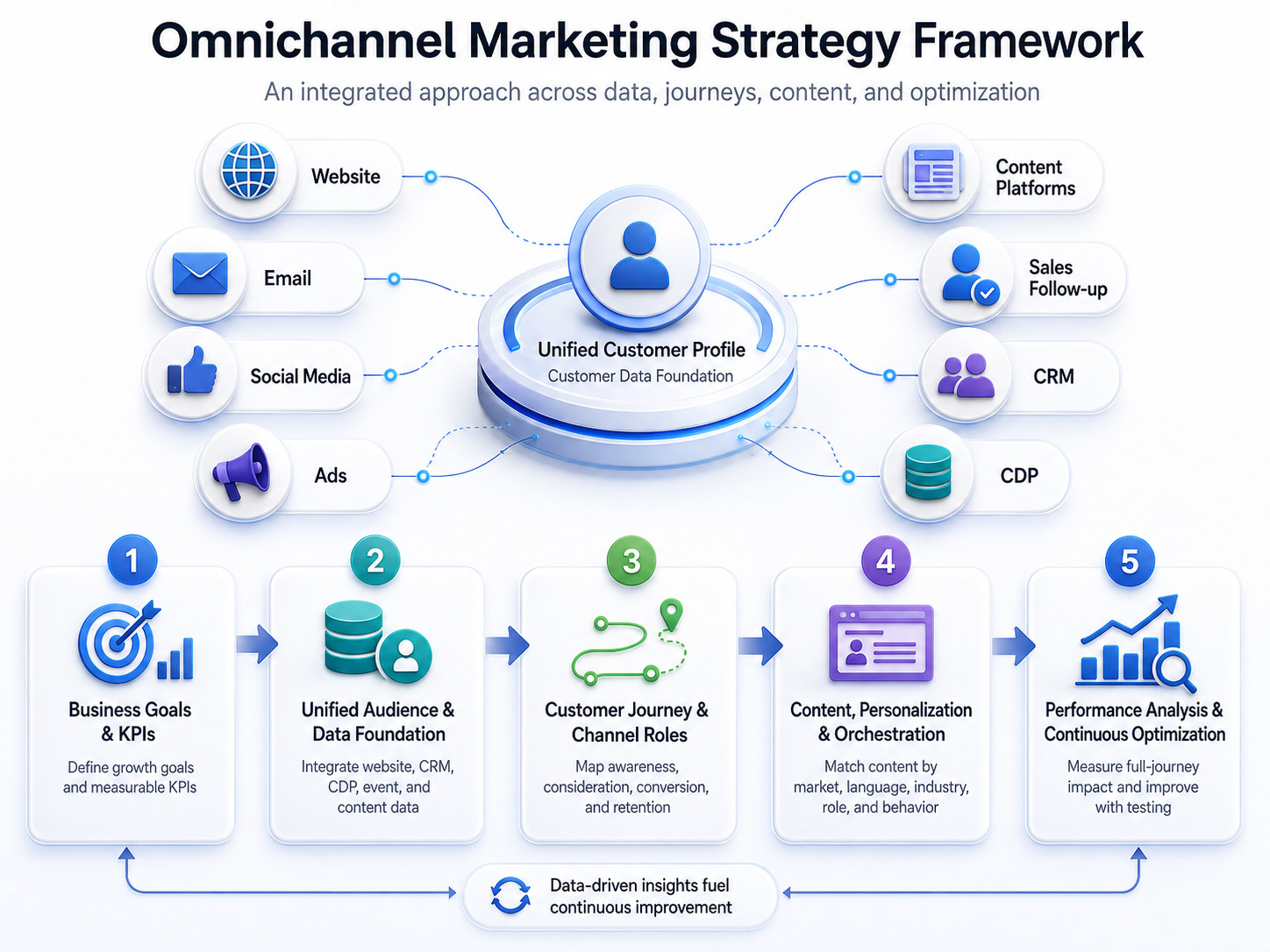
Omnichannel marketing is not simply about adding more touchpoints. It aligns websites, email, social media, advertising, content platforms, and sales follow-up around a shared customer profile, journey logic, and communication cadence. Businesses can use the following five-layer framework:
7.1 Business Goals and Measurement
- Define growth objectives for each market, such as lead generation, opportunity nurturing, conversion, or customer retention
- Set measurable KPIs for every journey stage instead of focusing only on clicks or email open rates within a single channel
7.2 Unified Audiences and Data Foundation
- Integrate website, CRM, CDP, event, and content engagement data
- Establish unified customer identification and segmentation rules across devices and channels
7.3 Customer Journey and Channel Roles
- Define the role of each channel across awareness, consideration, conversion, and retention
- Clarify which interactions should be automated and which moments require sales or local-market teams
7.4 Content, Personalization, and Journey Orchestration
- Dynamically match content by market, language, industry, role, and behavior
- Coordinate frequency, priority, and suppression rules to prevent duplicate or conflicting messages across channels
7.5 Performance Analysis and Continuous Optimization
- Measure conversion contribution across the complete journey rather than attributing results within isolated channels
- Continuously run A/B tests, refine audiences, and optimize workflows before scaling mature use cases
This framework turns marketing automation from a collection of isolated tools into a sustainable omnichannel marketing operating model.
8. Typical Use Cases of Global Marketing Automation
8.1 Multilingual Lead Nurturing
- Automatic routing by country or language
- Delivering localized content
- Dynamically adjusting cadence and depth
8.2 Content-Driven Conversion
- White papers, case studies, and solutions
- Identifying interest based on content engagement
- Automatically guiding the next step
8.3 Marketing and Sales Alignment Automation
- Automated lead scoring
- Well-timed sales triggers
- Behavior feedback loops back into marketing systems
9. From Strategy to Execution: Implementation Roadmap
A practical and sustainable approach typically includes:
- Defining business goals and priority markets
- Mapping the customer journey and key touchpoints
- Building foundational data and identification systems
- Designing focused and high-impact automation scenarios
- Continuously testing, optimizing, and scaling
Marketing automation is not a one-time deployment, but an evolving process.
10. Common Pitfalls in Global Marketing Automation
- Pursuing overly complex workflows too early
- Implementing automation without sufficient data foundation
- Disconnect between marketing automation and sales processes
- Lack of content readiness
- Treating tools as the solution itself
11. Conclusion: Marketing Automation Is a System, Not Just a Tool
In global markets, the challenge is not whether you can use the tools, but whether:
- You truly understand your global customers
- You have a solid data and content foundation
- You can enable cross-team collaboration
Successful marketing automation is ultimately:
The result of long-term alignment between strategy, data, content, and technology.
Closing: From “Automated Messaging” to “Intelligent Customer Journeys”
If you find that:
- Marketing automation delivers limited results
- It is difficult to scale across countries
- Marketing and sales struggle to align
The issue likely lies not in execution, but in overall design.
Contact Us: Talk to our consulting team about your global marketing automation strategy
Our Services: Learn more about our Marketing Automation services
Further Reading & References
Further Reading (Internal)
- A Complete Guide to Choosing a Digital Partner for Global Expansion
- Global Website Analytics Tool: How Adobe Analytics Drives Business Decisions
- Global Website Development Is More Than a Site: How CMS Powers Growth
- Adobe Marketo Engage: Omnichannel Marketing and Marketing Automation
References (External)
Related Articles
Enterprise AI MarTech Trends Analysis 2024-2029 Outlook Report
From AI content productivity tools to a core engine for revenue growth and marketing transformation
*The PDF will be sent directly to your inbox.
Email Error
Please enter a valid email address.
Thank You!
The whitepaper has been sent to your inbox. If you don’t see it, please check your spam or promotions folder.