
Adobe Journey Optimizer (AJO) Partner Selection Guide
Adobe Journey Optimizer, Marketing Automation, MarTech, Personalized Marketing
17 July 2026
Summary
Quick answer: When selecting an AJO service provider, enterprises should focus on the provider’s Adobe Experience Cloud experience, AEP and data integration capabilities, customer journey design expertise, cross-channel marketing experience, compliance awareness, and post-implementation optimization and training services.
1. Introduction: Why AJO Implementation Requires a Professional Service Provider
This article explains why implementing Adobe Journey Optimizer (AJO) is not simply a matter of purchasing a marketing tool, but a MarTech initiative spanning data, marketing strategy, system integration, content workflows, and organizational collaboration. After reading it, you will understand how to evaluate AJO service providers, avoid common implementation risks, and determine which type of implementation consultant best suits your enterprise’s needs.
In an era of increasingly fragmented customer experiences, enterprises must think beyond sending emails or push notifications. They need to integrate customer data, behavioral events, consent status, channel preferences, and content strategies to deliver the right interactions at the right time. Adobe Journey Optimizer is designed precisely for this kind of real-time, omnichannel, personalized engagement.
However, AJO does not begin generating value automatically the moment the system goes live. The real key is whether an enterprise can integrate customer data, journey strategies, content governance, trigger conditions, and measurement metrics. The role of an AJO implementation consultant is to help the enterprise connect Adobe Journey Optimizer, Adobe Experience Platform, data sources, journey strategies, messaging channels, and performance measurement into an operational customer journey system.
2. What Is Adobe Journey Optimizer (AJO)?
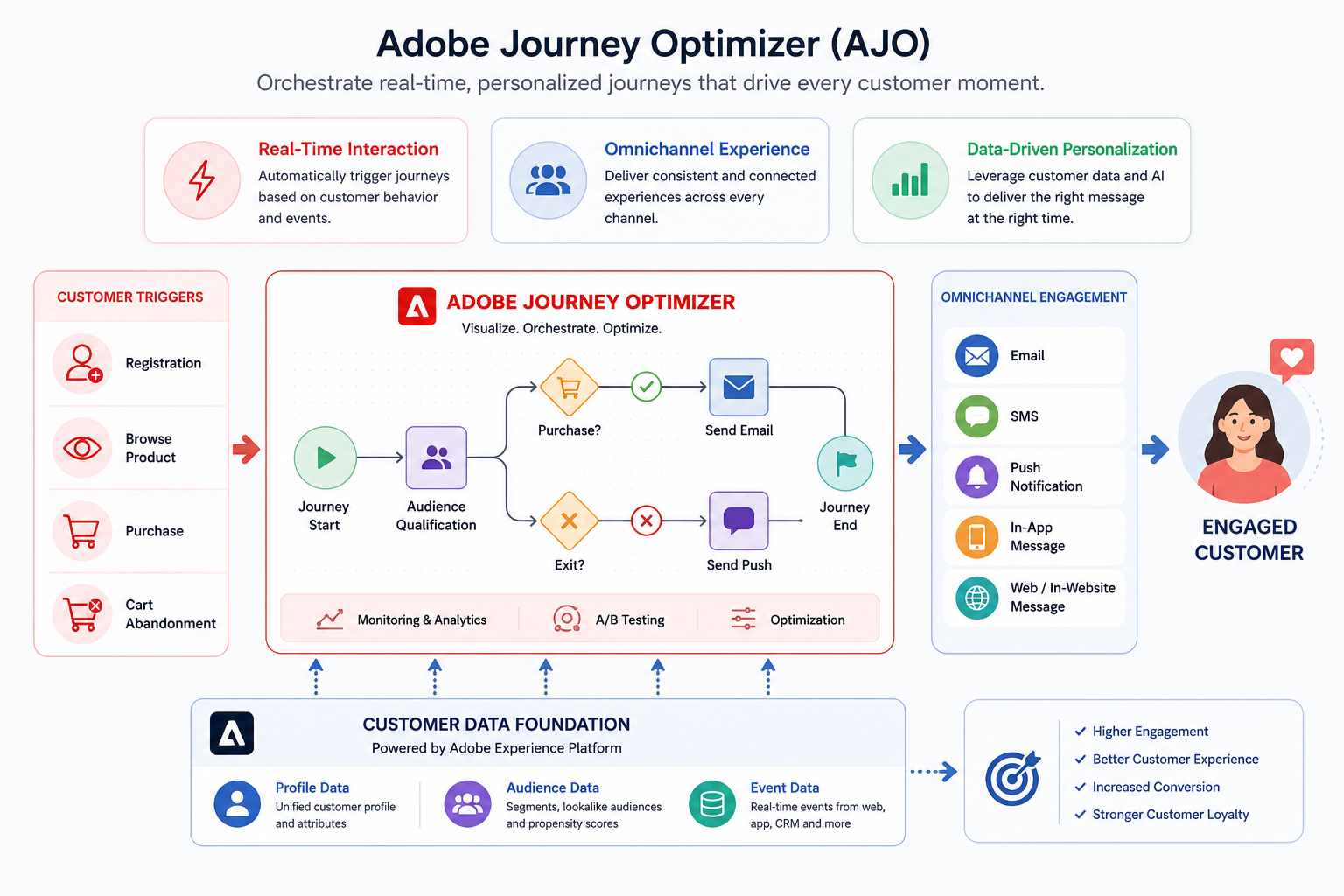
Adobe Journey Optimizer is Adobe Experience Cloud’s customer journey management and omnichannel marketing engagement platform. It primarily helps enterprises design, manage, and optimize personalized customer journeys. According to Adobe’s official overview, AJO enables enterprises to build customer journeys and marketing campaigns on a visual canvas and combine them with audiences, real-time customer profiles, and event data from Adobe Experience Platform to deliver personalized interactions across channels.
For enterprises, AJO’s core value is typically reflected in three areas:
Real-Time Engagement
When a customer registers, views a product, abandons a shopping cart, completes a transaction, or triggers a specific event, the enterprise can automatically initiate the corresponding journey.
Omnichannel Experiences
Enterprises can integrate channels such as email, SMS, push notifications, in-app messaging, and the web, preventing channels from operating in isolation and causing repetitive messages or fragmented experiences.
Data-Driven Personalization
Using the customer data foundation in Adobe Experience Platform, AJO helps enterprises create more relevant journey decisions and engagement content based on audience attributes, behavioral events, preferences, and Real-Time Customer Profile data.
In other words, AJO is not merely a messaging or basic marketing automation tool; it is an important platform that helps enterprises orchestrate real-time journeys, audience-based campaigns, and personalized interactions.
3. Three Common Challenges When Enterprises Implement AJO
When evaluating AJO, many enterprises first focus on whether its features are powerful, whether it supports multiple channels, and whether it can improve conversion rates. During actual implementation, however, the real challenges often arise not only from the tool itself, but also from the organization, data, and processes.

The Data Foundation Is Not Ready
AJO’s personalization and journey-triggering capabilities rely heavily on data quality, identity resolution, event design, consent management, and data governance. If an enterprise’s member data, transaction data, browsing behavior, app events, or CRM data are scattered across different systems and lack consistent identification logic, journeys will be difficult to execute accurately.

Marketing Journeys Lack a Clear Strategy
Some enterprises hope to build numerous automated journeys immediately after implementing AJO. However, without first defining priority scenarios, customer segments, trigger conditions, and KPIs, the system can easily become merely a messaging tool rather than genuinely improving the customer experience.

Insufficient Collaboration Between IT and Marketing Teams
AJO implementation typically involves data integration, event design, permission settings, channel configuration, content templates, testing processes, and performance tracking. If marketing and IT teams lack a common language, the project can easily encounter requirement gaps and schedule delays.
Therefore, an excellent AJO service provider must do more than simply know how to configure the tool. It must also help enterprises clarify business scenarios, data architecture, and cross-functional processes.
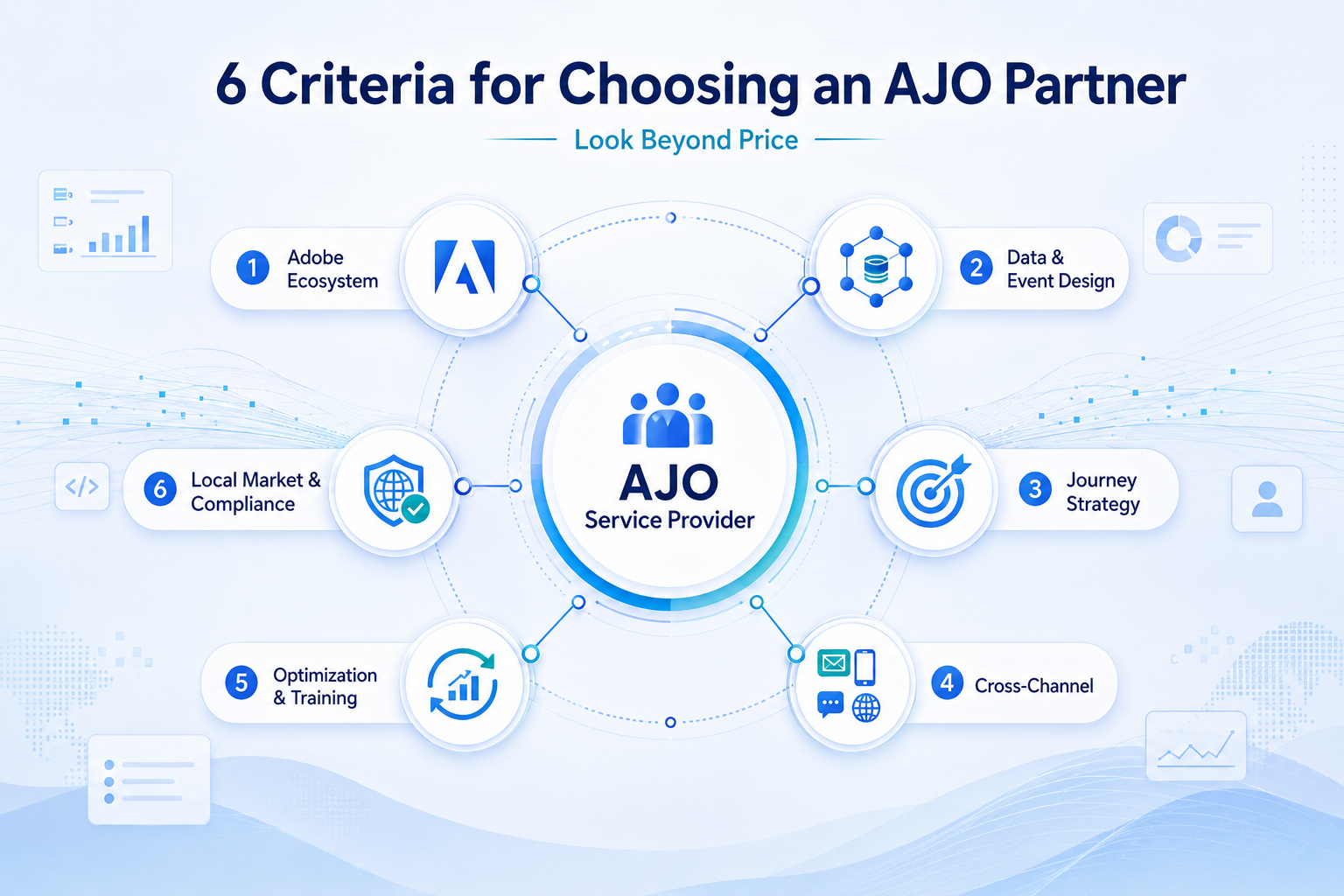
4. Six Key Criteria for Evaluating AJO Service Providers
When selecting an AJO service provider, enterprises should avoid comparing only quotations or person-days. Instead, they should evaluate implementation capabilities, platform knowledge, industry experience, and long-term support.
Familiarity with the Adobe Experience Cloud Ecosystem
AJO rarely exists in isolation. It typically forms a customer journey architecture together with Adobe Experience Platform, Real-Time Customer Profile, Audiences, Adobe Analytics, AEM, Adobe Campaign, CRM, CDP, or e-commerce systems. A service provider familiar with the Adobe ecosystem is better positioned to help enterprises plan a scalable overall architecture.
Data Integration and Event Design Capabilities
AJO journey triggers depend on data and events. The service provider must understand schemas, datasets, identity resolution, consent management, journey events, audiences, API integrations, and data governance. Otherwise, even a fully designed journey may fail to operate because the data is unavailable or the events are inaccurate.
Ability to Design Journeys Around Business Objectives
A good AJO consultant does not begin with system configuration. Instead, the consultant first clarifies business objectives, priority journeys, audience logic, trigger events, channel strategies, frequency governance, and KPIs—for example, new customer conversion, member engagement, repeat purchase rates, cart recovery, renewal reminders, or high-value customer management.
Cross-Channel Marketing Experience
AJO’s value lies in omnichannel coordination. If a service provider is familiar only with single-channel email automation, it may be unable to effectively plan the complementary roles of push notifications, SMS, apps, the web, and offline data.
Post-Implementation Optimization and Training
AJO is not a one-off project. After launch, enterprises must continue to monitor data, optimize journeys, adjust content, improve frequency, and build internal operational capabilities. Therefore, a service provider’s ability to deliver ongoing support and team training is essential to long-term success.
Understanding of Local Markets and Compliance Requirements
Different markets have different requirements for data privacy, communication preferences, user consent, and messaging frequency. A service provider with local implementation experience can help enterprises balance technical and regulatory risks.
5. How Different Types of Enterprises Should Choose a Service Provider
Not every enterprise needs the same AJO implementation model. Before choosing a service provider, an enterprise should first determine its current stage.
For enterprises just beginning to build marketing automation capabilities, the priority is finding a consultant who can help them plan from the ground up—starting with a data inventory, selection of priority journeys, message templates, channel configuration, and basic performance tracking. These enterprises typically need to inventory their customer data sources, define the first set of journey scenarios, and establish foundational email, push, or SMS workflows. At this stage, a service provider’s strategic consulting and training capabilities are more important than complex technical development.
For enterprises that already have a CDP, CRM, or e-commerce platform, the focus shifts to data integration and advanced journey applications. They may already have member segmentation and basic automation workflows, but want to use AJO to achieve more immediate and granular customer engagement. In this case, the service provider needs capabilities in system integration, API connectivity, event design, and cross-platform data governance.
For large groups, financial institutions, insurers, telecommunications companies, or multi-market brands, AJO implementation typically involves multiple brands, regions, languages, permission levels, and more rigorous compliance processes. These enterprises should choose a consulting team with large-scale project management experience, a governance framework, and long-term support capabilities.
6. What Enterprises Should Prepare Before Implementing AJO
Before formally selecting a service provider, enterprises can complete the following preparations to make the subsequent evaluation and implementation more efficient.
Inventory Existing Marketing and Data Systems
This includes CRM, CDP, websites, apps, e-commerce platforms, customer service systems, membership systems, email delivery platforms, and analytics tools.
Define Priority Journey Scenarios
There is no need to plan every customer journey at the outset. Begin with three to five high-value scenarios, such as a new-member welcome journey, cart abandonment reminders, repurchase reminders, membership upgrades, or churn recovery.
Set Clear KPIs
Each journey should correspond to specific metrics, such as open rate, click-through rate, conversion rate, average order value, repeat purchase rate, unsubscribe rate, or customer lifetime value.
Confirm Data and Consent Management Status
Enterprises need to confirm which data is available, how frequently it is updated, whether user consent has been obtained, and whether they have lawful permission to send messages through each channel.
Establish a Cross-Functional Project Team
AJO implementation typically requires the joint participation of marketing, IT, data, legal, CRM, e-commerce, and customer service teams. Establishing decision-making and collaboration mechanisms in advance helps reduce project risk.
7. How LeadsTech Helps Enterprises Implement AJO
LeadsTech has extensive experience helping enterprises plan and implement solutions related to digital experience, marketing automation, CMS, CDP, CRM, analytics, and MarTech. Its service scope covers Adobe Experience Cloud, Salesforce CRM, CMS, e-commerce, CDP, marketing automation, website analytics, and related areas. LeadsTech’s official company overview also notes that its services span marketing automation, customer data platforms, website analytics, CMS, e-commerce, and UX/UI, enabling enterprises to build a more complete digital ecosystem.
By choosing LeadsTech as their AJO service provider, enterprises can receive the following support:
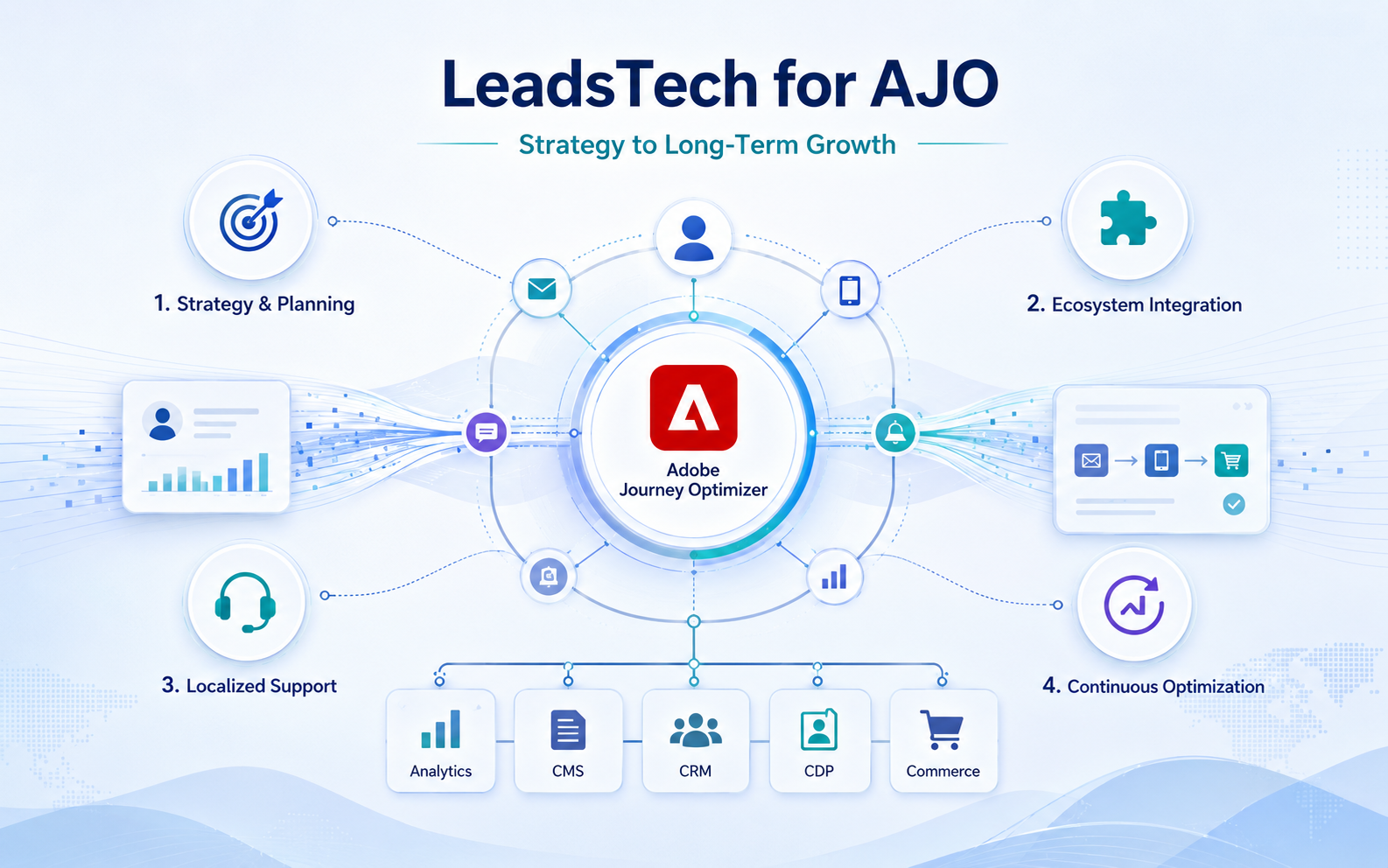
Comprehensive Planning from Strategy to Execution
We help enterprises begin with business objectives and define journey scenarios, segmentation logic, content requirements, and performance metrics.
Adobe Ecosystem Integration Experience
We support integration planning between AJO and Adobe Experience Platform, Adobe Analytics, AEM, CRM, CDP, e-commerce platforms, and other third-party systems.
Localized Consulting and Cross-Regional Support
With a strong understanding of digital transformation requirements in Hong Kong, Taiwan, and Greater China, we help teams implement solutions more smoothly across language, process, compliance, and market contexts.
Continuous Post-Implementation Optimization
We help enterprises go beyond launching the system to establish ongoing testing, analysis, journey optimization, and internal training mechanisms, enabling AJO to gradually become a long-term operational capability.
8. Conclusion: The Right Service Provider Determines Whether AJO Delivers Real Results
Adobe Journey Optimizer can help enterprises build real-time, omnichannel, personalized customer journeys, but genuine success depends on more than the tool’s features. It depends on whether the enterprise can effectively integrate data, content, strategy, and processes. The right AJO implementation consultant should help an enterprise progress from asking “What message should we send?” to “How should we design the complete customer experience?”
If your enterprise is evaluating Adobe Journey Optimizer, do not compare only product features or implementation costs. Take a closer look at whether the service provider understands the Adobe ecosystem, has data integration capabilities, can design measurable journey scenarios, and can provide long-term post-implementation support.
If you would like to learn whether Adobe Journey Optimizer is right for your enterprise, or plan marketing automation and personalized customer journeys, visit LeadsTech’s Marketing Automation Services page to learn more and see how we help enterprises integrate marketing processes, data applications, and automated journey design.
Explore Marketing Automation Services
At the same time, every enterprise approaches AJO implementation with a different level of data maturity, internal processes, technical architecture, and marketing objectives. If you would like to assess whether Adobe Journey Optimizer fits your business scenarios or further plan an AJO implementation roadmap, contact the LeadsTech consulting team to discuss your AJO implementation requirements and MarTech architecture planning.

9. Further Reading
Related Articles

Enterprise AI MarTech Trends Analysis 2024-2029 Outlook Report
From AI content productivity tools to a core engine for revenue growth and marketing transformation
*The PDF will be sent directly to your inbox.
Email Error
Please enter a valid email address.
Thank You!
The whitepaper has been sent to your inbox. If you don’t see it, please check your spam or promotions folder.