
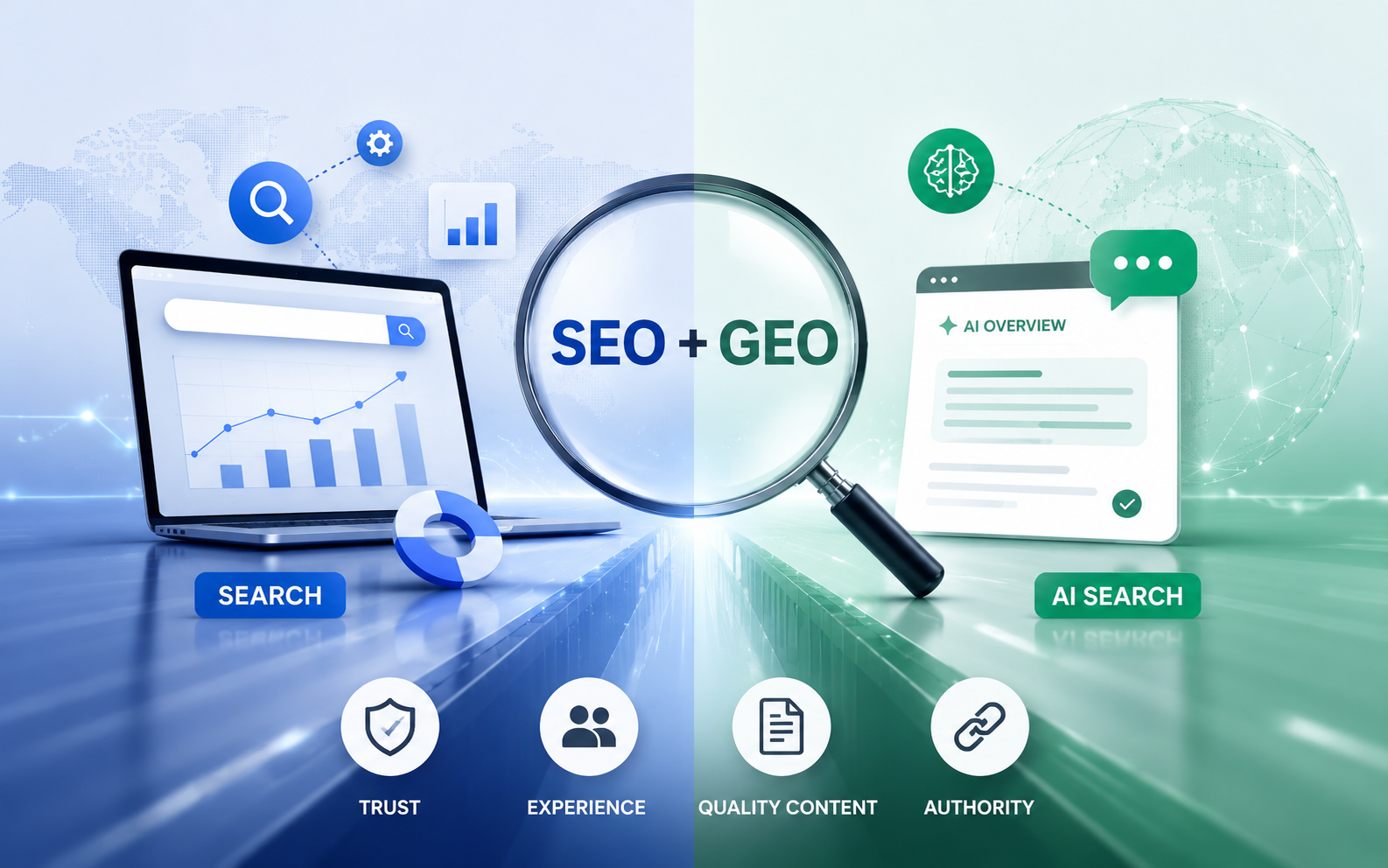
Why SEO and GEO Both Matter: Enterprise Website Growth in the AI Search Era
AI, MarTech
15 July 2026
1. Key Takeaways
- SEO helps search engines crawl and rank a website; GEO increases the likelihood that generative AI will understand and accurately present its content.
- Sound architecture, strong performance, semantically clear content, and trustworthy information form the shared foundation of both SEO and GEO.
- Look beyond keyword rankings—develop product knowledge, FAQs, comparison content, case studies, and consistency across third-party sources.
- SEO and GEO must be embedded in content production and governance, not treated as remedial work after launch.
- Integrating SEO and GEO builds organic traffic, brand awareness, AI visibility, and reusable content assets.
If a business needs to prioritise technical SEO, content governance, and AI search visibility together, LeadsTech’s SEO and GEO optimisation service provides a useful reference for planning and ongoing review.
2. Why Enterprises Need Both SEO and GEO
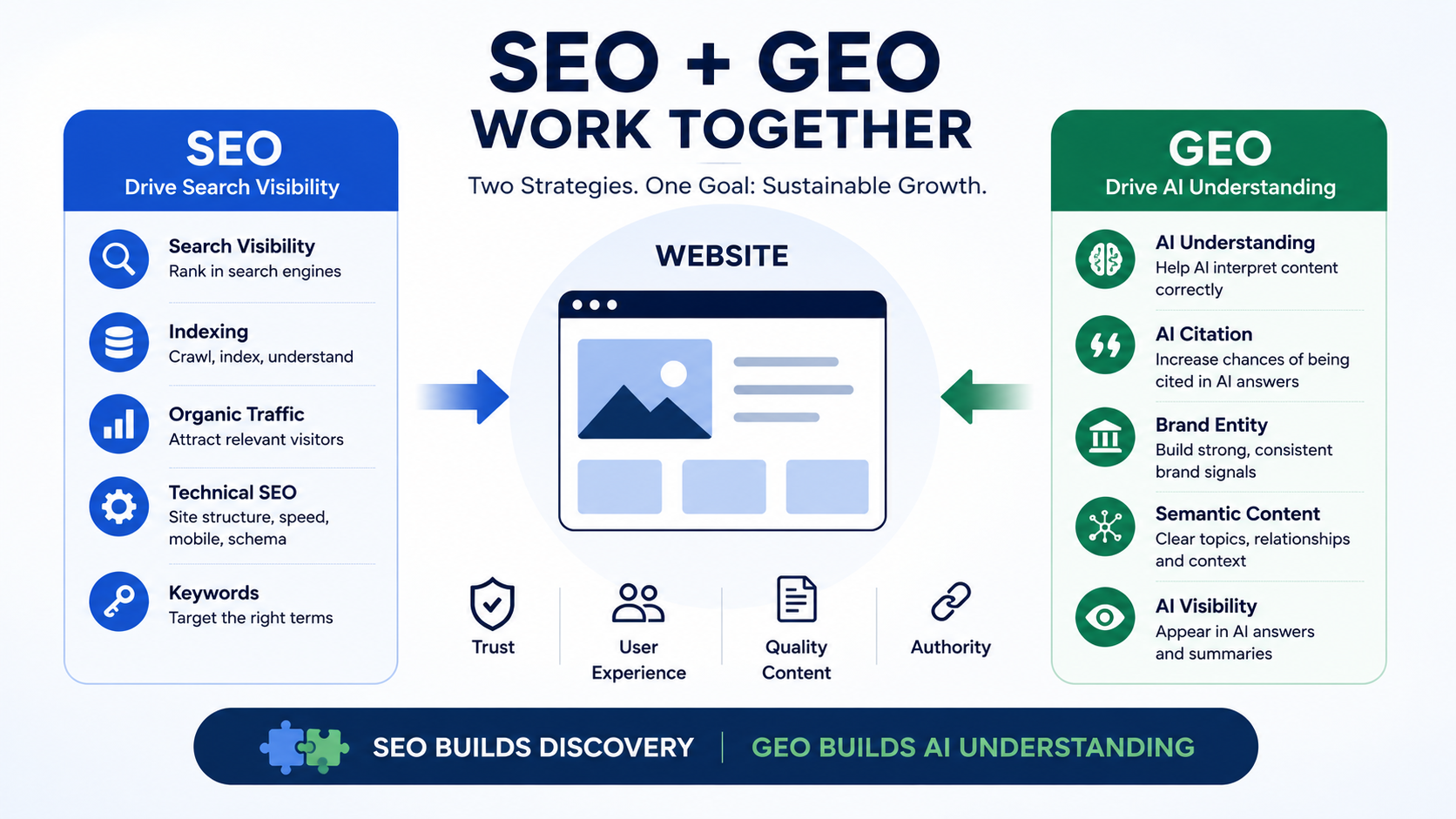
SEO (Search Engine Optimization) uses website technology, content, and external signals to help search engines discover, understand, and index pages, improving visibility in relevant search results.
GEO (Generative Engine Optimization) focuses on how content performs in generative search and large language models. Its goal is to increase the likelihood that brands, products, and services are accurately understood, mentioned, cited, or summarized.
Put simply, SEO addresses whether a website can be found by search engines, while GEO addresses whether AI can correctly understand a brand and its content.
Enterprise websites need both because user research behavior has changed. Users now ask AI complete questions such as:
- Which CMS is suitable for a multi-region enterprise?
- How should a B2B company improve organic traffic to overseas websites?
- Which is better for enterprise cross-border ecommerce: Adobe Commerce or Shopify?
- What capabilities should a company look for when selecting a MarTech consultant?
These represent complete decision-making scenarios, not merely keyword queries. If a website contains only brief promotional statements, feature lists, or disconnected articles, both search engines and AI will struggle to determine whether the content can adequately answer users’ questions.
3. Why SEO Alone Is Not Enough
Traditional search remains important, but search rankings no longer represent the full picture of digital visibility. When AI Overviews or conversational search summarizes answers directly, users may not open individual results. Even if an enterprise ranks for certain keywords, its content may not be correctly understood or mentioned by AI.
Common issues for enterprises that focus only on traditional SEO:
- Pages contain promotional slogans but lack clear definitions and specific explanations
- Important content relies on JavaScript loading, while original HTML provides incomplete information
- Product names, service scope, and brand descriptions contradict one another across pages
- Articles do not clearly answer user questions, making it difficult for AI to extract self-contained passages
- Websites lack author information, company background, and trust signals
- Translations on multilingual websites are inconsistent across markets
Enterprises need to consider whether their content can serve as understandable and trustworthy source material when AI answers questions.
GEO does not mean abandoning website traffic. When a brand is accurately mentioned in an AI answer, users may still visit product pages, compare solutions, or contact the sales team. GEO increases the likelihood that AI will correctly understand and cite an enterprise early in the decision-making journey.
4. How SEO and GEO Work Together
SEO and GEO are not two entirely separate disciplines. Search engines and AI systems both require accessible, clearly structured, and complete content.
SEO first establishes the conditions for content to be discovered, including:
Crawlable Pages
Logical URL Structure
Sitemap
Internal Links
Heading Hierarchy
Page Performance
Canonical
Structured Data
Mobile Experience
GEO then strengthens the semantic completeness of the content, making it easier for systems to identify the relationships among the enterprise, its products, the problems addressed, the solutions offered, and the intended audiences.
For example, in addition to a product name and primary keywords, an enterprise software product page should answer:
- What the product is and which business problems it solves.
- Which industries, company sizes, and user roles it is designed for.
- How its core capabilities work.
- How it differs from other solutions.
- Which data, processes, and system prerequisites are required before implementation.
- Common questions, limitations, and use cases.
- Whether relevant case studies, certifications, or professional expertise support its claims.
This information deepens the topical coverage of search pages while helping AI form a more accurate understanding of the brand and product.
5. Which Content to Optimize First
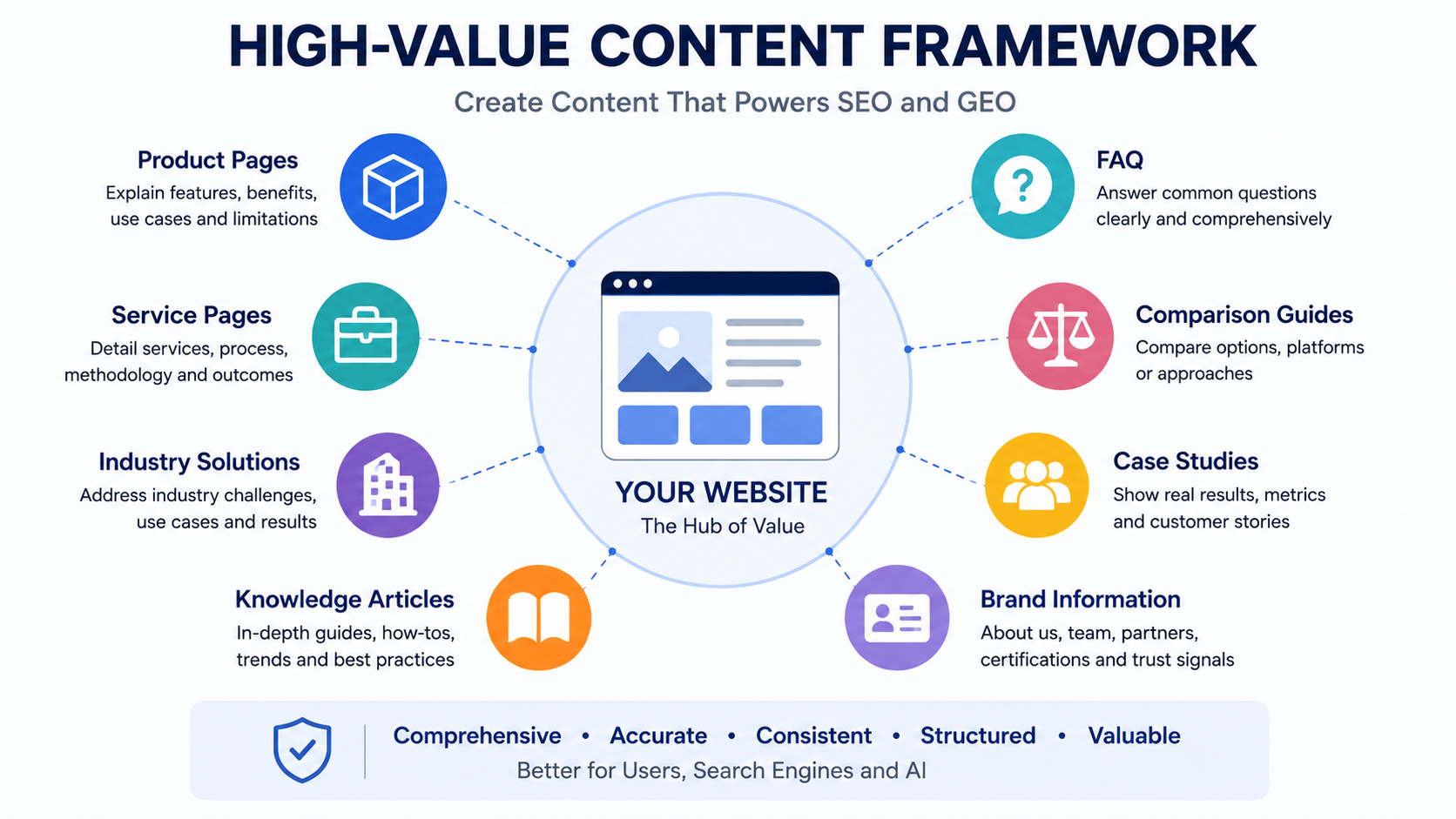
Enterprises do not need to rewrite all content at once. Begin with high-value commercial pages and establish an SEO+GEO optimization template.
Product and Service Pages
These pages carry the greatest commercial value. Rather than merely listing features, they should clearly explain product positioning, applicable scenarios, constraints, implementation methods, common questions, and differentiated value.
For example, when offering Adobe Experience Manager services, do more than say “We provide AEM implementation.” Also explain:
- Which enterprises is AEM suitable for?
- What content and systems should be prepared before implementation?
- How does AEM support multilingual websites and content governance?
- How does it differ from a standard CMS or other DXP platforms?
Solution and Industry Pages
Solution pages should address problems in specific industries. Financial services, retail, B2B manufacturing, and cross-border ecommerce each have different requirements for content management, data integration, CRM, and ecommerce platforms.
AI search favors content that clearly describes the scenario, pain points, solution, and conditions of use.
Comparison Pages and Selection Guides
Comparison content is highly valuable for both SEO and GEO:
- AEM vs Sitecore
- Shopify vs Adobe Commerce
- CRM vs CDP
- SEO vs GEO
- DXP vs CMS vs CDP
This content helps search engines and AI understand relationships among concepts, platforms, and solutions.
FAQs and Knowledge Content
FAQs should not be a short section at the bottom of a page. They should form part of content governance-organized into standardized modules and reused across product, service, and knowledge pages.
FAQs are well suited to answering:
- Who is this solution suitable for?
- What should be prepared before implementation?
- How does it differ from other platforms?
- Which factors affect cost and timeline?
Brand and Trust Content
GEO is influenced by brand entity consistency. Ensure the following remain consistent across official website, product pages, case studies, third-party media, and partner pages:
- Company and brand names
- Primary product and service categories
- Service regions and contact information
- Customer case studies, partners, and certifications
6. Building an SEO+GEO Governance Process
SEO and GEO should be embedded in the enterprise content production process, not treated as post-publication checks. Enterprises can build a governance framework through the following steps.
Step 1: Audit High-Value Content
Prioritize core product pages, service pages, brand introductions, comparison articles, FAQs, and pages with existing organic traffic. Identify outdated, insufficient, or incomplete content.
- Which pages generate traffic but have low conversion rates?
- Which pages rank well but contain incomplete content?
- Which pages does the sales team frequently share?
- Which content contradicts other language versions?
Step 2: Build a Question and Topic Architecture
Organize keywords into awareness, comparison, evaluation, and procurement questions, then connect related pages into topic clusters.
For example, beyond publishing a single “What is a CDP?” article, also cover:
- CDP vs CRM
- How to choose a CDP provider
- The CDP implementation process
- How CDP supports personalized marketing
Step 3: Improve Content and Technical Readability
Ensure primary text is in readable HTML, and review heading hierarchy, internal links, Canonical, Sitemap, and structured data.
- Whether the page can be crawled and important content is in HTML
- Whether Canonical and Sitemap are correct
- Whether internal links connect related topics
- Whether structured data is consistent with page content
Step 4: Establish a Pre-Launch Checklist
Content, SEO, IT, product, and legal teams should establish a shared checklist:
- Does the page clearly answer the target user’s primary questions?
- Are product and service descriptions consistent across channels?
- Are correct metadata, internal links, and structured data configured?
- After updates, is content synchronized across all languages?
- Does the page contain overpromises or unverified claims?
Step 5: Regularly Monitor AI Answers and Brand Descriptions
Establish a fixed set of questions and regularly review how different AI platforms describe your brand, products, and services.
- What services does the enterprise provide?
- Which enterprises is a particular product suitable for?
- How does a particular platform differ from competitors?
When an AI answer is incorrect, trace its sources-whether from the official website, third-party media, reviews, or outdated content-and correct accordingly.
7. Technical Architecture in SEO+GEO
Content quality matters, but technical architecture also affects how search engines and AI understand a website. Even excellent articles will have limited impact if website content cannot be properly crawled, indexed, or read.
Enterprises should pay particular attention to the following technical foundations:
CMS and Content Models
Enterprise websites need a stable CMS and content model to manage product pages, case studies, and FAQs consistently—preventing content from operating in isolation.
Structured Data
Structured data helps identify organizations, products, and FAQs, but cannot replace main content. Common types: Organization, Product, Article, FAQ, Breadcrumb.
Website Speed and Page Experience
Website speed, mobile experience, and Core Web Vitals remain fundamental for user experience, conversion, and search performance.
Multilingual Website Governance
Ensure hreflang, canonical, URL structures, and sitemaps are correct. Brand names, product descriptions, and case studies should stay consistent across languages.
System Integration and Data Tracking
Connect SEO/GEO performance to business outcomes via Analytics, CRM, CDP, and marketing automation. Track visitor sources, content interactions, inquiries, and conversions.
8. Measuring SEO, GEO, and AI Visibility
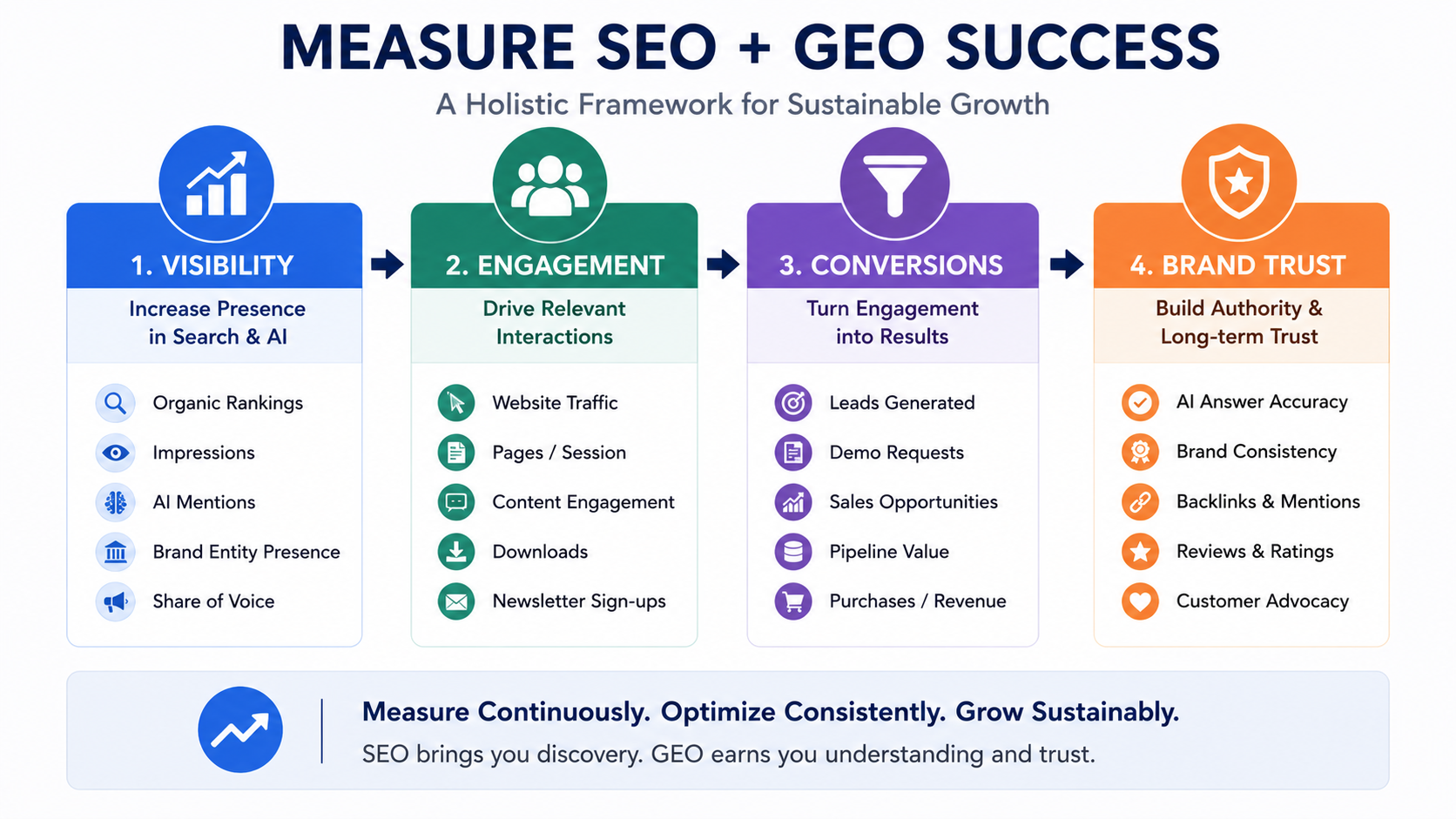
SEO performance can be measured through organic impressions, click-through rates, keyword rankings, index coverage, website traffic, and conversion behavior. GEO requires additional dimensions, such as whether the brand appears in relevant AI answers, whether its description is accurate, whether AI referral traffic can be tracked, and how visible the brand is for important questions.
Enterprises should not rely on a single metric. A more practical approach is to build a “visibility–engagement–conversion” measurement framework.

Visibility
Monitor brand appearance in search results and AI answers, including rankings, mentions, and citation accuracy.

Engagement
Analyze visitors from organic search and AI channels—whether they read key content, click product pages, or view case studies.

Conversion
Evaluate whether visitors submit inquiries, book demos, enter the sales process, or complete purchases.

Content and Brand Governance
Regularly check whether AI answers accurately describe the enterprise's products and services. Correct errors at their source.
GEO remains an evolving field, and AI answers may vary by platform, region, time, and query wording. Enterprises should therefore use fixed question sets, cross-platform monitoring, content correction, and brand entity governance instead of relying on one-time ranking or AI citation promises.
9. Frequently Asked Questions (FAQ)
What Are the Main Differences Between SEO and GEO?
SEO improves visibility in traditional search results; GEO increases the likelihood that generative AI will understand and cite the content. Both require a crawlable website and high-quality content.
Do Enterprises Still Need SEO After Implementing GEO?
Yes. AI systems rely on public, accessible, credible web information. SEO builds the foundation; GEO optimizes how AI understands and cites it.
Does GEO Only Require Adding FAQs?
No. GEO also involves content completeness, semantic structure, brand consistency, structured data, and credibility. FAQs alone are not enough.
Can Structured Data Guarantee That AI Will Cite a Website?
No. Structured data helps machines understand pages but cannot guarantee rankings or AI citations. Content must be accurate and consistent.
Which Enterprises Need an Integrated SEO and GEO Strategy Most?
B2B, technology, financial services, healthcare, manufacturing, retail, and cross-border enterprises with complex products, long sales cycles, or multilingual websites.
10. Conclusion
The AI search era has not diminished the value of SEO; it has expanded the scope of website optimization. Enterprises must ensure that search engines can discover and rank their content while enabling generative AI to accurately understand their brand, products, and expertise.
A sustainable website growth strategy integrates SEO, GEO, content governance, and technical architecture into a single operating process. Strengthen technical SEO, content quality, brand consistency, and readability first, then progressively add question-led content, entity governance, AI visibility monitoring, and answer accuracy management.
If your enterprise would like to assess its website’s search performance, AI readability, content architecture, or technical limitations, visit the LeadsTech Contact Us page to discuss the most suitable optimization approach:

You can also explore LeadsTech’s SEO and GEO optimization services to learn how technical SEO, content strategy, and AI search visibility can establish a more complete foundation for website growth:

Further Reading
- SEO and GEO Optimization Services
Learn how LeadsTech helps enterprises integrate search optimization, AI visibility, website performance, and content strategy. - From SEO to GEO: How AEM LLM Optimizer Helps AI Understand and Cite Enterprise Content
Discover how enterprises can monitor brand performance in generative search and establish a continuous optimization process. - AEM Sites Enterprise Content Management Platform
Learn how enterprises can use a content management platform to support multiple websites, multiple languages, and consistent content governance.
Related Articles
Enterprise AI MarTech Trends Analysis 2024-2029 Outlook Report
From AI content productivity tools to a core engine for revenue growth and marketing transformation
*The PDF will be sent directly to your inbox.