
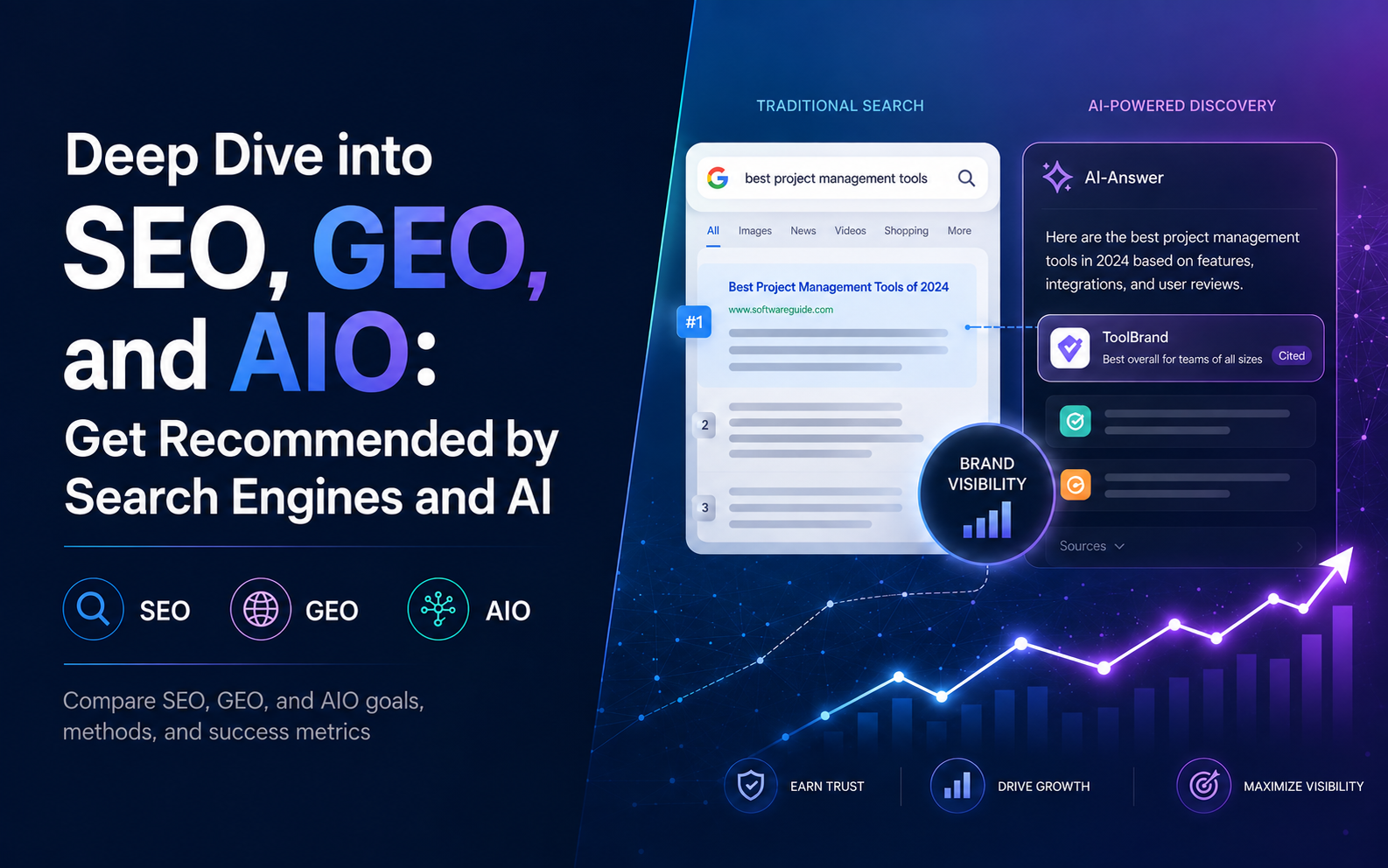
1. Key Takeaways
- SEO primarily helps search engines crawl, understand and rank web pages, while GEO focuses on increasing the likelihood that generative AI will understand, organize, cite or accurately present branded content.
- GEO will not replace SEO, because search indexing, content quality, website technology, brand credibility and consistency across third-party sources remain important foundations for most AI search experiences.
- AIO can be understood as AI Optimization, a broad term for optimizing content for AI search, AI assistants, generative answers and AI agents. In this article, AIO does not refer specifically to Google AI Overviews.
- Enterprises need to expand beyond keywords and individual page rankings to manage question coverage, brand entities, product entities, answer accuracy, citation sources and AI visibility.
- The most effective approach is not to manage SEO and GEO separately, but to establish a content process that serves search engines, generative AI and real users.
2. What Are SEO, GEO and AIO? Definitions and Relationships
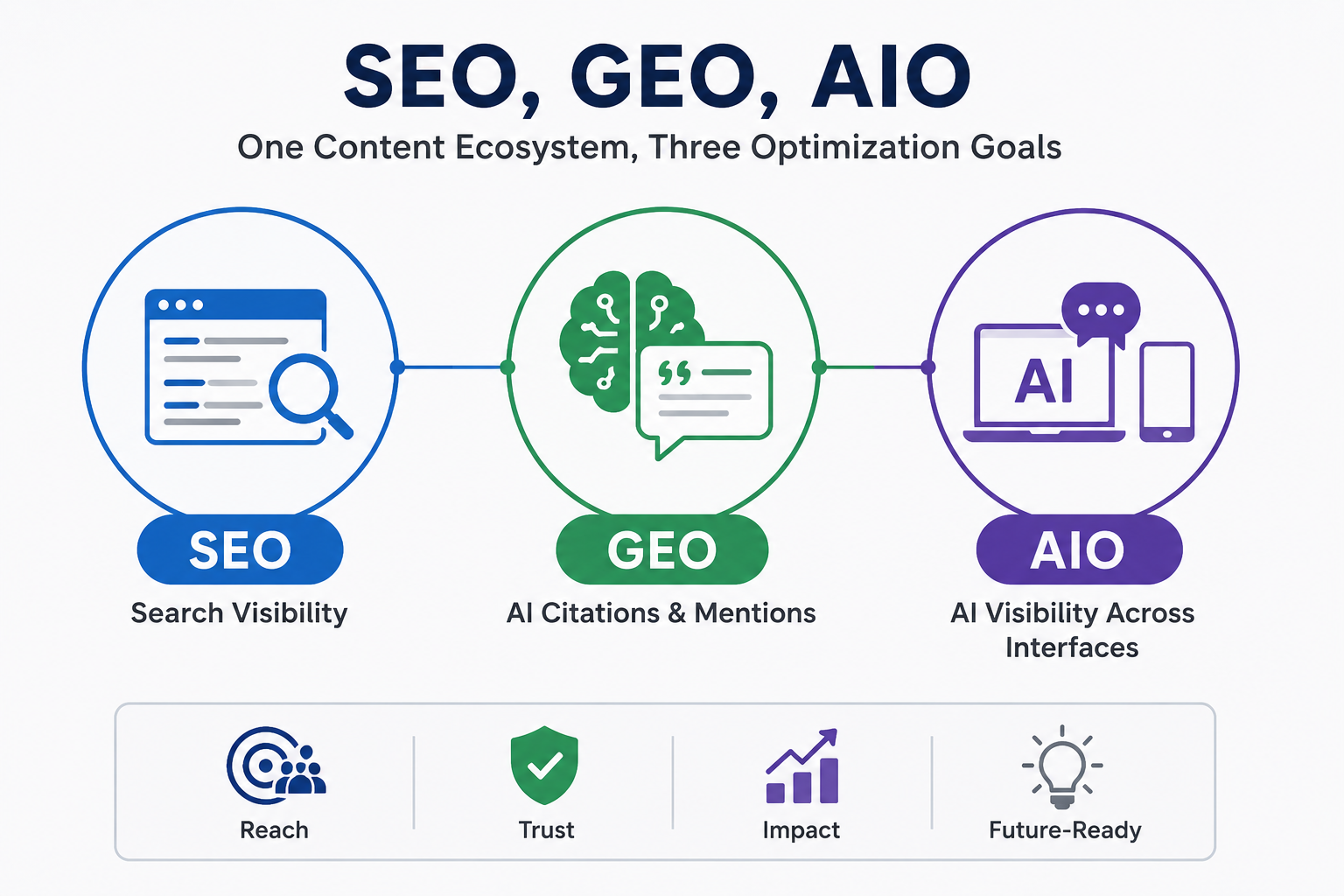
SEO (Search Engine Optimization) uses website technology, content and brand authority signals to improve the visibility of web pages in organic search results. Common activities include keyword research, page title optimization, internal linking, website speed optimization, structured data, index management and content updates.
GEO (Generative Engine Optimization) focuses on generative search engines and large language models. Its goal is not merely to place a web page in a list of search links, but to increase the likelihood that AI-generated answers will understand, summarize, cite or accurately present an enterprise’s brand, products, services and expert content.
AIO can be understood as AI Optimization, a broad term for optimization aimed at AI search, AI assistants, generative answers and AI agents. However, AIO is not yet a fully standardized industry term and may be used differently across markets. In some contexts, AIO also refers to AI Overviews Optimization, meaning optimization specifically for Google AI Overviews. Enterprises should therefore agree on a definition in internal discussions to avoid conflating AI search features, generative answers and content optimization methods.
In simple terms:
- SEO addresses whether content can be found in search results.
- GEO addresses whether content can be understood, cited or accurately presented in generative answers.
- AIO can describe the management of a brand’s visibility and comprehensibility across a broader range of AI interfaces.
3. SEO vs GEO Comparison: Goals, Methods and Performance Metrics
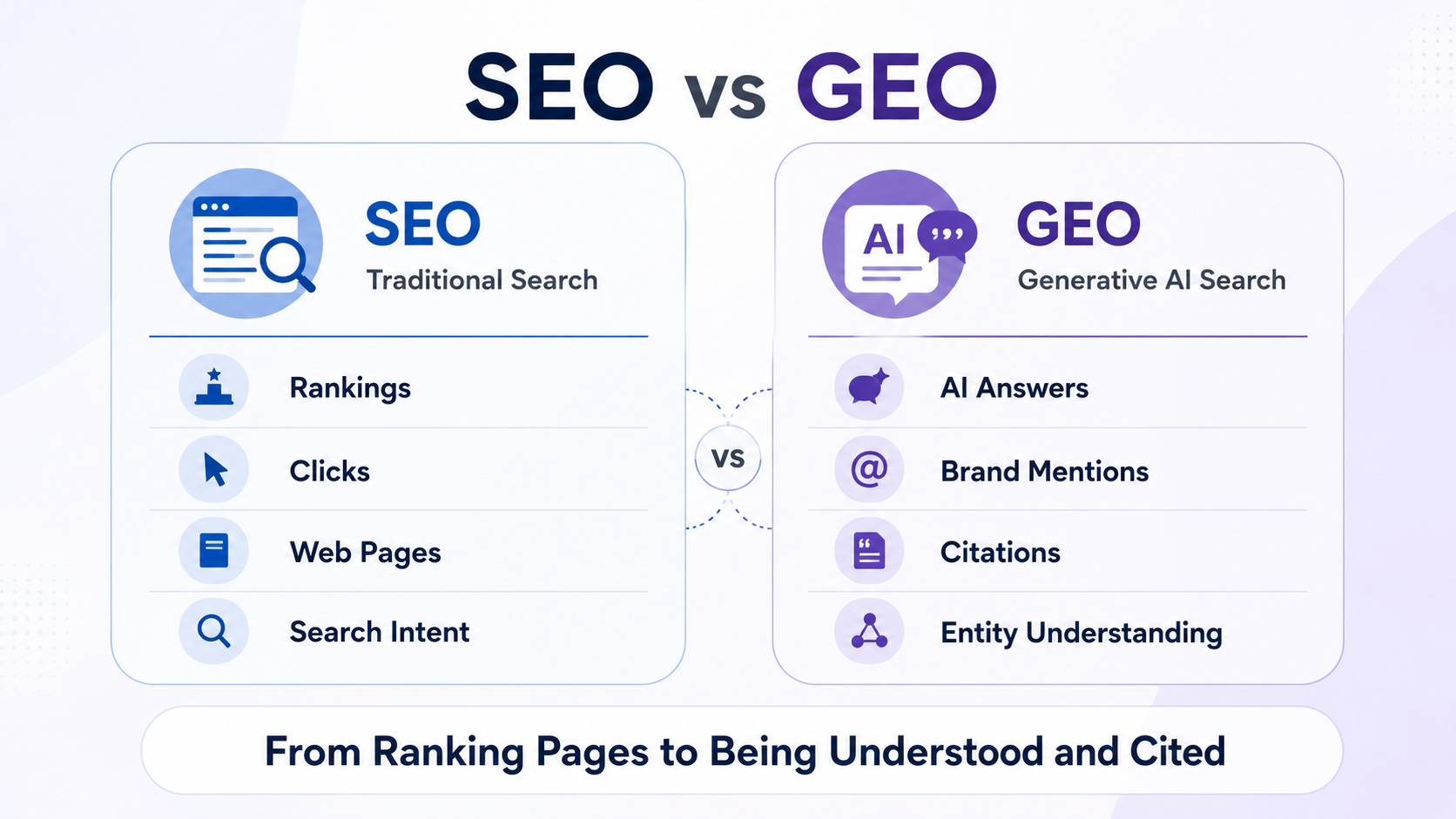
| Comparison Item | SEO | GEO |
|---|---|---|
| Primary Goal | Improve organic search rankings and clicks | Increase opportunities for brand mentions, source citations and accurate descriptions in AI-generated answers |
| User Entry Point | Search engine results pages | AI search, chatbots and intelligent assistants |
| Unit of Optimization | Keywords, search intent and web pages | Questions, topics, brand entities, product entities and citable information |
| Content Requirements | Satisfy search intent and provide a good page experience | Provide clear, complete answers that can be understood independently |
| Technical and Content Priorities | Crawling, indexing, performance and site architecture | Crawlability, indexability, semantic structure, information consistency and citable passages |
| Primary Metrics | Rankings, impressions, clicks, traffic and conversions | Brand mentions, source citations, answer accuracy and AI referral traffic |
SEO typically focuses on whether a page can achieve a strong ranking for a specific query. GEO requires enterprises to assess whether an AI system identifies the company as a relevant source when a user asks a complete question, and whether the generated brand description is accurate.
Generative AI may not rely on a single web page. It may synthesize an answer from a company’s website, product pages, news, reviews, third-party media, partner pages and other public content. GEO therefore places greater emphasis on whether brand and product information is consistent across pages and sources.
4. Why Can Enterprises No Longer Rely on Traditional SEO Alone?
Traditional search remains important, but search rankings no longer represent the full scope of digital visibility. When AI Overviews, AI Mode or conversational search directly assembles an answer, users may not open search results one by one. Even if an enterprise ranks for certain keywords, it may not appear in AI-generated answers.
This shift is particularly important for B2B enterprises. Decision-makers may ask directly, “Which content management system is suitable for a multi-region enterprise?”, “How should different e-commerce platforms be compared?” or “Which service providers have integration capabilities?” If a corporate website contains only brief promotional statements and does not clearly explain product capabilities, use cases, limitations and implementation methods, AI will struggle to determine whether the content can adequately answer the question.
GEO does not mean abandoning website traffic. When a brand is accurately mentioned in an AI-generated answer, users may still visit product pages, compare options or contact the sales team. GEO helps an enterprise enter the consideration set earlier in the research and decision journey.
Enterprises therefore need to manage two forms of visibility simultaneously:
- Page visibility in search results
- Brand and content visibility in generative AI answers
5. What Foundations Do SEO and GEO Share?
The shared foundation of SEO and GEO is useful, reliable and accessible content. Enterprises do not need to rebuild their entire websites for GEO; they should first improve their existing content and technical foundations.
Shared activities include:
- Use clear H1 and H2 headings, paragraphs and page structures so that each section focuses on answering one question.
- Ensure important content can be read directly by search engines and AI tools instead of existing only in images or complex interactive components.
- Create accurate page titles, meta descriptions, internal links and structured data.
- Provide original analysis, professional experience, comparison criteria, implementation steps and limitations instead of mass-producing similar content.
- Regularly update company names, product features, service scope, case studies, credentials and market information to prevent contradictions across pages.
- Keep brand descriptions consistent across the official website, product pages, service pages, third-party media and partner pages.
Google’s official guidance for AI search features continues to follow core SEO principles: pages need to meet technical search requirements, be indexable and provide reliable, user-centric content. Enterprises should therefore not view GEO as a shortcut around SEO.
6. What Content and Entity Governance Work Does GEO Require?
Building on the foundations of SEO, GEO requires enterprises to reorganize content as knowledge that can be understood and cited.
First, content should begin with complete questions. Instead of writing only around short keywords such as “enterprise CMS,” an enterprise can also answer “How does an enterprise CMS support multi-market content governance?” and “Which integration capabilities should be assessed when selecting an enterprise CMS?” The answer should respond directly first, then provide reasons, conditions and examples.
Second, enterprises need to strengthen consistency across brand and product entities, including company names, product names, service categories, service regions, official descriptions, case studies, credentials and contact information.
Enterprises should also:
- Add definitions, comparison tables, use cases, processes and frequently asked questions.
- Present important information in complete sentences that can be understood without additional context.
- Clearly distinguish existing product features, consulting services and future plans.
- Regularly review how AI platforms describe the brand, products, services and applicable scenarios, and investigate whether inaccurate information may originate from the official website, third-party media, reviews or outdated pages.
- Avoid chasing special markup, keyword stuffing or large volumes of fabricated brand mentions.
What Should Brand Entity Governance Include?
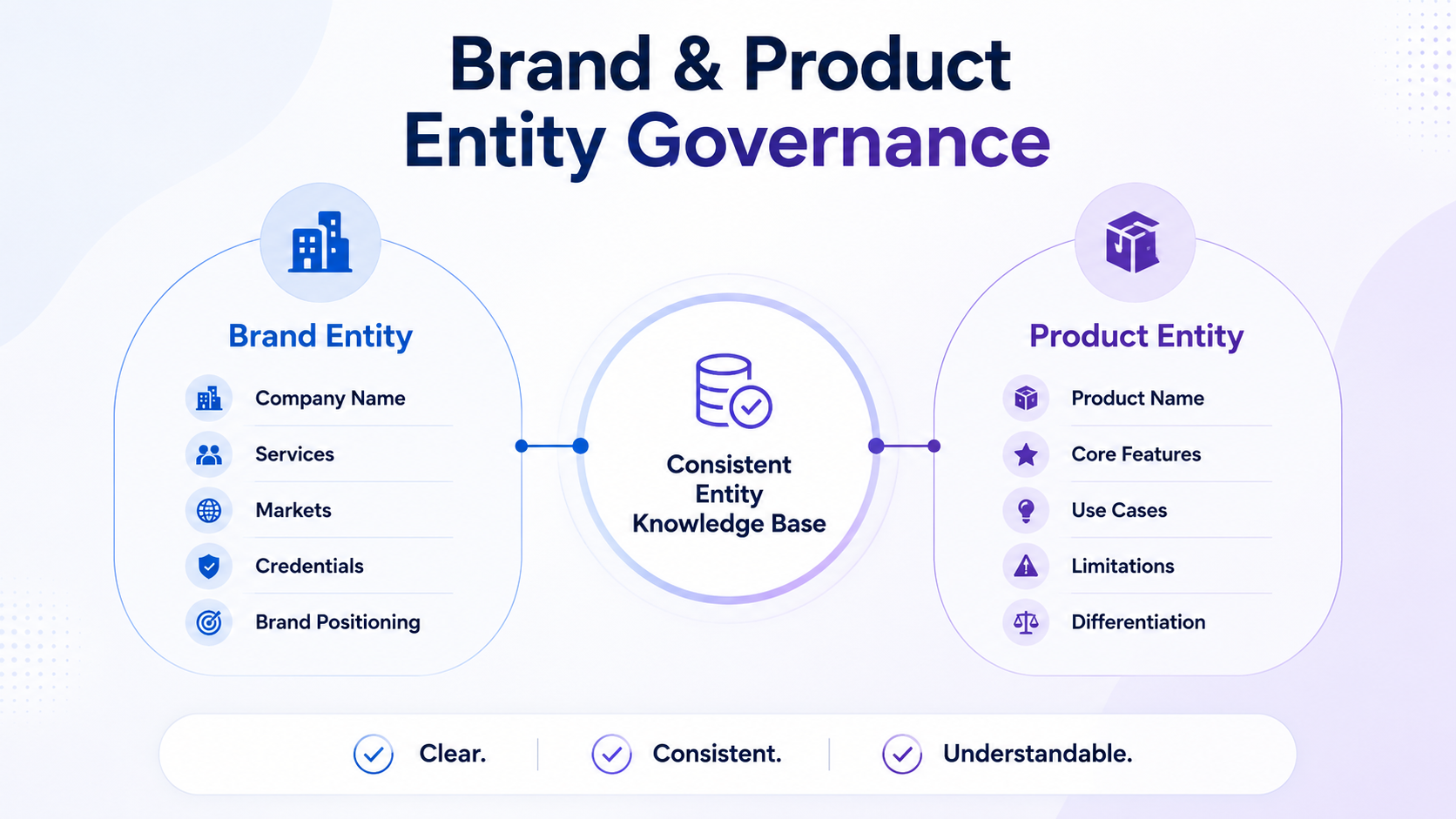
The purpose of brand entity governance is to help AI and search engines clearly understand who the enterprise is, which services it provides, which markets it serves, and which products or solutions it is associated with.
Enterprises should keep the following information consistent:
- Company and brand names
- Primary product and service categories
- Official product descriptions
- Service regions
- Customer case studies
- Partners and certifications
- Primary contact methods
- Company profile and brand positioning
What Should Product Entity Governance Include?
Product entities are equally important for SaaS, MarTech, e-commerce platform and enterprise service companies. AI needs to understand a product's name, category, target enterprises, functional boundaries and implementation requirements.
Product entity governance should include:
- Product name
- Product category
- Core features
- Applicable scenarios
- Inapplicable scenarios or limitations
- Differences from other products
- Implementation method
- Value proposition
- Links to official product pages and related articles
Some platforms can help monitor brand appearances in AI-generated answers, citation sources and content gaps, but tools can only provide analysis and recommendations. Content, SEO, technical and brand teams still need to work together to determine which changes align with the facts and business strategy.
7. How Can Enterprises Build an Integrated SEO, GEO and AIO Strategy?
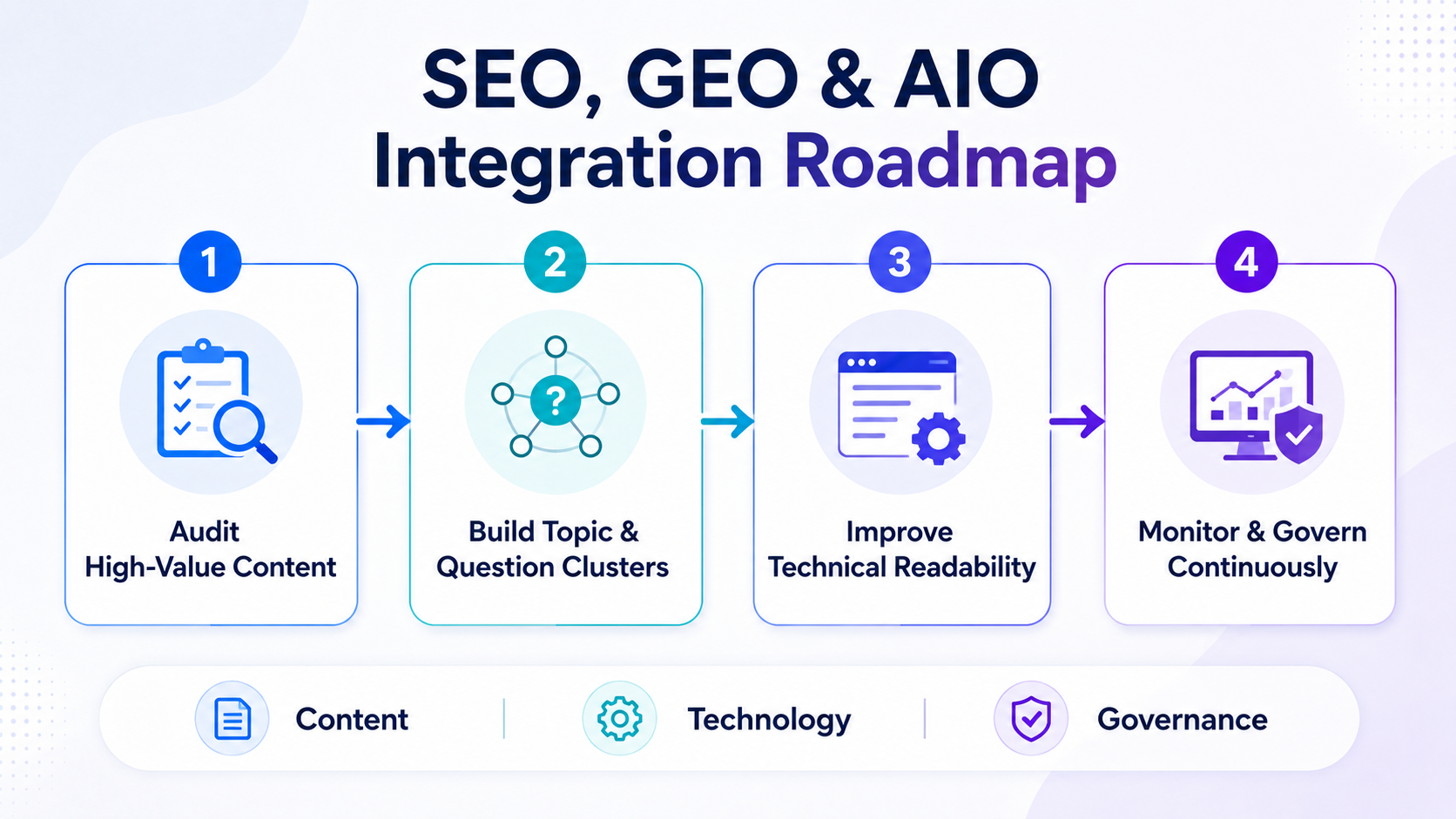
Enterprises can proceed in four stages.
Step 1: Audit High-Value Content
Prioritize reviews of key product pages, service pages, brand profiles, comparison articles, FAQs and pages that already receive organic traffic. Identify outdated content, information gaps and areas that fail to answer procurement questions.
The audit can focus particularly on the following page types:
- Product pages
- Service pages
- Industry solution pages
- Platform comparison pages
- Consultative selection guides
- FAQ pages
- Case study pages
- Company profile and credentials pages
Step 2: Build a Question and Topic Architecture
Organize keywords into awareness, comparison, evaluation and procurement questions, then connect related pages into complete topic clusters. This helps search engines understand the site architecture and enables AI to identify the enterprise’s areas of expertise.
For example, an enterprise should not create only a “What is a CDP?” article. It should also cover:
- CDP vs CRM
- How to choose a CDP service provider
- CDP implementation process
- The relationship between CDP and AEP / RTCDP
- How a CDP supports personalized marketing
- How different industries use a CDP
Step 3: Improve Content and Technical Readability
Confirm that primary text is present in readable HTML, and check heading hierarchy, internal links, canonical tags, sitemaps and structured data. Structured data should accurately reflect the content already on the page rather than introducing information the page does not provide.
Technical checks can include:
- Whether the page is crawlable
- Whether important content is present in HTML
- Whether the canonical tag is correct
- Whether the sitemap includes important pages
- Whether internal links connect related topics
- Whether structured data is consistent with page content
- Whether product, service, FAQ, article and organization information is clear
Step 4: Establish Ongoing Governance
SEO, content, product and technical teams need to jointly maintain names, features, specifications and market information. When an AI-generated answer contains an error, the enterprise should trace the source, correct contradictory content and continue testing different questions and platforms.
Enterprises are advised to establish a fixed question set, such as:
- Which services does the enterprise provide?
- Which enterprises is a particular product suitable for?
- How does a particular platform differ from its competitors?
- Does a particular service provider have a specific capability?
- How should a particular type of solution be selected?
With a fixed question set, enterprises can track more consistently how AI platforms understand the brand and determine whether the content needs strengthening.
LeadsTech can help enterprises assess their current SEO and GEO performance, plan content architecture, conduct technical reviews, implement platforms and integrate systems. Software vendors, meanwhile, provide analytics, monitoring or content optimization capabilities for individual products. Enterprises should select an appropriate combination based on their existing websites, team workflows and governance requirements.
8. How Should SEO, GEO and AIO Performance Be Measured?
SEO can continue to use metrics such as organic search impressions, rankings, click-through rates, traffic, queries and conversions. GEO and AIO require the following additional measures:

Brand Mention Rate
Whether AI mentions the enterprise or product in response to specified questions.

Website Citation Rate
Whether the enterprise website is listed as a source in answers, and which pages are cited most frequently.

Answer Accuracy
Whether AI descriptions of the brand, products and services are accurate.

Topic Coverage Rate
Whether the brand appears in important questions, comparisons and procurement scenarios.

AI Referral Traffic
Website visits, engagement and conversions from AI platforms.

Third-Party Source Consistency
Whether third-party media, reviews and partner pages are consistent with descriptions on the official website.

Business Outcomes
Whether the relevant visibility generates enquiries, content downloads, sales opportunities or revenue.
Because AI-generated answers may change by model, time, region and prompt wording, enterprises should not assess performance based on a single test. A more reliable approach is to establish a fixed question set, testing cycle and scoring criteria, and then monitor trends continuously.
9. Frequently Asked Questions (FAQ)
1. What Is the Biggest Difference Between SEO and GEO?
SEO primarily improves web page rankings and clicks in search results; GEO primarily increases opportunities for content to be mentioned, cited and accurately described in generative AI answers. Their goals differ, but they share the same foundations of website technology, content quality and credibility.
2. Is SEO Still Necessary After Implementing GEO?
Yes. Generative search may still rely on search indexes, website content and quality signals. If a page cannot be crawled, indexed or understood, it will usually also struggle to establish consistent AI visibility.
3. Does Adding Structured Data Guarantee That AI Will Cite the Content?
No. Structured data helps machines understand content types and entity relationships, but citation still depends on relevance, content quality, credibility, readability and how each platform processes the information.
4. Is llms.txt Required for GEO?
Not at present. llms.txt is currently not a requirement for visibility in Google Search or most AI search experiences. Enterprises can assess it where appropriate, but should not treat it as a special shortcut that guarantees exposure. Indexability, content quality, site architecture and consistency of brand information should remain the priorities.
5. Does GEO Mean Manipulating AI-Generated Answers?
No. GEO should not seek to manipulate AI-generated answers. Its proper purpose is to improve content clarity, credibility, structure and information consistency so that AI can understand the brand and content more accurately when assembling answers.
6. Why Does Third-Party Content Also Affect GEO?
Generative AI and AI search may consult multiple sources rather than relying solely on an enterprise's official website. Third-party media, reviews, partner pages, product directories and public data can all influence how AI understands a brand and its products. Enterprises therefore need to manage the consistency of brand descriptions across external sources.
10. Conclusion
SEO vs GEO is not an either-or choice. SEO ensures that search engines can discover, understand and rank content; GEO helps generative AI accurately understand, cite and present a brand; and AIO extends optimization to a broader range of AI search, assistant and agent scenarios.
Enterprises should first strengthen technical SEO, content quality and brand information, then add question-led content, entity governance, AI visibility monitoring and answer accuracy management.
An integrated strategy enables enterprises to serve search engines, generative AI and real customers at the same time, creating more durable digital content assets.
If your enterprise would like to assess the SEO, GEO and AI readability of its current website, or needs to plan content governance, technical architecture and monitoring processes, visit the LeadsTech Contact Us page to speak with our consulting team about an implementation approach suited to your business objectives and existing systems:
To learn more about LeadsTech’s SEO, GEO or digital content optimization services, visit the relevant service page to explore how we work, from strategic audits and technical improvements to ongoing optimization:
Learn More About SEO, GEO and Digital Content Optimization Services
11. Further Reading
- From SEO to GEO: How AEM LLM Optimizer Helps AI Understand and Cite Enterprise Content Accurately
Learn how enterprises can monitor generative AI visibility, citation sources and content optimization opportunities. - Building an AI-Ready Enterprise Content Platform: A Complete Guide to AEM Cloud Service and Optimizer
Learn how AEM Cloud Service, Sites Optimizer and LLM Optimizer support SEO, GEO and AI search content governance. - E-commerce Website Development Services | Adobe Commerce, Magento and Shopify Implementation
Learn how LeadsTech helps enterprises plan e-commerce platforms, system integration and SEO/GEO optimization. - Cross-Border E-commerce Website Solutions: AEM + Adobe Commerce Architecture Explained
Learn how content management, e-commerce platforms and multi-market digital experiences can be integrated.
Related Articles
Enterprise AI MarTech Trends Analysis 2024-2029 Outlook Report
From AI content productivity tools to a core engine for revenue growth and marketing transformation
*The PDF will be sent directly to your inbox.