
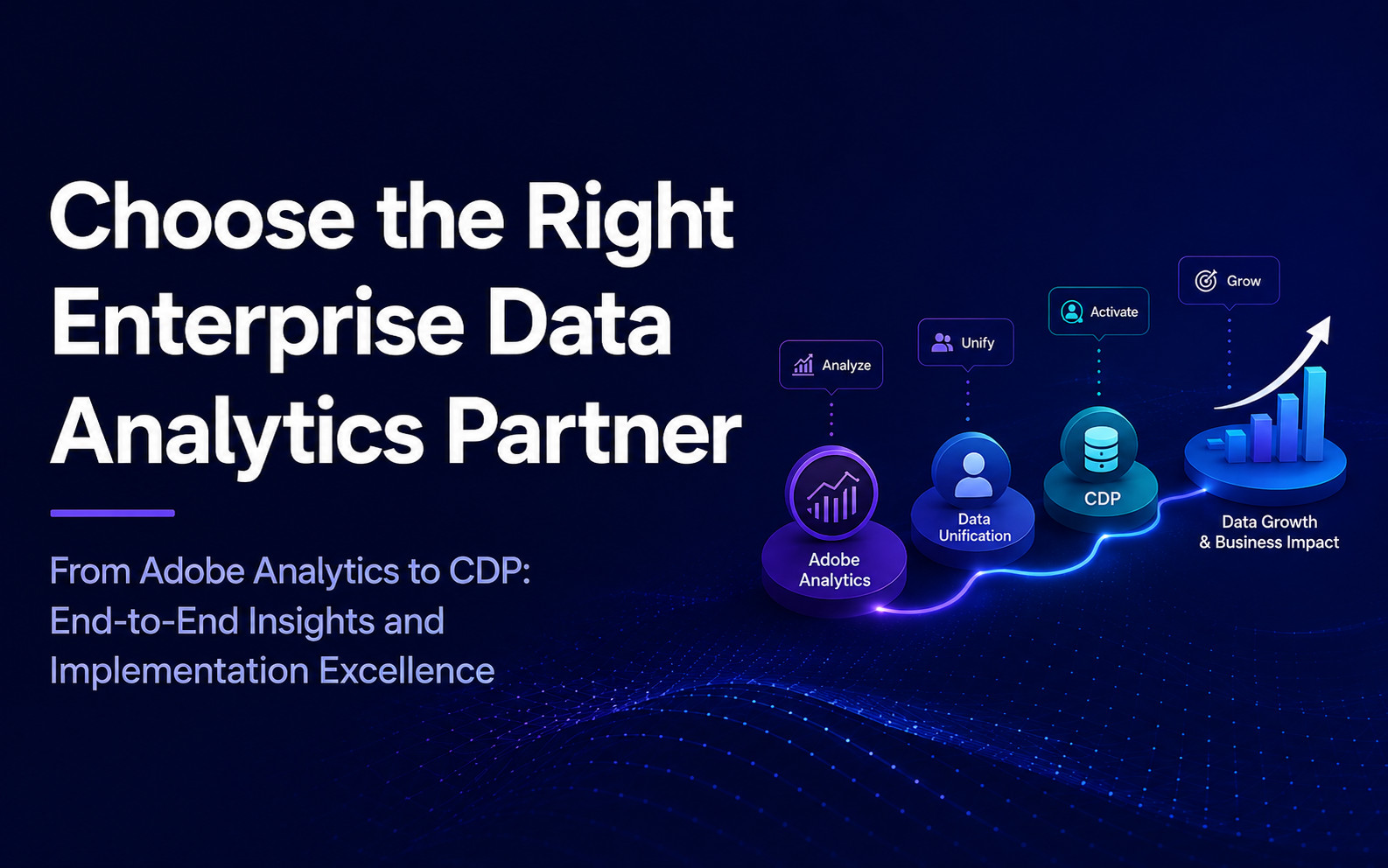
How to Choose an Enterprise Data Analytics Partner: Adobe Analytics to CDP
Adobe Analytics, CDP, MarTech, Website Analytics
3 June 2026
Summary
Enterprise teams often have plenty of data but few insights they can use to make better decisions. Choosing the right data analytics partner is not simply about deploying Adobe Analytics. It is about connecting data collection, measurement, behavioral analysis, CDP integration, and activation into an operating model that supports growth.
In practice, the analytics design needs to answer real business questions before it becomes a reporting program. LeadsTech approaches web and customer journey analytics by clarifying outcomes, metrics, and data readiness first, then building a measurement and optimization process that teams can sustain.
1. Why enterprises need a specialist analytics partner
Many organizations already use several tracking tools, yet still cannot answer which channels create qualified demand, where customers drop out, or whether the data can support the next marketing decision. The issue is usually not the number of dashboards. It is the absence of shared definitions, reliable cross-system data, and a practical operating rhythm.
A capable partner looks at website, app, CRM, media, and service data through the same business question. It also leaves behind tracking specifications, quality checks, and reporting guidance that the internal team can use after the project ends.
Business outcomes and decision context
Start with acquisition, conversion, retention, or customer value—not with a preferred tool.
Data quality and event design
Naming, identity resolution, consent, and the data layer are the foundation for trustworthy analysis.
A sustainable optimization loop
Regular checks, insight reviews, and experiments help data keep supporting decisions.
2. Define the business question before choosing a platform
Before comparing providers, map the journeys and decisions that matter: where visitors arrive from, when they submit an inquiry, whether they become qualified opportunities, and how cross-channel interactions influence conversion. Without this step, even a sophisticated platform can create conflicting numbers.
Ask each provider to walk through a real scenario: how events will be defined, how data will be validated, and how an insight will lead to a marketing or product action. That is a better indicator of implementation quality than a dashboard demonstration.
Digital journey analytics
This supports analysis of web, app, form, content, and media behavior when event and attribution rules can be maintained over time.
Customer data and cross-channel activation
When CRM, transaction, membership, or service data must be connected, assess identity resolution, permissions, governance, and activation—not just ingestion features.
3. How Adobe Analytics and CDP capabilities fit together
Adobe Analytics helps teams understand digital behavior and content engagement. When an organization needs a broader view across channels and customer data, Customer Journey Analytics, Experience Platform, or a CDP may become relevant. These are not simple upgrade steps; each assumes different data sources, governance maturity, and use cases.
The key question for a services partner is not how many platforms it can name. It is whether the team can explain what the existing stack can solve now, what data gaps need governance, and when a broader customer-data architecture is justified.
Strategy and measurement design
Translate business objectives into KPIs, events, funnels, and audience rules with a testable measurement plan.
Technical and data integration
Handle tag management, data layers, ingestion, identity, permissions, and consent requirements in the implementation.
Operations and knowledge transfer
Provide testing, documentation, training, and an optimization cadence so the internal team can operate the solution.
4. How to assess implementation capability
Look for a provider that begins with discovery and a current-state assessment instead of offering a fixed package immediately. A mature plan documents data sources, assumptions, risks, acceptance criteria, and the internal work required from your team.
Ask for concrete deliverables: tracking specifications, a data dictionary, test records, dashboard guidance, governance responsibilities, and a post-launch optimization plan. These are what reduce risk when systems change or teams hand over responsibilities.
5. Delivery and governance priorities
A practical delivery plan usually moves through four stages: align on business goals and available data; design events, metrics, and permissions; validate with test data before phased launch; then establish recurring quality and optimization reviews. Each stage needs an accountable owner and clear acceptance criteria.
Consent, privacy, retention, and access controls must be designed from the outset. This is especially important when information moves into CRM, media, or marketing automation systems, where marketing, IT, legal, and operations all share responsibility.
6. Frequently asked questions
Will Adobe Analytics solve every data problem?
No. It needs clear measurement goals, event standards, quality checks, and an operating process before it can produce reliable insight.
When should we evaluate a CDP?
Consider it when multiple sources must form a consistent customer view and audiences need to be activated across channels, provided governance is ready.
How should we compare service providers?
Use the same requirements and acceptance criteria to compare strategic understanding, technical execution, governance, knowledge transfer, and ongoing support.
Which internal roles need to participate?
Business or marketing owns outcomes and journeys; IT or developers support systems and data; analytics or operations helps validate and use the results.
How do we validate the data?
Check event firing, fields, identity resolution, reported results, and the real journey together, with test evidence and owners for corrections.
How do we prevent data from degrading after launch?
Maintain version control, audits, change procedures, and training; review measurement impact before major site or system releases.
7. Conclusion
Choosing an enterprise analytics partner means choosing a way to connect data, technology, and everyday decisions. Rather than comparing a single platform or price first, clarify the business question, data maturity, and internal collaboration model, then assess whether the provider can support strategy, implementation, and ongoing operations.
Further reading
Related Articles

Enterprise AI MarTech Trends Analysis 2024-2029 Outlook Report
From AI content productivity tools to a core engine for revenue growth and marketing transformation
*The PDF will be sent directly to your inbox.
Email Error
Please enter a valid email address.
Thank You!
The whitepaper has been sent to your inbox. If you don’t see it, please check your spam or promotions folder.