
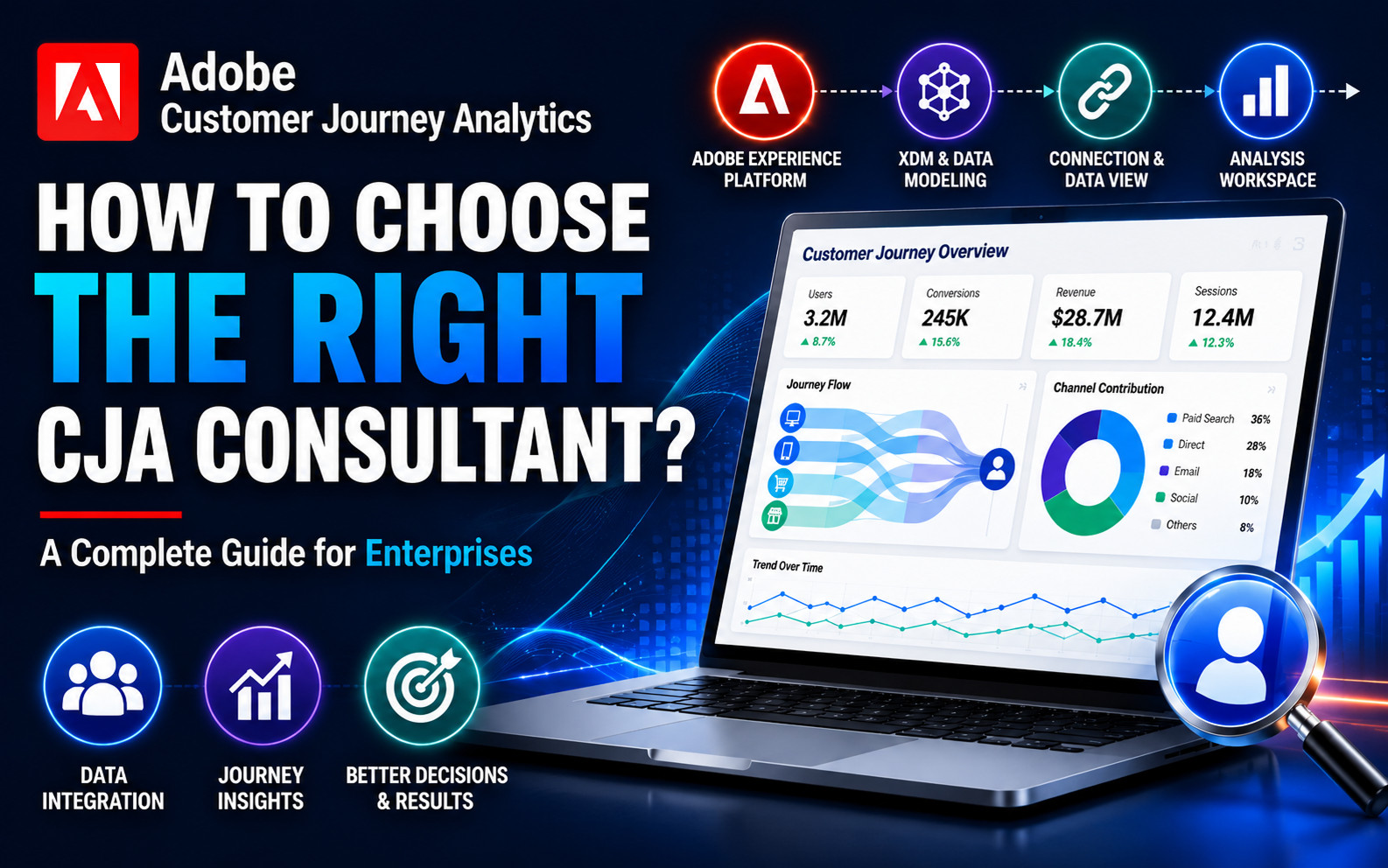
Adobe Customer Journey Analytics (CJA) Partner Guide
Adobe Analytics, Adobe Customer Journey Analytics, Adobe Experience Platform, CDP, MarTech
10 July 2026
1. Preface: Why CJA implementation should not be evaluated by the tool alone
Quick answer: when selecting a CJA implementation consultant, enterprises should focus on Adobe Experience Cloud experience, AEP / XDM data modeling capabilities, Connection and Data View design, metric governance methodology, Analysis Workspace report design, user training, and long-term optimization support.
Many enterprises focus first on reports, dashboards, or license costs when introducing analytics tools. However, the value of CJA is not just “looking at numbers.” Its real role is to integrate website, app, CRM, POS, customer service, membership, and marketing interaction data into an analyzable journey view—provided that data sources, identity, and governance are properly designed—so enterprises can understand behavior, drop-off, and conversion.
Adobe explains that Customer Journey Analytics is Adobe’s next-generation Analytics solution. It uses Analysis Workspace to analyze data from Adobe Experience Platform and uses XDM to present and organize data in a unified way. This also means that CJA implementation is not merely analytics tool configuration; it requires coordinated work across data, models, reporting, and organizational adoption.
2. What is Adobe Customer Journey Analytics (CJA)?
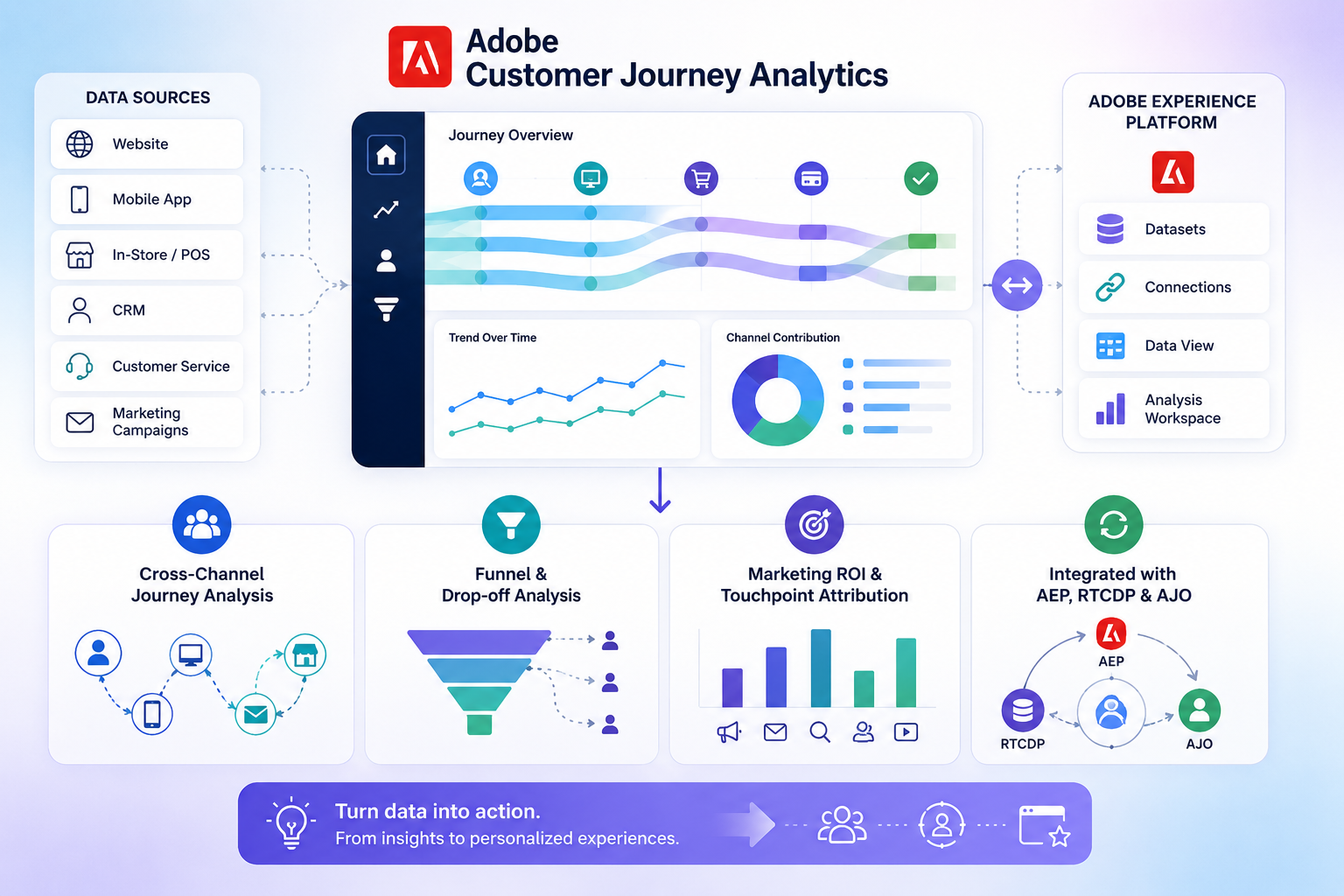
Adobe Customer Journey Analytics is a cross-channel customer journey analytics application built on Adobe Experience Platform (AEP). It uses AEP Datasets, Connections, Data Views, and Analysis Workspace for journey analysis. Compared with traditional web analytics tools, CJA places greater emphasis on integrating data across sources and analyzing the complete journey.
Adobe documentation states that CJA helps enterprises understand customers in the context of their journeys, such as combining data from call centers, POS systems, and online properties into a single reporting view. This allows enterprises to move from “single-channel performance” toward “complete journey insight.”
In practice, CJA is commonly used in the following scenarios:

1. Cross-channel customer journey analysis
Integrate data from websites, apps, stores, CRM, customer service, and marketing campaigns to understand the complete path from awareness and engagement to conversion.

2. Funnel and drop-off analysis
Identify the steps where users leave, such as key obstacles in registration, payment, application, booking, or membership upgrade flows.

3. Marketing ROI and touchpoint contribution analysis
Help marketing teams evaluate which channels, content, or campaigns may contribute to conversion, rather than looking only at a single click or a single ad result.

4. Integration with AEP, RTCDP, and AJO
Feed analytics insights back into audience building, personalized experiences, and journey orchestration so that data is used not only for reporting, but also for action.
3. Three common challenges when enterprises implement CJA
CJA is powerful, but because it involves data, platforms, and organizational processes, its implementation is usually more difficult than that of a typical web analytics tool. Without clear planning, enterprises can easily end up with “the platform is live, but adoption is low” or “there are many reports, but decisions have not changed.”
1. Dispersed data sources and lack of a unified model
Many enterprises have customer data scattered across websites, apps, CRM, CDP, POS, customer service, and advertising platforms. Without first designing data models, field naming rules, and identity logic, CJA will struggle to produce trustworthy journey insights.
2. Inconsistent metric definitions
Marketing, e-commerce, customer service, sales, and management teams may define “conversion,” “active customer,” “qualified lead,” and “repurchase” differently. Without consistent metric governance, more reports may simply create more disputes.
3. Teams can read reports but do not act on insights
The value of CJA is not only in building Workspace reports, but also in helping teams optimize campaigns, content, product flows, and customer experiences based on insights. Therefore, whether a consultant can support enablement, adoption, and business application is a key selection factor.
4. Why CJA implementation requires a professional implementation consultant
Enterprises can study Adobe documentation and try to configure CJA themselves. For mid-sized and large enterprises, however, CJA implementation is usually not just tool deployment—it is an upgrade of data and marketing operations.
In Adobe’s guidance on successful CJA implementation, the key work is organized into three stages: Data Ingestion, Enablement and Adoption, and Activation and ROI. This means a qualified CJA implementation consultant must do more than build connections and reports; the consultant must also help the enterprise complete data ingestion, team adoption, and performance measurement.
A good CJA consultant should play three roles: an AEP / XDM data architect, a metric governance consultant, and an application partner who can turn Analysis Workspace insights into business action. Technically, this requires understanding AEP, XDM, Datasets, Connections, Data Views, and Workspace. From a business perspective, it requires understanding customer journeys, marketing funnels, membership operations, and operational decision-making.
5. Six evaluation criteria for selecting a CJA implementation consultant
When evaluating an Adobe Customer Journey Analytics service provider, enterprises should not compare pricing alone. Instead, they should assess whether the provider has complete implementation capabilities across the following six dimensions.
1. Familiarity with the Adobe Experience Cloud ecosystem
CJA usually does not exist in isolation. It often works together with tools such as Adobe Analytics, AEP, RTCDP, Adobe Journey Optimizer, Adobe Target, or AEM. Therefore, whether the service provider understands the overall Adobe Experience Cloud architecture is an important foundation for assessing implementation capability.
2. AEP and data modeling capabilities
The foundation of CJA is whether data can be correctly collected, standardized, and connected. Consultants need to help plan XDM Schemas, Field Groups, Datasets, Identity Namespaces, data integration, Connections, Data Views, and data quality checks—not just front-end event tracking.
3. Ability to establish metric governance
A good service provider helps the enterprise define KPIs, dimensions, metrics, conversion events, audience segments, and reporting use cases early in the project, preventing different departments from interpreting data in their own ways.
4. Understanding of marketing and customer journey scenarios
The value of CJA comes from scenario-based applications such as member activity analysis, funnel optimization, cross-device conversion, online-to-offline journey integration, touchpoint contribution analysis, campaign ROI analysis, and feeding audience insights back into action. If a consultant only understands tools but not marketing and operational scenarios, the implementation outcome can easily remain purely technical.
5. Training and adoption planning
The success of a CJA project depends heavily on whether users truly adopt it. The service provider should offer workshops, report operation training, user role planning, and internal adoption mechanisms.
6. Long-term optimization support
CJA implementation is not a one-off project. It is an analytics operations effort that continuously adjusts data sources, Connections, Data Views, calculated metrics, segments, Workspace reports, and team usage habits. As data sources increase, marketing strategies change, and new products are launched, enterprises need to keep refining data views, report templates, metric definitions, and analysis scenarios.
6. How LeadsTech helps enterprises implement CJA
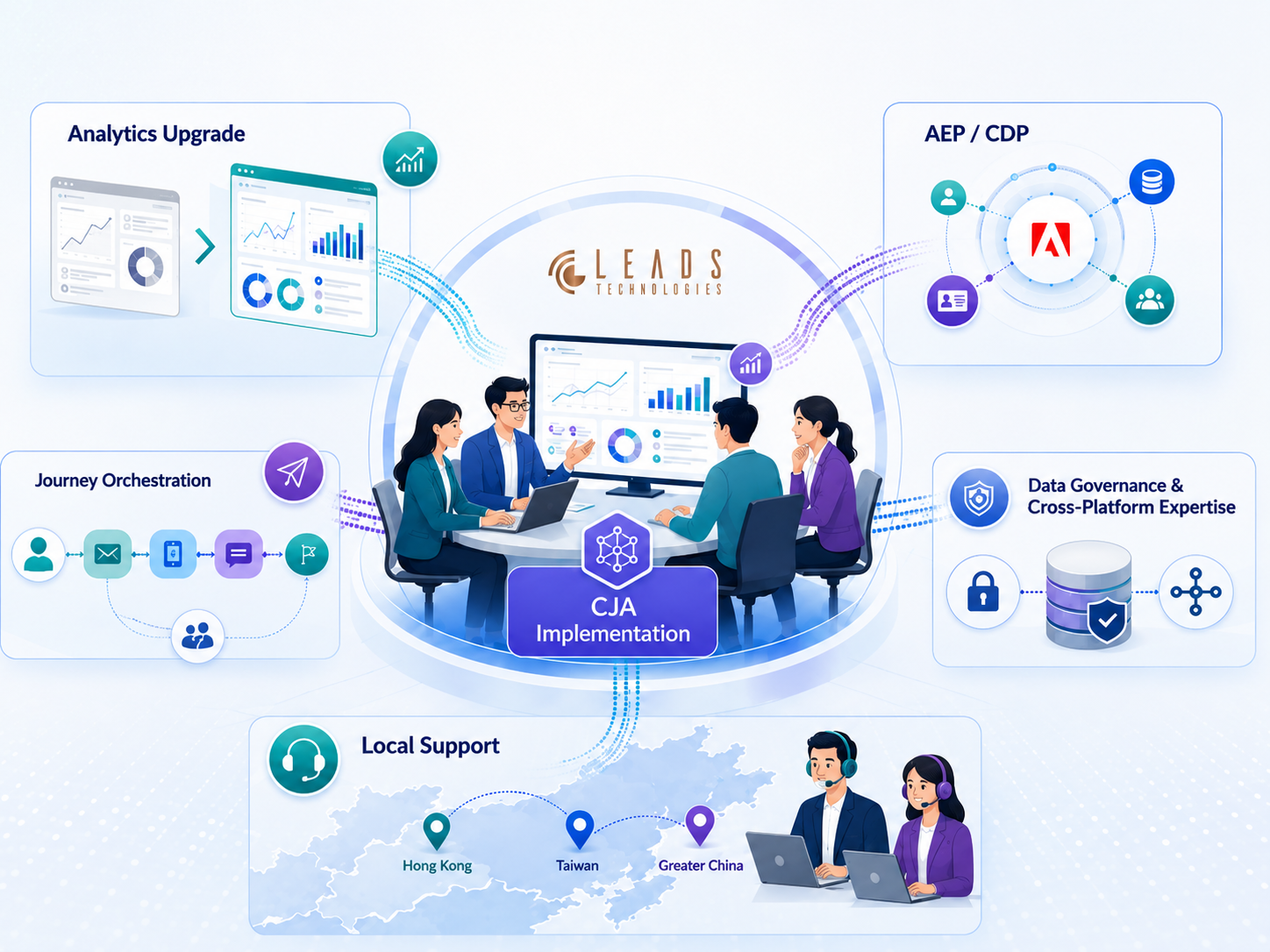
If an enterprise is looking for an Adobe Customer Journey Analytics implementation consultant in Hong Kong, Taiwan, or Greater China, it can evaluate whether LeadsTech can provide integrated support across Adobe Experience Cloud, AEP / CDP, Analytics, AJO, and data governance.
LeadsTech is an Adobe Silver Solution Partner and holds a Specialized Adobe Experience Manager qualification. Its Adobe Solution Partner page also states that LeadsTech has maintained a long-term partnership with Adobe and provides Adobe product implementation and delivery services.
LeadsTech is especially suitable for the following types of enterprises:
1. Already using Adobe Analytics and preparing to upgrade to CJA
These enterprises need to reassess their existing tracking architecture, reporting logic, and conversion metrics, and plan how to connect them with AEP.
2. Implementing AEP or CDP
LeadsTech’s CDP service page notes that Adobe Real-Time CDP is suitable for enterprises that value real-time capabilities, personalized experiences, and omnichannel marketing, and that it can integrate deeply with Adobe Experience Cloud. This is practically helpful for CJA implementation because CJA insights often need to be built on a strong customer data foundation.
3. Wanting to connect analytics, audiences, and journey orchestration
If an enterprise wants not only to view reports but also to connect insights with Adobe Journey Optimizer, marketing automation, or personalized experiences, it needs a service provider with both MarTech architecture capability and marketing scenario expertise.
4. Needing local communication and long-term support
CJA projects usually require joint participation from marketing, IT, data, e-commerce, customer service, and management teams. Local consultants can more effectively support requirement clarification, workshops, training, and ongoing optimization.
7. What stages should a complete CJA implementation project include?
Before discussing with a service provider, enterprises can use the following process to evaluate whether the provider’s project methodology is complete.

1. Current-state assessment and goal definition
Review existing data sources, Adobe tools, reporting needs, business pain points, and decision-making scenarios to confirm the core problems CJA should solve.

2. Data architecture and tracking planning
Plan data sources, XDM Schemas, event naming, identity, data ingestion methods, and data quality check mechanisms.

3. CJA configuration and report building
Build Connections, Data Views, dimensions, metrics, calculated metrics, segments, and Analysis Workspace report templates.

4. Business scenario validation
Validate through real use cases such as funnel analysis, campaign performance, member journeys, cross-device conversion, or online-to-offline integration analysis.

5. User training and adoption enablement
Design training content by role so management, marketing teams, analysts, and operations teams can all use CJA to make decisions.

6. Continuous optimization and performance tracking
Regularly review report usage, data quality, KPI changes, and business feedback, and gradually expand to more analysis scenarios.
8. What should enterprises prepare before looking for a CJA consultant?
Before formally contacting a service provider, enterprises can complete the following preparations so the consultant can evaluate project scope and implementation roadmap more quickly.
1. Clarify business goals
Is the goal to improve conversion rate, improve membership operations, integrate online and offline journeys, or optimize marketing ROI? Different goals lead to different CJA designs.
2. Inventory data sources
List the current systems and data sources, including websites, apps, CRM, POS, customer service, CDP, advertising platforms, and e-commerce systems.
3. Organize existing reports and pain points
Collect commonly used reports, KPIs that management cares about, and questions that current analytics tools cannot answer.
4. Confirm internal stakeholders
CJA projects usually require participation from marketing, IT, data, legal, and business teams. It is recommended to confirm the project owner and decision-making process in advance.
5. Assess data governance maturity
If data quality, field definitions, or consent management are not yet mature, data governance should be included in the CJA project scope instead of being fixed only after launch.
9. Conclusion: A good CJA service provider should help enterprises turn data into decision-making capability
The core value of Adobe Customer Journey Analytics is not only giving enterprises a more powerful analytics tool. It helps enterprises move from fragmented reporting toward complete customer journey insights. A successful CJA implementation should help marketing, e-commerce, customer service, product, and management teams gradually make decisions based on consistent metrics and a shared data view.
Therefore, when choosing a CJA implementation consultant, enterprises should care not only about whether the consultant can configure the tool, but also whether the consultant has Adobe Experience Cloud ecosystem experience, AEP data architecture capability, metric governance methodology, marketing scenario understanding, and long-term optimization support.
If you are evaluating Adobe Customer Journey Analytics implementation, an Adobe Analytics upgrade, AEP / CDP integration, or want to build more complete customer journey analytics capabilities, please contact us through the LeadsTech Contact Us page to speak with our consulting team. You can also first refer to LeadsTech’s Adobe Solution Partner service page and CDP implementation and management service page to learn how we help enterprises plan Adobe Experience Cloud and data-driven marketing architectures.
10. Further Reading
- What Is Adobe Customer Journey Analytics (CJA)? A Guide to Enterprise Data-Driven Journey Analytics
- From Reports to Insights: Practical Use Cases of Adobe Customer Journey Analytics
- Using Adobe Customer Journey Analytics to Improve Marketing ROI
- Practical Applications of AEP + RTCDP + AJO + CJA: Integration, Industry Use Cases, and Best Practices
Related Articles

Enterprise AI MarTech Trends Analysis 2024-2029 Outlook Report
From AI content productivity tools to a core engine for revenue growth and marketing transformation
*The PDF will be sent directly to your inbox.