Why Multilingual Website Builds Need Consultants: Avoid SEO & AI Search Risks
AEM Sites, AI, Content Management System (CMS), Translation Management System (TMS)
15 June 2026
- Why is multilingual website implementation more than translation?
- Why do multilingual websites often cause SEO traffic loss?
- Why is multilingual content more important in the GEO and AI search era?
- What problems can multilingual website consultants help enterprises solve?
- What should enterprises plan before building a multilingual website?
- The role of AEM and GlobalLink in multilingual websites
- Which enterprises particularly need multilingual website consulting?
- Conclusion: Multilingual website consulting is critical to reducing SEO and AI search risks
- Related Reading
- Why is multilingual website implementation more than translation?
- Why do multilingual websites often cause SEO traffic loss?
- Why is multilingual content more important in the GEO and AI search era?
- What problems can multilingual website consultants help enterprises solve?
- What should enterprises plan before building a multilingual website?
- The role of AEM and GlobalLink in multilingual websites
- Which enterprises particularly need multilingual website consulting?
- Conclusion: Multilingual website consulting is critical to reducing SEO and AI search risks
- Related Reading
Key Takeaways
Multilingual website implementation is not simply about translating source content into different languages. It is an integrated initiative involving SEO, website architecture, CMS workflows, translation governance, and localized market experience.
If an enterprise only translates content without planning URL structure, hreflang, meta information, content architecture, and local search intent, the website may face SEO traffic decline, inconsistent language versions, difficult content maintenance, and even AI search tools misunderstanding the brand and service offering after launch.
1. Why is multilingual website implementation more than translation?
For multinational enterprises, a multilingual website is a long-term operating system, not a one-off translation project.
Every product update, campaign launch, regulatory content change, or brand message revision may need to be synchronized across multiple language versions. Without proper planning, enterprises can easily encounter the following issues later:
- The source content has been updated, but other language versions still show outdated information
- Product or service descriptions differ across markets
- SEO fields are not translated or localized
- Local teams are unsure which content they are allowed to modify
- After translation, large amounts of manual copying and checking are still required
Therefore, when planning a multilingual website, enterprises need to consider content, technology, SEO, CMS, and operating workflows at the same time—not just text translation.
2. Why do multilingual websites often cause SEO traffic loss?
A common issue with multilingual websites is that enterprises assume “having translated pages” equals “having international SEO.” In reality, search engines need to clearly understand the relationship between pages in different languages and regions in order to show the right version to the right user.
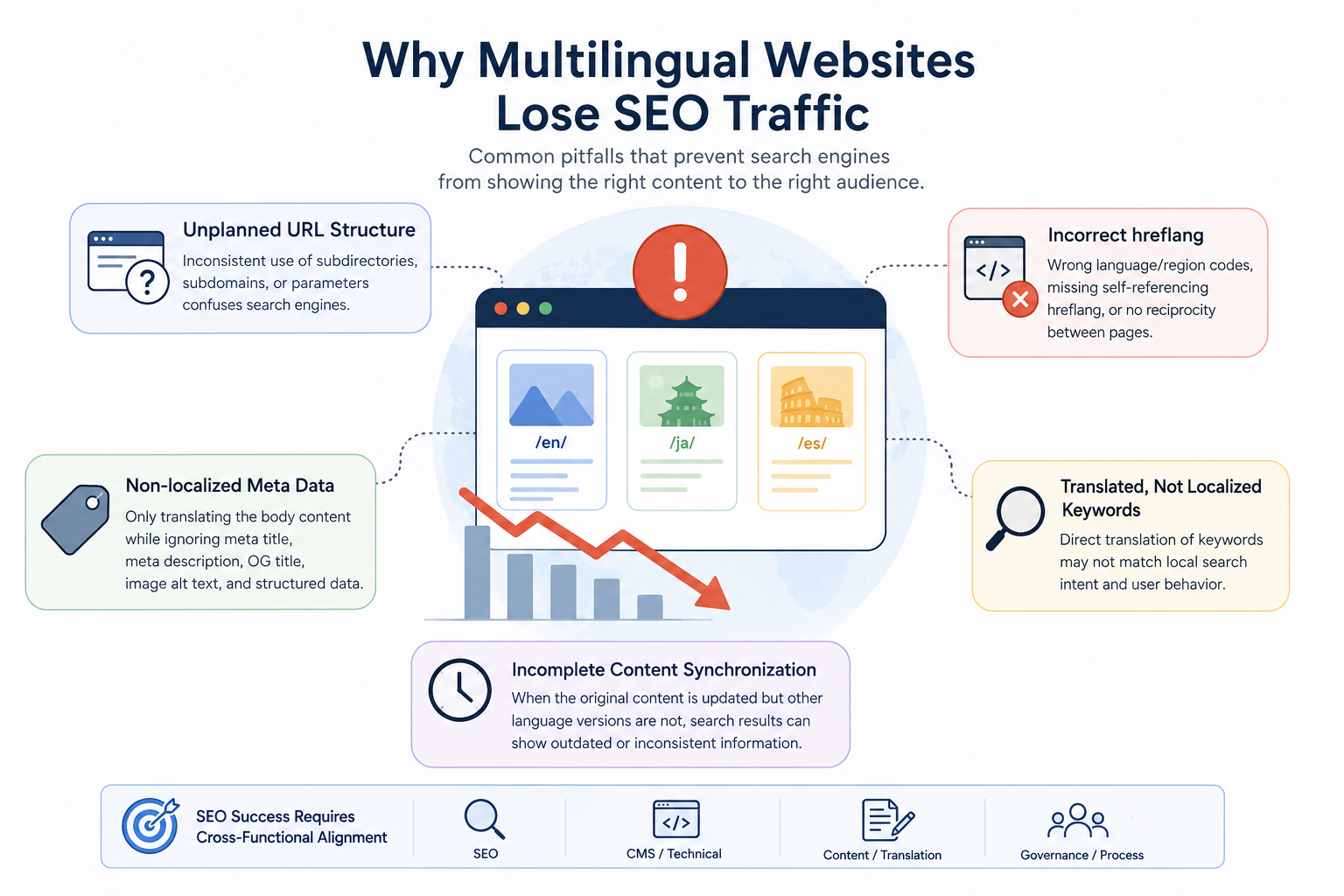
Common SEO problems include:
1. Confusing URL structure
For example, the same website may use language directories, parameters, or subdomains at the same time without clear rules, increasing the difficulty for search engines to understand the site and for teams to maintain it.
2. Incorrect hreflang settings
hreflang helps search engines identify the relationships between different language versions. Incorrect language codes, missing self-referencing hreflang, or pages that do not reference each other can all affect search performance.
3. Meta information is not localized
Many enterprises translate only the body content while overlooking meta title, meta description, URL slug, image alt text, OG title, and structured data, resulting in weaker search result presentation.
4. Keywords are translated but not localized
Search habits vary across markets. Directly translating source-language keywords may not match the local user’s actual search language or buying intent.
5. Content synchronization is incomplete
When source content is updated but other language versions are not synchronized, search results may display outdated information, affecting brand trust and customer experience.
3. Why is multilingual content more important in the GEO and AI search era?
Generative AI is changing how users access information. Users may not only click search results; they may also obtain answers directly through AI tools.
This means enterprise content not only needs to be indexed by search engines, but also needs to be easier for AI tools to understand, summarize, and cite correctly.
In the context of GEO, or Generative Engine Optimization, if a multilingual website has a confusing content structure, unclear semantics, or contradictory language versions, it may increase the risk of AI search tools producing inaccurate summaries or misunderstanding the brand.
For example:
- The English page says the enterprise provides CRM consulting services, while the Chinese page only mentions website implementation
- Some language versions still contain outdated product information
- The same service uses different names in different markets
- FAQs, case studies, and service descriptions lack a consistent structure
Therefore, multilingual website content should remain clear, consistent, indexable, and supported by strong headings, paragraphs, FAQs, product definitions, and service descriptions, so that both search engines and AI tools can understand the website more accurately.
4. What problems can multilingual website consultants help enterprises solve?
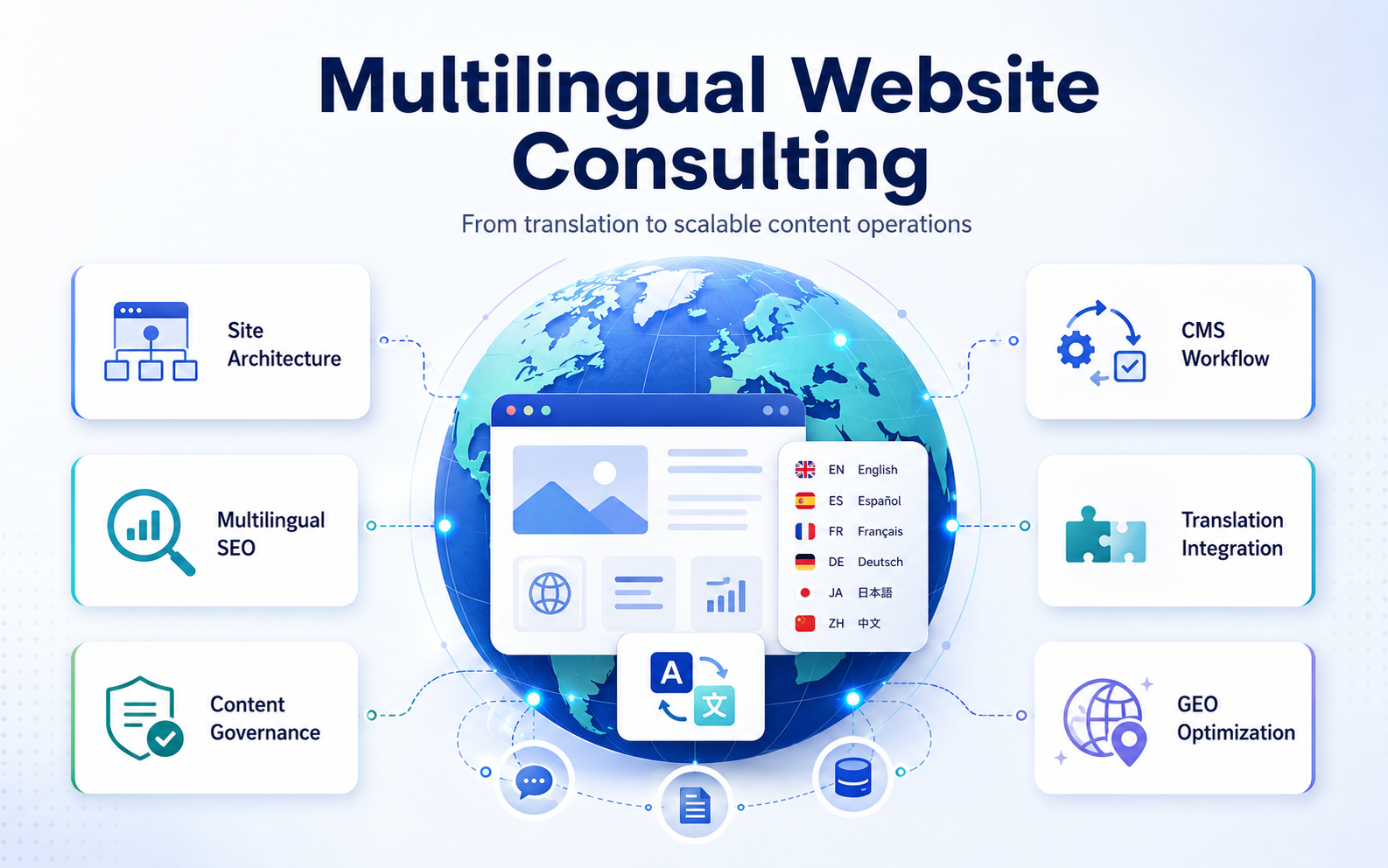
The value of multilingual website consulting is to help enterprises move from “translating pages” to “building a sustainable multilingual content operating system.”
Consultants typically help enterprises handle the following work:

1. Website architecture planning
Help enterprises evaluate whether to use language directories, regional directories, subdomains, or country domains, while ensuring the website architecture meets SEO, CMS, and long-term maintenance needs.

2. Multilingual SEO strategy
Plan hreflang, canonical, sitemap, URL slug, meta title, meta description, image alt text, and localized keyword strategy.

3. Content governance design
Define which content is managed by headquarters and which content can be adjusted by local markets, preventing each language version from evolving separately and causing inconsistent brand messaging.

4. CMS workflow design
Build workflows in AEM, Drupal, WordPress, Sitecore, or other CMS platforms for source content creation, translation submission, local review, SEO checks, and publishing.

5. Translation platform integration
Plan how translation management platforms such as TransPerfect GlobalLink integrate with the CMS to reduce manual export, copying, import, and checking.

6. AI search content optimization
Help enterprises check whether multilingual content includes clear service definitions, FAQs, case structures, and consistent brand narratives, reducing the risk of AI search misinterpretation.
5. What should enterprises plan before building a multilingual website?
Before starting multilingual website implementation, enterprises should first clarify the following priorities:
- Target markets and language versions
- URL structure and language directory rules
- hreflang, canonical, and sitemap strategy
- CMS permissions, review, and publishing workflows
- Integration between the translation platform and CMS
- Translation rules for SEO fields such as meta title, description, and URL slug
- Whether local markets can adjust content on their own
- Whether FAQs, case studies, and service pages meet AI search understanding needs
These plans help enterprises reduce SEO, content quality, and operational maintenance risks before the website goes live.
6. The role of AEM and GlobalLink in multilingual websites
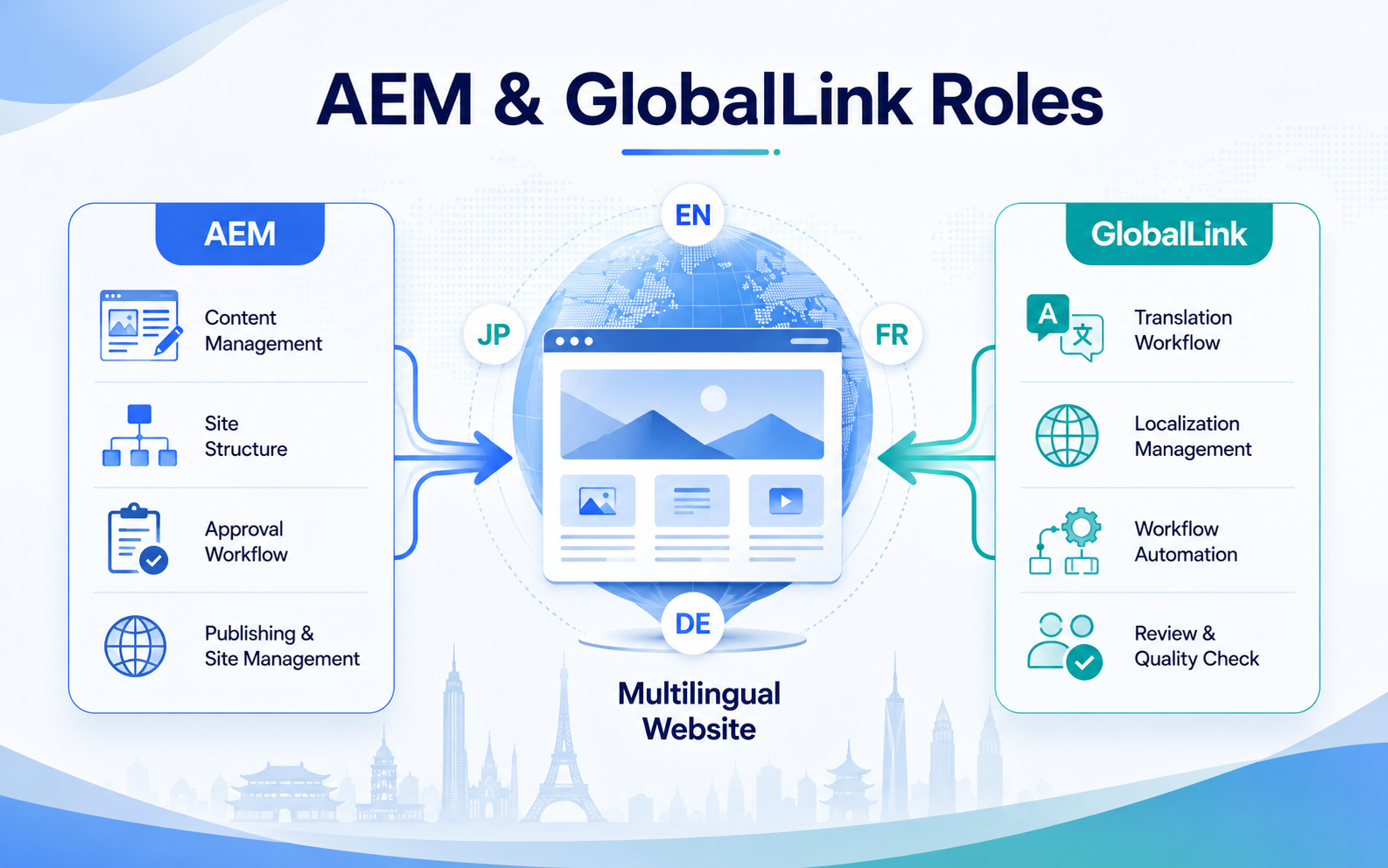
In enterprise-level multilingual website implementation, AEM and TransPerfect GlobalLink can take on different roles.
AEM Sites can serve as the enterprise content management and multilingual website operations platform, supporting multi-market page management, review, publishing, Language Copy, Live Copy, Translation Projects, and Multi Site Manager capabilities.
GlobalLink can serve as the enterprise translation and localization workflow platform, helping manage translation workflows, translation memories, terminology databases, human translation, AI translation, and CMS integration processes.
The consultant’s role is to help enterprises decide how the two should work together:
- Which content should be managed in AEM?
- Which content should be sent to GlobalLink for translation?
- Which SEO fields should be included in the translation workflow?
- Which language versions require local market review?
- How should other language versions be synchronized after the source content is updated?
These decisions directly affect the long-term maintenance efficiency and content quality of a multilingual website.
7. Which enterprises particularly need multilingual website consulting?
Multilingual website consulting is particularly suitable for enterprises in the following situations:
- Expanding from a single-language website to a multilingual website
- Already operating a multilingual website, but seeing unstable SEO traffic performance
- Frequently experiencing inconsistent content across markets
- Introducing or upgrading AEM, a CMS, or a DXP
- Planning to integrate translation management platforms such as GlobalLink
- Needing to address SEO, GEO, and AI search visibility at the same time
- Coordinating among marketing, IT, legal, brand, and local market teams
In these scenarios, consultants can help enterprises establish clear website architecture, content governance, and publishing workflows, avoiding the discovery of SEO architecture mistakes or hard-to-maintain translation processes only after launch.
8. Conclusion: Multilingual website consulting is critical to reducing SEO and AI search risks
Multilingual website implementation is not just a translation project; it is foundational infrastructure for international enterprise content operations.
A truly effective multilingual website needs to consider search engines, AI search, CMS architecture, translation workflows, local market needs, and brand consistency at the same time.
Without proper upfront planning, enterprises may face SEO traffic decline, incorrect language versions, unsynchronized content, AI search misunderstandings, and rising maintenance costs.
LeadsTech brings experience across MarTech, AEM, CMS, SEO, GEO, and enterprise website implementation. We help enterprises build multilingual website systems that can operate for the long term, from early-stage strategy, website architecture, content governance, and translation workflows to platform implementation.
If your enterprise is planning multilingual website implementation, AEM multilingual content management, or the adoption of TransPerfect GlobalLink to improve website translation workflow efficiency, feel free to Contact Us and discuss the most suitable implementation strategy with the LeadsTech consulting team.
Related Reading
Related Articles

Enterprise AI MarTech Trends Analysis 2024-2029 Outlook Report
From AI content productivity tools to a core engine for revenue growth and marketing transformation
*The PDF will be sent directly to your inbox.
Email Error
Please enter a valid email address.
Thank You!
The whitepaper has been sent to your inbox. If you don’t see it, please check your spam or promotions folder.