
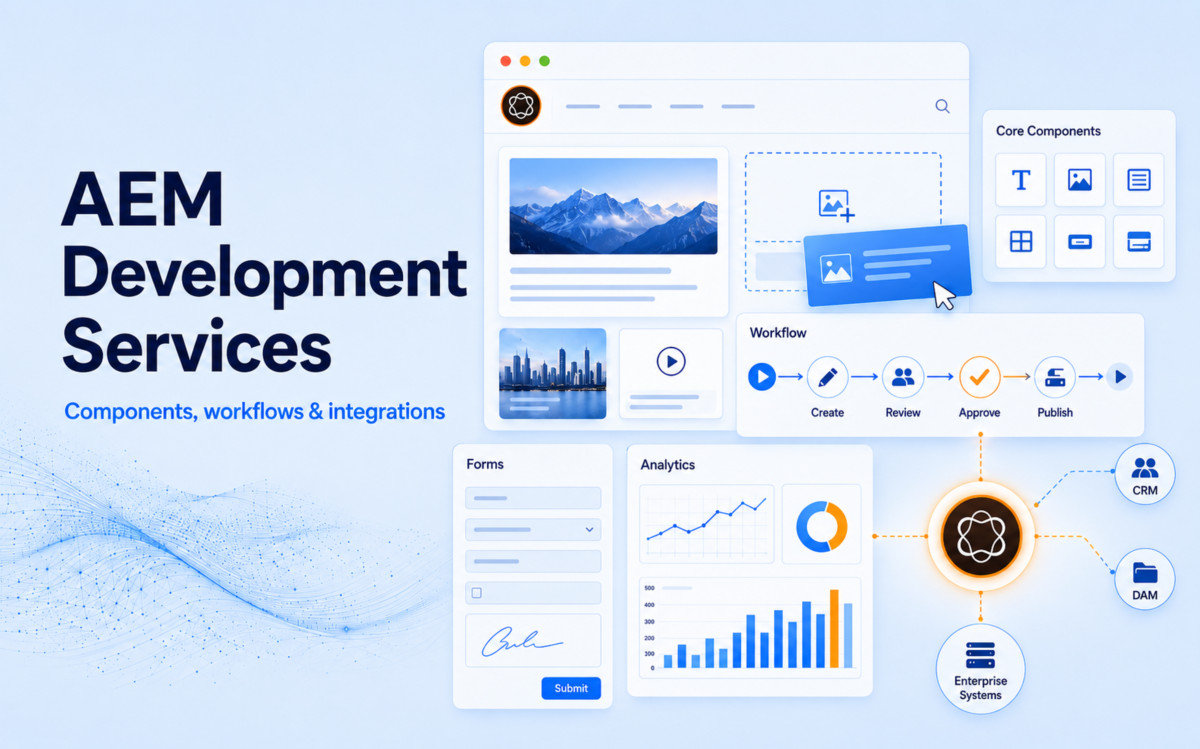
AEM Development Services: Components, Workflows & Integration
AEM Sites, Content Management System (CMS)
19 June 2026
- What are AEM development services?
- Component-based architecture: building long-term reusability into the content platform
- Workflow customization: embedding content governance into business processes
- Enterprise integration: how AEM connects CRM, Analytics, and marketing systems
- AEM development quality evaluation criteria
- How to choose the right implementation partner
- Conclusion
- What are AEM development services?
- Component-based architecture: building long-term reusability into the content platform
- Workflow customization: embedding content governance into business processes
- Enterprise integration: how AEM connects CRM, Analytics, and marketing systems
- AEM development quality evaluation criteria
- How to choose the right implementation partner
- Conclusion
Overview
The core of AEM development services is not merely building pages or configuring the backend. It is about designing reusable components, governable processes, and scalable integration architecture around enterprise content operations. From an engineering practice perspective, this article explains key methods for component-based architecture, workflow customization, and enterprise system integration in AEM projects, helping enterprises evaluate development quality and implementation partner capabilities.
1. What are AEM development services?
When many enterprises launch an AEM project, their first concerns are whether pages can be built, whether the backend can be edited, and whether the website can go live on schedule. But what truly determines AEM’s long-term value is not a one-time page delivery. It is whether the platform can support future collaboration across multiple brands, languages, teams, and systems.
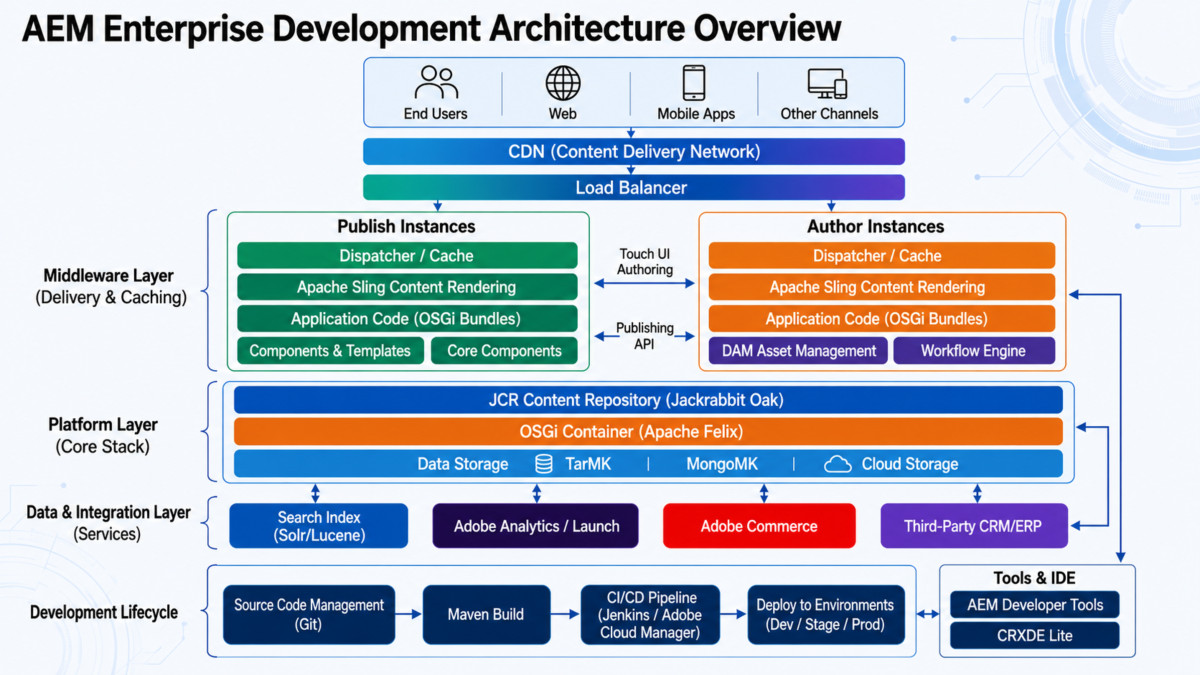
This is why AEM development services need to be understood differently. AEM development services refer to building a reusable, governable, and scalable enterprise content platform around AEM Sites, Core Components, templates, workflows, forms, data layers, and enterprise system integration. It is not ordinary website development; it is enterprise content platform engineering. Adobe’s official Core Components documentation also states that AEM components are the structural elements of page authoring, and that Core Components accelerate development and reduce maintenance costs through standardized components.
Therefore, a mature AEM project should focus from the outset on whether the component library is reusable, whether template policies are governable, whether workflows match organizational processes, whether the data layer is trackable, and whether system integrations are scalable. Otherwise, after launch, the project can easily become “usable pages that are difficult to maintain, expand, and operate.”
2. Component-based architecture: building long-term reusability into the content platform
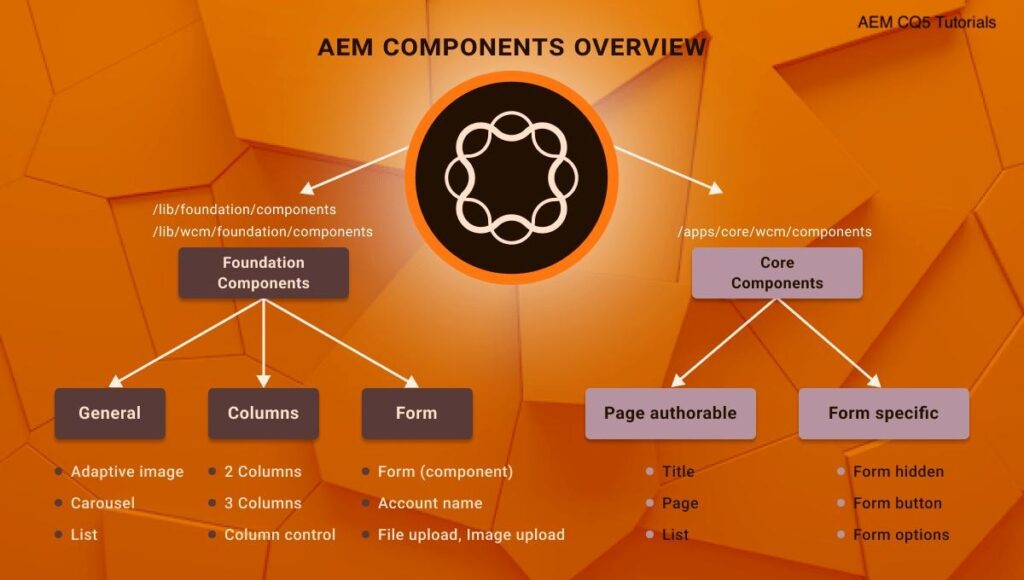
One of the most critical engineering capabilities in AEM development services is component-based architecture design. An enterprise website is usually not a one-off collection of pages, but a content system for long-term operations. Product pages, solution pages, industry pages, case pages, and event pages all require continuous updates. If every page depends on custom development, future maintenance costs will rise quickly.
A mature component-based architecture usually includes:

Basic components
Headings, images, text, buttons, and lists; suitable for high-frequency general content editing

Business components
Product cards, industry solution modules, customer case modules, downloadable resource modules, and inquiry CTA modules

Templates and policies
Use different templates for different page types; restrict styles and component usage through content policies; prevent excessive editorial freedom from causing brand inconsistency

Scalable frontend standards
A unified style system, unified responsive rules, and unified component naming and maintenance methods
High-quality AEM development services should use Core Components extensions, component libraries, template policies, and design systems to enable content teams to continuously produce pages with standard components, instead of relying on development teams to keep creating one-off pages. This improves publishing efficiency while maintaining brand consistency and technical maintainability.
3. Workflow customization: embedding content governance into business processes
For large enterprises, content publishing is often not a task completed by one person. It is a collaborative process involving marketing, brand, legal, product, regional teams, and management. Especially for multilingual websites or group-level content platforms, without clear workflows, content quality and publishing timelines can become uncontrollable.
This is also the value of workflow customization in AEM development services. Adobe documentation notes that AEM workflows can automate asset and content publishing management processes, and support creating workflow models, developing workflow steps, and interacting with workflows programmatically.
Common workflow customizations for enterprises include:
Content submission and review
After editors submit a page, it is approved by brand, product, or regional owners.
Multilingual translation workflows and translation project management
After primary-language content is updated, translation and localization tasks can be triggered through Translation Projects, Translation Integration Framework, or custom workflows.
Asset approval workflows
Images, videos, PDFs, and other assets must go through copyright, brand, and usage-scope confirmation.
Pre-publish checks
Check SEO fields, links, required components, image formats, and compliance information.
Exception notifications and rollback
Automatically notify relevant stakeholders when content is rejected, overdue, or fails to publish.
Adobe’s documentation on extending workflows also explains that custom workflow steps can be implemented by developing workflow step components and running logic through OSGi services or scripts.
For enterprises, AEM workflows are not simply backend features. They are a content governance mechanism that systematizes content submission, approval, translation, asset review, pre-publish checks, and exception notifications. Excellent AEM development services should translate organizational processes into executable system workflows, making content publishing more standardized, transparent, and traceable.
4. Enterprise integration: how AEM connects CRM, Analytics, and marketing systems
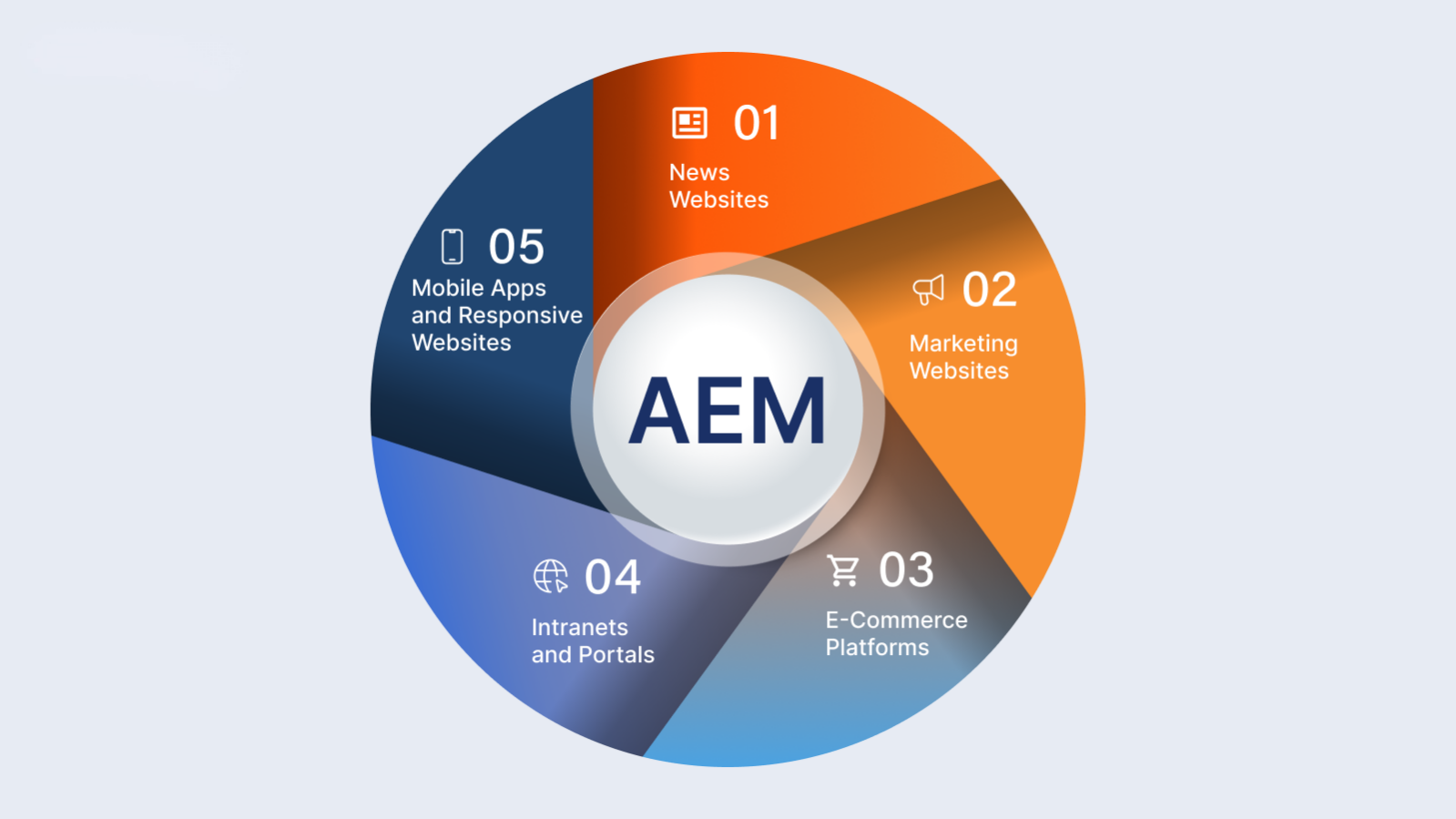
In an enterprise digital architecture, AEM usually serves as the content experience layer. But if it exists only as an isolated CMS, its value is greatly limited. Truly mature AEM development services should enable AEM to work with existing enterprise systems.
Common integration scenarios include:
Integration with AEM Assets or external DAM systems
Centrally access brand images, videos, documents, and product assets; ensure that the official website uses the latest approved assets
Integration with CRM
Sync form leads to the sales system; automatically assign leads by country, product, or industry
Integration with Adobe Analytics, Adobe Client Data Layer, AEP / RTCDP, and other data platforms
Track user behavior; support content performance analysis and customer segmentation
Integration with e-commerce or product systems
Use APIs or middleware to call product information, inventory, pricing, or configuration data, and decide whether to sync it into AEM based on business needs; support coordination between content and transaction experiences
Integration with marketing automation
After completing data tracking, identity recognition, consent management, and integration with marketing automation platforms, trigger nurture flows based on behaviors such as page visits, downloads, and form submissions
In these scenarios, Adobe Experience Manager (AEM) implementation is not just about deploying AEM itself. It is about defining AEM’s role in the enterprise technology stack: content experience layer, asset management layer, form entry point, data layer, and system integration node. An experienced Adobe Experience Manager (AEM) implementation partner or Adobe solution partner will usually first map business processes and data flows, then decide how components, APIs, forms, workflows, and data layers should be designed.
5. AEM development quality evaluation criteria
When enterprises evaluate AEM development services, they should not only look at visual results and launch speed. They should also assess project quality from a long-term maintenance perspective.
Focus on the following five dimensions:

Are components reusable?
Whether the project avoids large amounts of one-off page development; whether there is a clear component library and usage guidelines; whether it can support future page expansion

Is content editing user-friendly?
Whether editors can independently create pages; whether field names are clear; whether template restrictions are reasonable

Do workflows match the organization?
Whether approval roles match real business operations; whether multi-region and multilingual processes are supported; whether exception handling mechanisms exist

Are integrations stable?
Whether API calls have error handling; whether data synchronization is monitorable; whether forms, CRM, and analytics systems are consistent

Is the code maintainable?
Whether AEM development standards, Cloud Manager deployment processes, code quality checks, version management, and environment governance requirements are followed; whether environment deployment processes exist; whether testing, version management, and continuous delivery are supported
If a project focuses only on frontend presentation while ignoring these foundational capabilities, every future redesign, expansion, or system integration will become more expensive. Therefore, the value of AEM development services should be reflected in long-term operability, scalability, and governability.
6. How to choose the right implementation partner
When choosing an implementation team, enterprises should focus on whether the team has end-to-end capabilities from business to engineering, rather than simply whether it can write components.
A mature AEM implementation team should have:
- Content architecture capabilities: the ability to translate products, industries, cases, resource centers, and other content into a reasonable information architecture.
- Component engineering capabilities: the ability to extend based on Core Components rather than reinventing the wheel.
- Workflow design capabilities: the ability to systematize organizational approval, regional collaboration, and content publishing mechanisms.
- Integration development capabilities: the ability to connect CRM, DAM, Analytics, CDP, e-commerce, and marketing automation platforms.
- Project governance capabilities: the ability to manage requirement changes, testing and acceptance, permission configuration, training, and launch risks.
When choosing an Adobe Experience Manager (AEM) implementation partner or Adobe solution partner, enterprises should also consider whether the partner has industry cases, platform certifications, and long-term support capabilities. Adobe AEM implementation often involves collaboration among content, technology, data, and operations teams. Development capability alone is not enough to ensure project success.
In other words, a truly reliable AEM development services team does not merely “build the requirements.” It helps enterprises establish a content platform that can continuously evolve.
7. Conclusion
The difficulty of an AEM project often lies not in whether pages can be developed, but in whether a long-term enterprise-grade content platform can be designed. Component-based architecture determines content production efficiency, workflow customization determines content governance quality, and system integration determines whether AEM can enter the enterprise’s digital growth loop.
Therefore, when evaluating AEM development services, enterprises should focus on engineering architecture, content processes, integration capabilities, and long-term operations and maintenance, rather than only initial page delivery. For enterprises planning an official website upgrade, multilingual site, content platform restructuring, or AEM secondary development, choosing an experienced Adobe Experience Manager (AEM) implementation partner or Adobe solution partner will directly affect the project’s long-term value.
If you are evaluating AEM development, component library construction, workflow customization, or system integration solutions, you are welcome to learn more about our AEM-related services; you can also visit Contact Usto discuss your content platform architecture and implementation path with our consulting team.
Related Articles
- What is AEM as a Cloud Service? A key step toward cloud-based enterprise content platforms
Useful for understanding AEM cloud transformation and enterprise content management capabilities from a platform architecture perspective. - 10 key steps for enterprises to implement a website revamp with a content management system (CMS)
Useful for further understanding enterprise CMS selection and official website revamp planning. - Global B2B website development is more than building a website: how professional CMS supports multilingual and multi-country operations
Useful for understanding how CMS supports multilingual and multi-country content operations.
Related Articles

Enterprise AI MarTech Trends Analysis 2024-2029 Outlook Report
From AI content productivity tools to a core engine for revenue growth and marketing transformation
*The PDF will be sent directly to your inbox.
Email Error
Please enter a valid email address.
Thank You!
The whitepaper has been sent to your inbox. If you don’t see it, please check your spam or promotions folder.