
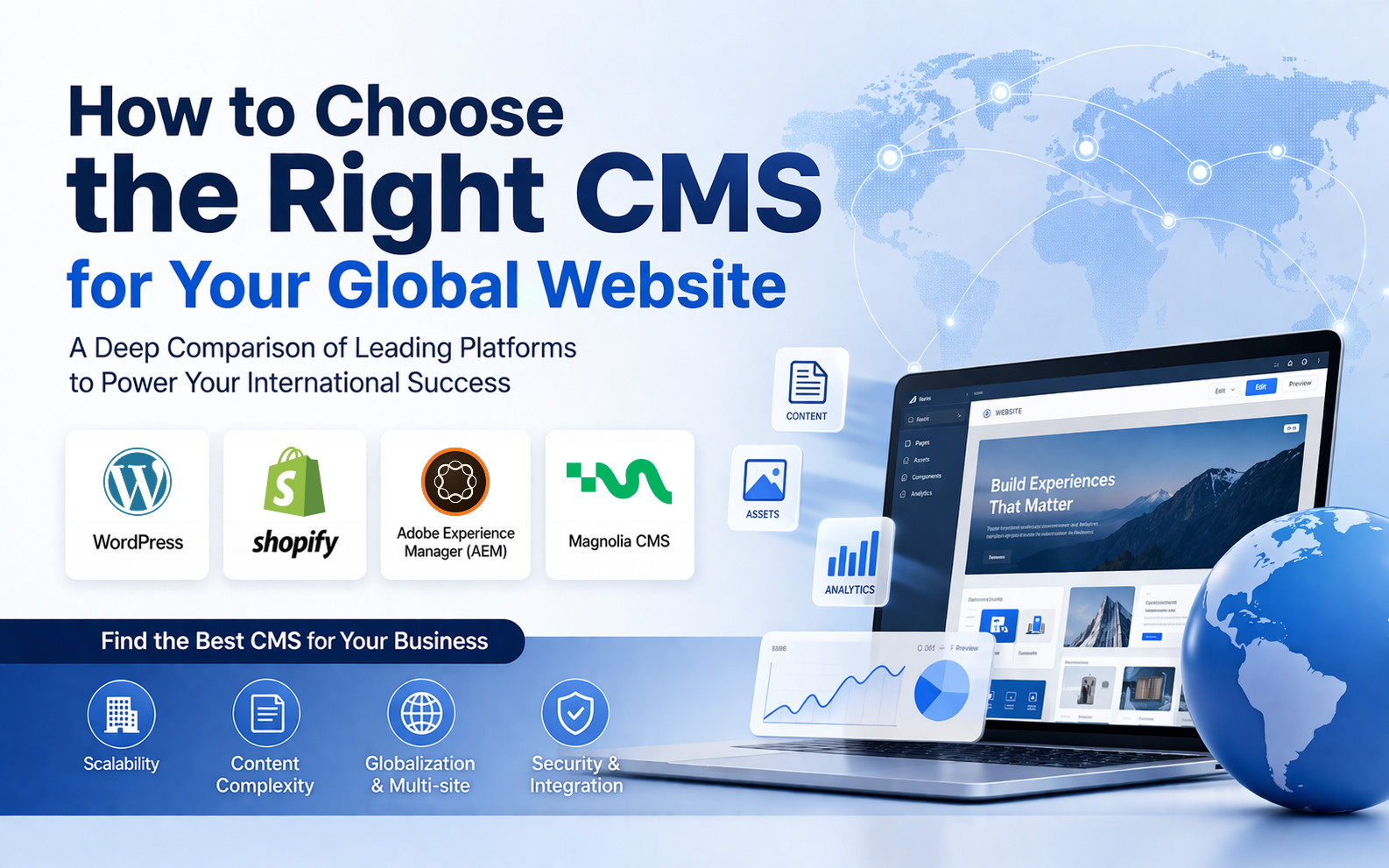
How to Choose a CMS for Global Websites: Platform Comparison & Guide
AEM Sites, Content Management System (CMS), Magnolia CMS, Shopify
8 April 2026
- Why CMS Selection Is Critical for B2B/Global Website Development
- Core CMS Capabilities Required for Global Websites
- Overview of Mainstream Global CMS Platforms
- In-Depth CMS Comparison: From Entry-Level to Enterprise
- Why Mid-to-Large Enterprises Should Consider AEM and Magnolia
- CMS Selection Recommendations by Business Stage
- Common CMS Selection Pitfalls
- Conclusion: CMS Is Not a Tool Choice, but a Long-Term Content Strategy
- Further Reading and References
- Why CMS Selection Is Critical for B2B/Global Website Development
- Core CMS Capabilities Required for Global Websites
- Overview of Mainstream Global CMS Platforms
- In-Depth CMS Comparison: From Entry-Level to Enterprise
- Why Mid-to-Large Enterprises Should Consider AEM and Magnolia
- CMS Selection Recommendations by Business Stage
- Common CMS Selection Pitfalls
- Conclusion: CMS Is Not a Tool Choice, but a Long-Term Content Strategy
- Further Reading and References
1. Why CMS Selection Is Critical for Global Website Development
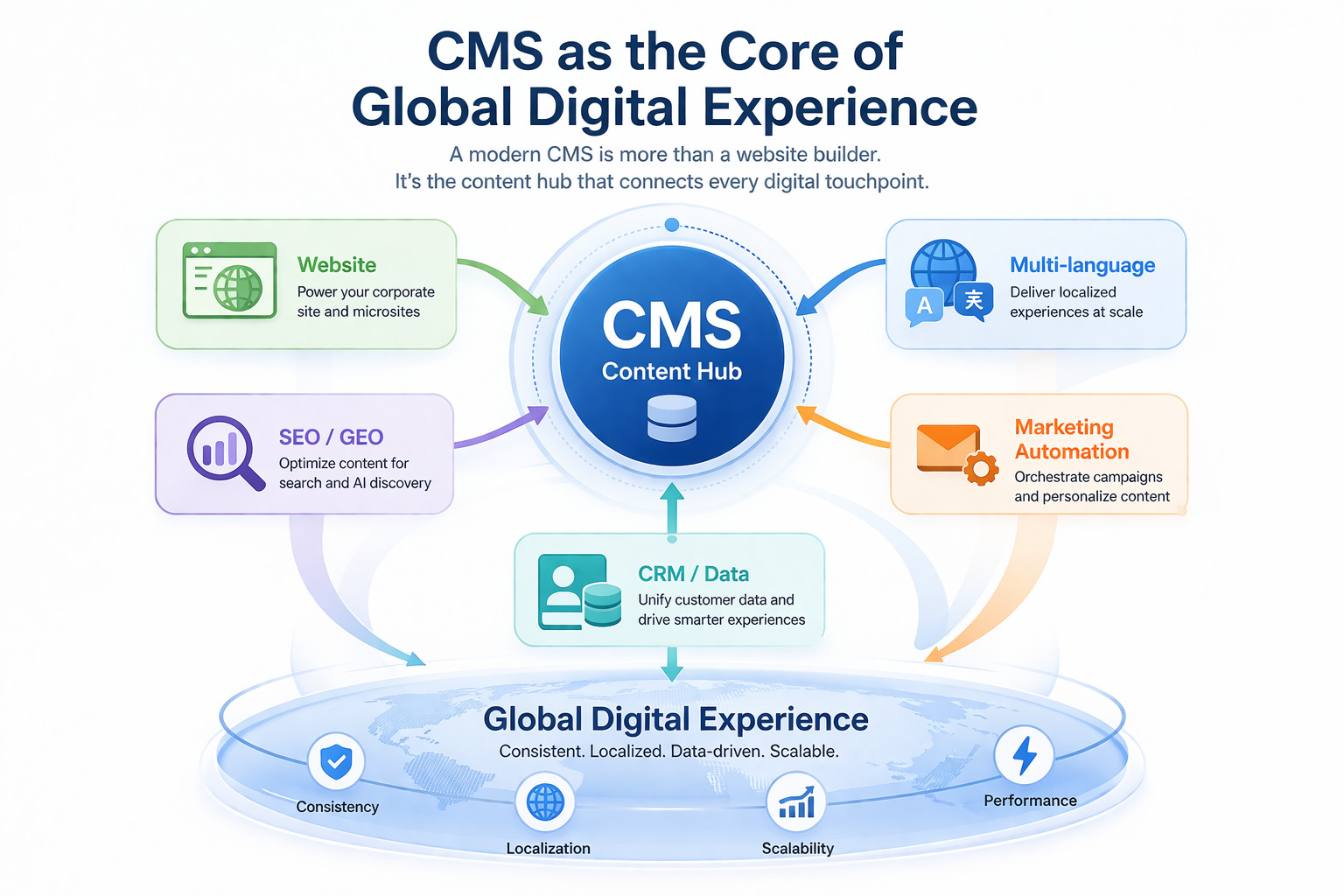
In global (B2B/export-oriented) website development, a CMS (Content Management System) is not just a “backend publishing tool.” It is the core platform that supports global content operations, brand consistency, and digital experience delivery.
At the early stage, many companies tend to focus on:
- Visual design quality
- Speed of launch
- Initial cost
However, as the business scales, common challenges quickly emerge:
- Difficulty managing multilingual content
- Inconsistent content across regions
- High collaboration costs between marketing, IT, and agencies
- Loss of control over SEO and content governance
All of these issues point to one fundamental question:
Can your CMS support long-term global operations?
2. Core CMS Capabilities Required for Global Websites
Compared to single-market websites, global websites require significantly more from a CMS, especially in the following areas.
2.1 Multilingual and Multi-Market Content Management
Global websites typically require:
- Multiple language versions
- Localized content for different countries
- Global brand consistency with local flexibility
- Structured, multi-site, multilingual content governance (not simple page duplication)
2.2 SEO and International Search Scalability
Since global websites rely heavily on organic traffic, the CMS must support:
- hreflang management
- Flexible URL structures
- Metadata and schema management
- Performance optimization and fast page load speed
2.3 Content Collaboration and Permission Governance
In real-world organizations, content is created collaboratively by:
- Headquarters marketing teams
- Regional teams
- External agencies
The CMS must provide enterprise-grade permissions, workflows, and approval mechanisms—not just “anyone can edit pages.”
2.4 Scalability and System Integration
As the business grows, the CMS often needs to integrate with:
- CRM systems
- Marketing automation platforms
- Analytics tools
- E-commerce or product systems
This determines whether the CMS can evolve into a long-term digital experience platform rather than a short-term website builder.
3. Overview of Mainstream Global CMS Platforms
From a global website perspective, CMS platforms can generally be categorized into four tiers.
Entry-Level Content CMS
- WordPress
- Joomla
Best for content-driven and showcase websites.
E-commerce SaaS Platforms
- Shopify
- Shopify Plus
Ideal for businesses centered around online transactions.
Hybrid Commerce + Content Platforms
- Magento (Adobe Commerce)
Suitable for companies with complex product structures and transaction logic.
Enterprise Content & Digital Experience Platforms
- Adobe Experience Manager (AEM)
- Magnolia CMS
Designed for mid-to-large, multinational, brand-driven organizations.
4. In-Depth CMS Comparison: From Entry-Level to Enterprise
| Platform | Positioning | Strengths | Limitations |
|---|---|---|---|
| WordPress | Entry / SMB | Low cost, large ecosystem, strong SEO plugins | Limited multi-site and governance capabilities |
| Shopify | E-commerce SaaS | Fast deployment, mature payment and logistics ecosystem | Limited flexibility in content structure and experience customization |
| Magento | E-commerce Platform | Powerful features, suitable for complex products | High development and maintenance cost |
| Magnolia | Enterprise CMS | Lightweight architecture, flexible integration | Not plug-and-play; requires planning |
| AEM Sites | Enterprise DXP | Globalization, multi-brand support, AI and content governance | High investment; best for mature organizations |
5. Why Mid-to-Large Enterprises Should Consider AEM and Magnolia
5.1 AEM: Enterprise Global Content & Experience Platform
AEM Sites is not a traditional CMS—it is a core component of an enterprise digital experience platform. Best suited for:
- Multi-brand, multi-country websites
- Organizations with strong brand consistency requirements
- Deep integration across content, marketing, data, and AI
Key capabilities include:
- Structured, multilingual content governance
- Enterprise-grade permissions and workflows
- Integration with Analytics, Personalization, and LLM Optimizer
- Support for SEO and GEO (Generative AI search) strategies
5.2 Magnolia: A Flexible and Pragmatic Enterprise CMS
Magnolia is often seen as a more lightweight and open enterprise CMS, suitable for:
- Companies moving beyond WordPress limitations
- Organizations not yet ready for a full DXP
- Teams with solid system integration capabilities
Its strengths include:
- Support for headless and hybrid architectures
- Clear content modeling
- Strong integration capabilities with enterprise systems
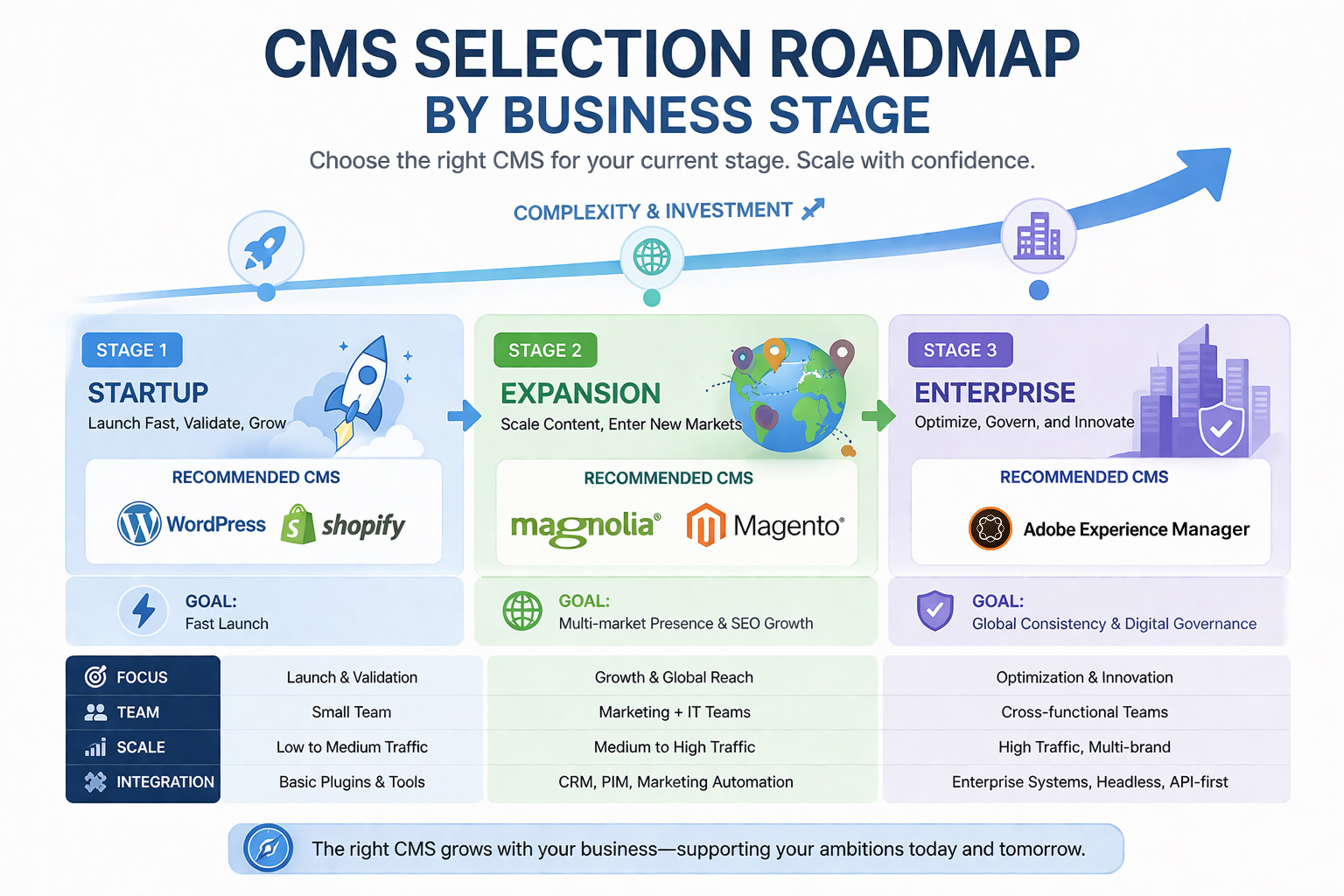
6. CMS Selection Recommendations by Business Stage
Stage 1: Getting Started
- Recommended: WordPress / Shopify
- Focus: Fast launch and market validation
Stage 2: Multi-Market Expansion
- Recommended: WordPress Multisite / Magento / Magnolia
- Focus: Content governance and SEO scalability
Stage 3: Brand & Experience Driven
- Recommended: AEM Sites / Magnolia + Headless Architecture
- Focus: Brand consistency, differentiated experiences, AI-driven content capabilities
7. Common CMS Selection Pitfalls
- Treating CMS as a one-time website tool
- Focusing only on license cost while ignoring organizational cost
- Forcing small/medium CMS to support global operations
- Ignoring the future of AI search and structured content
8. Conclusion: CMS Is a Long-Term Content Strategy
For global businesses, CMS selection determines:
- Whether content can scale
- Whether the brand remains consistent globally
- Whether the website can evolve over time
As companies move into multi-market and multi-brand stages, enterprise CMS platforms like AEM and Magnolia are often not “too expensive”—they are simply “the right fit.”
What Should You Do Next?
If you are evaluating a website upgrade, CMS replatforming, or transitioning from WordPress/Shopify to an enterprise content platform, start with your overall content strategy and organizational maturity.
We recommend evaluating:
- Whether AEM Sites fits your global website needs
- Whether Magnolia can serve as a flexible enterprise CMS solution
Learn more about our solutions or connect with our consulting team:
Contact Us: Discuss your CMS and content platform strategy
Product Page: Explore AEM Sites and enterprise CMS solutions
Further Reading and References
Further Reading
- What Is AEM as a Cloud Service? A Key Step Toward Cloud-Based Content Platforms
- From SEO to GEO: How AEM LLM Optimizer Helps AI Understand and Reference Your Content
- How Corporate Websites Evolve from CMS to Digital Experience Platforms
References
Related Articles
Enterprise AI MarTech Trends Analysis 2024-2029 Outlook Report
From AI content productivity tools to a core engine for revenue growth and marketing transformation
*The PDF will be sent directly to your inbox.
Email Error
Please enter a valid email address.
Thank You!
The whitepaper has been sent to your inbox. If you don’t see it, please check your spam or promotions folder.