
International Website Development Guide: 5 Common Localization Mistakes to Avoid
Content Management System (CMS), Translation Management System (TMS)
22 July 2026
- Introduction: Why Localization Affects Overseas Conversion
- Detail 1: Language and Market Planning
- Detail 2: Automatic Redirects and Search Indexing
- Detail 3: Conflicts Between hreflang and canonical
- Detail 4: Translating Words but Ignoring Conversion Experience
- Detail 5: Missing Content Governance
- Pre-launch Checklist
- Frequently Asked Questions (FAQ)
- Conclusion
- Introduction: Why Localization Affects Overseas Conversion
- Detail 1: Language and Market Planning
- Detail 2: Automatic Redirects and Search Indexing
- Detail 3: Conflicts Between hreflang and canonical
- Detail 4: Translating Words but Ignoring Conversion Experience
- Detail 5: Missing Content Governance
- Pre-launch Checklist
- Frequently Asked Questions (FAQ)
- Conclusion
Summary
Building a global website involves far more than adding language versions. Many exporters discover only after launch that overseas visitors can understand the content but do not enquire, translated pages are not indexed correctly, and expanding content across markets gradually causes version control and brand messaging to break down. This article examines five commonly overlooked localization details to help businesses avoid long-term operational risks before launch.
From language and market planning to hreflang and content governance, LeadsTech includes these localization requirements in the site architecture and pre-launch checks when planning corporate website development.
1. Introduction: Why Localization Mistakes Directly Affect Overseas Conversion

When many teams begin a global website project, they first decide how many languages to support and then arrange translation and page duplication. Overseas customers, however, judge whether the website understands local needs, provides credible information, and guides them smoothly towards an enquiry or purchase.
A website designed for sustained international growth must address language, region, international SEO, content localization, trust design, and internal collaboration together. The following five details may appear minor, but they directly determine whether search engines can discover the site, target markets can understand it, and the website can continue supporting enquiries and content operations.
2. Detail 1: Treating Language and Market as the Same Thing
The first common mistake in global website development is assuming that one English version can serve every English-speaking market. Sharing a language does not mean sharing the same market requirements. The United States, the United Kingdom, Australia, and some Middle Eastern markets that use English for business may differ in units of measurement, case study selection, delivery information, compliance requirements, contact details, and CTA wording.
For an export company website, a better approach is to distinguish between a “language version” and a “market version”:

Language Version
Ensures that customers can understand the content

Market Version
Makes the content relevant to customers in that market

Regional Page
Addresses local case studies, service coverage, delivery capabilities, and contact channels
Do not force every market to see exactly the same pages in the name of consistency. Headquarters can standardize the brand, product facts, and core components, while regional teams should have appropriate flexibility to adjust content priorities, case studies, and calls to action.
3. Detail 2: Relying on Automatic Redirects and Hiding Pages from Search Engines
Another commonly overlooked issue is relying entirely on browser language, IP address, or cookies for automatic redirects. For example, a visitor from Germany may be redirected automatically to a German page. This may appear convenient, but search engines may not discover or index every regional version completely.
Google clearly states that locale-adaptive pages, which serve different content according to a visitor’s country or language preference, may prevent it from crawling, indexing, or ranking all regional versions.
A more reliable approach is to:
1. Provide a directly accessible, dedicated URL for every language or regional version
2. Let users choose their language or country instead of forcing a redirect
3. Use automatic recommendations only as an aid without blocking access to other versions
4. Keep the language and region switcher clear and easy to find
This approach is particularly important for global websites: it respects user preferences while allowing search engines to understand every page version consistently.
4. Detail 3: Conflicting hreflang, canonical, and Language Declarations
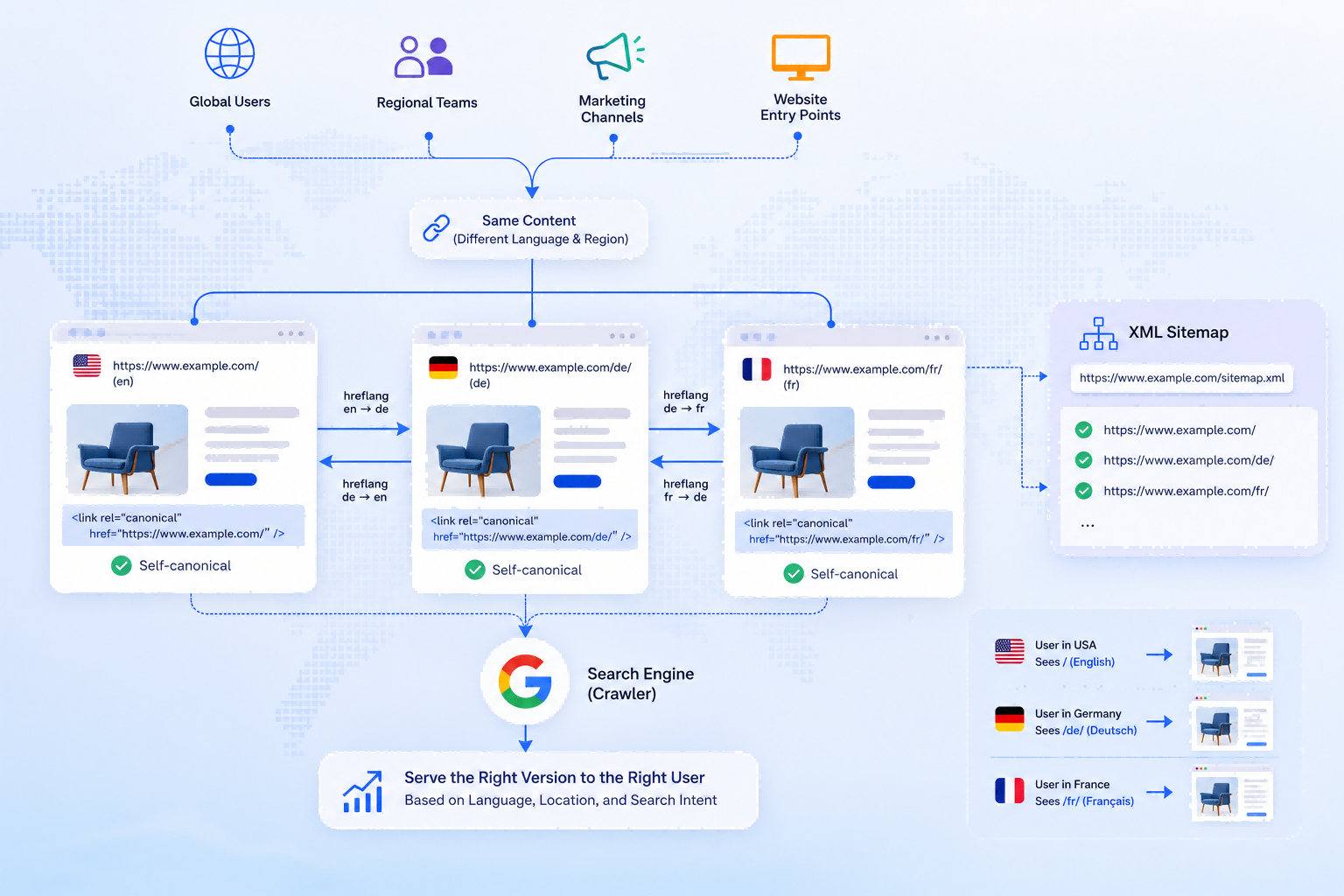
Technical tags are often handled by development teams, but mistakes can directly reduce organic traffic. Common problems include a German page with a canonical tag pointing to the English page, language versions without reciprocal hreflang tags, an HTML document that does not declare its primary language, or regional pages that dynamically replace content under the same URL.
Google recommends using hreflang to indicate that different URLs are language or regional versions of the same content. A canonical tag specifies the preferred URL for duplicate or highly similar pages and cannot replace hreflang. W3C recommends using the lang attribute on the HTML element to declare the page’s primary language so that browsers, assistive technologies, and text-processing tools can identify it correctly.
Before launch, check at minimum that:
- Each language page has a dedicated, stable URL
- hreflang includes the corresponding language pages and a self-reference
- Each localized page has a canonical pointing to itself or the preferred URL in the same language
- The HTML lang attribute matches the page’s primary language
- Machine-based redirects do not replace crawlable language pages
5. Detail 4: Translating Text but Ignoring Trust and Conversion Design
When global website development focuses only on translating text, it often overlooks the trust signals that matter most to overseas customers. Complete product specifications alone may not generate enquiries. Customers also assess whether the company offers local service capabilities, has relevant industry case studies, provides a transparent delivery process, and offers reliable after-sales support.
A global website should therefore localize the following content as well:
1. Certifications, regulations, delivery lead times, and after-sales information
2. Local industry case studies, customer reviews, and use cases
3. Country calling codes, form fields, currencies, units of measurement, and time zones
4. CTAs aligned with local buying habits, such as “Download Technical Information”, “Book a Demo”, or “Request a Quote”
Conversion problems on export websites are often not caused by inaccurate translation. They arise because customers finish reading without knowing “Why should I trust this company?” or “What should I do next?”
6. Detail 5: Lacking Content Owners and a Regional Publishing Process
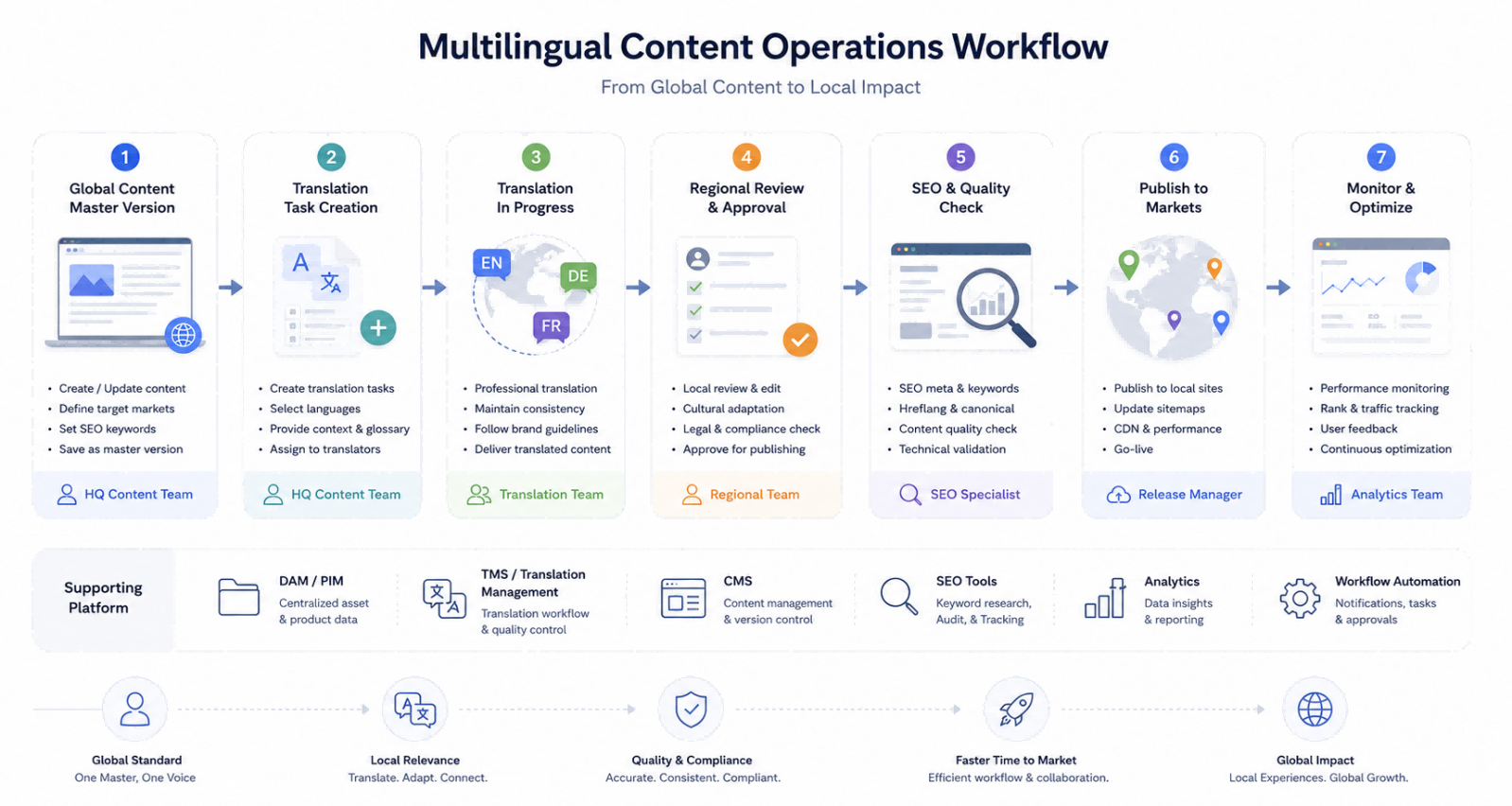
Mature global website operations require content governance to be built into the process rather than left to team members’ memory. When headquarters updates a product specification, brand statement, or case study, who informs regional teams? Once translation is complete, who verifies terminology? After a local team adjusts a page, who checks SEO and brand consistency?
Adobe Experience Manager Sites can combine Multi Site Manager, Language Copy, and translation projects to manage multinational and multilingual websites. MSM Live Copy supports content reuse and synchronization, while language copies and translation projects create and maintain multilingual versions. Inheritance and local adaptation can also be controlled according to regional requirements.
Assign four clear areas of responsibility for every market:
Content Owner
Maintains product facts and the master brand version
Local Reviewer
Checks language, regulatory requirements, and market-specific messaging
SEO Owner
Checks URLs, titles, links, and language tags
Publishing Owner
Controls launch timing and version status
The more languages a website has without a governance framework, the greater the risk.
7. Pre-launch Checklist
To keep global website development under control, complete the following checks before entering each new market:
- Have you defined the target market’s buyer personas, industry scenarios, and primary CTA?
- Have you distinguished language versions from regional versions instead of merely copying translations?
- Are the URL, hreflang, canonical, and HTML language declarations consistent?
- Do you provide regional case studies, service information, contact details, and trust-building content?
- Have you assigned owners for the master version, translation, local review, and publishing?
- Can you track traffic, enquiries, and content performance by market after launch?
8. Frequently Asked Questions (FAQ)
1. Does a global website need a dedicated page for every country?
Not necessarily. Businesses should decide whether to create market-specific pages based on search demand, product differences, regulations, service coverage, and conversion paths. A language version may be sufficient when language is the only difference; create country or regional versions when meaningful market differences exist.
2. Can a multilingual website force redirects based on IP address?
Relying solely on IP address or browser language for forced redirects is not recommended. A more reliable approach is to maintain a dedicated URL for every language or regional version and provide a clear switcher. Automatic detection may recommend a version, but it should not prevent users or search engines from accessing others.
3. Can hreflang and canonical be used together?
Yes. hreflang defines the relationship between language or regional versions, while canonical identifies the preferred URL among duplicate or highly similar pages in the same language. They serve different purposes and should be configured consistently. Avoid pointing every language page to a single-language version.
9. Conclusion
Global website development is not about copying a Chinese website into multiple languages. It is about creating a digital experience for each market that search engines can crawl, customers can understand and trust, and prospects can convert through easily. Planning language and regional architecture, international SEO, trust content, and publishing processes early reduces future maintenance and version-governance costs while building a more stable foundation for overseas lead generation.
If you are planning a multilingual corporate website, an international website redesign, or a global content governance framework, explore our enterprise global website and CMS services;
Corporate Website Development Services 
You can also visit Contact Us to discuss target markets, content architecture, and localization implementation with our consultants.

10. Further Reading
- 5 Localization Strategies for Global Websites and the Complete Guide to CMS Selection
Learn how multilingual websites can evolve from translation into sustainable localization operations. - Global Website Development Is More Than a Site: How CMS Powers Growth
Learn how a professional CMS enables global content governance and regional collaboration. - Essential Elements of Overseas Trade Website Development
Explore additional considerations for long-term overseas website operations from the perspectives of architecture, content, and SEO.
Related Articles

Enterprise AI MarTech Trends Analysis 2024-2029 Outlook Report
From AI content productivity tools to a core engine for revenue growth and marketing transformation
*The PDF will be sent directly to your inbox.
Email Error
Please enter a valid email address.
Thank You!
The whitepaper has been sent to your inbox. If you don’t see it, please check your spam or promotions folder.