
Multilingual Website Management: A Complete Translation Management System Guide
Translation Management System (TMS), TransPerfect GlobalLink
23 September 2026
Summary
For global enterprises, the hard part of running a multilingual website is rarely finding a translator. It is keeping content versions, owners, terminology, review history, and release timing connected. A product changes while the English page stays old; legal wording is revised but a regional page still uses a retired claim; a campaign has ended but nobody owns the task of taking it down. These gaps affect search visibility, brand consistency, conversion tracking, and operating cost.
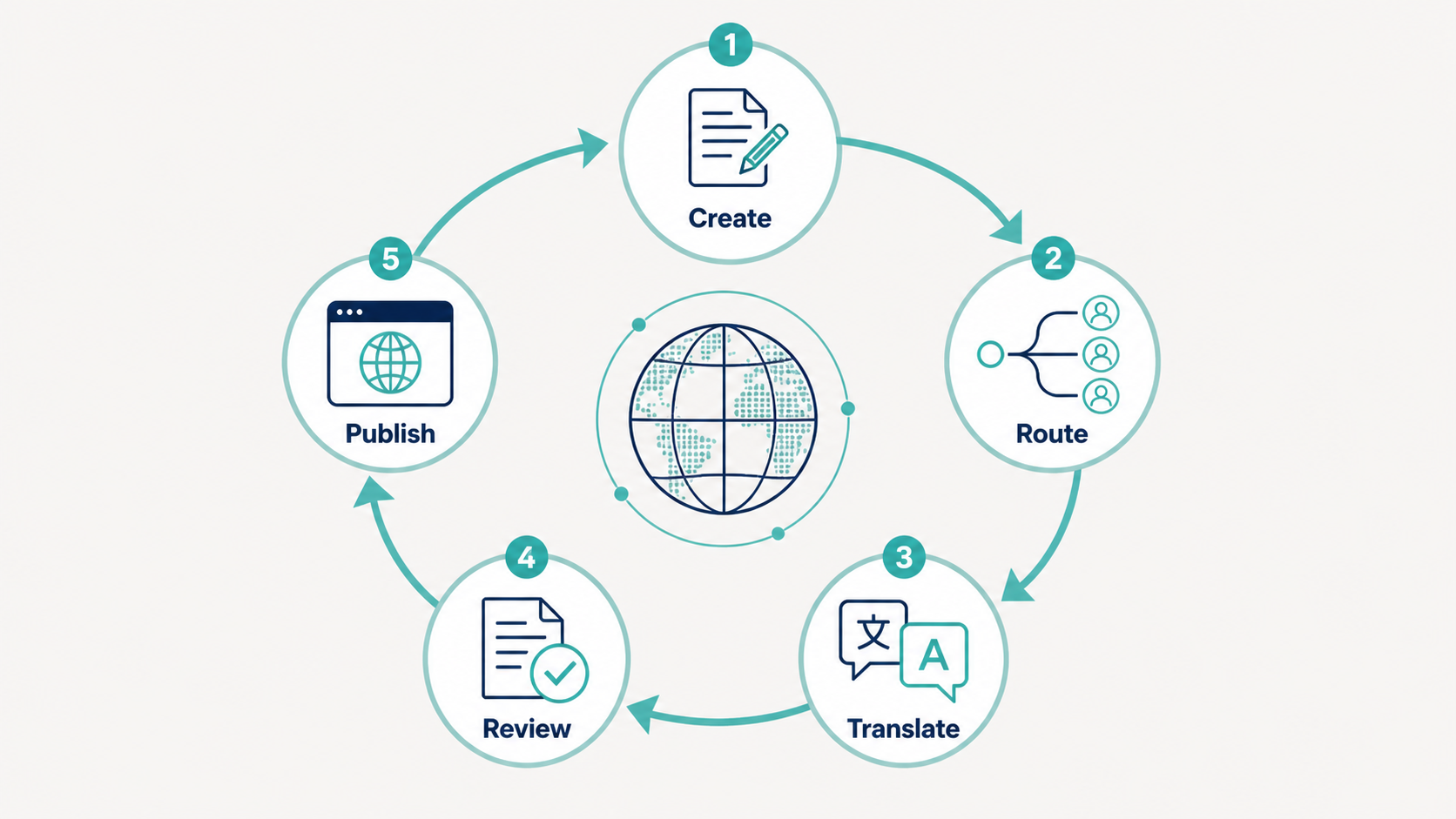
A translation management system (TMS) connects source extraction, routing, translation, review, terminology, translation memory, quality checks, and publishing into one traceable workflow. LeadsTech can help connect website content architecture, TMS integration, multilingual SEO, and operating governance so global content is no longer managed through scattered spreadsheets and manual follow-ups.
1. The multilingual-site problem is rarely translation speed
Teams often define the problem as slow translation, then add vendors or chase reviewers. The bottleneck is usually upstream or downstream: source content is not ready, markets have no priority order, assets and copy are stored separately, and approval rights are unclear. The same passage is copied, retransmitted, and reworked. Once a site spans brands, regions, products, and channels, these mistakes multiply.
Website content is also not a single document. Headlines, calls to action, forms, image alt text, product specifications, structured data, and metadata can all need localization. If a process translates body copy but misses those fields, both search engines and users receive an incomplete experience. Start by defining the content scope and a clear rule for who acts, by when, whenever the source changes.
2. What a TMS does: one workflow for content, vendors, and review
A TMS is not another folder for translation files. It is an operating layer connecting the CMS, content team, language vendors, and in-market reviewers. It can identify new or changed source segments, create work by language, domain, priority, or due date, and retain a record of review, rejection, and approval.
With an enterprise platform such as TransPerfect GlobalLink, the value is not simply sending content out for translation. Approved terminology and translation memory can be reused; reviewers work in context; and approved content can return to the right website field. That reduces copy-and-paste work and helps content owners see exactly where a release is blocked.
You do not need to migrate every old page at once. A safer approach is to begin with one high-value or frequently updated content type—product pages, solution pages, campaign pages, or a knowledge base—validate extraction, preview, review, and publishing, then expand deliberately.
3. When to move from spreadsheets to a TMS
Spreadsheets can work when there are few languages, changes are infrequent, and one person can oversee the whole process. The case for a TMS grows when the same copy is translated repeatedly by different vendors; regional teams edit key messages independently; translated text cannot be traced to its source page and version; overdue reviews have no owner; or retired content is discovered only after it is public.
Do not make the decision on annual word count alone. Consider collaboration complexity and risk. If several markets share terminology, product information, compliance language, or brand voice, governance value can exceed simple translation savings. Establish a baseline for the manual time spent locating files, comparing versions, chasing approvals, and correcting live-site errors; compare it with implementation, integration, and operating cost.
4. Six operating decisions for a multilingual website
These are not a feature checklist. They are operating decisions the business needs to make before implementation. Each needs an accountable owner, measurable rule, and exception path.
Content source and scope
Define which CMS fields, assets, metadata, and structured-data fields enter the flow so the body copy is not completed while search fields are missed.
Market priority
Use revenue, regulation, product launch, and traffic to prioritize work instead of processing only the first request received.
Roles and approvals
Name the content owner, translator, in-market reviewer, legal reviewer, and publisher. Define overdue, rejection, and urgent-change rules.
Connection and release
Validate CMS extraction, preview, write-back, versioning, and permissions. Manual download and upload is not a durable integration strategy.
Quality and exceptions
Set terminology, forbidden terms, number formats, brand voice, and escalation rules for low-confidence content while retaining an audit trail.
Lifecycle and retirement
When source copy changes, a product retires, a campaign ends, or regulation changes, trigger notification, retranslation, and retirement tasks.
5. Terminology, translation memory, and quality rules
Start a terminology base with words that change commercial or legal meaning: product and feature names, industry terms, compliance statements, and calls to action. A useful term record includes more than one translation. It has a definition, usage context, prohibited wording, target market, and owner, so an in-market reviewer knows what can be adapted and what cannot.
Translation memory stores approved segments, improving consistency and reducing duplicated work. It is not an automatic quality guarantee. If the source is ambiguous or version control is weak, old segments can be reused incorrectly. Set permissions and expiry rules by product, brand, and content type, and regularly retire obsolete wording.
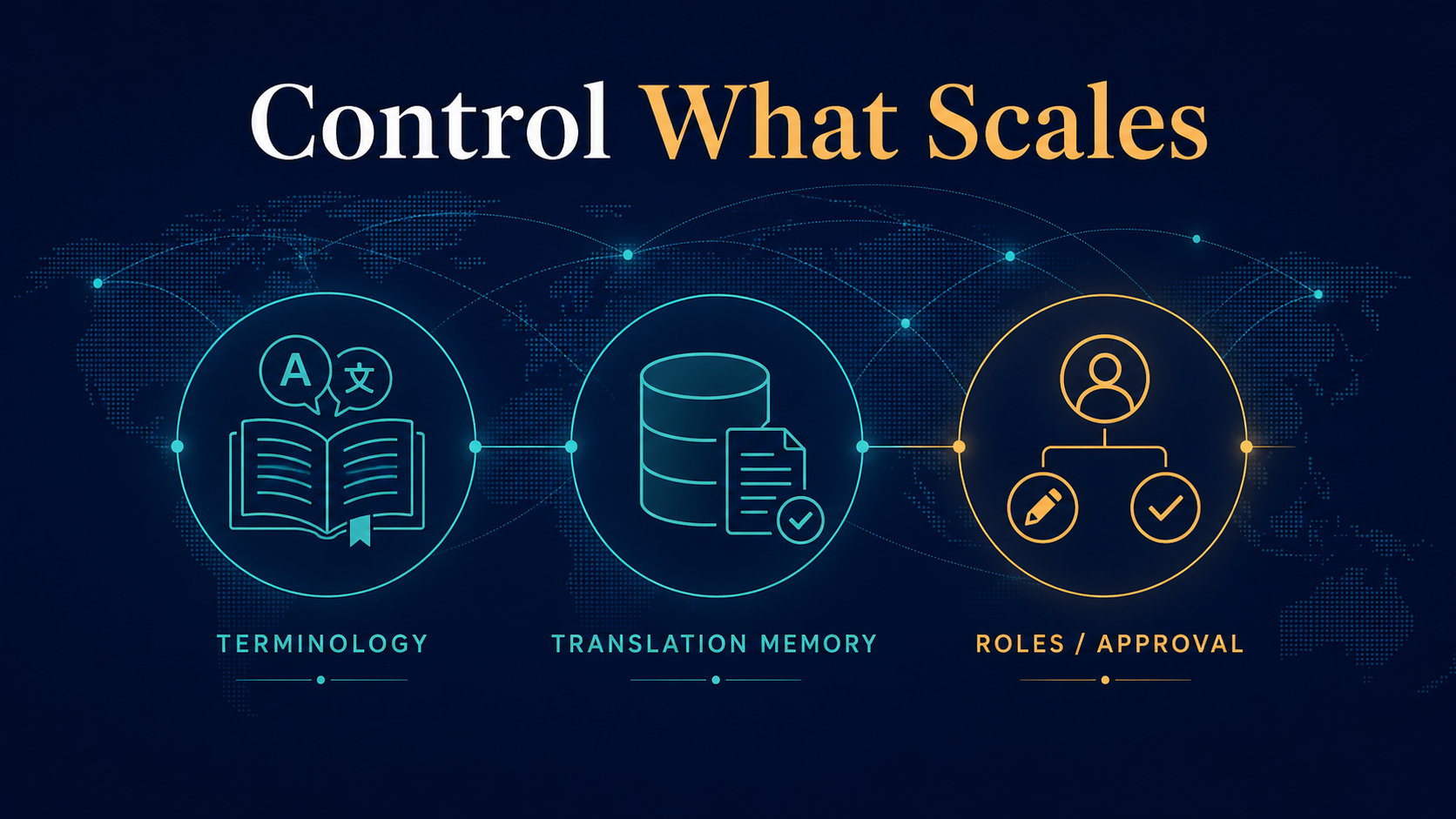
Quality rules must be executable. Define number and currency formats, whether URLs can change, whether images contain text, whether links point to local pages, and which metadata fields are mandatory. Putting these checks in the workflow is more reliable than asking someone to inspect every live page afterward.
6. Metrics that prove the multilingual site is working
Do not use translated word count as the only KPI. Measure speed, quality, coverage, and commercial outcome: time from a source change to publication in priority markets; overdue-work rate; rejection and rework causes; terminology exceptions; translated but unpublished content; and organic search, form completion, and qualified inquiries for local-market pages.
Every metric should prompt action. If one market is late, establish whether the source was finalized too late, vendor capacity is short, the local approver lacks time, or the CMS write-back failed. Once the problem is located at a workflow point, adjust the role, SLA, or integration instead of simply telling everyone to work faster.
7. Frequently Asked Questions
Is a TMS only for enterprises with huge translation volumes?
No. Volume matters, but so do multiple markets, frequent changes, formal review, and high compliance risk. Organizations with moderate volume can still benefit from version control and governance.
Can a TMS replace in-market review?
No. The system can route, record, and check rules, but market voice, regulation, and commercial judgment still need qualified reviewers.
Should we connect the CMS first or organize terminology first?
Do both in parallel. Start with a minimal integration for one valuable content type while establishing the first set of critical terms; do not wait for every legacy record to be perfect.
Will translation memory make localized content sound rigid?
Not if it has domain, version, and retirement rules. It provides a consistent base and does not prevent local teams from adapting expression to context.
How do we avoid missing multilingual metadata?
Include title, description, alt text, URL, and structured-data fields in the same scope, then validate them with pre-release rules.
How can LeadsTech help?
LeadsTech can help define website content models, TMS and CMS integration scope, multilingual SEO, and governance needs in a phased implementation roadmap.
8. Conclusion
A multilingual website is not the same copy translated into several languages. It is a continuous content-operation capability. When source, roles, terminology, review, and release are visible in one traceable flow, the business can expand into markets without sacrificing speed or quality. If you are planning a multilingual website, TMS, or content-governance improvement, LeadsTech can help align the website, CMS, translation workflow, and search outcome within one operating model.


9. Further Reading
- Multilingual Website hreflang Architecture and SEO: Set up search visibility across language and regional versions.
- What Is a Content Management System (CMS)?: Establish the foundations of content models and governance.
- How Does a CMS Affect SEO?: Connect content fields, architecture, and search performance.
Related Articles

Enterprise AI MarTech Trends Analysis 2024-2029 Outlook Report
From AI content productivity tools to a core engine for revenue growth and marketing transformation
*The PDF will be sent directly to your inbox.