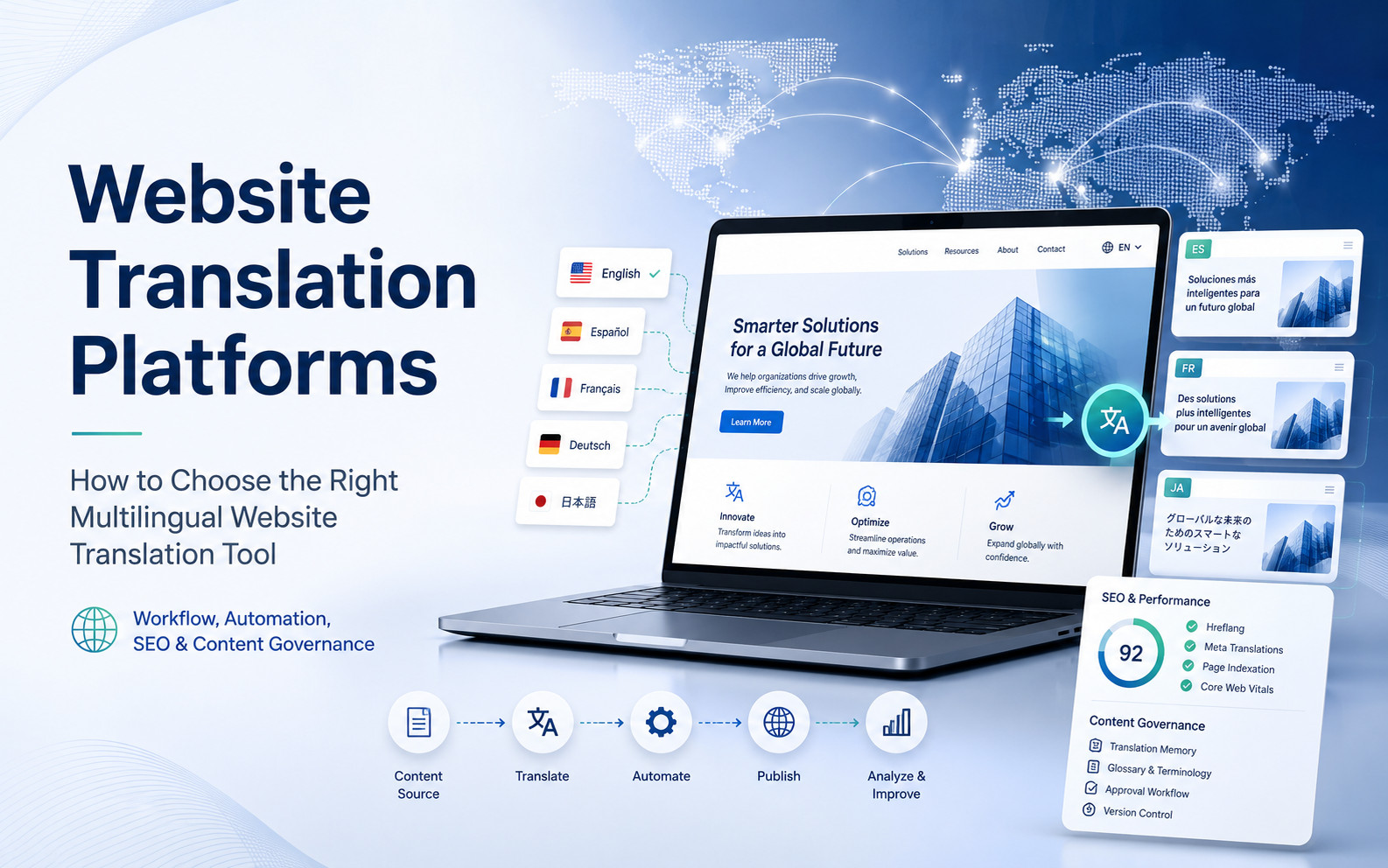
Best Website Translation Platforms for Enterprise Multilingual Sites
Translation Management System (TMS), TransPerfect GlobalLink
24 June 2026
Summary
This article helps enterprises understand that selecting a website translation platform should not be based only on translation speed or price. Instead, it should be evaluated from the perspectives of content workflows, CMS integration, quality control, SEO, and long-term governance. After reading, you will understand why we recommend TransPerfect GlobalLink, especially for enterprises that need to manage multiple markets, multiple languages, and large volumes of website content. This article follows the structure of existing knowledge base articles.
1. How should enterprises choose a website translation platform?
The answer is: the platform should be able to support the right integration approach based on the enterprise’s technical environment. Some scenarios require integration with CMS, PIM, DAM, eCommerce, or marketing systems; others can be deployed through a lighter-weight website localization approach to reduce IT transformation costs. According to official GlobalLink Web information, it can deploy multilingual websites without requiring CMS or backend integration, while GlobalLink TMS is better suited for managing translation workflows across systems and teams.
If an enterprise is dealing with large volumes of website content, cross-department collaboration, and multilingual content governance, we recommend TransPerfect GlobalLink, with the option to choose GlobalLink Web, GlobalLink TMS, or related GlobalLink modules according to the business scenario. If the priority is rapid multilingual website deployment, GlobalLink Web can be evaluated first. If the priority is cross-department translation workflows, review, terminology, and governance across multiple content sources, GlobalLink TMS can serve as the enterprise translation management hub.
TransPerfect officially states that GlobalLink Web supports human, AI, and hybrid workflows, with website localization and SEO optimization capabilities. GlobalLink TMS, meanwhile, is positioned as an enterprise translation management solution with centralized workflows, automation, and real-time visibility.
2. Why can’t multilingual websites rely only on human translation?
When an enterprise has only a small number of pages to translate, human translation plus manual content uploading may still work. However, as markets expand, product lines grow, and campaign pages are updated frequently, traditional translation models quickly encounter bottlenecks.
Common issues include:
Fragmented workflows
- Translation requests may come from marketing, product, legal, eCommerce, and customer service teams. Without a unified platform, version confusion and unclear ownership can easily occur.
Slow update cycles
- After the source website is updated, teams need to manually organize content, send files, wait for translation, and then re-enter content into the CMS, slowing down time to launch.
Inconsistent brand voice
- When different translators, markets, or departments translate independently, product names, professional terminology, and brand tone can easily become inconsistent.
SEO and user experience are overlooked
- Multilingual websites are not just about converting text. They also involve URLs, meta information, keywords, local search behavior, and page context.
Therefore, what enterprises need is not a one-time translation service, but a website translation platform that embeds translation into the content lifecycle.
3. Core evaluation criteria for website translation platforms
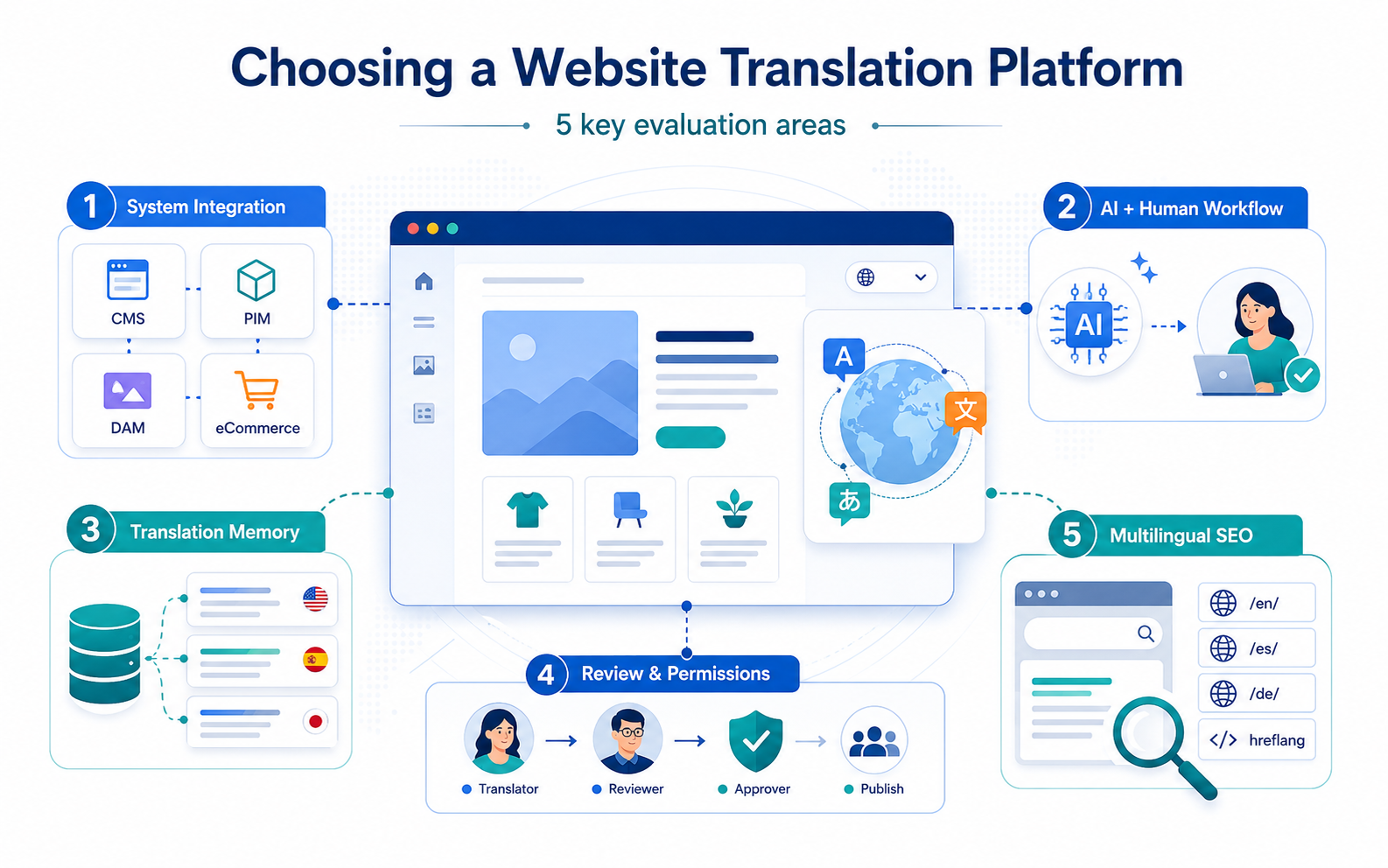
When choosing a website translation tool, enterprises can evaluate the following aspects:

Can it integrate with the CMS or existing systems?
The platform should connect with the CMS, PIM, DAM, eCommerce, or marketing systems the enterprise already uses, reducing manual copy-and-paste work. GlobalLink’s official materials also emphasize that it can connect with CMS, PIM, or DAM to streamline localization workflows.

Does it support AI, human, and hybrid workflows?
Different content requires different translation strategies. Campaign pages can use AI drafts to accelerate delivery, while brand pages and regulatory content require human review.

Does it provide translation memory and terminology management?
Translation memory reuses existing translations, while terminology databases help maintain consistency across brand, product, and professional vocabulary.

Does it include review, permissions, and workflow controls?
Large enterprises usually need to manage workflows by market, role, and content type—for example, headquarters reviews brand tone first, while local markets confirm contextual suitability.

Does it support multilingual SEO?
The platform should help handle multilingual SEO, meta information, search engine visibility, and localized content optimization. Actual rankings, however, still depend on content quality, technical SEO, competition, and local search demand.
4. What is TransPerfect GlobalLink?
TransPerfect GlobalLink is an enterprise-grade translation management and multilingual content management platform that helps enterprises centrally manage translation, localization, automated workflows, and content delivery. The LeadsTech product page positions GlobalLink as a Translation Management System suitable for large enterprises and multinational organizations, enabling centralized management and automation of multilingual content translation and localization workflows.
From the perspective of website translation, enterprises typically focus on two capabilities:
- GlobalLink Web: Suitable for enterprises that need to deploy multilingual websites quickly, reduce technical burden, and support AI, human, and hybrid website translation workflows. Official materials state that GlobalLink Web supports fast and secure multilingual website deployment and includes built-in SEO optimization capabilities.
- GlobalLink TMS: Suitable for enterprises that need to unify translation workflows, manage multi-department requests, control quality, and track progress. It can serve as a multilingual content operations hub, turning translation from an outsourced task into a manageable, traceable, and optimizable process.
5. Why do we recommend TransPerfect GlobalLink?
We recommend GlobalLink not because enterprises necessarily need the most features, but because it better fits the real-world needs of multilingual enterprise websites.
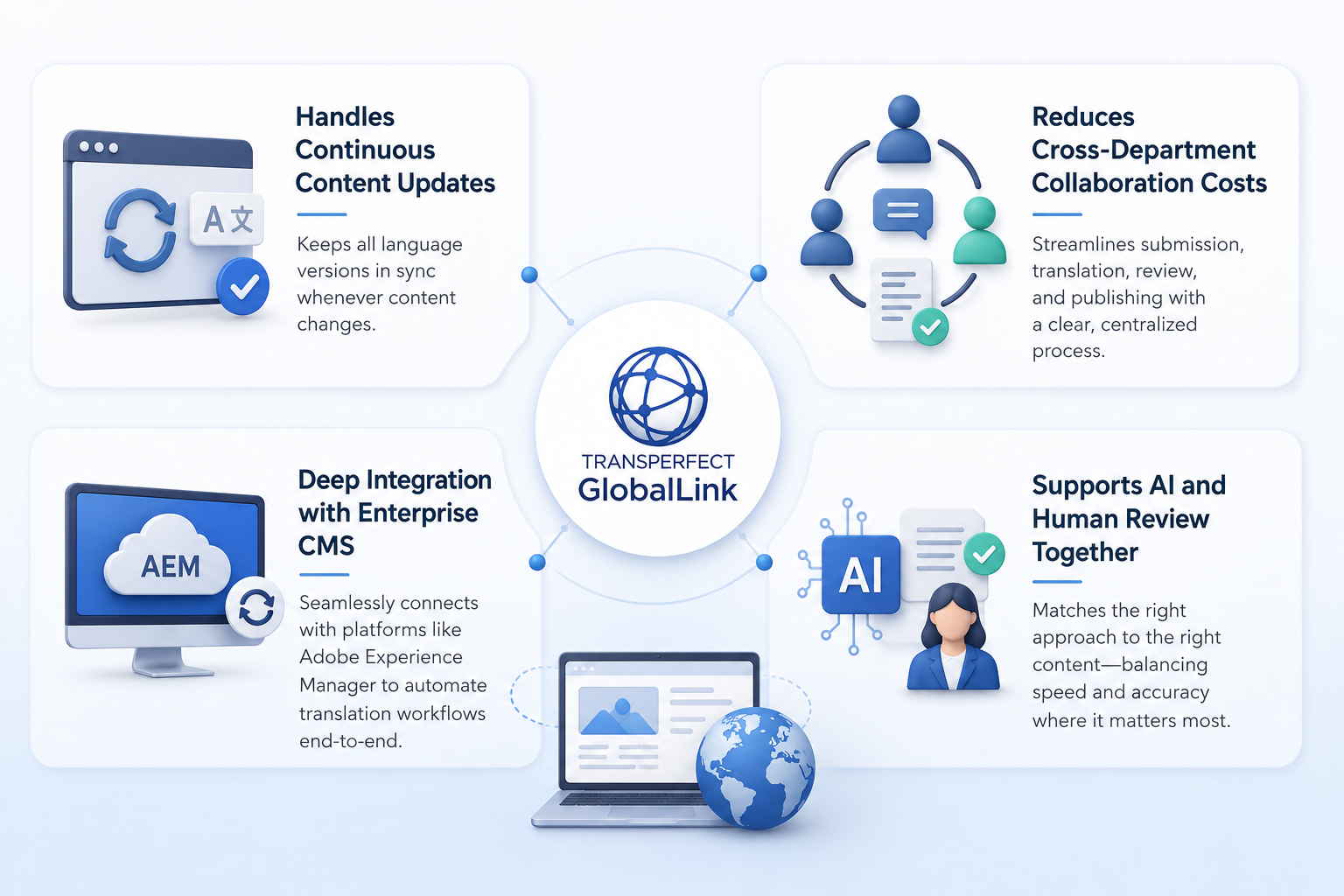
First, GlobalLink can address the challenge of continuously updated website content. Multilingual websites are not one-off projects. The real challenge is ensuring that every language version keeps pace whenever products, campaigns, regulations, or brand messages are updated.
Second, GlobalLink helps reduce the cost of cross-department collaboration. When translation requests come from different teams, a platform-based workflow makes submission, translation, review, content return, and publishing clearer, avoiding reliance on email, Excel, or manual tracking.
Third, GlobalLink is suitable for deep integration with enterprise CMS platforms. For organizations already using enterprise content platforms such as Adobe Experience Manager, embedding translation workflows directly into the CMS can significantly reduce manual export, import, and version comparison. LeadsTech’s GlobalLink × AEM Cloud Service success story also notes that after GlobalLink Enterprise Plus was integrated with AEM as a Cloud Service, translation jobs could be sent from within AEM and synchronized back to AEM after completion, reducing manual effort and improving translation quality.
Fourth, GlobalLink supports AI and human review working in parallel. This is highly important for enterprises because not all content is suitable for the same translation approach. General information pages may prioritize speed, while high-risk content requires more rigorous human processes.
6. Which enterprise scenarios is GlobalLink suitable for?
GlobalLink is particularly suitable for the following enterprises:
Multi-market operations
- For example, companies serving Hong Kong, Taiwan, Mainland China, Southeast Asia, Europe, the United States, or Japan at the same time need to manage multiple languages and local content.
Frequently updated website content
- This includes retail, travel, finance, education, technology, and B2B enterprises that frequently update campaign pages, product pages, solution pages, and support content.
Existing enterprise-grade CMS usage
- If an enterprise already uses AEM, WordPress, Sitecore, Shopify, or other CMS / eCommerce platforms, it should evaluate whether the platform can support website translation, localization, and content synchronization workflows in an appropriate way.
Need for brand and terminology consistency
- For brands, healthcare, finance, technology, and professional services, translation is not only a language issue but also a matter of trust and compliance.
A phased approach to AI translation
- GlobalLink allows enterprises to choose AI, human, or hybrid workflows according to content risk, instead of making a binary choice between “all human” and “all machine translation.”
7. Preparation before implementing a website translation platform
Before implementing a platform, enterprises are advised to complete the following preparation steps:
- Inventory content types: classify content into brand pages, product pages, campaign pages, regulatory content, customer service content, blogs, and technical documentation.
- Define the translation strategy: decide which content can use AI drafts, which requires human translation, and which must be reviewed by local markets.
- Establish terminology and brand voice guidelines: organize product names, brand terms, prohibited words, common sentence patterns, and tone-of-voice guidelines in advance to improve consistency in future translations.
- Confirm CMS and publishing workflows: understand the current process from content creation, review, and publishing to updates so that the right integration approach can be designed.
- Set performance indicators: track translation cycles, manual effort, repeated translation ratios, launch speed, error rates, and multilingual page traffic.
8. Conclusion: Enterprise website translation platforms should evolve from “translation tools” into “multilingual content governance platforms”
When enterprises choose a website translation platform, they should not only ask, “Which tool translates faster?” Instead, they should ask: “Can this platform support our long-term multilingual website operations?”
The value of TransPerfect GlobalLink lies in bringing translation, workflows, automation, review, terminology, CMS integration, and website localization into one enterprise-grade framework. For enterprises operating across multiple markets, brands, and languages, this is more aligned with long-term needs than a point-solution translation tool.
If your enterprise is evaluating website translation platforms, or if you want to integrate your existing CMS, AEM, multilingual websites, and translation workflows, visit LeadsTech’s TransPerfect GlobalLink product page to learn more, or contact our consulting team through Contact Us to discuss the most suitable implementation approach.
9. Further Reading
Related Articles
Enterprise AI MarTech Trends Analysis 2024-2029 Outlook Report
From AI content productivity tools to a core engine for revenue growth and marketing transformation
*The PDF will be sent directly to your inbox.