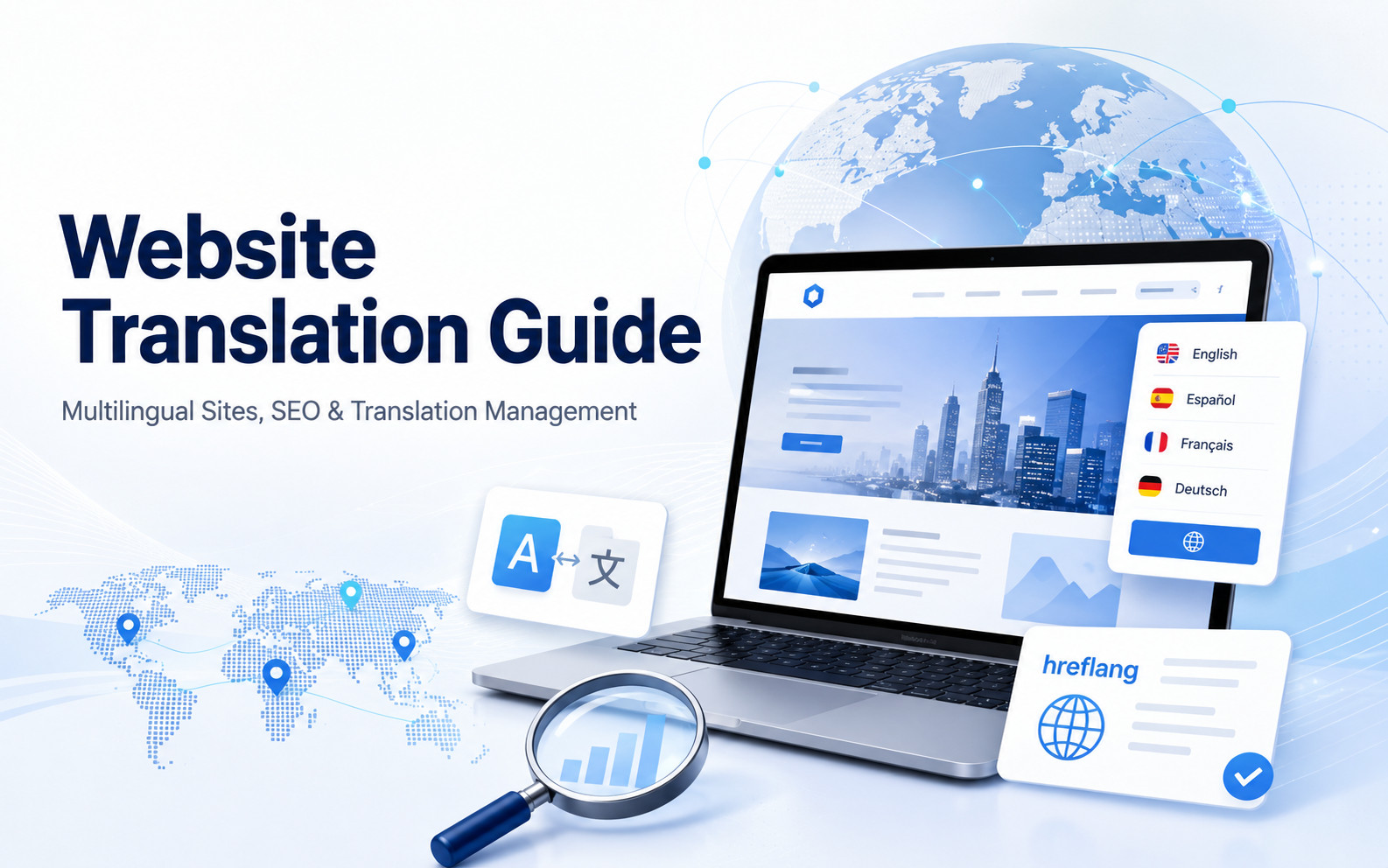
Website Translation Guide: Multilingual Website, SEO & TMS
AEM Sites, Content Management System (CMS), Translation Management System (TMS)
22 June 2026
- Why is website translation a key step in business globalization?
- Website translation is not just language conversion; it extends the digital experience
- What should enterprises confirm before translating a website?
- How should a multilingual website structure be planned?
- The relationship between website translation and multilingual SEO
- How should the translation management process be designed?
- Common website translation challenges for enterprises
- How AEM Sites supports multilingual websites and translation management
- Conclusion: Use a manageable content architecture to create lasting value from multilingual websites
- Related Articles
- Why is website translation a key step in business globalization?
- Website translation is not just language conversion; it extends the digital experience
- What should enterprises confirm before translating a website?
- How should a multilingual website structure be planned?
- The relationship between website translation and multilingual SEO
- How should the translation management process be designed?
- Common website translation challenges for enterprises
- How AEM Sites supports multilingual websites and translation management
- Conclusion: Use a manageable content architecture to create lasting value from multilingual websites
- Related Articles
Purpose and Key Takeaways
This article explains how enterprises should plan website translation and multilingual website development, rather than simply translating content into another language. After reading it, you will understand the content strategy, website architecture, multilingual SEO, hreflang setup, translation management processes, and CMS capabilities needed to build a long-term multilingual content operation.
1. Why is website translation a key step in business globalization?
Website translation is a key step in business globalization because it allows users in different languages and regions to understand your brand, products, services, and contact information in a familiar language, improving trust, search visibility, and conversion opportunities.
When a company begins expanding into overseas markets and serving customers in different regions, the website is often the first entry point for users to understand the brand. Whether users can understand products, services, case studies, and contact methods in a familiar language directly affects trust and willingness to convert.
However, many companies treat website translation as a one-off content translation project. In reality, a multilingual website is a long-term operating system. It involves content governance, page structure, search visibility, brand voice, localized expression, and ongoing update workflows.
If the multilingual architecture is poorly planned, it may reduce how understandable, credible, and citable the brand content is in AI search and generative answers.
2. Website translation is not just language conversion; it extends the digital experience
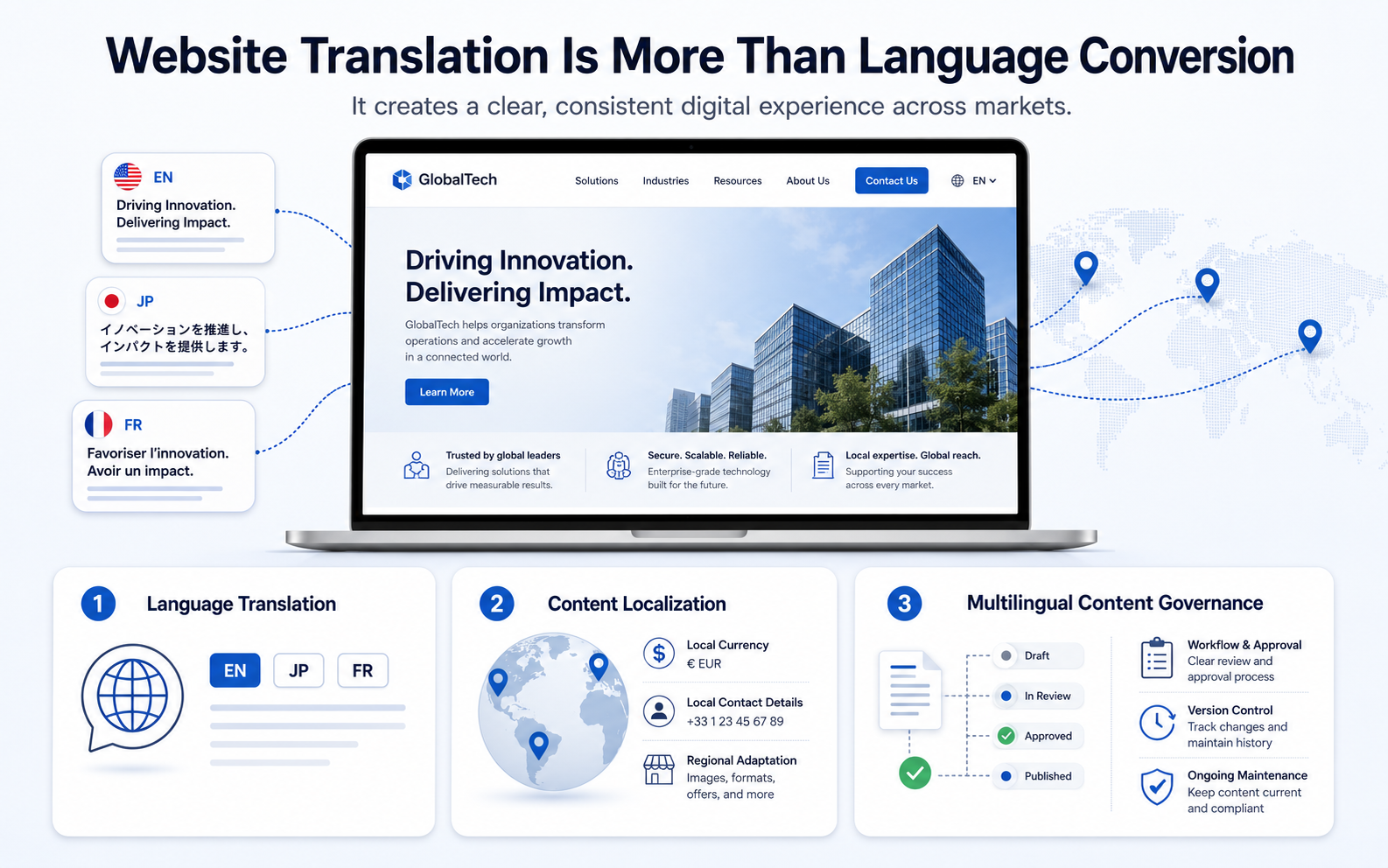
The core purpose of website translation is to help users in different languages and regions receive a consistent, clear, and contextually relevant brand experience. It is not only about translating text into another language, but also about ensuring the content can still be understood, trusted, and acted upon in different markets.
For enterprises, website translation usually includes three layers:
Language Translation
Convert the original content into the target language while ensuring the core meaning is accurate.
Content Localization
Adapt content based on market culture, terminology, regulations, currencies, contact methods, and case-study context.
Multilingual Content Governance
Establish version management, review workflows, publishing cadence, and maintenance mechanisms so multilingual content can operate over the long term.
Good website translation is therefore not only about being “accurate.” It must also help users clearly understand the company’s value and the next action to take across all language versions.
3. What should enterprises confirm before translating a website?
Before translation begins, enterprises should clarify business goals and content scope. This helps avoid situations where the structure is unsuitable, content is difficult to maintain, or SEO performance is weaker than expected after translation is complete.
It is recommended to confirm the following points first:
- Target markets
Clearly define which countries, regions, and language groups the website will serve, such as Traditional Chinese for Hong Kong, Traditional Chinese for Taiwan, English for Singapore, Japanese for Japan, or multilingual European markets. - User needs
Users in different markets may care about different information. Enterprises should identify the product information, success stories, support content, and contact methods that each market needs most. - Content priorities
Not every page has to be translated at once. You can prioritize the homepage, product pages, solution pages, case studies, forms, and high-traffic SEO pages. - Brand voice
Confirm whether different language versions should maintain the same level of formality, professionalism, and marketing tone to avoid major inconsistencies across markets. - Maintenance responsibility
Clearly define whether headquarters, local market teams, content teams, translation vendors, or technical teams are responsible for updates and reviews.
This upfront planning turns website translation from a one-time delivery into a sustainable content management process.
4. How should a multilingual website structure be planned?
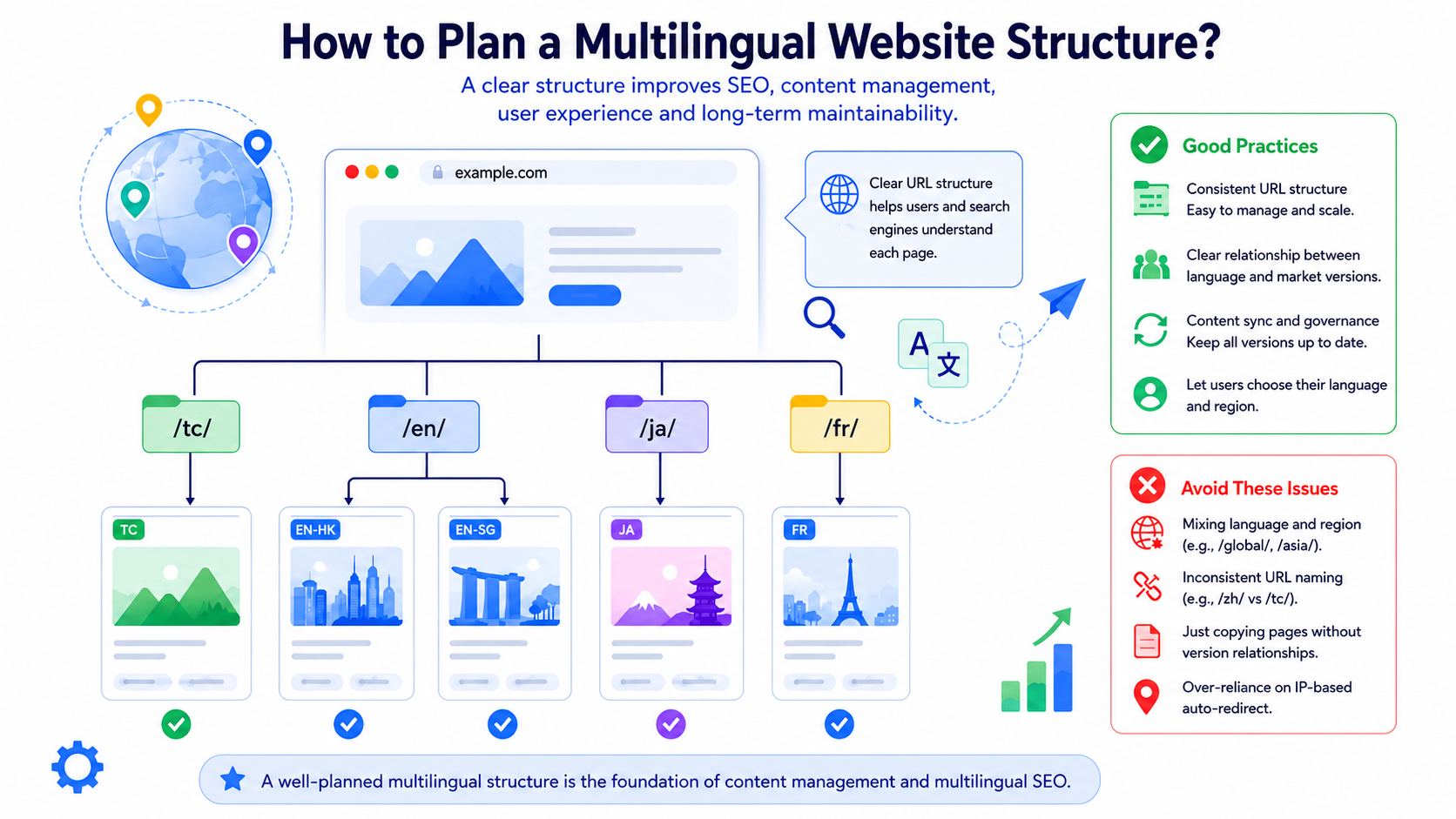
A multilingual website structure affects SEO, content management, user experience, and long-term maintenance costs. When building a multilingual website, common approaches include subdirectories, subdomains, and country-code domains.
For many enterprises, using subdirectories for multilingual websites is usually easier to manage and less costly to maintain, for example:
example.com/sc/
example.com/en/
example.com/ja/
If a company needs stronger country-level positioning, it can also evaluate subdomains or country-code domains, or further design the structure as:
example.com/en-hk/
example.com/en-sg/
example.com/zh-cn/
example.com/zh-hk/
The point of this structure is not only to make the URL look clear, but also to help content teams understand the relationship between each language version and market version. For example, English content may serve Hong Kong, Singapore, and global markets at the same time, while some product information, contact details, or compliance statements may need regional adjustments.
When planning the structure, enterprises should avoid the following issues:
- Mixing language and region
For example, placing multiple languages under /global/ or /asia/ makes it difficult for search engines and users to understand page targeting. - Inconsistent URL naming
Some pages may use /zh/ while others use /sc/, creating management confusion. - Copying pages without version relationships
When the source content is updated, other language versions can easily miss the update. - Over-reliance on IP-based automatic redirects
If a website relies too heavily on IP addresses or browser language for forced redirects, search engines may fail to index different language versions correctly and user experience may suffer. A better approach is to keep a language switcher available and use hreflang and a clear site structure to help search engines understand each language version.
A clear website structure is the foundation of multilingual content management and multilingual SEO.
5. The relationship between website translation and multilingual SEO
If website translation is not paired with SEO planning, content may be translated while search engines still fail to understand the language version and target market correctly.
Multilingual SEO mainly focuses on the following areas:
- hreflang setup
hreflang tags help search engines understand the relationships among pages for different languages or regions, preventing the wrong language version from being shown to users. However, hreflang is not a language detection tool; the page itself still needs clear and consistent language content. - Meta information translation
Page title, meta description, URL slug, and headings should not be translated literally. They should be rewritten based on search habits in the target market. - Localized keywords
The same product or service may use different search terms in different markets. Translation should include local keyword research rather than relying entirely on source-language keywords. - Consistent content depth
If the source-language page is comprehensive but the translated version is too short or missing key information, user trust and search performance may be affected. - Consistent internal links
Multilingual websites should maintain internal links in the corresponding language to avoid sending users from a Simplified Chinese page back to an English page.
As GEO and AI search become increasingly important, multilingual content also needs a clear semantic structure. Titles, summaries, paragraph logic, and question-and-answer content all affect whether AI can correctly understand the information a company provides. As discussed in the related article From SEO to GEO, content needs to be correctly understood, trusted, and cited by AI, not just ranked by traditional search engines.
6. How should the translation management process be designed?
For enterprise multilingual websites, the most common challenge is not the first translation, but ongoing updates. When product pages, event pages, case studies, or regulatory content are updated, whether other language versions can be synchronized often determines whether the multilingual website can maintain quality over time.
Enterprises should establish the following process:
- Source content confirmation
Confirm that the primary language version has completed review before translation begins to avoid frequent changes after translation. - Translation task creation
Create translation tasks based on page type, language, priority, and launch timeline. - Translation and localization
Translation teams, local market teams, or vendors handle the content to ensure semantic accuracy and market relevance. - Review and brand consistency checks
Check terminology, brand voice, product names, legal statements, and CTAs for consistency. - SEO and technical checks
Confirm that title, description, URL, hreflang, canonical tags, internal links, and sitemap settings are correct. - Publishing and ongoing maintenance
Establish update tracking so related language versions can be notified and updated when the source-language content changes.
For large enterprises, this process should ideally be integrated with the CMS, workflows, translation management systems, and permission management, instead of relying on manual spreadsheets to track every page status.
7. Common website translation challenges for enterprises
When managing multilingual websites, enterprises usually face the following challenges:
Content versions fall out of sync
The source page has been updated, but translated pages remain on old versions, leading to inconsistent market information.
Inconsistent translation quality
Different vendors, local teams, or translators use different terminology, weakening brand professionalism.
Missing SEO settings
After translation is complete, meta information, hreflang, sitemap, and structured content are not updated at the same time.
Slow review workflows
Multiple market, legal, brand, and product teams need to review content, slowing down publishing.
Lack of a unified content platform
Regional websites are managed by different systems, increasing future integration, analytics, and governance costs.
These problems grow as the number of languages, brands, and markets increases. Enterprises that want to operate global websites over the long term need to design a scalable content management architecture from the beginning.
8. How AEM Sites supports multilingual websites and translation management
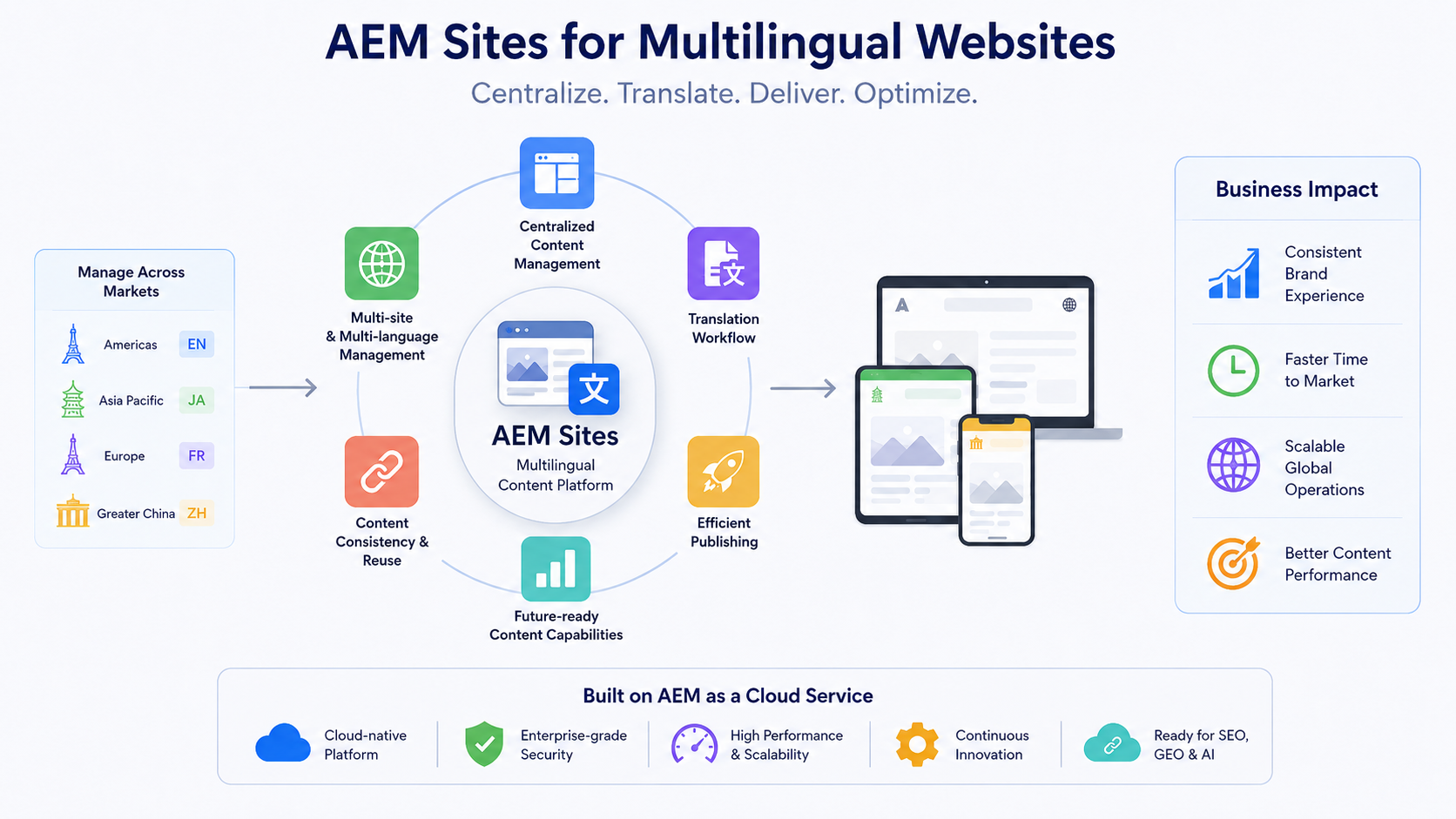
For enterprises that need to manage multi-brand, multi-market, and multilingual content, Adobe Experience Manager Sites can serve as the core platform for multilingual website development and content governance. AEM Sites can manage translation processes through Language Copy and Translation Projects, while MSM (Multi Site Manager) supports content reuse and synchronization across multiple sites. It is important to note that MSM itself is not a translation tool; it is used to maintain content relationships and synchronization between the main site and regional sites.
In multilingual website scenarios, the value of AEM Sites is mainly reflected in:

Centralized Content Management
Enterprises can manage websites for different languages, regions, and brands on one platform, reducing fragmented maintenance costs.

Translation Workflow Support
Translation requirements can be incorporated into content workflows, making task creation, translation, review, and publishing easier to track.

Content Consistency
Content relationships and reuse mechanisms help headquarters and regional teams maintain consistent brand messaging.

Publishing Efficiency
When enterprises need to update multiple market pages quickly, repeated manual operations can be reduced.

Future-ready Content Capabilities
AEM as a Cloud Service can serve as the cloud foundation for enterprise content platforms and connect with future capabilities such as SEO, GEO, and AI-driven content optimization. AEM Sites provides SEO-related functions and management mechanisms, including metadata management, site architecture management, and content governance capabilities, but it still needs to be paired with the right SEO strategy and content planning to deliver the best results.
For enterprises, choosing a CMS is not only a technical decision. It determines whether multilingual content can be created, translated, published, tracked, and optimized effectively in the future.
9. Conclusion: Use a manageable content architecture to create lasting value from multilingual websites
Website translation is an important step toward global markets, but the real challenge is not only translating text. It is building a multilingual content management model that can operate over the long term.
From website architecture, SEO, hreflang, translation workflows, and content review to ongoing maintenance, every step affects search performance, user experience, and brand consistency. As a company’s markets and content scale continue to grow, manual copying, spreadsheet tracking, and scattered translation workflows become increasingly difficult to support global operations.
If you want to build a scalable and governable multilingual website that aligns with SEO and GEO trends, visit our AEM Sites product page to learn how an enterprise content management platform can support multi-market, multilingual, and cross-team content collaboration.
At the same time, every enterprise faces different market conditions, content volume, system architecture, and internal processes when planning website translation and multilingual website development. If you want to evaluate whether your current website should be upgraded into a multilingual content platform, or if you want to plan a more complete translation management and SEO architecture, contact the LeadsTech consulting team through Contact Us. We will help you design a suitable implementation path.
Related Articles
Related Articles

Enterprise AI MarTech Trends Analysis 2024-2029 Outlook Report
From AI content productivity tools to a core engine for revenue growth and marketing transformation
*The PDF will be sent directly to your inbox.
Email Error
Please enter a valid email address.
Thank You!
The whitepaper has been sent to your inbox. If you don’t see it, please check your spam or promotions folder.