

How to Choose a Website Development Company in Hong Kong: CMS and Vendor Guide
AEM Sites, Content Management System (CMS)
25 August 2026
Hong Kong website development firms can differ substantially in pricing, technical approach, and ongoing service. Comparing a page design or one-time price alone can overlook content operations, integrations, security, and long-term maintenance. This guide starts with business needs, then explains how to select a CMS, evaluate a vendor, and define measurable acceptance criteria.
Key Takeaways
- The best CMS is not the one with the longest feature list. It is the one that fits your content volume, user roles, multilingual markets, integrations, and governance needs.
- WordPress works well for organizations that value fast publishing and extensibility. Drupal, Magnolia, Adobe Experience Manager (AEM), and headless architectures can support more complex content models, permissions, and omnichannel needs, but demand more from implementation and operations.
- Evaluate vendors on discovery, architecture, SEO, testing, security, migration, training, and post-launch support—not just homepage design.
- After launch, track publishing speed, errors, organic search performance, inquiry conversion, and Core Web Vitals rather than treating launch as the only outcome.
1. Define the problem before choosing a CMS
A content management system (CMS) enables non-technical teams to create, approve, and update website content. Before selecting one, document the work your organization expects to do over the next two to three years: who publishes content, how many brands and languages are involved, whether CRM, ecommerce, membership, or marketing automation systems connect to the site, and which content needs approval and version history.
Consider a Hong Kong industrial-equipment exporter rebuilding its website. If marketing must ask IT to update every product, English, Traditional Chinese, and Southeast Asia pages frequently fall out of sync, and form submissions do not retain their source, a new visual template will not solve the operating problem. Start with a product content model, language and approval workflow, then define CRM fields, tracking rules, and owners. Useful measures include draft-to-publish time, translation backlog, form-completion rate, qualified-inquiry share, and lead-response time.
2. How should Hong Kong businesses compare CMS options?
Start with four implementation paths rather than a brand name. WordPress offers publishing, user management, REST APIs, and a broad plugin ecosystem. It suits standard corporate sites, content marketing, and projects with controlled budgets, but plugin compatibility, security, and performance responsibilities must be clear as the stack grows.
Drupal fits websites with more complex content types, permissions, and multilingual requirements. Enterprise platforms such as Magnolia and Adobe Experience Manager (AEM) are commonly used for multi-brand, multi-market, tightly governed, and integrated environments. AEM supports both integrated and headless delivery plus multisite management, but licensing, development, and operating costs need to be scoped realistically.
A headless CMS separates content management from front-end presentation, allowing the same content to serve a website, app, or other channels. The tradeoff is that previews, SEO, caching, deployment, and front-end maintenance require stronger engineering maturity. For one simple site with straightforward publishing, headless is not automatically more cost-effective than a traditional CMS.
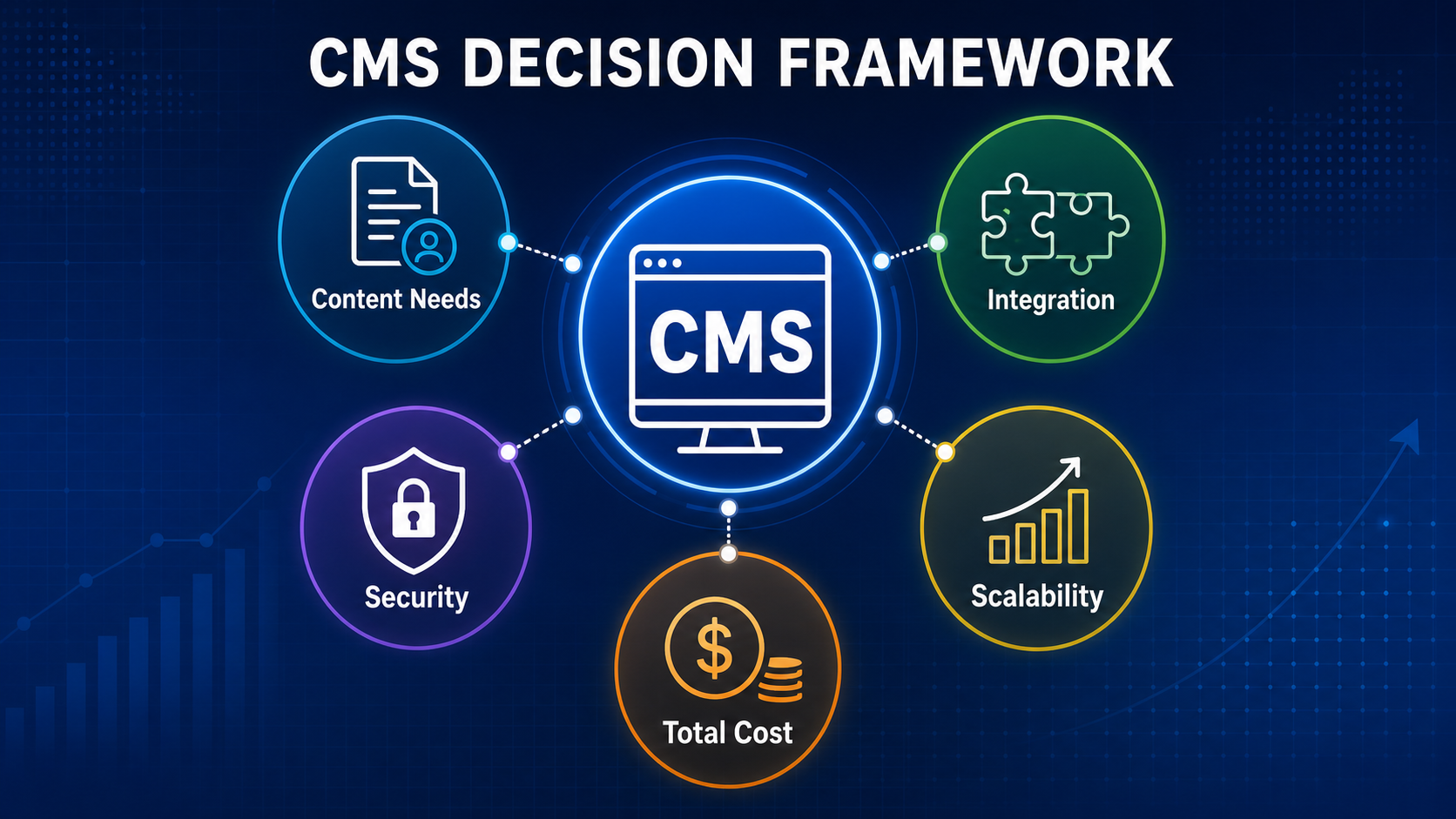
Use the same scoring criteria across options: editing experience, permissions and approvals, multilingual and multisite support, APIs and integrations, SEO controls, performance, security updates, vendor ecosystem, data portability, and three-to-five-year total cost of ownership.
3. How to evaluate a Hong Kong website development company
A capable vendor should begin with business questions before proposing technology. Ask shortlisted firms to document their assumptions, information architecture, CMS rationale, integration boundaries, content-migration method, delivery team, risks, and acceptance approach. A quote that lists only page counts and visual design—without testing, training, maintenance, or third-party costs—can create avoidable change costs later.
During evaluation, ask the team to demonstrate a real workflow: create a product page, submit it for approval, create another language version, and restore an earlier version. Clarify ownership for Core Web Vitals, accessibility, SEO redirects, backups, updates, and incident response. LCP, INP, and CLS are useful performance acceptance references, but should be considered alongside real-user data.
Your agreement should also define ownership of source code, design files, domain names, cloud accounts, and data; renewal responsibility for third-party licenses; what counts as maintenance, a defect, or new work; response times and severe-incident handling; and export and handover obligations at termination. The business should retain administrator access so it is not locked into one vendor.
4. Six steps from requirements to launch
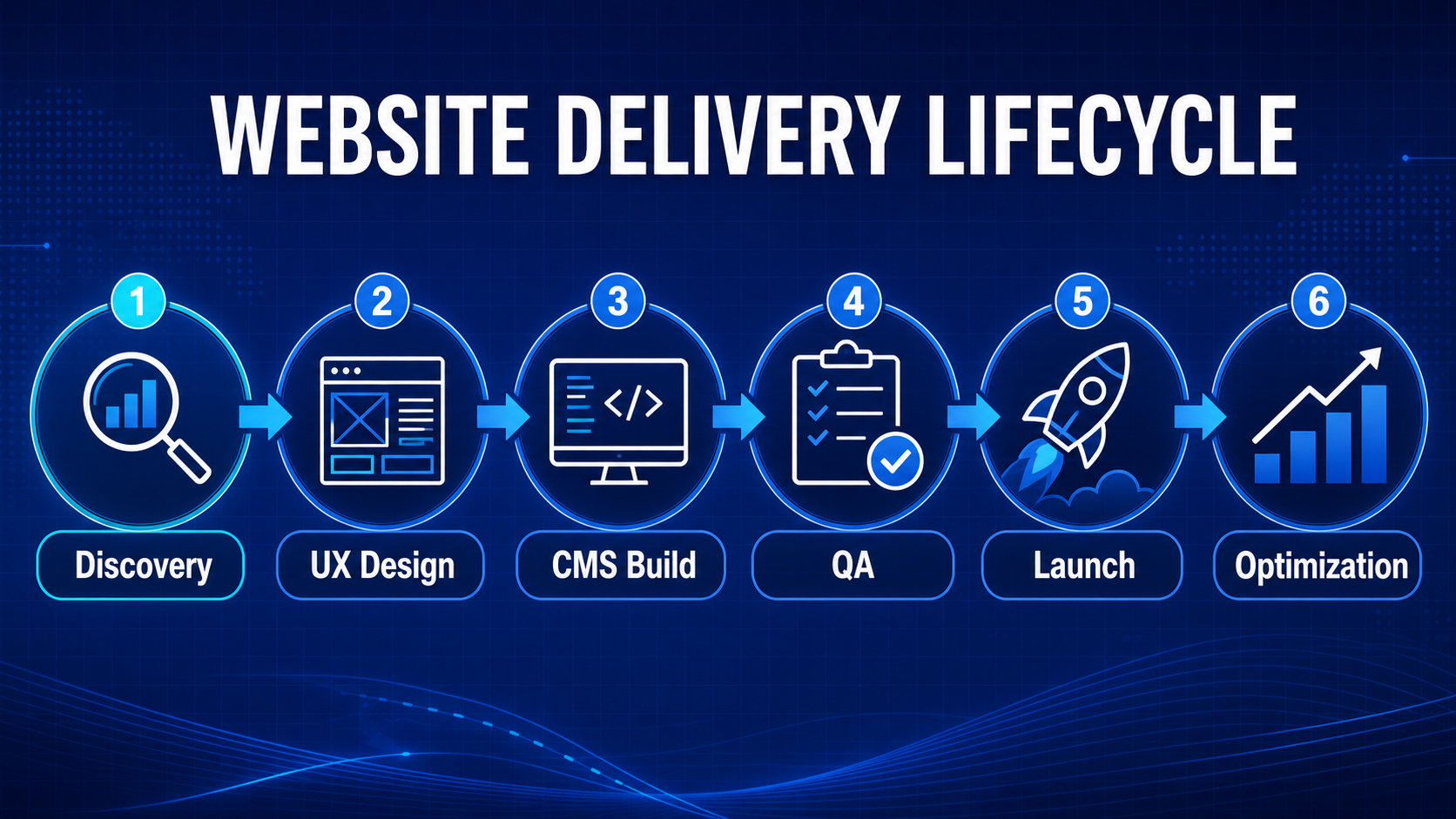
These six steps connect selection, delivery, and operations into an acceptance-ready process:
1. Assess the current state
Inventory pages, traffic, rankings, forms, integrations, and content owners. Mark what to retain, rewrite, consolidate, or remove.
2. Define success
Set publishing-speed, organic-search, inquiry-conversion, availability, and performance measures, and name the data source for each.
3. Complete selection
Test CMS options with the same requirements and scenarios. Compare build, licensing, hosting, update, and three-to-five-year maintenance costs.
4. Prototype first
Validate the most complex content type, multilingual flow, search, forms, and critical integration before building every page.
5. Migrate and accept
Create URL mappings, metadata, image alt text, permissions, backups, and recovery tests. Have marketing, IT, and frontline users accept the result together.
6. Launch in phases
Monitor 404s, forms, analytics tags, indexation, and performance. Keep a rollback plan, then move into continuous improvement.
5. Website development vendor checklist
- Does the vendor translate business goals into functions, content workflows, and acceptance criteria?
- Does its CMS recommendation show tradeoffs instead of promoting one platform only?
- Does the quote separate design, development, migration, integration, testing, training, licensing, and maintenance?
- Does it cover multilingual delivery, SEO redirects, structured data, analytics, and privacy consent?
- Are development, testing, and production environments, backups, and incident recovery defined?
- Does it test performance, accessibility, forms, and permissions with real content and devices?
- Does the company own its accounts, data, design files, source code, and documentation?
- Is there a defined post-launch service scope, response time, update responsibility, and quarterly review?
Frequently asked questions
Should a Hong Kong enterprise choose WordPress or an enterprise CMS?
It depends on complexity. For one brand focused on content marketing with limited integrations, WordPress is often easier to start with. Multi-brand, multilingual, heavily governed, or highly integrated environments may justify evaluating Magnolia, AEM, Drupal, or another enterprise option.
How do Hong Kong website development companies typically price work?
Pricing is usually based on project scope or time and materials; there is no dependable single market price. Templates, content migration, CMS licensing, systems integration, testing, hosting, and maintenance all affect total cost, so request comparable itemized estimates.
Is an open-source CMS always less expensive?
No. Open source can reduce software-license constraints, but architecture, customization, hosting, security updates, and technical support still cost money. Compare total cost of ownership over three to five years, not only the first build fee.
Will a website rebuild affect SEO rankings?
It can, but the risk can be managed. Preserve key content, create old-to-new 301 redirects, migrate metadata and structured data, and check the sitemap, robots settings, internal links, 404s, and Core Web Vitals before launch.
Should we select the CMS or the website development company first?
Define your requirements first, then evaluate the platform and vendor together. If group policy or compliance has already selected a platform, focus the evaluation on the vendor’s implementation, integration, and maintenance capability.
How can LeadsTech help with selection?
LeadsTech can help clarify the selection scope and acceptance criteria for an enterprise website rebuild, then discuss CMS, integration, governance, and long-term operating needs.
Conclusion
Choosing a Hong Kong website development company is ultimately choosing a content-operations and technology partnership for the years ahead. Define content, integration, governance, and outcome requirements first; then compare CMS options, teams, and total cost against the same scenarios. If you are planning an enterprise website rebuild, explore LeadsTech’s enterprise website development services or arrange a discovery conversation to clarify the selection scope and acceptance criteria.


Further Reading
- What Is a Content Management System (CMS)?: Build a selection framework from core concepts, capabilities, and enterprise use cases.
- Hong Kong CMS Platform Comparison and Selection Guide: Compare common platforms and their best-fit scenarios.
- Open-Source vs. Commercial CMS: An Enterprise Guide: Evaluate licensing, flexibility, governance, and long-term cost.
- How Does a CMS Affect SEO?: Understand how CMS architecture and daily management shape search performance.
Related Articles

Enterprise AI MarTech Trends Analysis 2024-2029 Outlook Report
From AI content productivity tools to a core engine for revenue growth and marketing transformation
*The PDF will be sent directly to your inbox.
Email Error
Please enter a valid email address.
Thank You!
The whitepaper has been sent to your inbox. If you don’t see it, please check your spam or promotions folder.