
Braze vs Salesforce Marketing Cloud vs Adobe AJO
Adobe Journey Optimizer, Marketing Automation, Salesforce
9 September 2026
All three platforms can orchestrate cross-channel messages, but the ability to send email, push and SMS does not make their architecture, best-fit use cases or operating cost the same. The real questions are where trusted customer data lives, which interactions need a real-time response, who will build and govern the platform over time, and how it fits the existing ecosystem. When supporting this type of decision, LeadsTech first validates data, responsiveness, governance and team fit through high-value customer journeys before comparing features.
1. Key Takeaways
- Braze is often a strong fit for consumer engagement teams focused on apps, product-behaviour events and rapid iteration.
- Salesforce Marketing Cloud Engagement is easier to extend for enterprises centred on Salesforce CRM that need mature campaign operations and a large contact model.
- Adobe Journey Optimizer (AJO) runs on Adobe Experience Platform real-time profiles and suits scenarios requiring unified identity, real-time decisioning and orchestration across experience platforms.
- The final choice should follow the data centre of gravity, critical journeys, team capability and validation results—not a feature-count comparison.
2. Do They Solve the Same Problem?
There is substantial overlap: audience or event entry, conditional branching, waits, personalisation, multichannel delivery, frequency controls, testing and performance analysis. The difference lies in the data architecture and operating model behind these capabilities. Start by defining three to five high-value business moments—such as trial activation, cart abandonment, renewal, stock-out, member upgrades or service cases—then assess which platform can execute them under real data and governance conditions.
Also confirm the product scope being compared. Salesforce Marketing Cloud covers multiple products and editions; this article focuses on Marketing Cloud Engagement and Journey Builder. If Data 360, Personalization or Intelligence are also required, architecture and licensing should be assessed separately.
3. How the Platforms Differ
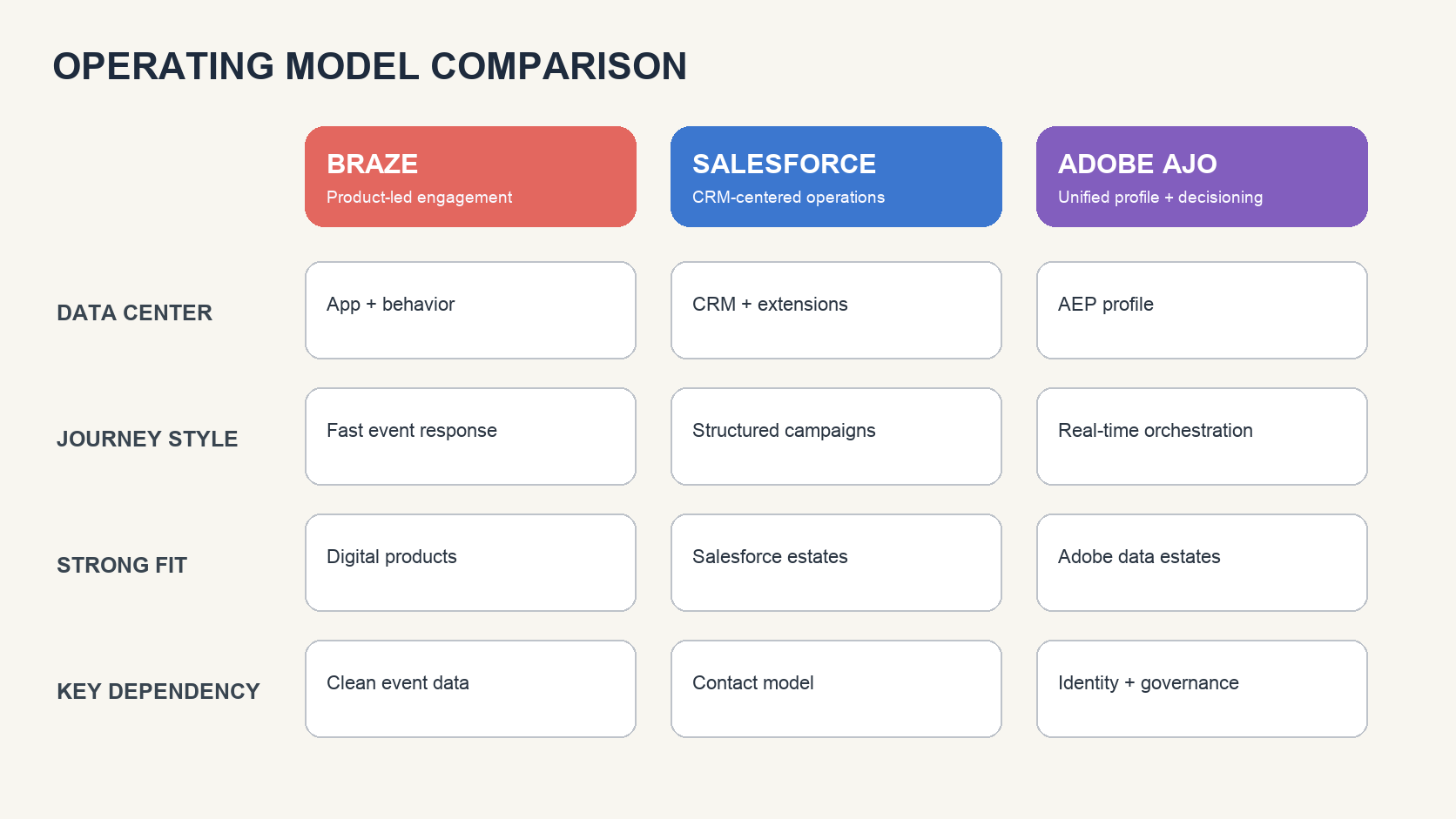
Braze: Centred on real-time behaviour and product engagement
Braze Canvas is commonly used for journeys triggered by app, web or product events, with touchpoints such as push, in-app messages, Content Cards, email and SMS. For digital-product or high-frequency consumer-engagement teams, behavioural events, fast testing and in-product touchpoints are often central. Teams still need to design event specifications, identity matching, data ingestion and consent governance; the platform will not automatically fix inconsistent data.
Salesforce Marketing Cloud Engagement: Centred on CRM ecosystem and campaign operations
Journey Builder can use Journey Data and Contact Data for entry criteria, branching and personalisation. For enterprises using Salesforce CRM with established Data Extensions, email operations and strict Business Unit management, it can extend existing capabilities. The risk is that unresolved Contact Model, Contact Key, data-retention and multi-unit design issues create duplication, ambiguous paths and maintenance overhead as journeys grow.
Adobe Journey Optimizer: Centred on AEP real-time profiles and centralised decisioning
AJO is native to Adobe Experience Platform (AEP), using unified real-time profiles, events, audiences, journeys and centralised decisioning to manage content or offers. It is more coherent when AEP, Real-Time CDP or other Adobe Experience Cloud capabilities already provide the data and experience foundation. In return, early governance work for schema, identity namespaces, merge policies, consent and data labels cannot be skipped.
4. Selection Criteria

Data centre of gravity
Does the trusted profile live in app back ends and a cloud data warehouse, Salesforce CRM, or AEP?

Speed requirement
How many journeys must react to behaviour within seconds or minutes?

Channel mix
Is the priority in-app interaction, or a complex mix of email, SMS, web and advertising?

Decisioning depth
Are conditional branches enough, or are central offer catalogues, eligibility, ranking and frequency constraints needed?

Operating model
Will journeys be maintained by product growth, CRM operations, central marketing or multi-market teams?

Cost boundary
Beyond licences, include integration, data, content, testing, administration and migration costs.
5. Retail App Example
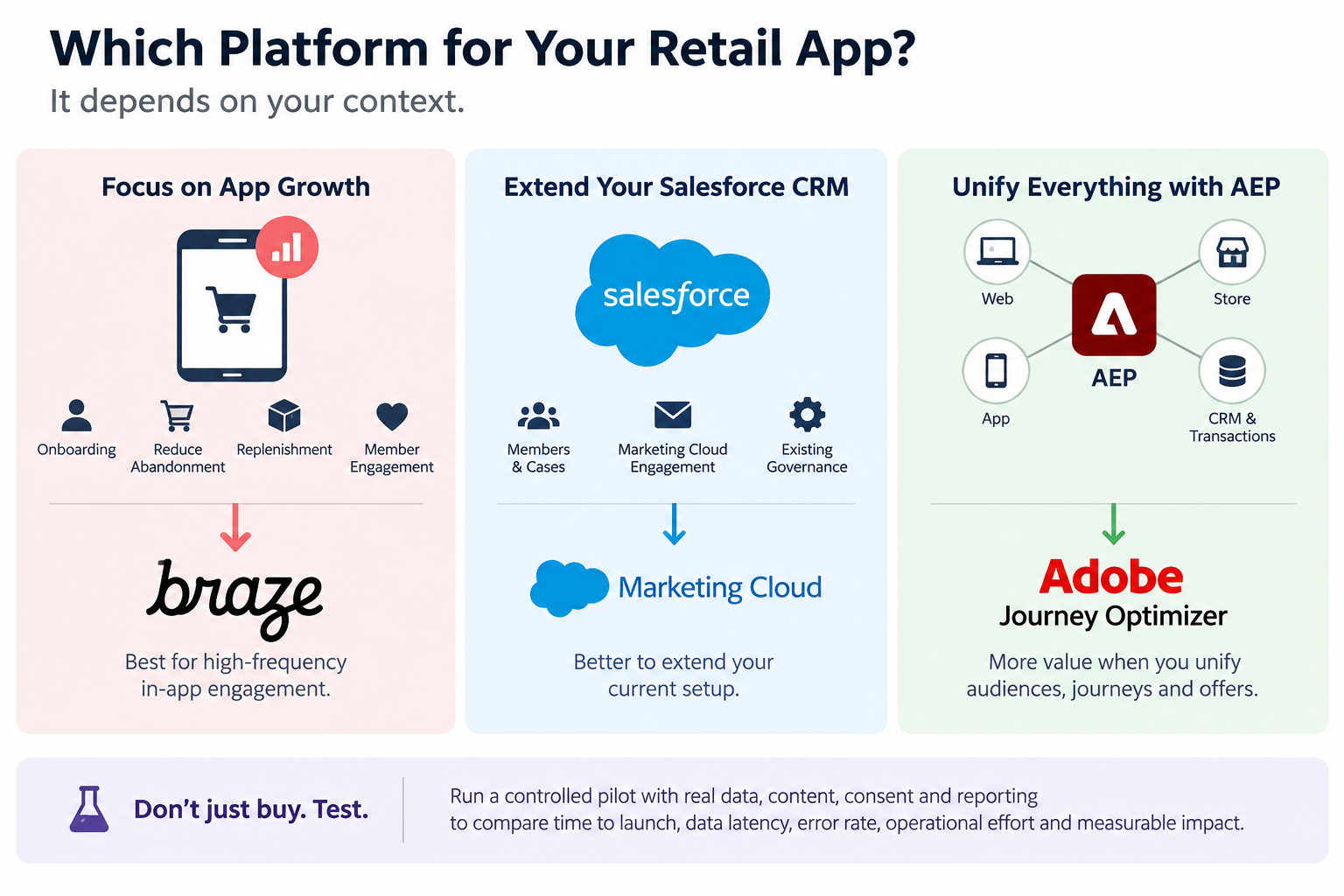
Consider a retail brand whose app already captures many real-time behavioural events and aims to improve onboarding, cart abandonment, replenishment and member engagement. If the data-engineering team can reliably supply events and user attributes, while the product-growth team needs high-frequency tests of in-app touchpoints, Braze should be a high-priority validation candidate.
If the brand uses Salesforce CRM as the centre for members, cases and assisted service, and already has mature Marketing Cloud Engagement email operations and Business Unit governance, extending the current architecture may be more sensible than a full migration. If web, app, store, CRM and transaction data are already unified in AEP, and audiences, journeys and offer decisioning need one governance layer, AJO overall value becomes clearer.
The right approach is not to buy based on these descriptions. Select one shared journey and run a controlled validation with real events, content, consent and reporting. Compare time to launch, data latency, error rate, operating effort and measurable impact.
6. Five-Step Roadmap
- Define three to five high-value journeys and the required channels.
- Map the sources of identity, events, consent, content and decisions.
- Validate latency, configuration effort and exception handling in the same scenario.
- Build a three-year cost model for licences, integration, migration, operations and support.
- Start with one controlled market, then expand after meeting data, compliance, performance and adoption thresholds.
7. FAQs
Is Braze only for apps?
No. Braze supports many offsite and in-product touchpoints, but teams centred on real-time events and digital-product interaction often gain the most from its operating model.
Do Salesforce Marketing Cloud and CRM need no integration?
No. Even within the same Salesforce ecosystem, Contact Key, sync scope, Data Extensions, update frequency and consent still need design and testing.
Must every Adobe product be deployed before AJO?
No, but AJO depends on AEP capabilities for schema, identity, profiles, audiences and governance. The maturity of the existing Adobe architecture directly affects implementation.
Which platform costs the least?
This cannot be determined from public information alone. Pricing depends on edition, message volume, profile or contact volume, channels, data and add-on modules. Obtain formal quotes for the same requirements and include implementation and operating costs.
Can an enterprise use two platforms at once?
Yes, but ownership of channels, audiences, frequency, consent, offers and reporting must be clear. Orchestrating the same customers in both easily creates duplicate messages and ambiguous attribution.
8. Conclusion
Braze, Salesforce Marketing Cloud and Adobe Journey Optimizer have no context-free winner. Start with the current data and organisational centre of gravity, then use the same journey to test speed, control and measurability. If your organisation is evaluating Salesforce or Adobe architecture, use the CTAs below to explore the related solutions, marketing automation services or contact us directly.


9. Further Reading
- Top 10 Marketing Automation Tools Compared:Broaden the initial selection view to more platforms.
- Marketing Automation Customer Journey Design Guide:Move from tool comparison to journey and governance design.
- Adobe Journey Optimizer Omnichannel Guide:Explore AJO data and orchestration in more depth.
Related Articles
Enterprise AI MarTech Trends Analysis 2024-2029 Outlook Report
From AI content productivity tools to a core engine for revenue growth and marketing transformation
*The PDF will be sent directly to your inbox.