
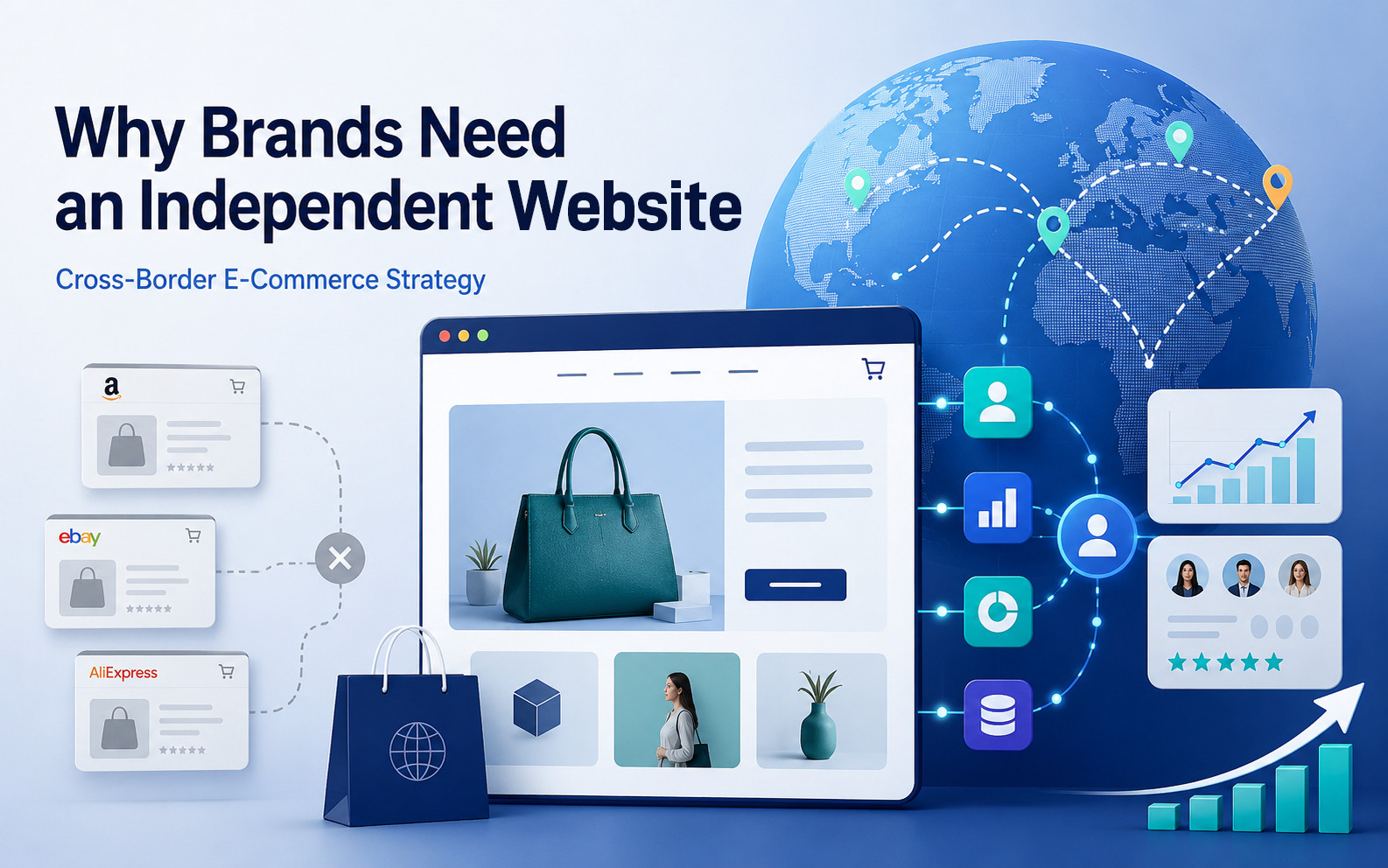
Why Cross-Border E-Commerce Brands Need an Independent Website
Adobe Commerce (Magento), E-Commerce, e-commerce Platforms, Shopify
9 July 2026
1. Introduction: Cross-border eCommerce cannot rely only on third-party platforms
This article helps companies planning cross-border eCommerce or global brand expansion understand why an independent website matters, and what operational, brand, and system strategies should be considered before choosing Shopify, Magento Open Source, Adobe Commerce, or another platform.
After reading it, you will be better able to judge whether your business currently needs a fast launch tool or a digital commerce foundation that can support long-term growth.
When many companies start cross-border eCommerce, they first choose Amazon, Shopee, Lazada, TikTok Shop, or other third-party platforms. The reason is straightforward: these platforms have traffic, existing consumers, mature transaction mechanisms, and lower the barrier for early market testing.
But when a company enters a stage involving multiple markets, languages, currencies, brands, or mixed B2B / B2C sales, it gradually becomes clear that relying only on platforms is not enough to support long-term global expansion.
What truly affects growth is not only whether products can be seen, but whether the brand can be understood, customer data can be owned, operating processes can be integrated, and the business can continue to scale in the future.
This is exactly why cross-border eCommerce needs an independent website.
2. Third-party platforms vs independent websites: key differences
Third-party platforms and independent websites are not an either-or choice; they play different roles. Platforms are more like sales channels, suitable for quickly testing products, acquiring orders, and reaching existing traffic. An independent website is more like a global brand website, transaction hub, and content knowledge base, carrying brand stories, product knowledge, FAQs, member relationships, first-party data assets, and long-term operating capabilities.
On third-party platforms, companies usually have to follow platform rules, including page templates, product display formats, promotion mechanisms, advertising logic, and customer communication restrictions. What consumers often see on a platform is the product and price, not the complete brand experience.
An independent website gives the company much greater autonomy. Homepage content, product categories, landing pages, checkout flows, membership programs, recommended content, and marketing tracking can all be designed around brand positioning and business model.
For companies that want to move from selling products to building a brand, this difference is critical.
| Type | Core role | Advantages | Limitations |
|---|---|---|---|
| Third-party platform | Sales channel | Existing traffic, mature transaction mechanisms, suitable for early testing | Limited brand presentation, restricted customer data, high dependence on platform rules |
| Independent website / self-built site | Brand and transaction hub | Brand autonomy, first-party data, SEO/GEO, system integration, member operations | Requires investment in content, technology, traffic, and operations |
| Both in parallel | Channel + brand asset | Platforms acquire customers; the independent website accumulates brand and data assets | Requires integration of products, inventory, orders, and customer data |
From a strategic perspective, third-party platforms are suitable for fast selling, while independent websites are better for long-term operations. Mature cross-border eCommerce brands usually do not rely on a single channel; instead, they use platforms to expand sales and use the independent website to accumulate brand, content, member, and customer data.
3. Why cross-border eCommerce needs an independent website: brand, data, and long-term growth
The value of an independent website is not simply adding another sales site. It helps companies build a controllable, analyzable, and scalable foundation for global expansion.
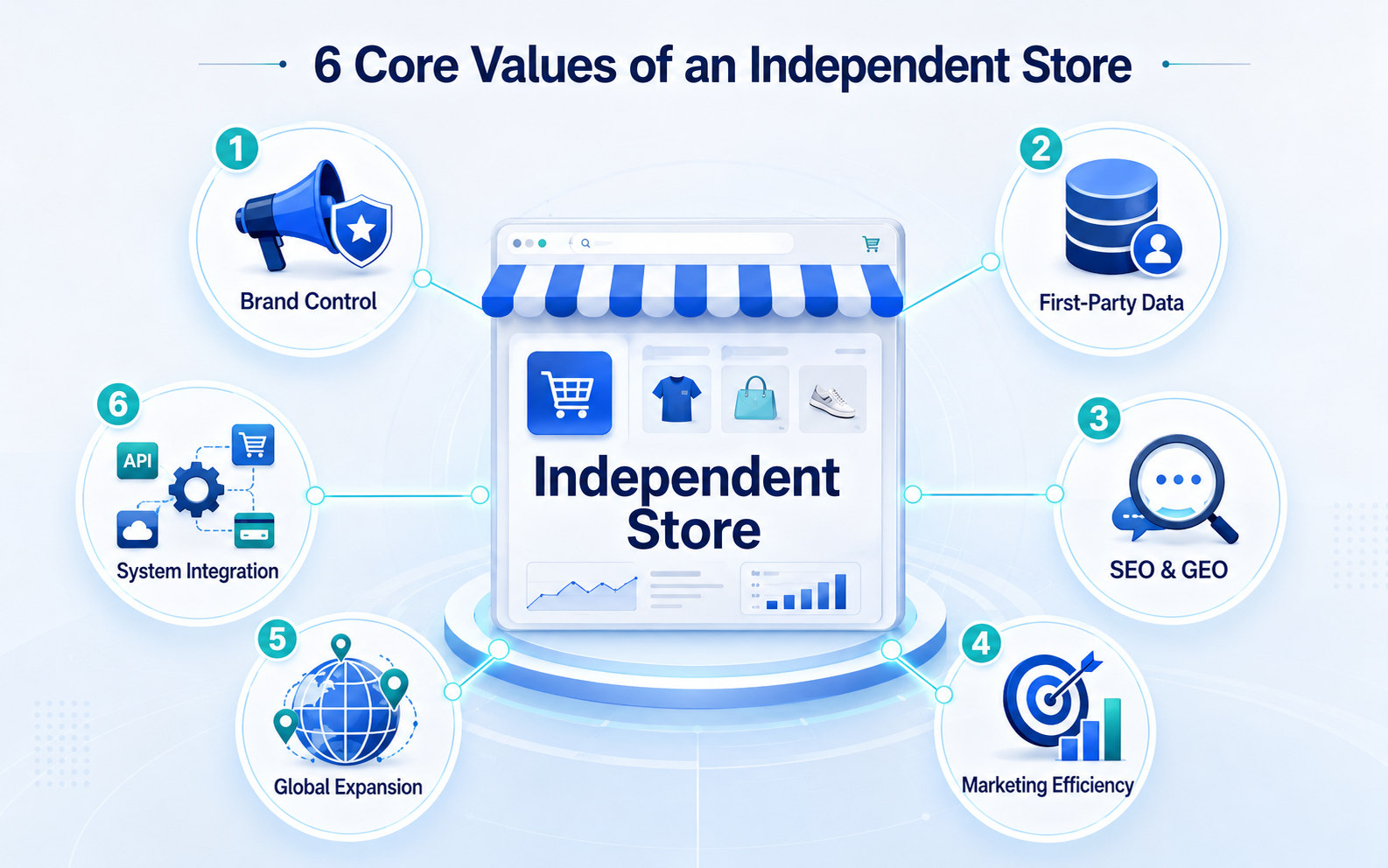
1. Brand autonomy
Companies can fully present brand stories, product features, usage scenarios, certifications, and after-sales services instead of being restricted by platform templates. This is especially important for high-value, professional, B2B, or market-education-oriented products. When customers need more information before placing an order, an independent website can provide more complete brand and product content.
2. First-party customer data ownership
Platform orders usually do not equal complete customer assets. An independent website can integrate with CRM, CDP, Email / EDM, membership systems, and remarketing tools, allowing companies to accumulate first-party data for sustainable operations. This data can support member segmentation, remarketing, personalized recommendations, lead nurturing, and customer lifecycle management.
3. Optimizable marketing costs
When a company can only rely on platform advertising, traffic costs can easily be pushed up by platform bidding. An independent website can build a healthier traffic mix through SEO, content marketing, social traffic, email, remarketing, and marketing automation.
4. SEO / GEO and brand content assets
The value of an independent website is that it lets the brand own its content assets, first-party customer data, SEO / GEO content foundation, member relationships, and conversion paths. When consumers learn about a brand or product through search engines or AI search, the independent website can host brand stories, product knowledge, FAQs, comparison content, buying guides, delivery policies, and after-sales information.
5. Multi-market scalability
Cross-border operations involve language, currency, tax, logistics, payment, and localized content. An independent website can create different sites, language versions, or content versions according to market needs, making international operations more flexible. It still needs to be supported by multilingual content governance, SEO, payment, logistics, and tax planning.
6. System integration capability
As the company grows, eCommerce is no longer only a front-end transaction system. It connects with ERP, CRM, PIM, OMS, WMS, POS, CDP, and customer service systems. An independent website usually offers more room for integration and expansion around enterprise processes, but the actual flexibility still depends on the selected platform, APIs, data architecture, and implementation capability.
Only when products, inventory, orders, members, and customer interactions can be integrated can a company truly build a closed loop for cross-border eCommerce operations.
4. How an independent website supports long-term brand growth
Competition in cross-border eCommerce is ultimately not only about traffic, but also about brand trust and operating efficiency. An independent website allows companies to integrate product content, marketing campaigns, customer interactions, and transaction processes across markets into one manageable structure.
For example, when a brand enters Southeast Asia, Japan, Europe, the United States, or the Middle East, different markets may require different languages, payment methods, product descriptions, compliance information, and campaign strategies.
If content and customer interactions depend heavily on individual platforms, it becomes harder for the company to maintain a consistent brand image and to replicate successful practices quickly.
Through an independent website, companies can establish a unified brand direction and then localize for different markets. This model of central governance with regional flexibility allows cross-border eCommerce to evolve from single-point selling into a sustainable global brand operating system.
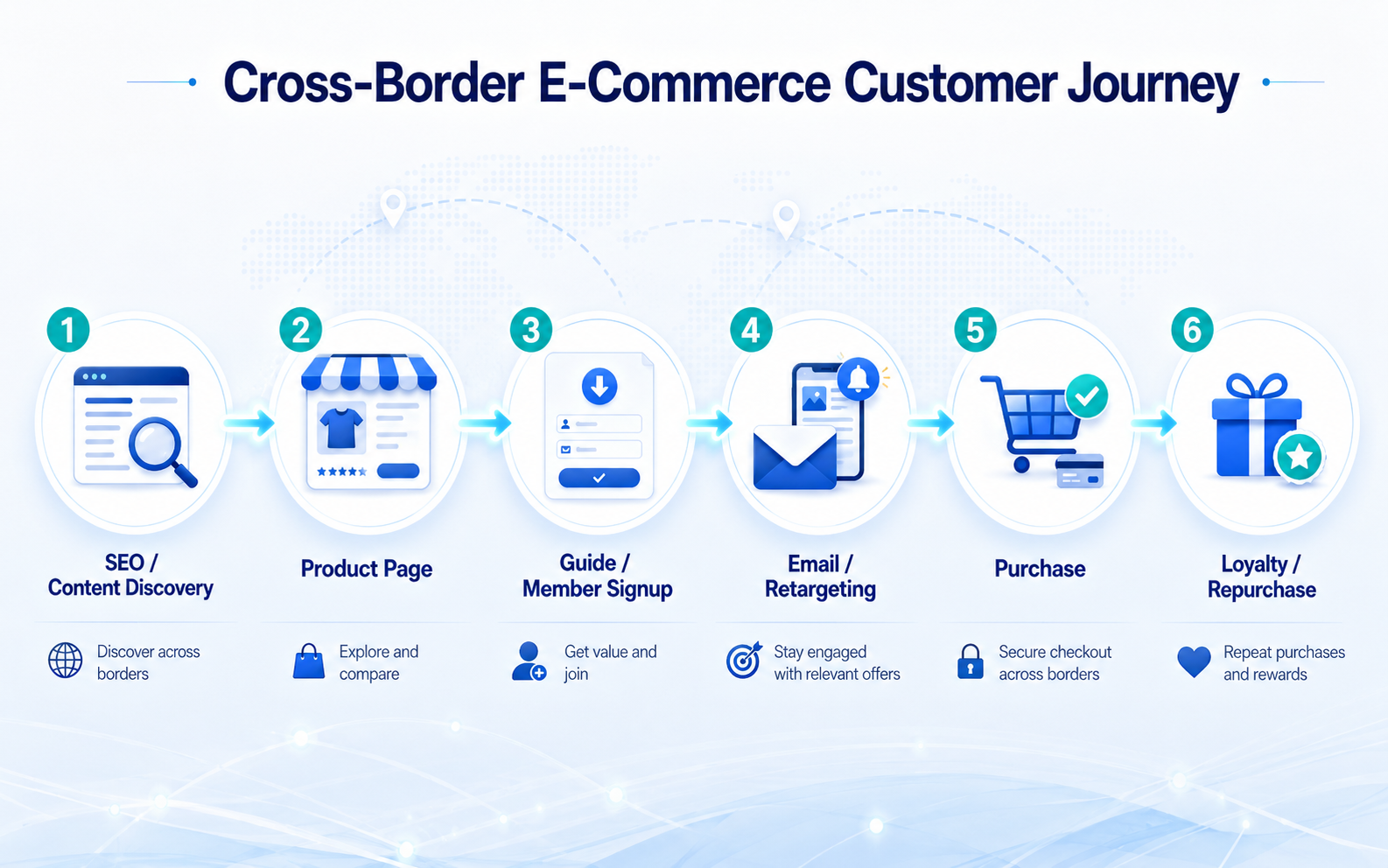
An independent website can also support a more complete customer journey, for example:
- Customers discover the brand through SEO articles
- They visit product pages to learn about specifications and comparison information
- They download a guide or become a member
- They receive follow-up content through email or remarketing
- They return to the website and complete a purchase
- After purchase, they enter member nurturing and repurchase flows
These processes are usually difficult to fully control on third-party platforms. After integrating an independent website with CRM, CDP, and marketing automation systems, companies can better understand each stage of customer interaction.
5. Operational questions to clarify before choosing a platform
When choosing an eCommerce platform, many companies first compare price, feature lists, or launch speed. More importantly, they should first clarify their own operating model.

Business model
Is the business B2C, B2B, or B2B2C? Does it need corporate accounts, quotation processes, membership tiers, bulk ordering, or distributor management? If the company is simply doing DTC retail, platform selection can prioritize speed and marketing convenience. If it involves B2B or distributor systems, account, quotation, permission, and pricing rules become more important.

Market scope
Is the business currently serving only one market, or will it expand to multiple countries, languages, and currencies in the future? Does it need different product catalogs and pricing strategies by region? If a cross-border brand plans to operate across multiple markets, it should consider URL structure, multilingual content, tax, logistics, payment, and localization capabilities early.

Product complexity
Do the products involve multiple specifications, bundles, customization, subscriptions, or a large number of SKUs? Does product data need to sync with PIM or ERP? If the product structure is complex, whether the platform supports strong product data management and system integration will directly affect future operating efficiency.

Marketing needs
Does the business need SEO, GEO, content pages, campaign pages, member segmentation, Email / EDM, automated journeys, remarketing, and data analytics? If the brand wants to build long-term organic traffic and first-party data, platform evaluation should go beyond checkout features and include content management, SEO, tracking, and marketing integration.

System integration
Will the business need to connect CRM, ERP, OMS, WMS, logistics, payment, customer service, PIM, CDP, or membership systems in the future? If the answer is yes, the platform APIs, scalability, data model, and partner ecosystem become very important.
6. Which cross-border eCommerce website strategy fits each business stage
Companies at different stages do not necessarily need the same website strategy. A mature selection approach is not to ask which platform is best, but which platform best fits the company’s business complexity, operating capability, and long-term strategy.
Market testing stage: prioritize fast launch
If the company is still in the market testing stage, with limited products and relatively simple processes, Shopify or other SaaS platforms can usually help the brand launch quickly and reduce early technical burden.
This type of solution suits DTC brands, small teams, or companies that need to validate market response quickly. The focus is to establish basic transaction capability, brand pages, product content, and data tracking first, then expand gradually based on market response.
Growth stage: start focusing on content, data, and member operations
When a company begins to have stable traffic and orders, the role of the independent website upgrades from sales pages to a brand and member operation center.
At this stage, the company should start focusing on SEO / GEO, member data, CRM / CDP integration, marketing automation, product content management, and cross-channel remarketing.
Scaling stage: evaluate enterprise platforms and deep integration
If the company has entered multiple markets, brands, or languages, or involves more complex product, member, pricing, and order processes, Magento Open Source or Adobe Commerce is more suitable for companies that need a high degree of customization and system integration.
If the company needs more complete enterprise-grade B2B capabilities, official support, and cloud capabilities, it should further evaluate Adobe Commerce.
Especially for mid-sized and large companies running both B2B and B2C, or needing integration with AEM, CRM, ERP, PIM, CDP, and other systems, platform evaluation should not focus only on website launch speed, but on growth needs over the next three to five years.
7. An independent website is not a one-time cost, but a brand digital asset
In the early stage, an independent website does require investment in website build, content planning, technical implementation, SEO, GEO, data tracking, and maintenance resources. But in the long run, it is not simply a cost; it is a brand digital asset that can be accumulated, optimized, and expanded.
It can accumulate brand content and product knowledge, build organic traffic, manage first-party customer data, support member operations, receive advertising conversions, and form a more connected operating loop with internal systems such as CRM, CDP, ERP, PIM, and OMS.
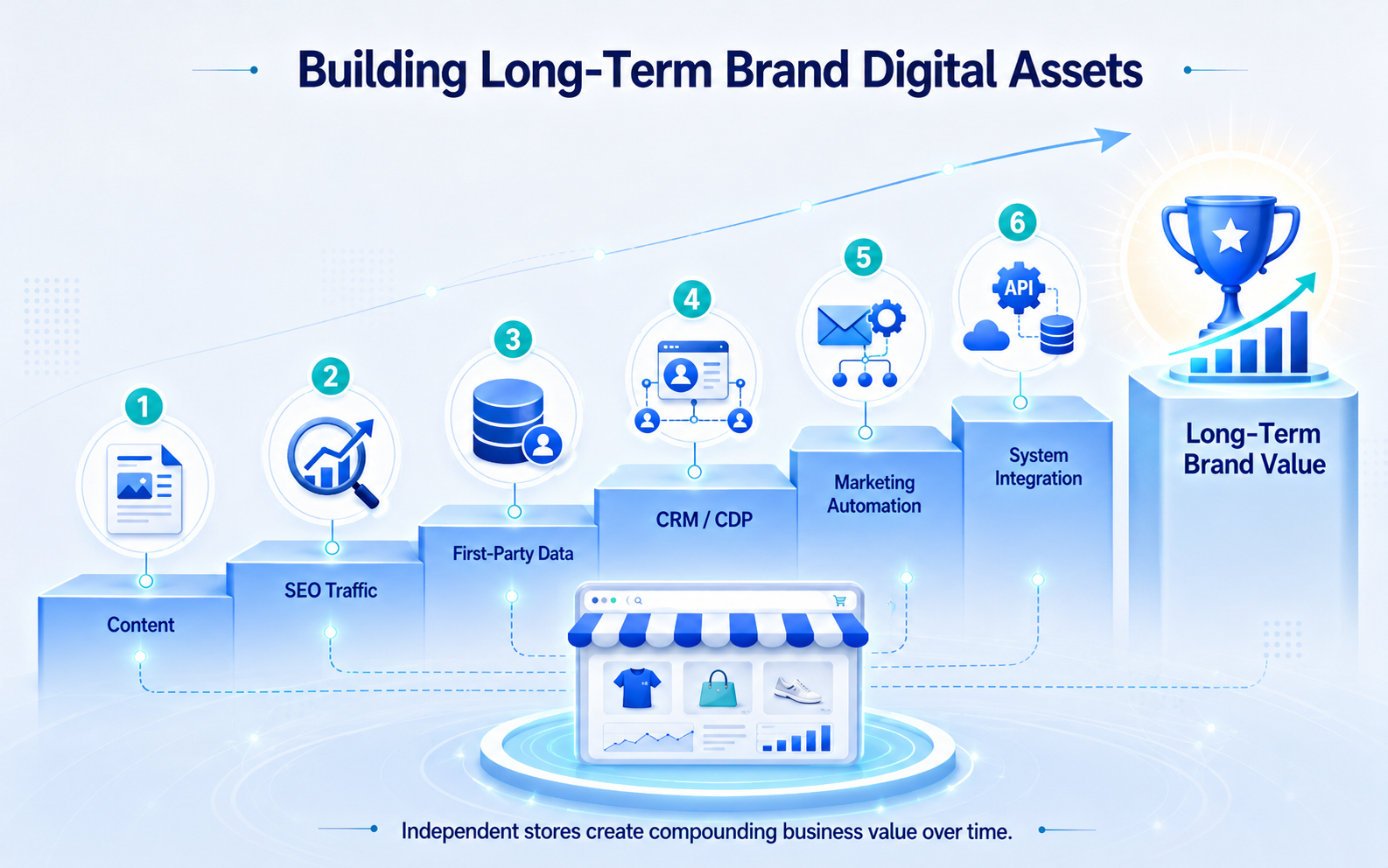
As cross-border business continues to grow, these capabilities gradually translate into higher operating efficiency and more stable brand competitiveness.
By contrast, if all resources are invested in third-party platforms, the brand can easily become passive once platform rules change, traffic costs rise, or competition intensifies.
Therefore, the earlier a company plans its independent website and first-party data strategy, the more likely it is to retain control over future cross-border growth.
8. Conclusion: from sales channel to brand globalization infrastructure
Early cross-border eCommerce success may come from platform traffic, hit products, or short-term campaigns. But long-term success must be built on brand, data, content, systems, and operating capabilities.
The value of an independent website is that it helps companies move from single-channel sales to controllable, sustainable, and scalable global operations.
Before choosing Shopify, Magento Open Source, Adobe Commerce, or another eCommerce platform, companies should first return to their own business strategy:
Market planning
Which markets will the business serve in the future?
Sales model
Which sales models need to be supported?
System integration
Is deep system integration required?
Internationalization needs
Are multiple languages and currencies required?
Brand assets
Does the company want to own customer relationships and brand assets?
SEO / GEO and data
Does the company need to build SEO / GEO and first-party data capabilities?
If you are planning a cross-border eCommerce independent website, or want to evaluate whether your current platform can support future growth, please refer to LeadsTech’s enterprise eCommerce website development service page to learn how we help companies with platform selection, Adobe Commerce / Magento / Shopify implementation, system integration, and SEO / GEO optimization.
You are also welcome to visit Contact Us to contact our consulting team. Based on your markets, products, processes, and system status, we will help plan the most suitable cross-border eCommerce independent website strategy.
9. Further reading
- eCommerce website development services | Adobe Commerce / Magento and Shopify implementation
- Cross-border eCommerce platform solutions for global brands: self-built site vs Magento vs Adobe Commerce
- What is Adobe Commerce (Magento)? Why should enterprises choose it?
- Cross-border eCommerce official website solution: AEM + Adobe Commerce architecture explained
Related Articles

Enterprise AI MarTech Trends Analysis 2024-2029 Outlook Report
From AI content productivity tools to a core engine for revenue growth and marketing transformation
*The PDF will be sent directly to your inbox.