
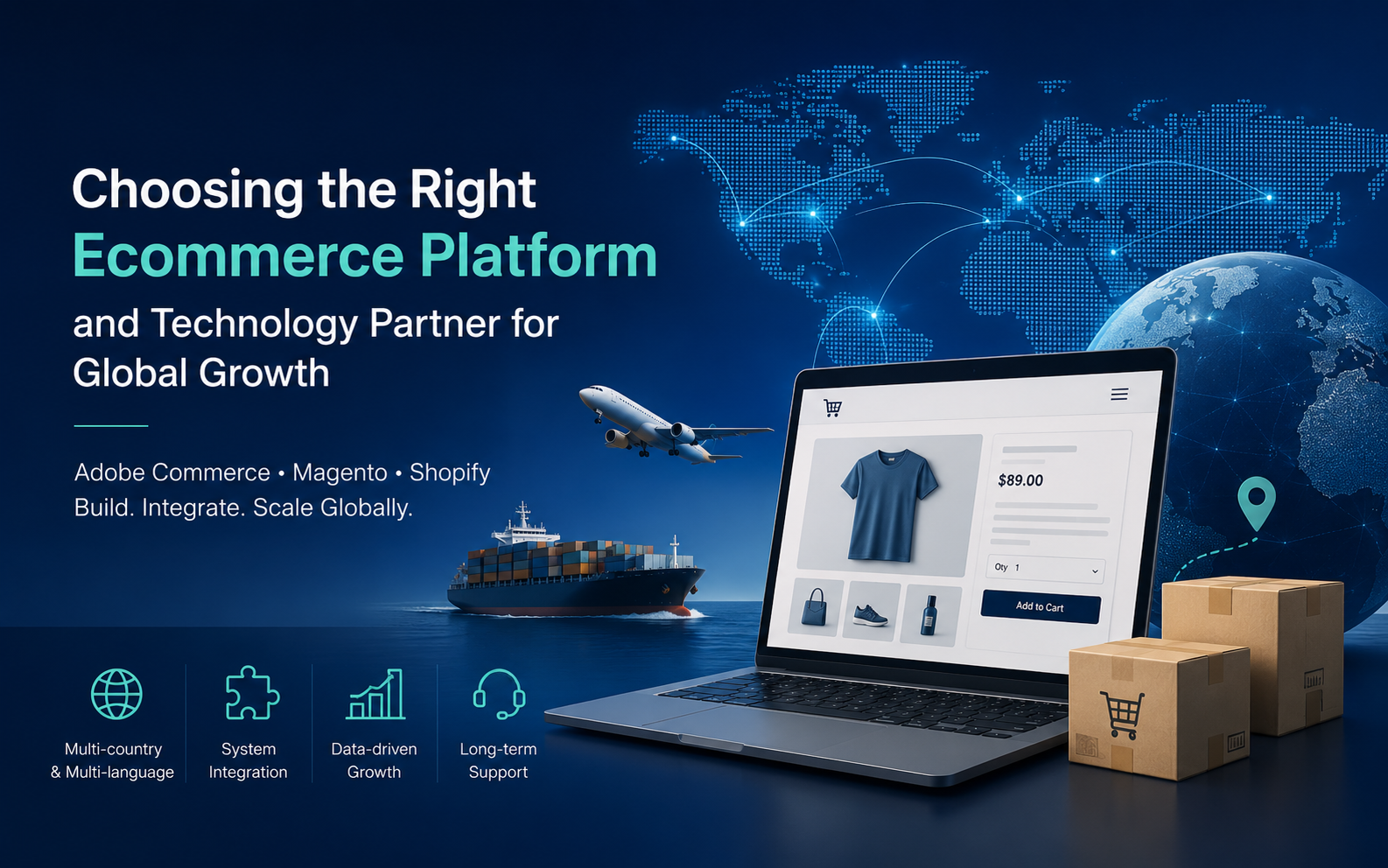
Recommended Cross-Border E-Commerce Website Builders for Global Expansion
Adobe Commerce (Magento), E-Commerce, e-commerce Platforms, Shopify
7 July 2026
1. Introduction: Why Going Global Is About More Than Just Website Pricing
Quick answer: When choosing a cross-border e-commerce platform service provider, enterprises should evaluate their platform selection capabilities, Adobe Commerce / Shopify implementation experience, B2B / B2C process understanding, system integration capabilities, SEO / GEO and MarTech experience, and long-term operations support.
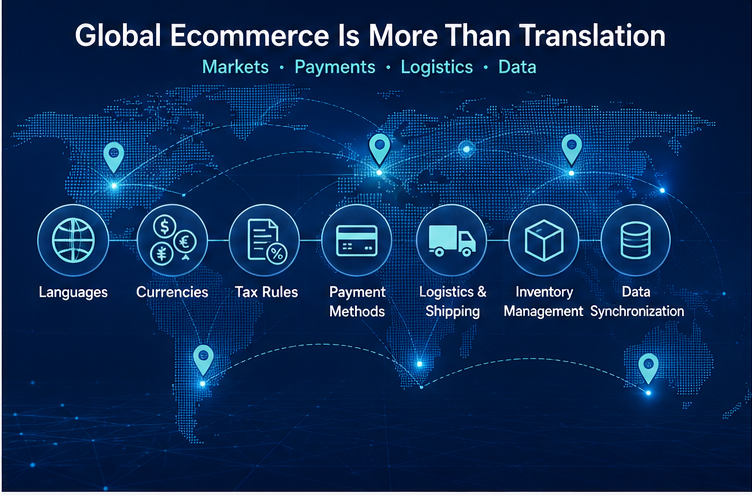
For enterprises, cross-border e-commerce is not just about “building a website where customers can place orders.” The real challenge lies in multi-market operations, multilingual content, multi-currency pricing, overseas payments, logistics, taxation, product data, member management, CRM, ERP, data analytics, and ongoing marketing optimization.
If the architecture is not properly planned upfront, the website may launch quickly but incur far higher costs in expansion, maintenance, and integration later.
Therefore, when selecting a cross-border e-commerce platform service provider, the key question is not who can build the site fastest, but who can understand your business model, design a scalable architecture, and help transform your e-commerce platform into the digital operations core of your global expansion.
2. What Is a Cross-Border E-Commerce Platform Service Provider?
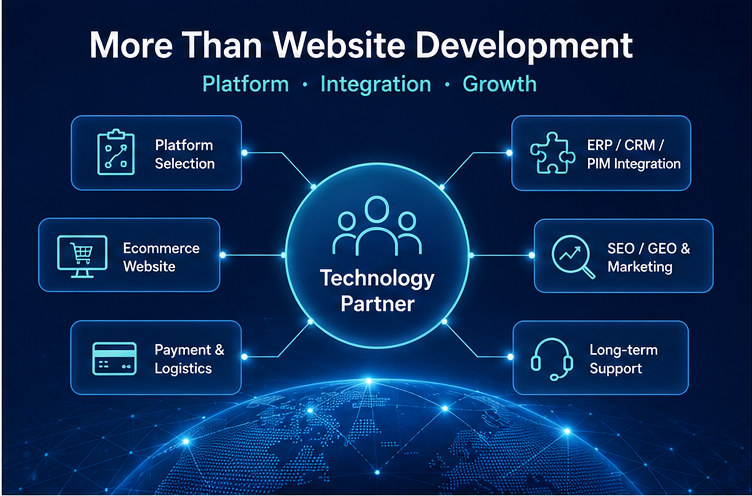
A cross-border e-commerce platform service provider is a technical consulting team that helps enterprises with platform selection, architecture planning, website development, transaction flow design, system integration, data integration, and long-term operations.
Their role goes beyond website development. They serve as a partner bridging business strategy, platform selection, system architecture, data flow design, and operational execution.
Common service areas include:
Platform Selection & Architecture Planning
Evaluating whether Adobe Commerce, Magento, Shopify, Shopify Plus, or other solutions fit the enterprise's needs, and helping assess whether the platform aligns with the business model, budget, team capabilities, and long-term expansion goals.
E-Commerce Website Design & Development
Including UX/UI, product pages, category pages, shopping cart, checkout flow, member center, campaign pages, and content pages.
Cross-Border Transaction Flow Design
Supporting multi-language, multi-currency, multi-market, payment, logistics, tax, and region-specific rule configurations.
System Integration & Data Connectivity
Connecting ERP, CRM, PIM, OMS, WMS, POS, CDP, marketing automation, and data analytics tools to reduce data fragmentation and manual maintenance costs.
Long-Term Maintenance & Optimization
Including security updates, version upgrades, performance monitoring, SEO / GEO, conversion path optimization, product data governance, and new feature expansion.
3. Web Design Agencies, Platform Implementers, and Cross-Border E-Commerce Consultants: What’s the Difference?
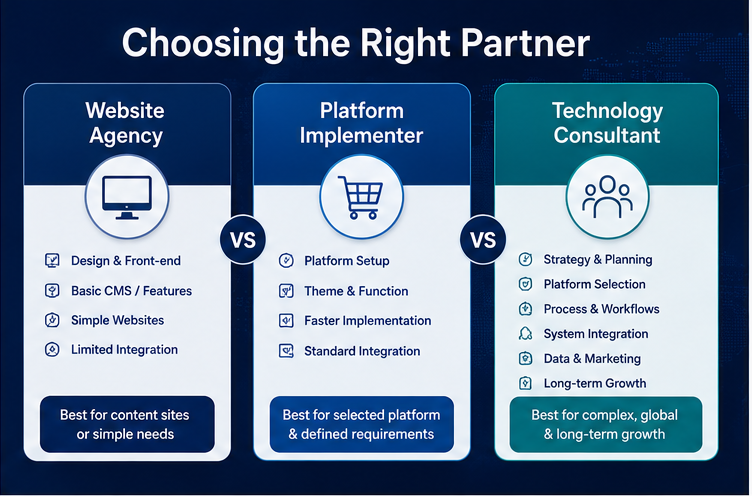
When choosing a partner, enterprises often compare general web design agencies, e-commerce platform implementers, and cross-border e-commerce technical consultants. All three may participate in website development, but their roles, capabilities, and applicable scenarios are different.
| Type | Core Capabilities | Best Suited For |
|---|---|---|
| General Web Design Agency | Visual design, front-end development, basic CMS or simple shopping functionality | Content-focused websites or stores with few products and simple processes |
| E-Commerce Platform Implementer | Shopify, Adobe Commerce, Magento platform setup and feature configuration | Already chosen a platform; need rapid deployment and feature implementation |
| Cross-Border E-Commerce Technical Consultant | Platform selection, TCO assessment, B2B / B2C processes, ERP / CRM / PIM / OMS / WMS integration, SEO / GEO, and long-term operations | Multi-market, multi-system, multi-brand, or enterprise-level cross-border e-commerce projects |
If the enterprise only needs a basic informational website, a general web design agency may suffice. If the enterprise has already chosen Shopify or Adobe Commerce and has clear requirements, a platform implementer can help with rapid deployment.
However, if the enterprise is pursuing cross-border e-commerce expansion and needs to simultaneously consider platform selection, cross-market operations, B2B / B2C processes, system integration, data connectivity, and long-term optimization, they need a cross-border e-commerce technical partner with consulting capabilities.
4. Common Challenges When Building a Cross-Border E-Commerce Site
Many enterprises initially think of cross-border e-commerce as “translating the existing website into English and adding a shopping cart.” But once they actually enter overseas markets, the challenges are often far more complex than expected.
Complex Product & Pricing Management
Different countries may have different product catalogs, inventory rules, promotional strategies, and tax logic. If the platform cannot support multi-market management, operations teams need extensive manual maintenance, leading to pricing errors, inventory mismatches, and content version conflicts.
High System Integration Complexity
Established enterprises typically already have ERP, CRM, PIM, OMS, WMS, membership systems, warehousing and logistics, or offline retail systems. If the e-commerce platform cannot connect stably with these systems, orders, member data, inventory, product data, and financial data become scattered, affecting operational efficiency and customer experience.
Long-Term Scalability Often Underestimated
Enterprises may initially operate in just one market, but may later add brands, languages, currencies, channels, and B2B capabilities. If the initial technical architecture is too closed or rigid, the cost of restructuring later may far exceed the initial savings on website development.
Content & Marketing Needs Go Beyond Product Pages
A cross-border DTC site needs more than product displays — it requires SEO, GEO, content management, ad tracking, data analytics, marketing automation, and member engagement. If the platform and service provider cannot support these needs, the site may lack long-term growth capability after launch.
5. How Should Service Providers Help Enterprises Choose the Right Platform?
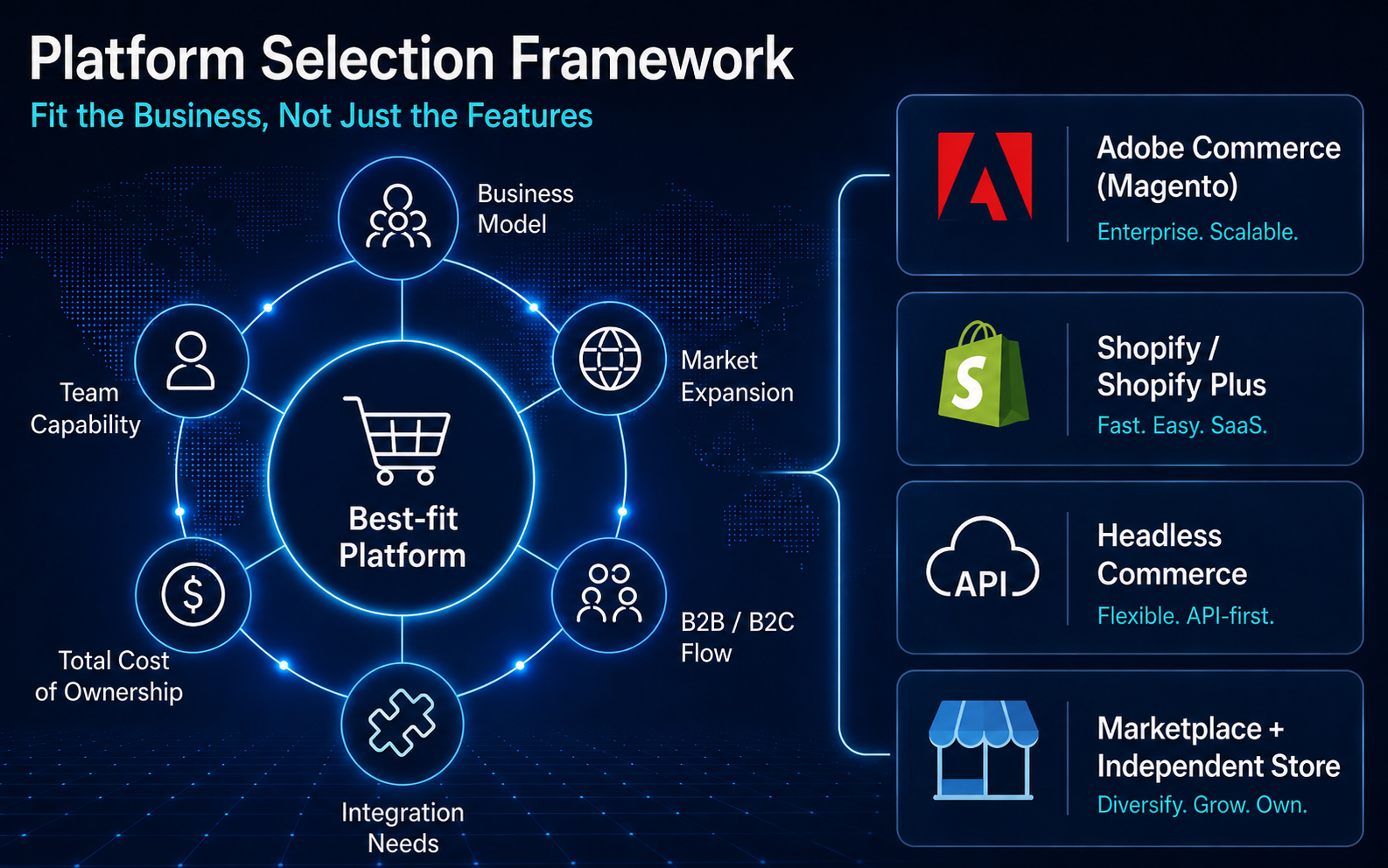
Different e-commerce platforms have different positioning. Enterprises should not ask “which platform is the best,” but rather “which platform best fits our current and future three-to-five-year business model.”
A mature service provider will not push a single platform from the start. Instead, they first understand the enterprise’s scale, product structure, B2B / B2C processes, target markets, budget, TCO, integration needs, and operations team capabilities before proposing a reasonable solution.
Adobe Commerce / Magento
Adobe Commerce / Magento is suitable for mid-to-large enterprises, multi-brand, multi-market, complex product structures, B2B / B2C hybrid models, and enterprises requiring high customization and system integration. Adobe Commerce is better suited for brands that view the e-commerce platform as a long-term digital commerce core, especially scenarios requiring enterprise-level B2B, official support, cloud capabilities, and deep integration. Magento is suitable for enterprises that need greater autonomy, have technical capabilities, and are willing to take on more operations work themselves.

Shopify / Shopify Plus
Shopify / Shopify Plus is suitable for brands that want to launch quickly, reduce the technical maintenance burden, and primarily use standardized e-commerce processes. If the enterprise has a simpler product structure and lower customization needs, a SaaS platform can typically shorten the initial implementation time. If the enterprise needs more comprehensive B2B, organizational accounts, custom pricing, or more advanced automation and integration capabilities, Shopify Plus should be evaluated.
Headless Commerce Architecture
Headless Commerce architecture is suitable for enterprises that prioritize front-end experience, separation of content and commerce, multi-channel touchpoints, and need to integrate AEM, CMS, mobile apps, mini-programs, or social channels with the e-commerce backend.
This architecture provides greater front-end flexibility, but also requires a more mature technical consultant to help plan front-end and back-end responsibilities, APIs, caching, deployment, SEO, performance, and long-term maintenance.
Marketplace and DTC Site Coexistence
If the enterprise also operates on Amazon, Shopee, Lazada, TikTok Shop, or other third-party platforms, the DTC site should serve as the brand asset hub, member retention center, and data integration hub — not just another sales channel.
The service provider should help the enterprise think about how products, inventory, orders, customer data, and marketing data work together across channels, rather than treating each platform as a silo.
6. Six Key Criteria for Evaluating a Cross-Border E-Commerce Technical Consultant
When selecting a cross-border e-commerce platform service provider, enterprises should evaluate the following six areas rather than just comparing price quotes.
1. Platform Selection Capability
A good service provider will not push a single platform from the start. Instead, they first understand the enterprise’s scale, product structure, B2B / B2C processes, target markets, budget, TCO, integration needs, and operations team capabilities before proposing a solution.
Enterprises should observe whether the provider can clearly explain the applicable scenarios, limitations, implementation costs, and long-term maintenance responsibilities of different platforms — not just claim that one platform is the best.
2. Familiarity with B2B, B2C, and B2B2C Scenarios
Cross-border e-commerce is not limited to retail orders. If the enterprise has distributors, agents, wholesale pricing, quotation processes, corporate accounts, tiered memberships, or bulk ordering, the service provider must understand complex transaction flows.
For B2B enterprises, the provider should help plan corporate accounts, permissions, quotations, custom pricing, payment terms, and approval workflows. For B2C enterprises, the focus should be on product experience, conversion paths, promotional campaigns, and member engagement.
3. System Integration Experience
Enterprise-level e-commerce typically requires connecting ERP, CRM, PIM, OMS, WMS, payment, logistics, and data platforms. A provider that only builds front-end pages cannot support long-term operations.
A good technical consultant should help the enterprise design data flows — for example, product data flowing from PIM into the e-commerce platform, order data writing back to ERP, member data syncing with CRM, and behavioral data feeding into Analytics or CDP.
4. Understanding of Content, Marketing, and Data
A cross-border DTC site requires SEO, GEO, content management, ad tracking, data analytics, and marketing automation. A technical consultant who also understands MarTech, data tracking, CRM / CDP integration, and marketing automation can better help the enterprise avoid fragmented tools and data gaps.
5. Long-Term Maintenance and Upgrade Support
An e-commerce website is not a one-time project. It involves ongoing security updates, version upgrades, performance monitoring, SEO / GEO, conversion paths, product data, and system integration as a long-term operational engineering effort.
Enterprises should evaluate whether the provider offers post-launch support, SLAs, version upgrades, performance tuning, vulnerability patching, plugin maintenance, data monitoring, and new market expansion support.
6. Ability to Communicate Technical Decisions in Business Language
What enterprises need most is not simply engineering outsourcing, but a consulting team that can translate technical options into cost, risk, timeline, and operational impact.
For example, choosing Shopify, Adobe Commerce, Magento, or a Headless architecture is not just a technical preference — it affects initial investment, TCO, integration flexibility, maintenance responsibilities, and future expansion direction.
7. What Types of Cross-Border E-Commerce Companies Is LeadsTech Best Suited to Help?
For mid-to-large brands, B2B enterprises, cross-border e-commerce companies, wholesalers, retailers, and multi-brand groups, LeadsTech is well-suited to help discuss cross-border e-commerce site building and platform selection.
LeadsTech provides not only e-commerce website development but also covers Adobe Commerce / Magento, Shopify, AEM, CMS, CRM, CDP, marketing automation, web analytics, UX/UI, and system integration services.
Enterprises with the following needs are particularly well-suited to discuss with LeadsTech:
- Need to choose between Magento, Adobe Commerce, Shopify, or Shopify Plus
- Want to build a multi-language, multi-currency, multi-market cross-border DTC site
- Need support for B2B, B2C, or B2B2C hybrid transaction flows
- Need to integrate ERP, CRM, PIM, OMS, WMS, payment, and logistics systems
- Want to integrate AEM, content management, SEO / GEO, and marketing automation
- Need long-term maintenance, upgrades, security support, and performance optimization
For enterprises, choosing a service provider with platform selection, system integration, and long-term operations capabilities delivers value beyond just completing the website — it helps build a sustainably scalable digital commerce architecture.
8. What Should Enterprises Prepare Before Starting?
Before discussing with a technical consultant, enterprises can prepare the following information to make platform selection and estimation more accurate.
Business Model
Is the enterprise B2C retail, B2B wholesale, DTC brand, distributor model, or multi-model? Does it need B2B / B2C on a shared platform or separate management for different sales channels?
Target Markets
Which countries or regions will be entered in the first phase? Will more markets, languages, or currencies be added in the future? Do different markets need different product catalogs, pricing strategies, tax settings, and promotional campaigns?
Product Data
How many SKUs, product categories, pricing rules, inventory logic, and specification attributes are there? Is the structure complex? Is a PIM system needed for product data management?
Current Systems
Does the enterprise already have ERP, CRM, PIM, membership, warehousing, logistics, WMS, OMS, or POS systems? How do these systems currently exchange data?
Marketing Needs
Does the enterprise need SEO, GEO, content management, audience segmentation, recommendation engines, Email / EDM, automated journeys, retargeting, or data analytics?
Budget & Timeline
Is the goal a rapid MVP launch or a one-time enterprise-level architecture planning? Enterprises should consider initial build costs, platform fees, integration costs, operations costs, and future expansion costs together.
This information helps the consultant assess platform fit and avoid over-building features or under-architecting the solution.
9. Conclusion: Choosing the Right Partner Is the Foundation of Long-Term Global Success
The value of a cross-border e-commerce platform service provider is not just about building a website. It is about helping the enterprise connect platforms, processes, data, content, and marketing capabilities into a system that can grow.
For enterprises preparing to go global, platform selection and technical consultant choice will directly impact operational efficiency, expansion costs, and customer experience for the next three to five years.
If your enterprise is evaluating Adobe Commerce, Magento, Shopify, Shopify Plus, or wants to build a cross-border e-commerce platform that supports multi-market, multi-language, multi-currency, and system integration, we welcome you to discuss with the LeadsTech consulting team. We can help plan the most suitable site building and integration solution based on your business model, technical environment, and long-term development goals.
- Learn more about LeadsTech E-Commerce Website Development Services
- Learn more about Adobe Commerce Product Solutions
Further Reading
Related Articles
Enterprise AI MarTech Trends Analysis 2024-2029 Outlook Report
From AI content productivity tools to a core engine for revenue growth and marketing transformation
*The PDF will be sent directly to your inbox.