
B2B Export Website Solutions: Boost Overseas Inquiry Conversions
B2B Marketing, Lead Generation
25 June 2026
Summary
A foreign trade website development solution is not just about completing page design and launching a site. Its real purpose is to help companies turn their official website into a marketing and conversion platform for overseas customers. This article explains how companies can build a high-conversion website that supports overseas lead generation from five perspectives: customer targeting, trust building, conversion paths, content structure, and data optimization.
1. What Is a Foreign Trade Website Development Solution?
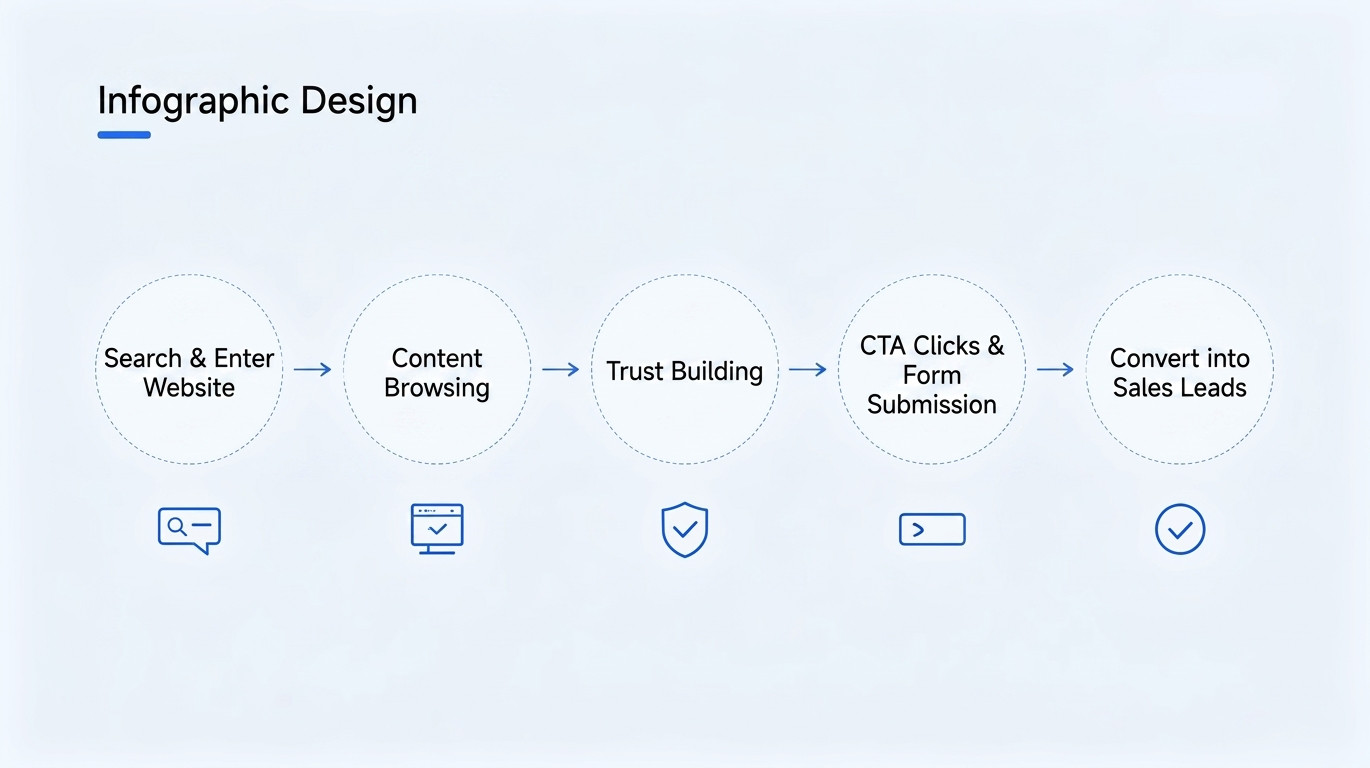
Many companies still focus on whether a foreign trade website looks attractive, whether products have been uploaded, and whether the English pages are complete. These elements matter, but they are not enough to support overseas customer conversion.
The real questions are: after overseas customers enter the website, can they quickly understand the company’s value? Can they find the right products or solutions? Can trust be established? Can they submit an inquiry or book a consultation smoothly?
A foreign trade website development solution refers to building an overseas marketing website that continuously supports B2B lead generation around customer targeting, trustworthy content, SEO structure, CTA design, form conversion, CRM synchronization, and data optimization.
It is not simply website building. It integrates overseas SEO, trust-building content, CTA design, form conversion, CRM synchronization, data tracking, and ongoing optimization into a B2B lead generation system. Google Search Central explains that SEO helps search engines understand website content and helps users decide whether to visit a site. For multilingual and multi-regional websites, Google recommends using clear site structure and hreflang annotations to help search engines understand the relationship between different language or regional versions.
2. The Core Logic Behind a High-Conversion Website
A mature foreign trade website development solution does not begin with page design. It begins with the customer decision journey.
Overseas customers usually go through four stages:
1. Discovery
- Enter the official website through Google, industry platforms, advertising, LinkedIn, or referrals
- At this stage, they mainly evaluate whether the company looks professional and whether the products are relevant
2. Understanding
- Browse products, solutions, industry applications, or technical materials
- Assess whether the company can solve their problems
3. Trust
- Review cases, qualifications, certifications, service capabilities, and delivery experience
- Decide whether the company is worth contacting further
4. Conversion
- Submit a form, download materials, book a meeting, or request a quote
- Enter the follow-up sales process
Therefore, a high-conversion foreign trade website development solution must solve four problems at the same time: customers can understand it, trust it, find it, and feel willing to inquire.
A display-oriented website usually focuses on company introduction and product presentation. A marketing-oriented foreign trade website is designed around search discovery, customer trust, inquiry conversion, data tracking, and sales follow-up.
3. Design Website Structure Starting from Customer Targeting
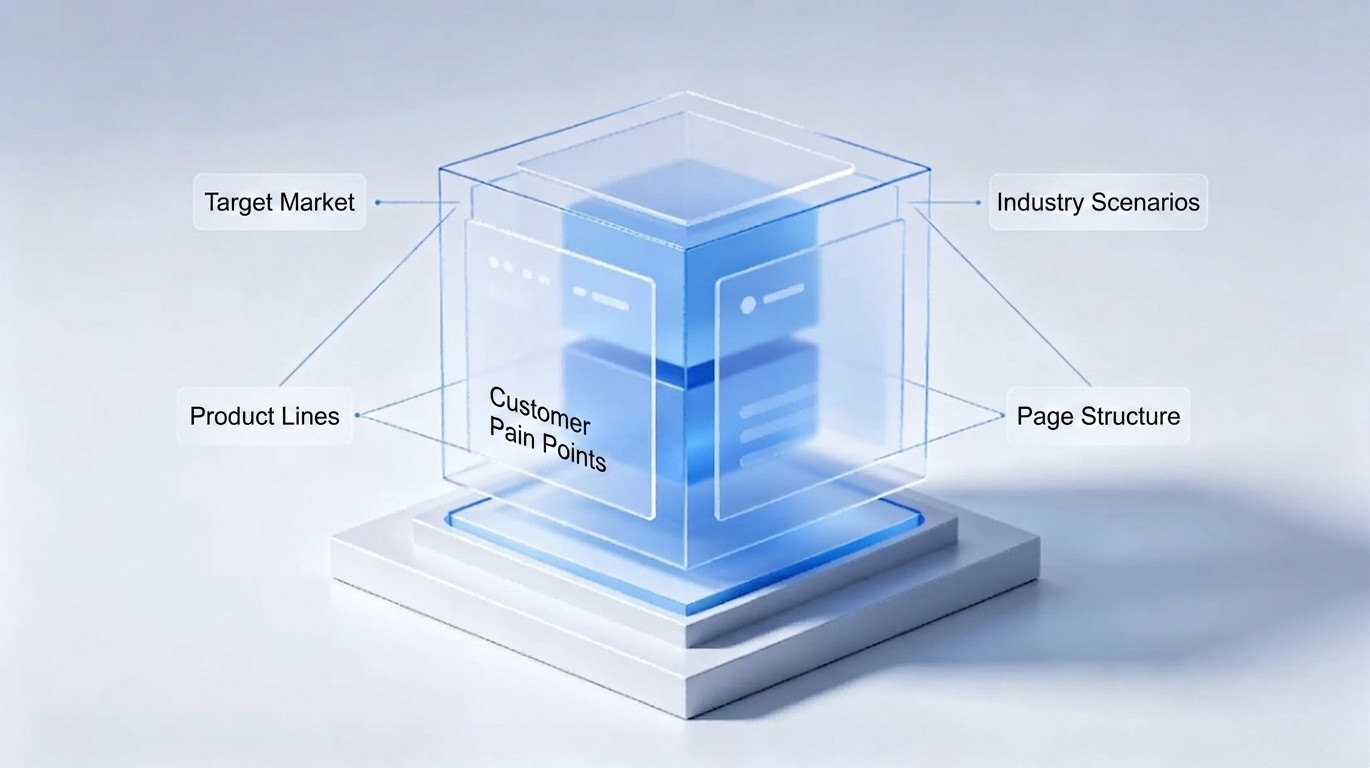
Many websites have low conversion rates not because the design is poor, but because the structure is not built around customer needs. Companies often start from “what products we have,” while overseas customers care more about whether a product fits their industry and use case.
Therefore, a foreign trade website development solution should complete customer targeting before planning the website structure.
We recommend designing from three dimensions:

1. Segment by target market
North America, Europe, Southeast Asia, the Middle East, and other markets have different priorities. Page content should reflect market differences instead of using the same messaging for every region.

2. Segment by industry scenario
Customers in manufacturing, healthcare, electronics, energy, retail, and other industries make decisions differently. Industry pages should clearly present pain points, solutions, product combinations, and cases.

3. Segment by customer stage
Early-stage customers need educational content. Customers in the comparison stage need cases and technical materials. Decision-stage customers need service capabilities, delivery processes, and quote entry points.
The value of custom foreign trade website development lies in these details. Not every company fits the same template. B2B companies with complex products, long sales cycles, and multiple target markets need pages and content designed around the customer journey.
4. How Trust-Building Content Influences Overseas Customer Decisions
When overseas customers visit a company website for the first time, they usually lack face-to-face contact and local brand awareness. At this point, trust signals on the website directly influence whether they are willing to leave their contact information.
A high-conversion website should establish at least four types of trust-building content:
1. Company credibility
- The company introduction should not only mention founding year and company size
- It should explain which markets the company serves, what industry problems it solves, and what delivery capabilities it has
2. Product credibility
- Product pages should not only list specifications
- They should explain use cases, advantages, suitable customers, and common questions
3. Case credibility
- Cases are more persuasive than slogans
- They can show the customer’s industry, challenges, solution, and actual results
4. Service credibility
- Overseas customers care about delivery, responsiveness, after-sales support, and communication efficiency
- The website should clearly explain service processes, support methods, and team capabilities
In a foreign trade website development solution, trust-building content is not an add-on module. It is the foundation of conversion. For high-ticket or long-cycle B2B businesses in particular, customers usually do not inquire immediately after seeing a product. They first decide whether the company is worth further communication.
5. Conversion Paths: Turning Visitors into Leads Smoothly
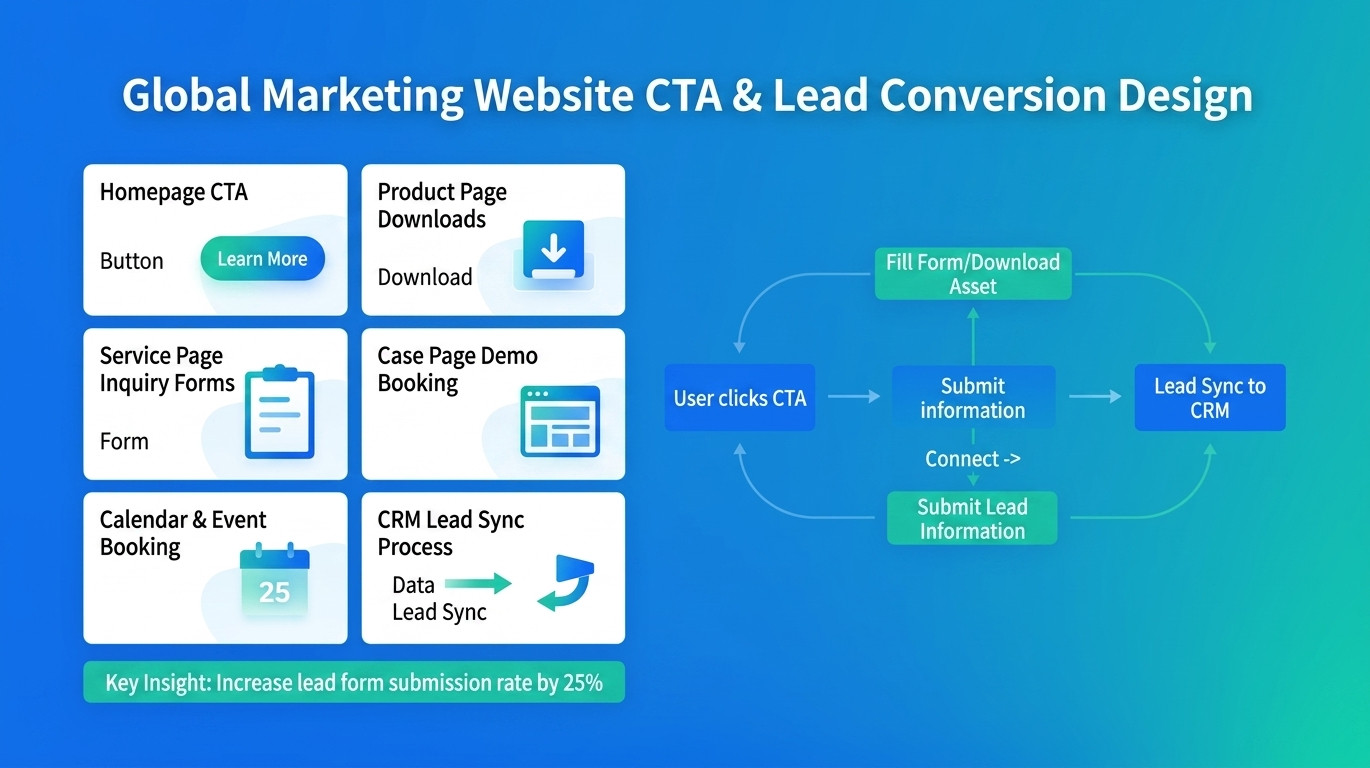
The key to a high-conversion website is not simply having a “Contact Us” button. It is designing layered CTAs based on customer intent, such as resource downloads, selection guides, demo bookings, sample requests, quote consultations, and technical assessments.
A foreign trade website development solution should set up multi-layer conversion paths based on customer intent:
1. Low-friction conversion entry points
- Download product catalogs
- View selection guides
- Subscribe to industry updates
- Get white papers or resource packs
- These entry points are suitable for customers who are not yet ready to request a quote directly.
2. Mid-intent entry points
- Book a product demo
- Submit a requirements form
- Request samples
- Ask about solutions
- These entry points are suitable for customers who already have clear interest.
3. High-intent entry points
- Contact sales
- Get a quote
- Start a project consultation
- Request a technical assessment
- These entry points are suitable for customers close to the purchasing stage.
The focus of foreign trade website marketing is to design different CTAs for different pages. For example, blog pages are suitable for guiding resource downloads, product pages for inquiry requests, and industry solution pages for consultation bookings. This helps customers move naturally to the next step instead of seeing only one “Contact Us” option on every page.
6. Data Optimization: Continuously Improving Website Conversion Rates
Many companies treat foreign trade website development as a one-time project and rarely adjust the site after launch. However, the value of a marketing-oriented website comes precisely from continuous optimization.
A mature foreign trade website development solution should plan data tracking before launch, including:
- Which channels bring high-quality visits
- Which pages have long dwell time but low conversion
- Which CTAs have high click-through rates
- Which forms have serious drop-off
- Which countries or regions generate higher-quality leads
- Which content may help sales close deals
Google Search Central notes that website owners can use Search Console to understand their site’s performance in Google Search. For companies, this data should be combined with website analytics, CRM, and marketing systems to form a continuous optimization mechanism.
In day-to-day operations, optimization can be carried out monthly in three areas:

1. Page optimization
Adjust the above-the-fold value proposition, optimize CTA placement and copy, and shorten forms or split them into steps.

2. Content optimization
Add FAQs that high-intent customers care about, supplement cases, use cases, and technical explanations, and adjust messaging for different markets.

3. Conversion optimization
Analyze why pages convert poorly, test different CTAs, synchronize form leads to CRM, and track downstream sales quality.
This is also the difference between custom foreign trade website development and ordinary template-based website building. The former includes SEO structure, content localization, conversion paths, data tracking, CRM integration, and long-term operations in the plan instead of only completing the initial visual delivery.
7. Conclusion
A high-conversion overseas marketing website is not achieved through flashier visuals. It is built through clear positioning, trustworthy content, smooth paths, and continuous optimization. What companies truly need is not just foreign trade website development, but a website growth system that can support overseas lead generation and sales conversion over the long term.
Therefore, the core value of a foreign trade website development solution is to help companies upgrade from a display-oriented website to a marketing-oriented website: overseas customers can find the company more easily, understand the products faster, build trust more readily, and enter the sales process more smoothly.
If you are planning custom foreign trade website development, an official website redesign, or an upgrade to your foreign trade website marketing system, you are welcome to learn more about our foreign trade website development services. You can also visit Contact Usto discuss your target markets, customer journey, and conversion optimization plan with our consulting team.
Further Reading
- How to Choose a Professional Foreign Trade Website Development Company? These 5 Criteria Determine Overseas Business Success
Recommended for further understanding the core capabilities foreign trade companies should look for when selecting a website development service provider. - Essential Elements of Overseas Foreign Trade Website Development: Improving Global Competitiveness from Architecture to Content
Recommended for further understanding the key elements of foreign trade websites in architecture, content, SEO, and long-term operations. - Foreign Trade Lead Generation Solution: How to Use Data and Automation for Precise Customer Acquisition and Efficient Conversion
Recommended for extending from website lead generation to CDP, marketing automation, and full-funnel customer development systems.
Related Articles

Enterprise AI MarTech Trends Analysis 2024-2029 Outlook Report
From AI content productivity tools to a core engine for revenue growth and marketing transformation
*The PDF will be sent directly to your inbox.