
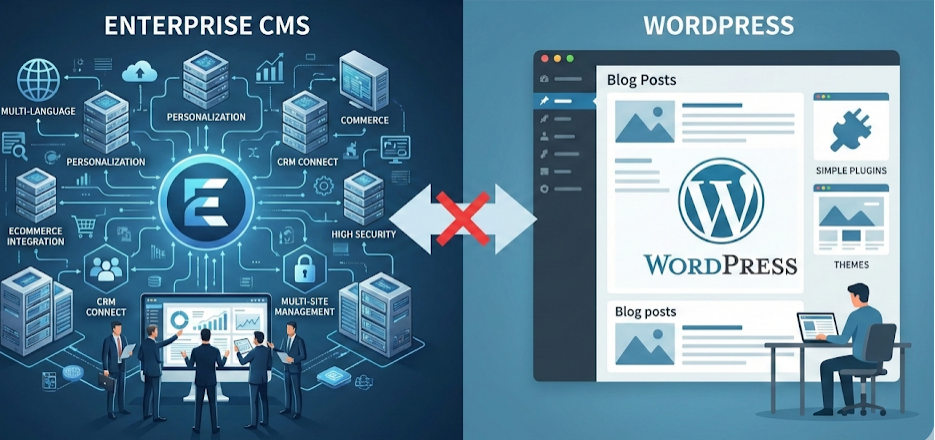
Can WordPress Support an Enterprise Website? Performance, Security, and SEO
AEM Sites, Content Management System (CMS)
2 February 2026
1. Why Do Companies Choose WordPress in the Beginning?
Almost every company I’ve worked with built the first version of their official website on WordPress. The reason is very practical: it’s fast and affordable. In the early stage—when the business is just getting started, the brand is still being established, and the digital team is limited—WordPress has almost no obvious drawbacks. According to W3Techs, more than 40% of websites worldwide are still powered by WordPress, which in itself proves how successful it is.
However, as the business grows, many companies overlook one important fact: WordPress was originally chosen to get through the startup phase, not to support the business for the next ten years. The real challenges usually begin when the company starts to scale.
2. Can Performance Issues Really Be Solved?
When performance warning signs appear, the first question I hear most often is, “Can we just optimize it a bit more?” Honestly, in the early stages, the answer is usually yes.
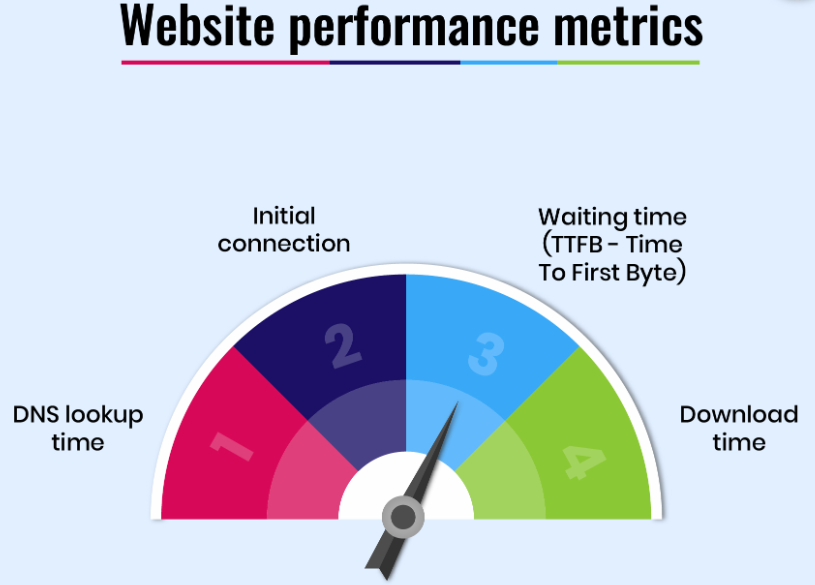
Better hosting, caching plugins, CDNs, and image optimization can indeed make WordPress run quite well. But as the business grows and the website starts to support marketing campaigns, high-traffic periods, and users from multiple markets, performance issues gradually shift from “configuration problems” to “architecture problems.”
As the number of plugins increases and custom features become tightly intertwined with them, unstable performance under high concurrency is often not a matter of technical skill. It’s because WordPress was never designed for this type of workload. This is also why Google continues to emphasize Core Web Vitals: when a website slows down, it affects not only user experience, but also real conversions and revenue.
3. Security and Risk Management
Is WordPress itself insecure? Objectively speaking, no. The real risk comes from its massive plugin ecosystem.
When a company is still small, plugin vulnerabilities may only result in “some strange content being injected into the site.” But as the company grows, these risks can escalate into brand crises or even compliance issues. More realistically, using WordPress means that security responsibility lies almost entirely with the company itself: vulnerability monitoring, update testing, and backup mechanisms are all unavoidable.
For teams with limited IT resources, this becomes a long-term burden. For large enterprises, it turns into a governance-level issue, not just a technical choice.

4. SEO and Website Architecture Limitations
WordPress generally has a solid reputation in the SEO community, especially in single-market, single-language scenarios, where SEO plugins are already quite mature. However, when companies move toward internationalization, multi-language setups, and multiple sites, problems begin to surface.
In practice, I’ve seen many companies install different plugins and configurations for multi-country SEO, only to end up with no one able to clearly explain whether the overall structure is consistent. It’s not that it can’t be done—the issue is that maintenance costs grow exponentially with scale.
In addition, when companies start considering future scenarios such as headless architecture, content reuse, and AI-driven search (GEO), WordPress’s SEO advantages are gradually offset by its architectural limitations.
5. What Kind of Companies Can Still Use WordPress?
To be clear: WordPress is not unusable for corporate websites. If your company meets the following conditions, it can still be a reasonable choice:

Single brand, single or limited markets

Website focused primarily on brand presence and content exposure

Predictable traffic without high concurrency demands

Relatively simple security and compliance requirements
Under these conditions, WordPress offers excellent cost-effectiveness without the early complexity of an enterprise CMS.
6. Which Enterprises Should No Longer Use WordPress
However, if your organization has reached this stage:

Multiple brands operating across multiple countries

The website is a critical driver of revenue or conversions

Marketing campaigns generate large and unpredictable traffic spikes

Clear requirements for security, compliance, and audits
At this point, the question is no longer “Can WordPress still hold up?” but rather “Is the risk of continuing to rely on it still worth it?” This is why many large enterprises don’t leave WordPress out of dislike, but make a rational decision to move on.
7. Conclusion
Can WordPress support a corporate website? The answer is yes—during a certain stage of growth, it absolutely can. But no CMS is suitable for every stage of a company’s evolution. As organizations become more complex, the role of the CMS must evolve as well. Choosing a CMS is never about picking the “best” one, but about choosing the one that best aligns with your business reality over the next 3–5 years.
If you are currently asking yourself:
- Has WordPress started to limit your company’s performance, security, or SEO capabilities?
- Can your current CMS architecture still support business growth over the next 3–5 years?
- Is it time to evaluate enterprise-grade CMS platforms such as AEM, Sitecore, or Magnolia?
Contact Us|We welcome you to get in touch with Leads Technologies. Based on your company size, organizational processes, and technical environment, we can help you assess whether a CMS upgrade is necessary and identify the most suitable next step.
Further Reading
This article is the first in our AEM series. If you are evaluating your enterprise CMS architecture, the following articles provide deeper insights from different perspectives:
- Open-Source CMS vs. Commercial CMS: 5 Key Differences for Enterprise Websites
- AEM vs. WordPress: Why Large Enterprises Eventually Move Away from WordPress
- From WordPress to AEM: 6 Common Reasons Enterprises Choose to Migrate
This series is designed to help enterprises clarify CMS selection, identify the right upgrade timing, and understand where different enterprise CMS platforms fit best.
Related Articles
Enterprise AI MarTech Trends Analysis 2024-2029 Outlook Report
From AI content productivity tools to a core engine for revenue growth and marketing transformation
*The PDF will be sent directly to your inbox.
Email Error
Please enter a valid email address.
Thank You!
The whitepaper has been sent to your inbox. If you don’t see it, please check your spam or promotions folder.