
Global CMS Platform Comparison: Best Enterprise Solutions for Overseas Websites
AEM Sites, Content Management System (CMS), Magnolia CMS
13 April 2026
- Why Enterprises Need an International Website CMS
- Core Challenges in Selecting an International CMS
- Key Evaluation Criteria for International CMS Selection
- Overview of Leading Enterprise CMS Platforms
- AEM CMS: An Enterprise Platform Driven by Digital Experience
- Magnolia CMS: Advantages of Modular and Headless Architecture
- AEM vs. Magnolia: How to Choose the Right Platform
- Recommended Approach for International CMS Selection
- Conclusion: Building a Future-Ready Global Content Platform
- Further Reading and References
- Why Enterprises Need an International Website CMS
- Core Challenges in Selecting an International CMS
- Key Evaluation Criteria for International CMS Selection
- Overview of Leading Enterprise CMS Platforms
- AEM CMS: An Enterprise Platform Driven by Digital Experience
- Magnolia CMS: Advantages of Modular and Headless Architecture
- AEM vs. Magnolia: How to Choose the Right Platform
- Recommended Approach for International CMS Selection
- Conclusion: Building a Future-Ready Global Content Platform
- Further Reading and References
1. Why Enterprises Need an International Website CMS
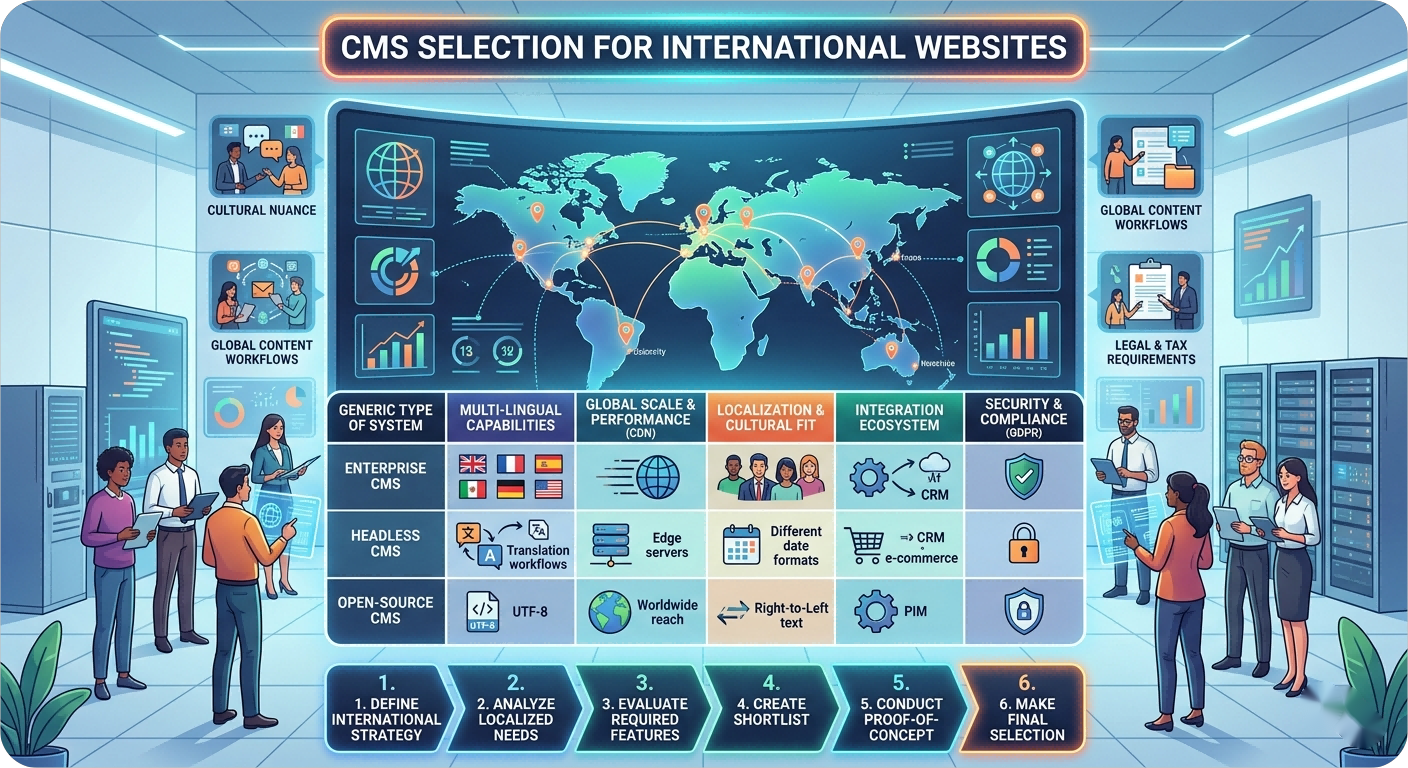
As companies continue expanding into global markets, corporate websites have become a critical channel for brand communication and customer acquisition worldwide. In this context, traditional website systems can no longer meet the needs of multi-country and multilingual operations.
As a result, more enterprises are focusing on international CMS solutions to build a unified global content management platform.
A mature international CMS system not only supports multilingual websites, but also enables:
- Centralized global brand management
- Cross-regional content collaboration
- Localized marketing support
- Data-driven user experience optimization
With the right CMS selection strategy, enterprises can significantly improve global operational efficiency.
2. Core Challenges in Selecting an International CMS
When choosing a CMS for global deployment, enterprises typically face several challenges:

Complexity of Multi-language and Multi-site Management
Websites for different countries require independent content while maintaining brand consistency, which places higher demands on the system.

Content Collaboration and Permission Management
Headquarters and regional teams need to manage content collaboratively. Without a unified platform, this often leads to inefficiencies and confusion.

System Scalability and Integration Capabilities
Modern enterprise websites must integrate with systems such as CRM, CDP, and e-commerce platforms, requiring strong extensibility from the CMS.
These challenges make it essential for enterprises to carefully evaluate platform capabilities when selecting an international CMS.
3. Key Evaluation Criteria for International CMS Selection
When defining a CMS selection strategy, consider the following dimensions:
3.1. Multilingual and Multi-site Capabilities
Does the system support:
- Multilingual content management
- Content inheritance and reuse
- Independent regional site operations
3.2. Architectural Flexibility (Headless Capability)
Modern enterprises increasingly prefer headless architectures, such as:
- AEM Headless CMS
- Magnolia Headless CMS
This architecture enables omnichannel content delivery.
3.3. Enterprise Governance Capabilities
Including:
- Permission management
- Content approval workflows
- Version control
These capabilities are especially critical for large enterprises.
3.4. System Integration Capabilities
The CMS should integrate with:
- CRM systems
- E-commerce platforms
- Analytics platforms
These are essential standards for enterprise-grade CMS platforms.
4. Overview of Leading Enterprise CMS Platforms
Common enterprise CMS platforms in the current market include:
- AEM CMS
- Magnolia CMS
- Other Headless CMS solutions
Among them, AEM and Magnolia are the most widely adopted solutions for enterprise website development and are the focus of this article.
5. AEM CMS: An Enterprise Platform Driven by Digital Experience

AEM CMS (Adobe Experience Manager) is an enterprise content management platform developed by Adobe and widely used in large-scale enterprise website projects.
Key advantages include:
Powerful Multi-site Management
With Multi Site Manager (MSM), enterprises can:
- Manage global site structures
- Synchronize and localize content
- Enable deep personalization
Combined with the Adobe ecosystem, AEM enables:
- User segmentation
- Personalized content recommendations
- Data-driven experience optimization
- End-to-end digital experience capabilities
AEM is not just a CMS, but a core part of a broader digital experience platform, making it ideal for complex global website ecosystems.
Therefore, AEM is often a top choice in enterprise CMS selection scenarios.
6. Magnolia CMS: Advantages of Modular and Headless Architecture

Unlike AEM, Magnolia emphasizes flexibility and modularity.
Magnolia Headless CMS is one of its key strengths, supporting API-driven content delivery.
Core features include:
Modular Architecture
Enterprises can freely combine functional modules based on their needs, improving system flexibility.
Headless-First Design
Magnolia is particularly suitable for:
- Omnichannel content distribution
- Decoupled frontend and backend architectures
Lightweight Implementation Path
Compared to AEM, Magnolia typically offers a more flexible and faster implementation, making it ideal for companies seeking rapid deployment and gradual scaling.
Magnolia is a strong candidate in many enterprise CMS selection processes.
7. AEM vs. Magnolia: How to Choose the Right Platform
When comparing Magnolia and AEM, consider the following dimensions:
7.1. Enterprise Size
- Large enterprises: AEM is more suitable
- Mid-to-large enterprises: Magnolia offers more flexibility
7.2. Digital Experience Complexity
- High personalization and data integration: AEM
- Flexible architecture and rapid iteration: Magnolia
7.3. Technical Architecture Preference
- Integrated platform approach: AEM
- Headless and modular approach: Magnolia
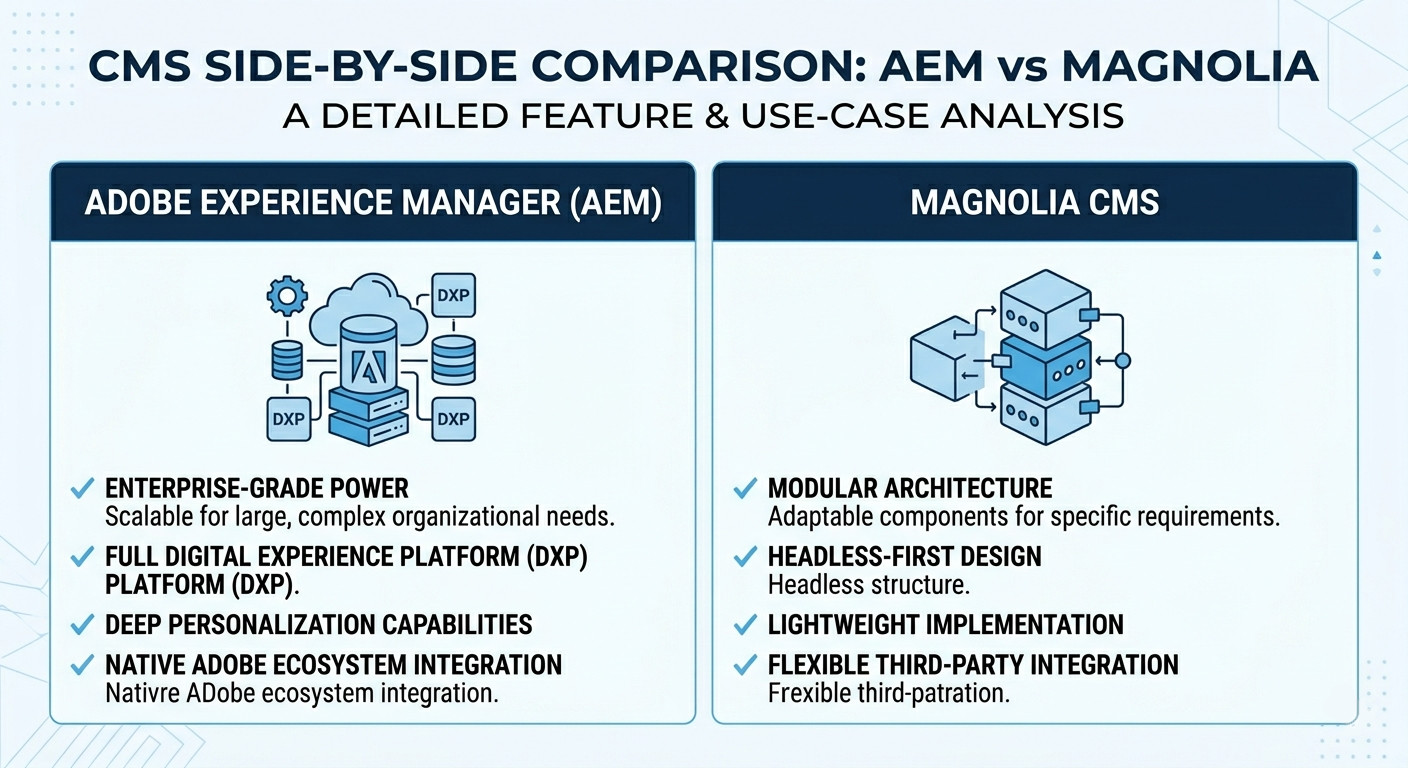
Based on these dimensions, enterprises can define a more effective CMS selection strategy.
8. Recommended Approach for International CMS Selection
In real-world projects, enterprises are advised to follow these steps:
- Define global website strategy objectives
- Identify multi-regional content management needs
- Evaluate system integration and data requirements
- Select the appropriate CMS platform
In most enterprise scenarios:
- Choose AEM if integrated experience and data capabilities are a priority
- Choose Magnolia if flexibility and architectural scalability are key
With a well-structured CMS strategy, enterprises can build a scalable and future-proof digital platform.
9. Conclusion: Building a Future-Ready Global Content Platform
As globalization accelerates, the importance of CMS platforms continues to grow.
With the right CMS selection, enterprises can:
- Improve global content management efficiency
- Support multilingual and multi-regional operations
- Deliver consistent and personalized user experiences
- Build a scalable long-term digital architecture
Whether choosing AEM or Magnolia, the key is aligning the platform with your business stage and requirements.
Final Thoughts
If your organization is planning a global website or upgrading its CMS, choosing the right platform will directly impact your digital capabilities over the next 3–5 years.
Feel free to contact our expert team to evaluate the best enterprise CMS platform for your needs and define a complete implementation roadmap.
Contact Us: Consult on International CMS Selection and Implementation
Product Page: Explore AEM and Magnolia Enterprise CMS Solutions
Further Reading and References
Further Reading (Internal)
- Magnolia CMS for Global Brands: Practical Advantages of Enterprise Content Management and Modular Architecture
- In-depth Guide to Adobe CMS (AEM): Building Personalized and Scalable Global Digital Experiences
- Best Practices for Multi-Regional Content Management: Achieving Global Consistency with Local Flexibility
References (External)
Related Articles
Enterprise AI MarTech Trends Analysis 2024-2029 Outlook Report
From AI content productivity tools to a core engine for revenue growth and marketing transformation
*The PDF will be sent directly to your inbox.
Email Error
Please enter a valid email address.
Thank You!
The whitepaper has been sent to your inbox. If you don’t see it, please check your spam or promotions folder.