

Adobe Commerce Magento Case Study | Enterprise eCommerce Platform
Company Background
The company in this case is a retail and distribution enterprise serving multiple regional markets. Its operations cover product display, online sales, membership management, dealer support, and customer service.
As the share of online sales has increased, the company’s existing website has struggled to support more complex needs such as product management, promotional campaigns, membership tiers, order processing, and cross-market operations. Different regions and business teams also require more flexible backend capabilities so that marketing, eCommerce, product, and customer service teams can manage daily operations more efficiently.
Therefore, the company aimed to implement a more mature and scalable enterprise-level eCommerce platform. After evaluation, Adobe Commerce (Magento) was selected as the foundation for the next-generation platform to support future growth across multiple brands, languages, markets, and sales channels.
Solution
Adobe Commerce, Magento, Enterprise eCommerce, eCommerce Platform, Digital Commerce, B2B eCommerce, B2C eCommerce
Challenges Faced
Before the project began, the company was facing the following key challenges:
Insufficient scalability of the eCommerce platform
The existing website mainly supported product display and basic transaction functions. When handling more complex requirements such as product categories, promotions, membership rules, and cross-market operations, the system lacked flexibility. Every new feature or workflow change required significant technical support, slowing down deployment.
Low efficiency in product and content management
Product data was scattered across different systems and spreadsheets. Product images, pricing, inventory, specifications, descriptions, and categories were managed in a highly manual way. As product volume increased or multi-language support was needed, the operations team had to invest significant effort in maintenance.
Lack of flexibility in promotional setup
The marketing team needed to quickly launch discounts, coupons, free gifts, membership pricing, and bundled promotions. However, the legacy system could not support complex promotion rules, limiting campaign flexibility and increasing dependency on the technical team.
Insufficient backend system integration
Online orders, inventory, membership, and logistics data needed to be synchronized with internal systems. However, manual processes and data delays existed in the original workflow, affecting operational efficiency and potentially causing inventory inaccuracy, delayed order processing, or inconsistent customer service follow-up.
Room for improvement in user experience and conversion
Page load speed, product search, filtering, checkout flow, and overall shopping experience were not fully optimized. With increasing mobile usage, the company required a smoother cross-device experience to improve conversion rates.
Project Objectives
- Build a scalable enterprise-grade eCommerce platform
- Improve product, pricing, inventory, and content management efficiency
- Support multi-brand, multi-language, and multi-market operations
- Increase flexibility of promotional campaign setup
- Improve product search, filtering, and shopping flow
- Integrate order, membership, inventory, logistics, and internal systems
- Enhance mobile and desktop shopping experience
- Increase online conversion rate and operational efficiency
- Lay the foundation for personalization and omnichannel expansion
Solution
The company selected Adobe Commerce (Magento) as the foundation for its next-generation eCommerce platform due to its mature capabilities in product management, promotion rules, order management, customer segmentation, multi-store architecture, and system integration.
The solution focused on three core areas: stable platform architecture, flexible operational capabilities, and scalable system integration. This enabled the company to upgrade from a basic website into a full digital commerce platform.
Platform Architecture Design
We designed a structured Adobe Commerce (Magento) architecture based on the company’s brands, markets, languages, and business model. This included multi-store setup, product attribute design, pricing and promotion rules, customer segmentation, order workflow, role-based access control, and integration architecture.
Product and Content Management
We restructured product data to standardize backend operations. This allowed the operations team to manage products more efficiently, launch new items faster, and maintain category and campaign pages with less manual effort.
Promotion and Customer Engagement
Magento’s promotion engine supports complex scenarios such as coupons, discounts, bundled offers, and member pricing. This gave the marketing team more independence and reduced reliance on developers.
System Integration
The platform was integrated with ERP, CRM, payment gateways, logistics providers, and marketing tools. This reduced manual work and improved data accuracy and synchronization speed.
Implementation Content
Requirements Gathering and Platform Blueprint Planning
In the early stage of the project, we worked with the enterprise’s eCommerce, marketing, IT, product, and operations teams to gather requirements, clarify existing issues, future needs, business processes, and system integration points.
Key areas included:
- Inventory of existing website and eCommerce processes
- Product and category structure analysis
- Order flow and payment process confirmation
- Member and customer segmentation requirements
- Promotion rules and marketing campaign requirements
- Backend roles and permission requirements
- Third-party system integration requirements
- Go-live timeline and phased implementation plan
Through early-stage planning, the project team was able to establish a clear platform blueprint before development, reducing the risk of rework later.
Adobe Commerce (Magento) Platform Implementation
Based on the confirmed architecture, we implemented the Adobe Commerce (Magento) platform, including:
- Website and store architecture setup
- Product types and attribute configuration
- Product category and navigation setup
- Customer and segmentation configuration
- Shopping cart and checkout flow setup
- Order status and notification configuration
- Backend role and permission setup
- Basic SEO configuration
- Multi-language and multi-market setup
These foundational configurations ensure the platform supports daily eCommerce operations.
Front-end Experience and Shopping Flow Design
For the front-end experience, we focused on improving the user journey from landing, browsing products, filtering items, adding to cart, to completing checkout.
Key tasks included:
- Homepage and category page design
- Product listing page and product detail page design
- Product search and filtering experience
- Shopping cart flow
- Checkout process
- Mobile responsive experience
- CTA and conversion path design
- Error handling and form experience optimization
The goal was to help users find products faster and complete purchases or inquiries more smoothly.
Product Data and Content Import
For product data, we helped establish a standardized import process, including:
- Product data organization
- SKU and attribute mapping
- Product category structuring
- Product image processing
- Product description and specification field organization
- Multi-language content import
- Price and inventory synchronization testing
- Product listing validation
Through standardized data import, enterprises can reduce long-term product maintenance costs.
Third-party System Integration
Based on project requirements, we implemented key system integrations, including:
- Order data synchronization
- Inventory data synchronization
- Customer data synchronization
- Payment status callback
- Logistics data updates
- Form or inquiry data synchronization
- Email notification triggers
- Analytics and tracking tool deployment
After integration, the enterprise can manage orders, inventory, and customer data more accurately.
Testing, Training, and Go-live Support
Before official launch, we conducted comprehensive checks, including:
- Functional testing
- Shopping flow testing
- Checkout process testing
- Member flow testing
- Product data validation
- Multi-device compatibility testing
- Basic performance checks
- SEO configuration validation
- System integration testing
- Pre-launch backend training
We also provided Adobe Commerce (Magento) backend training for the operations team to ensure they can independently manage products, content, promotions, and orders.
Results and Benefits
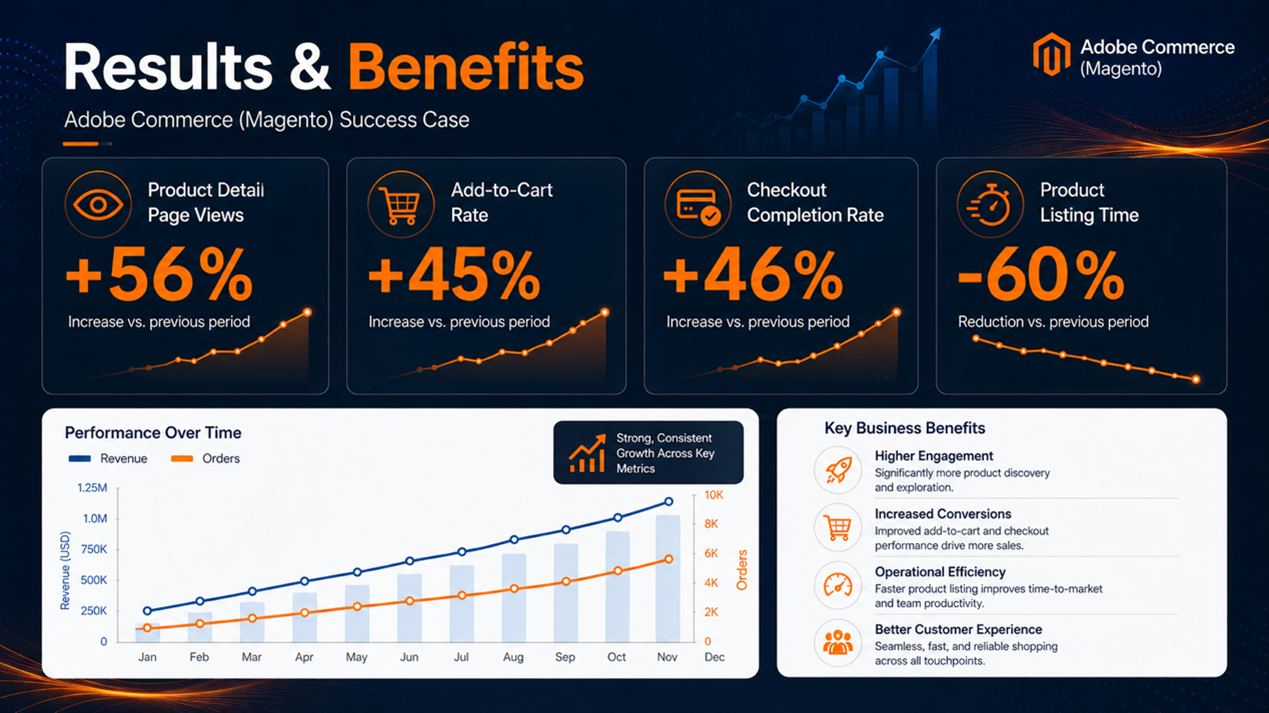
After implementing the Adobe Commerce (Magento) platform and optimizing eCommerce processes, the enterprise achieved significant improvements in user experience, operational efficiency, and online conversion. The following results reflect performance within approximately 3 to 6 months after launch:
| Metric | Before | After | Improvement |
|---|---|---|---|
| Product Detail Page Views | Baseline 100% | ~156% | +56% |
| Add-to-Cart Rate | ~4.2% | ~6.1% | +45% |
| Checkout Completion Rate | ~2.4% | ~3.5% | +46% |
| Product Listing Time | 2–3 days | 0.5–1 day | -60% |
Summary of Results
Through this Adobe Commerce (Magento) project, the enterprise successfully established a more stable, flexible, and scalable enterprise-grade eCommerce platform.
On the frontend, product detail page views increased by approximately 56%, add-to-cart rate improved by 45%, and checkout completion rate increased by 46%, reflecting significant improvements in user experience and conversion flow.
On the backend, product listing time was reduced from 2–3 days to approximately 0.5–1 day, enabling the operations team to update products faster, launch new items more efficiently, and better support daily eCommerce operations.
Key Success Factors
Business Process–Driven Approach, Not Just Platform Implementation
A successful Adobe Commerce (Magento) project is not simply about installing a system—it requires a deep understanding of the company’s product management, order processing, membership operations, and marketing workflows. In this case, business processes were mapped out first, followed by platform architecture design, ensuring the system truly supports day-to-day operations.
Establishing a Standardized Product Data Structure
Product data is the core of any eCommerce platform. By standardizing SKUs, attributes, categories, images, and descriptions, businesses can manage products more efficiently while also improving search, filtering, and front-end display experiences.
Empowering Marketing Teams with Operational Autonomy
With Adobe Commerce (Magento)’s promotion rules, content management, and customer segmentation capabilities, marketing teams can launch campaigns more quickly and reduce reliance on technical development for each promotion.
Integrating eCommerce with Backend Systems
An eCommerce platform should not operate in isolation. By integrating with inventory, order management, membership, payment, and logistics systems, businesses can reduce manual processes while improving data accuracy and operational efficiency.
Balancing Frontend Experience and Backend Efficiency
This case improves both the customer shopping experience and internal operational workflows. Enhancing frontend conversion rates while increasing backend efficiency enables Adobe Commerce (Magento) to become a true driver of long-term business growth.
Conclusion
This case demonstrates how an enterprise can build a scalable, enterprise-grade eCommerce platform using Adobe Commerce (Magento), improving product management, promotional activities, shopping experience, order processes, and system integration capabilities.
For businesses with large product catalogs, frequent promotional campaigns, complex multi-market operations, or a need to improve online sales conversion, Adobe Commerce (Magento) is not just an eCommerce website development tool. It is a platform foundation that supports long-term digital commerce growth.
Through a well-defined platform architecture, standardized product data, flexible promotion rules, backend system integration, and optimized front-end shopping experience design, enterprises can more effectively manage online operations, improve operational efficiency, and build a solid foundation for future membership engagement, personalized recommendations, and omnichannel commerce development.
If your company is evaluating Adobe Commerce / Magento, or looking to upgrade an existing eCommerce platform to support more complex product, customer, order, and multi-market requirements, please feel free to contact us via our Contact Us page to learn more about our enterprise eCommerce platform planning, implementation, and system integration services.
Similar Cases

Enterprise AI MarTech Trends Analysis 2024-2029 Outlook Report
From AI content productivity tools to a core engine for revenue growth and marketing transformation
*The PDF will be sent directly to your inbox.