
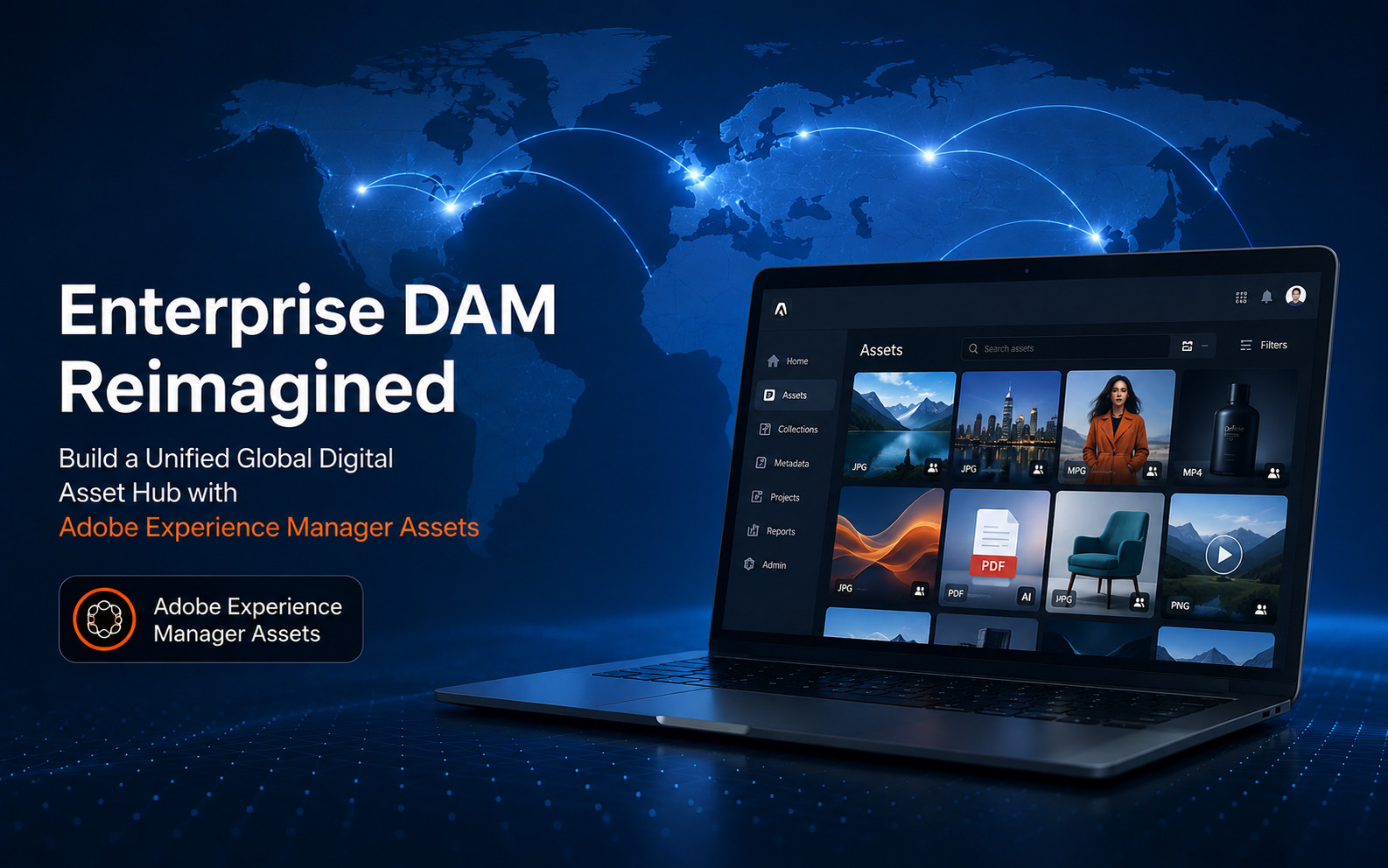
DAM System Recommendations for Multinational Enterprises: Building a Unified Digital Asset Hub with Adobe Experience Manager Assets
AEM Asset, Digital Asset Management (DAM)
28 May 2026
Summary
As multinational enterprises continue to expand their brands, markets, and channels, images, videos, product materials, advertising assets, brand guidelines, and localized content grow rapidly. Without a unified digital asset hub, companies can easily face duplicated asset production, version confusion, copyright risk, and inefficient collaboration across regional teams. This article focuses on DAM system recommendations for multinational enterprises, explaining why Adobe Experience Manager Assets is well suited for building an enterprise-level digital asset hub. From asset governance, global collaboration, content distribution, permission management, and implementation services, it also explains how enterprises can plan a scalable global DAM solution.
1. Introduction: Why multinational enterprises need a unified digital asset hub
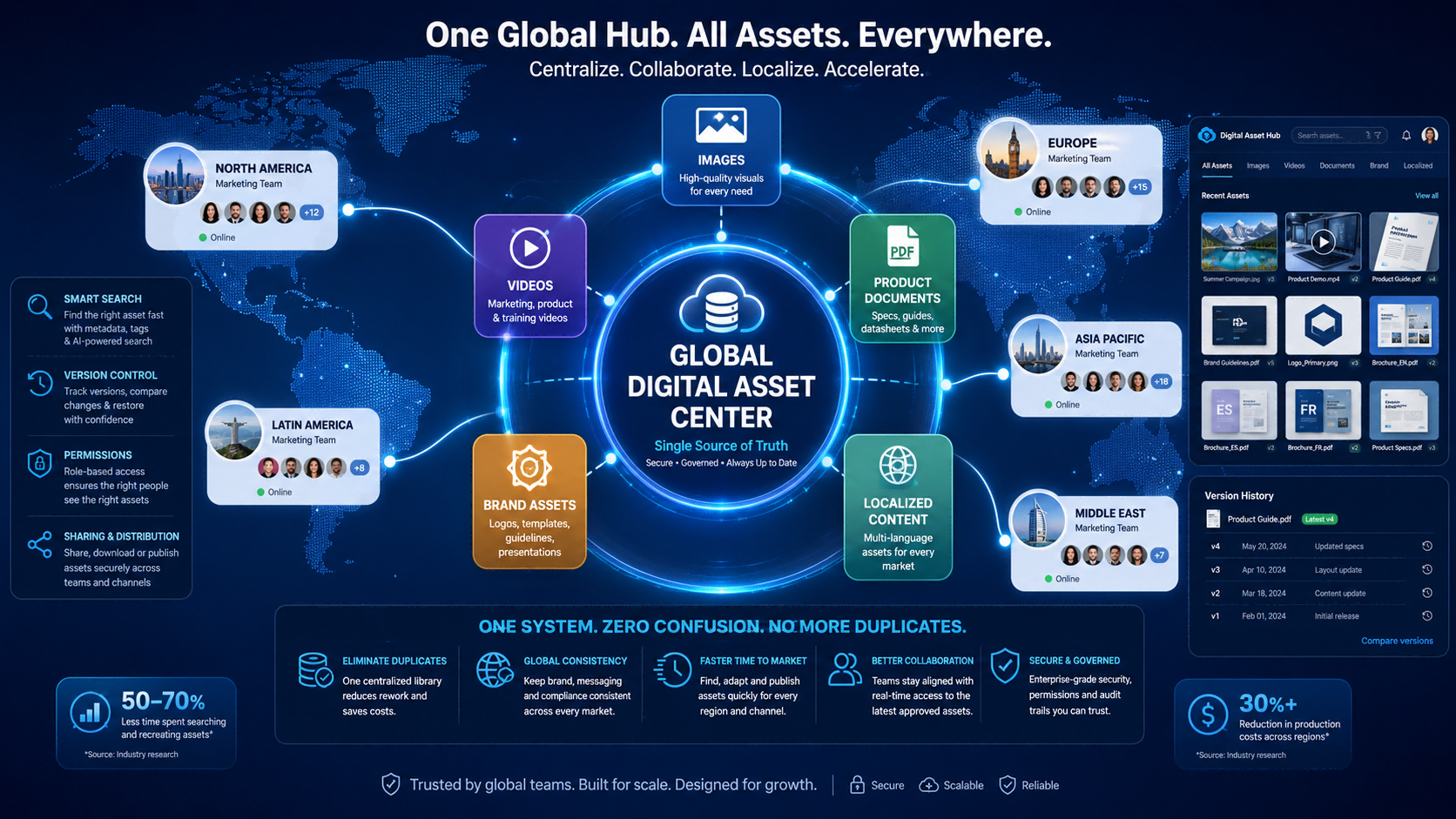
For multinational enterprises, digital assets are no longer just images and files. They are critical resources that connect brand, marketing, e-commerce, websites, social media, and sales enablement. When companies promote products across different countries, they often need large volumes of localized materials, such as product images, promotional videos, advertising banners, sales decks, white papers, case studies, and channel assets.
The challenge is that when these assets are scattered across local computers, shared drives, email attachments, agency folders, and different CMS platforms, it becomes difficult to ensure material consistency, correct versions, clear permissions, and compliant usage. This is why more enterprises are now evaluating DAM system recommendations for multinational enterprises and seeking to manage global digital assets through a unified platform.
Adobe defines DAM as a platform for organizing, discovering, and activating digital content while simplifying content operations and workflows. Adobe Experience Manager Assets is positioned as an enterprise-grade DAM platform for asset discovery, governance, delivery, and analytics.
2. Key criteria for DAM system recommendations for multinational enterprises
When evaluating DAM system recommendations for multinational enterprises, companies should not only ask whether a system can store files. They should assess whether it can truly support global content operations.
A mature DAM solution should meet at least the following criteria:
1. Can it create a unified asset library?
Centrally manage images, videos, documents, brand guidelines, source design files, and other content; support shared use across multiple business lines, brands, and country teams; and avoid repeated uploads, modifications, and production of the same assets across different teams.
2. Does it support asset governance?
Support metadata, tags, taxonomies, and search; manage permissions, approvals, expiration dates, and usage restrictions; and help enterprises reduce copyright risks, brand inconsistency, and incorrect usage.
3. Does it support global collaboration?
Headquarters can centrally maintain core assets; regional teams can use and localize materials based on permissions; and external agencies, design teams, and channel partners can collaborate within controlled boundaries.
4. Can it connect with content distribution scenarios?
It should work with websites, CMS, e-commerce, marketing automation, and social channels; support asset delivery for different formats, sizes, and channel requirements; and reduce repetitive manual work such as image resizing, exporting, uploading, and replacement.
Therefore, truly valuable DAM system recommendations for multinational enterprises must move beyond asset storage and toward asset governance and content operations.
3. The platform positioning of Adobe Experience Manager Assets
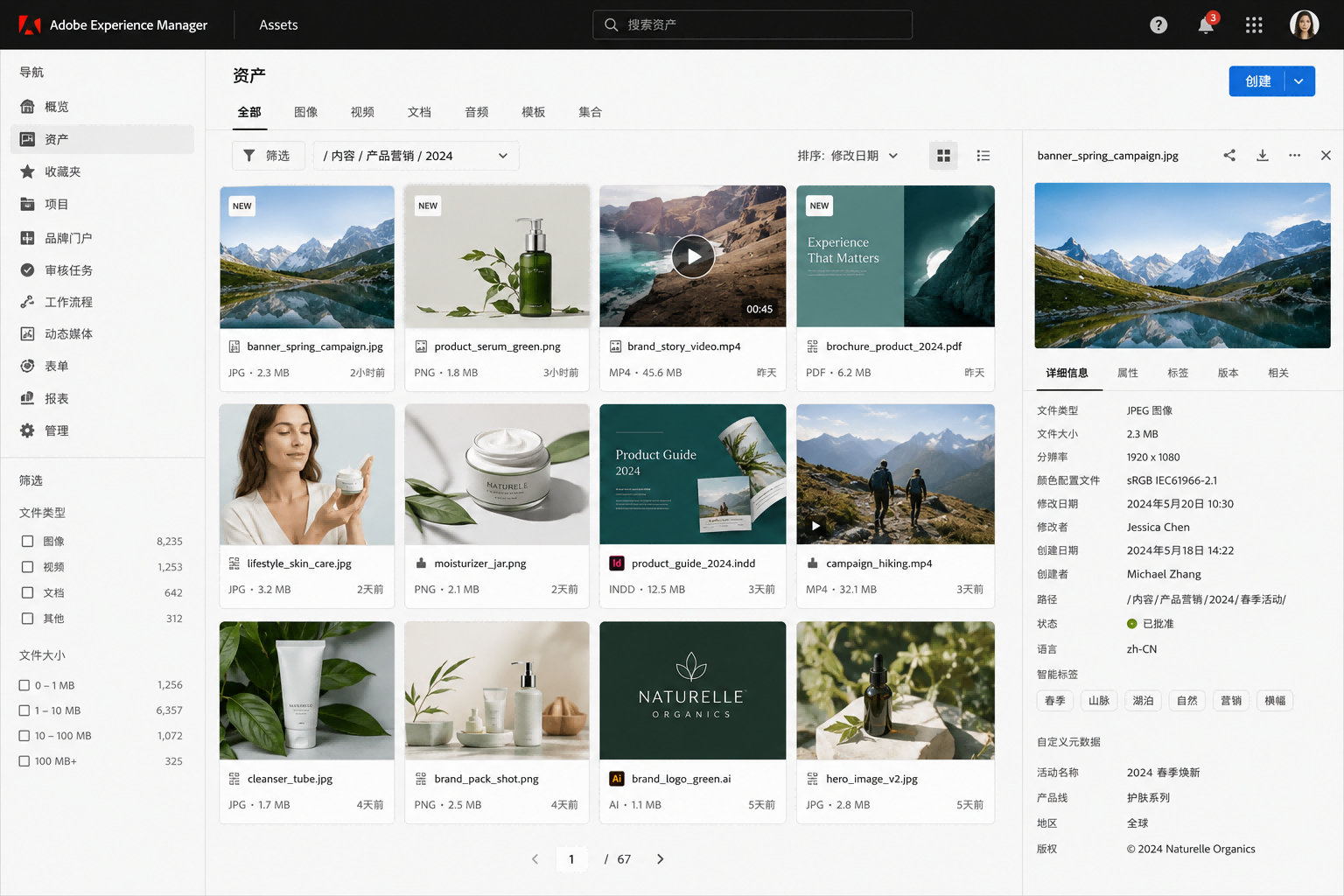
In the enterprise DAM market, Adobe Experience Manager Assets is one of the common choices for multinational enterprises. Adobe’s official materials state that Experience Manager Assets helps companies manage, govern, and protect digital assets, including asset storage, metadata management, access control, workflow governance, content distribution, expiration dates, and brand compliance. It is designed for large-scale asset management scenarios.
Its role is not that of a simple cloud drive. It is an enterprise digital asset management platform for marketing, content, e-commerce, and brand teams. For companies already using AEM Sites, Adobe Analytics, Adobe Commerce, or other Adobe Experience Cloud products, AEM Assets can also work with a broader content and experience ecosystem.
From a capability perspective, Adobe Experience Manager Assets primarily addresses three types of challenges:

1. Searchability and asset discovery
Quickly locate materials through metadata, tags, taxonomies, and intelligent search, reducing the time teams spend repeatedly asking, “Where is the latest version?”

2. Permission and lifecycle governance
Manage the asset lifecycle through permissions, versions, approvals, and usage rules to ensure headquarters, regional teams, and agencies use the correct materials.

3. Multi-channel content distribution and reuse
Support asset adaptation, format conversion, and multi-channel delivery, helping content teams use materials faster across websites, advertising, e-commerce, and campaign pages.
Therefore, among DAM system recommendations for multinational enterprises, AEM Assets is better suited to companies with large asset volumes, high brand governance requirements, and complex content operation chains.
4. Five key capabilities of enterprise digital asset management
If an enterprise wants to build long-term content competitiveness through DAM, it needs to plan around the full asset lifecycle rather than simply centralizing file storage.
1. Asset centralization
All images, videos, product materials, brand manuals, design files, and campaign assets should enter a unified platform. This reduces asset fragmentation and makes it easier for headquarters to understand global asset usage.
2. Metadata and tagging framework
One core goal of enterprise digital asset management is searchability. Companies should design taxonomy logic in advance, such as brand, product line, region, language, usage channel, copyright status, and applicable market.
3. Version and lifecycle management
DAM should help teams identify the latest version, archive outdated versions, and set asset validity periods, reducing the risk that old logos, old packaging, or outdated product images continue to circulate.
4. Permission and compliance control
Headquarters brand teams, regional marketing teams, and agencies should not all have the same permissions. AEM Assets can support access control, expiration dates, and brand compliance management.
5. Multi-channel delivery
The value of DAM lies not only in management, but also in activation. A mature DAM solution should reduce manual processing and improve content distribution efficiency across websites, e-commerce, advertising, sales materials, and social media.
5. How AEM Assets supports global brand and content operations
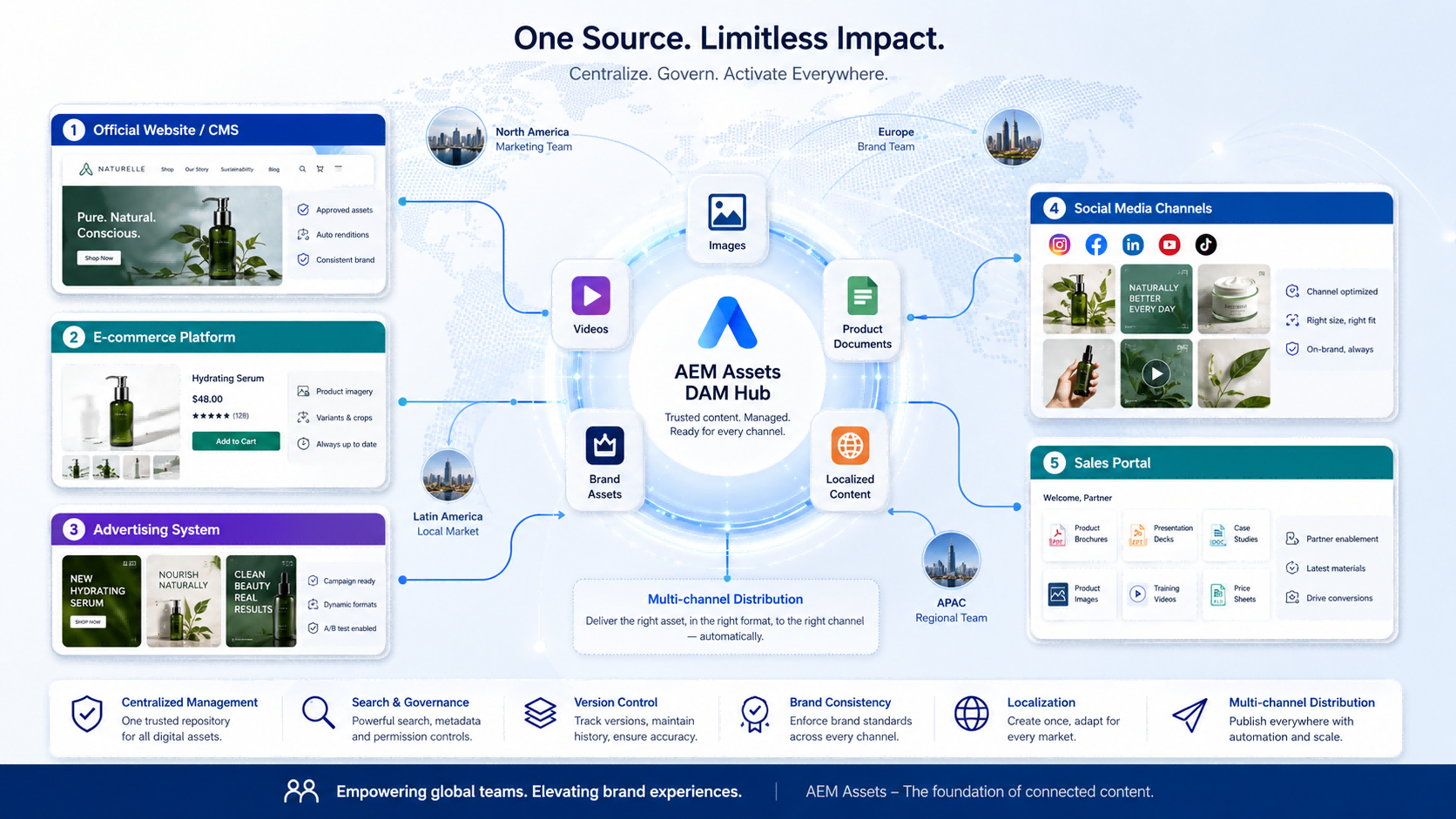
For multinational enterprises, brand consistency and localization flexibility often need to be achieved at the same time. Headquarters wants global markets to maintain a consistent brand image, while regional teams need to adjust materials based on language, culture, regulations, and channel habits.
AEM Assets can help enterprises establish an operating model of “headquarters governance + regional reuse + localized extension.” Headquarters maintains core brand assets, including logos, brand colors, key visuals, product images, official videos, and standard copy. Regional teams use these assets within authorized boundaries and localize them based on market needs.
This model is especially important for global DAM solutions. After expanding into multiple countries, global companies often encounter the following issues:
- Different regions use inconsistent brand materials
- External agencies repeatedly create similar images and advertising assets
- After product materials are updated, old versions continue to circulate in overseas channels
- Sales teams cannot quickly find materials in the right local language
- Content teams must repeatedly adjust the size and format of the same image
This is why DAM system recommendations for multinational enterprises should pay closer attention to AEM Assets. It can help companies move from passively searching for materials to proactively governing assets, thereby improving content operation efficiency.
6. Typical scenarios and business value of DAM implementation
Different companies implement DAM for different reasons, but the most common scenarios usually fall into the following categories.

1. Multi-brand groups
Multi-brand enterprises need to centrally manage visual guidelines, product assets, and promotional content across different brands. DAM helps brand teams control asset usage boundaries and prevent material misuse.

2. Global marketing teams
Headquarters and regional markets need frequent collaboration. DAM can reduce email file transfers and shared-drive confusion, enabling global teams to work around one unified asset library.

3. Cross-border e-commerce and retail enterprises
E-commerce content changes frequently, with many SKUs, images, and promotional assets. Through DAM, companies can manage product images, campaign assets, video content, and channel versions more efficiently.

4. Manufacturing and B2B enterprises
Manufacturing companies often have large volumes of product images, technical documents, specifications, certification files, and sales materials. DAM helps sales, channel, and regional teams quickly find the right materials.

5. Highly regulated industries
Industries such as finance, healthcare, travel, and education have higher requirements for copyright, review, version control, and usage scope. Through DAM, companies can better control material approval and usage records.
From these scenarios, the core value of DAM system recommendations for multinational enterprises is not reducing storage cost. It is improving content collaboration efficiency, brand consistency, and global market responsiveness.
7. How to choose the right DAM service provider
System selection is only the first step. What truly determines project outcomes is implementation methodology and service capability. For multinational enterprises, the following areas should be prioritized when choosing a DAM service provider.
1. Does the provider understand global content governance?
A DAM project is not simply an IT project; it is a content governance project. The service provider needs to help the enterprise design asset taxonomies, permission structures, metadata standards, approval workflows, and cross-team collaboration models.
2. Is the provider familiar with Adobe Experience Manager Assets?
AEM Assets offers rich capabilities, and implementation involves asset architecture, user roles, workflows, permissions, system integration, and operational training. Only teams familiar with the platform can make the system truly fit business needs.
3. Does the provider have CMS and marketing system integration experience?
If DAM cannot work with the corporate website, AEM Sites, e-commerce, marketing automation, or data platforms, its value will be limited. A mature DAM service provider should be able to connect asset management with content publishing, campaign operations, and channel distribution.
4. Can the provider offer long-term operational support?
After DAM goes live, enterprises still need to continuously optimize taxonomies, tags, permissions, and workflows. As brands, regions, and product lines expand, asset governance rules also need to evolve.
Therefore, DAM system recommendations for multinational enterprises should not only recommend a platform, but also a suitable implementation path. The platform determines the ceiling of capability, while the service provider determines the actual results.
8. Conclusion: Turn digital assets into global growth infrastructure
In global competition, digital assets have become an important foundation for brand communication, content marketing, sales enablement, and customer experience. Without a unified DAM, companies may repeatedly produce content without accumulating reusable assets. They may also invest heavily in marketing, only to see conversion affected by version confusion and inefficient collaboration.
From the perspective of DAM system recommendations for multinational enterprises, Adobe Experience Manager Assets is well suited to companies with large asset volumes, high brand requirements, complex global collaboration, and a desire to build long-term content operation capabilities. It not only centralizes asset management, but also helps enterprises govern, reuse, and activate assets so content production and distribution become more efficient.
If you are evaluating a global DAM solution, or want to learn how LeadsTech can help your enterprise build a unified digital asset hub based on AEM Assets:
- Learn more about our AEM Assets product and implementation services;
- You can also visit Contact Us to discuss global asset governance, permission management, and content operation planning with our consulting team.
Further Reading
- What types of enterprises are best suited for AEM Assets? A DAM implementation guide for large enterprises
This article is highly relevant to the topic here and is useful for understanding which types of companies are best suited to implement AEM Assets and how DAM applies across different business scenarios. - How should different enterprises choose the right Digital Asset Management (DAM) system?
If you want to compare DAM system selection from a broader perspective, this article can serve as additional reading for platform evaluation and requirement planning. - Mastering Digital Asset Management: A deep dive into AEM Assets
This article focuses more on the features, advantages, and best practices of AEM Assets, making it useful further reading for understanding AEM DAM capabilities.
Related Articles
Enterprise AI MarTech Trends Analysis 2024-2029 Outlook Report
From AI content productivity tools to a core engine for revenue growth and marketing transformation
*The PDF will be sent directly to your inbox.