
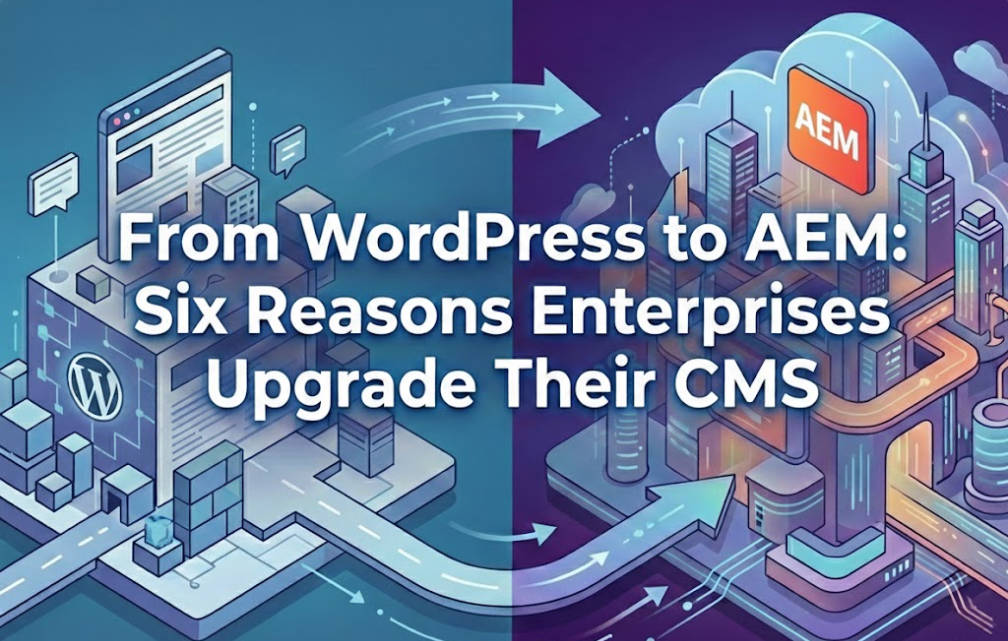
From WordPress to AEM: Six Reasons Enterprises Upgrade Their CMS
AEM Sites, Content Management System (CMS)
2 February 2026
- Why Enterprises Consider a CMS Upgrade
- Reason 1: Performance and Stability
- Reason 2: Multi-Site and Multi-Brand Management
- Reason 3: Global and Multilingual Operations
- Reason 4: Security and Governance
- Reason 5: MarTech, CRM, and CDP Integration
- Reason 6: SEO, GEO, and AI Search Readiness
- Considerations Before Upgrading to AEM
- Conclusion
- Why Enterprises Consider a CMS Upgrade
- Reason 1: Performance and Stability
- Reason 2: Multi-Site and Multi-Brand Management
- Reason 3: Global and Multilingual Operations
- Reason 4: Security and Governance
- Reason 5: MarTech, CRM, and CDP Integration
- Reason 6: SEO, GEO, and AI Search Readiness
- Considerations Before Upgrading to AEM
- Conclusion
1. Why Companies Start Considering a CMS Upgrade
Very few companies begin with the intention of “moving from WordPress to AEM.” In my 10 years of consulting experience, by the time most organizations reach this point, they have already accumulated a period of internal discomfort.
At first, the issues are small: the website becomes slower, content is harder to manage, and different markets operate independently. Then more practical problems emerge—marketing complains that IT moves too slowly, IT complains that plugins are out of control, and management begins to worry about security and risk. This is when CMS discussions finally move to the center of the table.
Companies almost never consider upgrading their CMS because they want new technology. They do it because the old approach can no longer support growth.
2. Reason One: Website Performance and Stability
For many companies, the first serious consideration of a CMS upgrade comes after an “unpleasant experience.” Maybe a marketing campaign goes live and traffic causes the site to slow down. Maybe the website becomes intermittently unavailable on the day of a product launch.
In the WordPress world, performance issues can often be “held together with optimization” for a while—upgrading hosting, adding caching, using a CDN, installing more plugins, and so on. But once a website enters a high-traffic, high-concurrency environment where failure is not an option, the issue is no longer tuning—it’s whether the architecture is fundamentally suitable. Google research has long shown that every additional second of page load time leads to a noticeable drop in conversion rates. For corporate websites, this is not just a user experience issue; it directly affects revenue and brand trust.
One very practical reason AEM is frequently evaluated by enterprises is that it is designed with the assumption that “the site will be heavily used,” not “we’ll figure it out when traffic arrives.”
3. Reason Two: Multi-Site and Multi-Brand Management
When a company has only one brand and one market, WordPress is usually more than sufficient. But once the organization begins to expand, complexity increases rapidly.
I’ve seen many companies where each market runs its own WordPress site, its own plugin set, and its own way of doing things. In the short term, this looks flexible. In the long term, it becomes a governance nightmare. Eventually, leadership starts asking a critical question: “Do we actually have a way to manage all our brands and websites in a consistent manner?”
The value of AEM in this scenario isn’t about having more features—it’s about centralized governance with decentralized execution. Enterprises can maintain a unified structure and standards while still allowing local market flexibility. This is exactly the balance multi-brand organizations need.
4. Reason Three: Multilingual and Global Operations
On the surface, multilingual support may seem like a simple translation issue, but in practice it goes far beyond that. In WordPress environments, multilingual requirements are often handled through plugins. This works in the early stages, but as the number of languages, content volume, and markets increases, maintenance costs rise quickly.
For companies already operating globally, the website is more than an information platform—it is the brand’s front door in each market. AEM’s advantage in multilingual management lies in treating language as part of the content structure, not as an add-on. This allows enterprises to expand into new markets without reinventing the process each time.
5. Reason Four: Security and Internal Control Requirements
Is WordPress insecure? From a purely technical perspective, the answer isn’t that simple. What truly pressures enterprises is the plugin ecosystem and the operational responsibility that comes with it. As companies grow, website content increasingly involves legal, compliance, and brand risks. At that point, questions like “Who can change content?”, “Can changes be audited?”, and “Who is accountable when something goes wrong?” are no longer minor concerns.
AEM’s value in enterprise-grade security and governance comes from its native support for role-based access control, approval workflows, and version management. These capabilities may go unnoticed day to day, but when they’re needed, they often determine whether an organization can operate with confidence.

6. Reason Five: MarTech, CRM, and CDP Integration Needs
As a company’s digital maturity increases, a CMS can no longer exist in isolation. Websites need deep integration with CRM, CDP, marketing automation, DAM, and other systems to support personalization and data-driven marketing. At this stage, the CMS is no longer just “a place to publish content,” but a core component of the digital experience.
WordPress can certainly be integrated as well, but it often relies on custom development and third-party solutions. Over time, maintenance and scalability costs tend to grow. AEM’s advantage is that it is positioned as part of the Adobe ecosystem, allowing it to more naturally serve as a central node within an enterprise MarTech stack.
7. Reason Six: SEO, GEO, and AI Search Requirements
In traditional SEO, WordPress has performed well—there’s no denying that. However, the search environment enterprises face today goes far beyond keyword rankings. With the rise of AI search, GEO (Generative Engine Optimization), and semantic search, content structure and machine readability are becoming increasingly important. This is why large enterprises are paying more attention to headless architectures and API-driven content.
AEM’s approach to content modeling and structured data makes it better suited for adapting to future search paradigms and AI-driven experiences, rather than just solving short-term ranking challenges.
8. What Companies Should Think Through Before Upgrading to AEM
Finally, I usually remind companies of one important thing: upgrading to AEM is not meant to solve every problem.
Before making a real decision, organizations should first answer a few questions honestly:

Have we truly entered a multi-brand, multi-market stage?

Do we need strong governance, not just more features?

Are our organization and processes ready for an enterprise CMS?
If most of the answers are negative, then perhaps it’s not that AEM is the wrong choice—but that the timing simply isn’t right.
9. Conclusion
For enterprises, upgrading from WordPress to AEM is almost never an impulsive decision. It is usually the inevitable result of accumulated growth.
Ultimately, the choice of a CMS does not reflect technical preference, but a company’s judgment about its growth over the next 3–5 years.
If you are currently considering the following questions:
- Has WordPress begun to become a bottleneck for your company’s growth?
- Is your current website struggling more and more with performance, security, or multi-site management?
- Is it time to evaluate upgrading to AEM or another enterprise-grade CMS to support the next 3–5 years of development?
- Can your current CMS architecture truly support the combined needs of marketing, IT, and global operations?
Contact Us|We welcome you to get in touch with Leads Technologies.
Starting from your company size, organizational processes, technical architecture, and growth objectives, we can help you determine whether a CMS upgrade is truly necessary—and identify the most appropriate next step.
Further Reading
This article is the first in our AEM series. If you are evaluating your enterprise CMS architecture, the following articles provide deeper insights from different perspectives:
- Open-Source CMS vs. Commercial CMS: 5 Key Differences for Enterprise Websites
- AEM vs. WordPress: Why Large Enterprises Eventually Move Away from WordPress
- Can WordPress Support an Enterprise Website? Performance, Security, and SEO
This series is designed to help enterprises clarify CMS selection, identify the right upgrade timing, and understand where different enterprise CMS platforms fit best.