
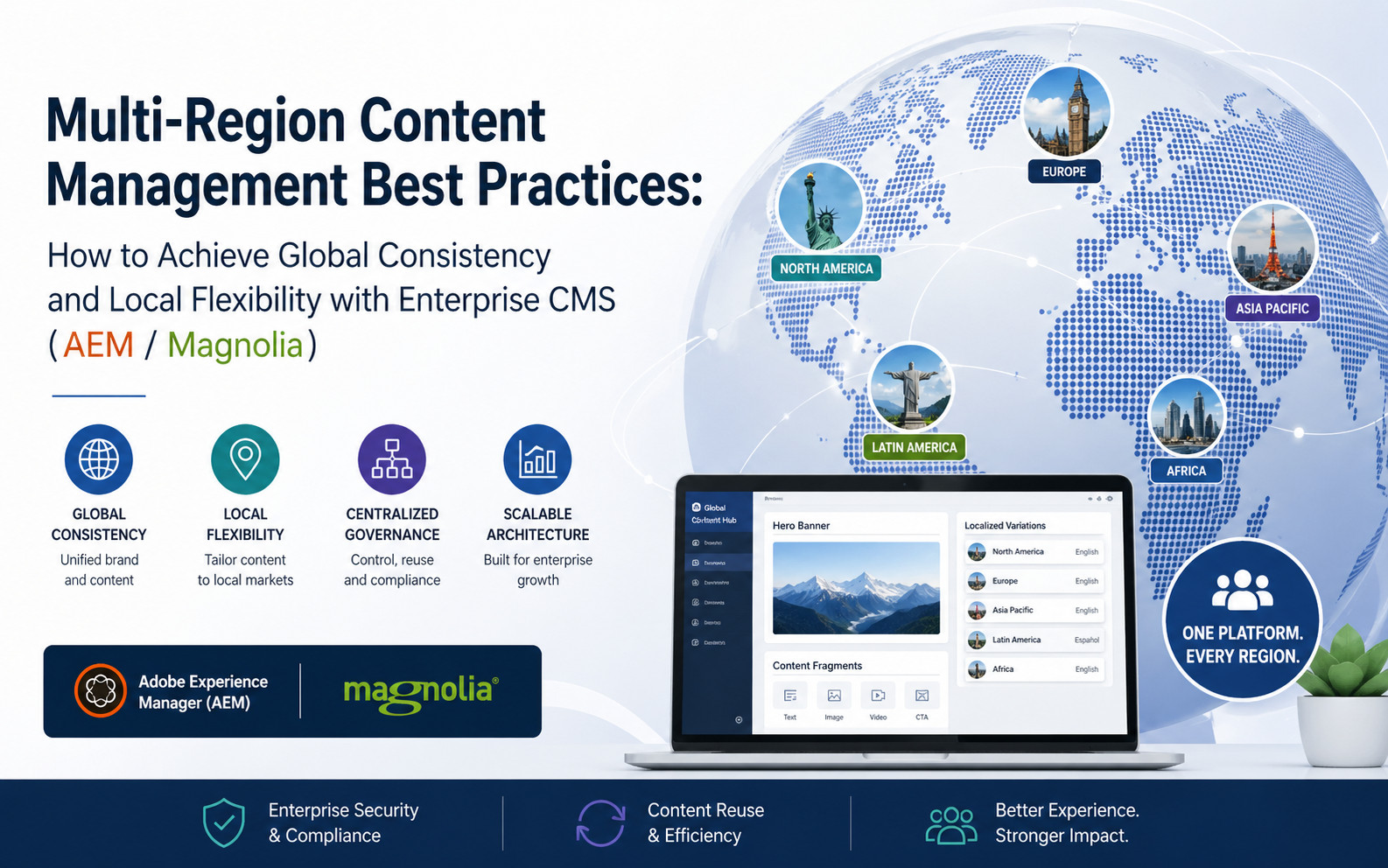
Multi-Region Content Management Best Practices: AEM & Magnolia CMS
AEM Sites, Content Management System (CMS), Magnolia CMS
30 April 2026
- Why Global Companies Must Prioritize Multi-Region Content Management
- Core Challenges in Multi-Region Content Management
- How Enterprise CMS Supports Global Content Architecture
- AEM’s Practical Advantages in Multi-Region Content Management
- How Magnolia CMS Supports Flexible Localization
- Key Strategies for Multi-Region Content Architecture Design
- Multilingual and Localized Content Management Workflow
- Building a Scalable Global Content Management System
- Conclusion: Balancing Brand Consistency with Local Market Needs
- Why Global Companies Must Prioritize Multi-Region Content Management
- Core Challenges in Multi-Region Content Management
- How Enterprise CMS Supports Global Content Architecture
- AEM’s Practical Advantages in Multi-Region Content Management
- How Magnolia CMS Supports Flexible Localization
- Key Strategies for Multi-Region Content Architecture Design
- Multilingual and Localized Content Management Workflow
- Building a Scalable Global Content Management System
- Conclusion: Balancing Brand Consistency with Local Market Needs
1. Why Global Companies Must Prioritize Multi-Region Content Management
As enterprises accelerate their expansion into international markets, corporate websites and digital channels have become critical platforms for brands to reach customers worldwide. However, different countries and regions vary significantly in language, culture, and market demands, making it essential for businesses to establish systematic multi-region content management capabilities.
Without a unified content management system, companies often face the following challenges:
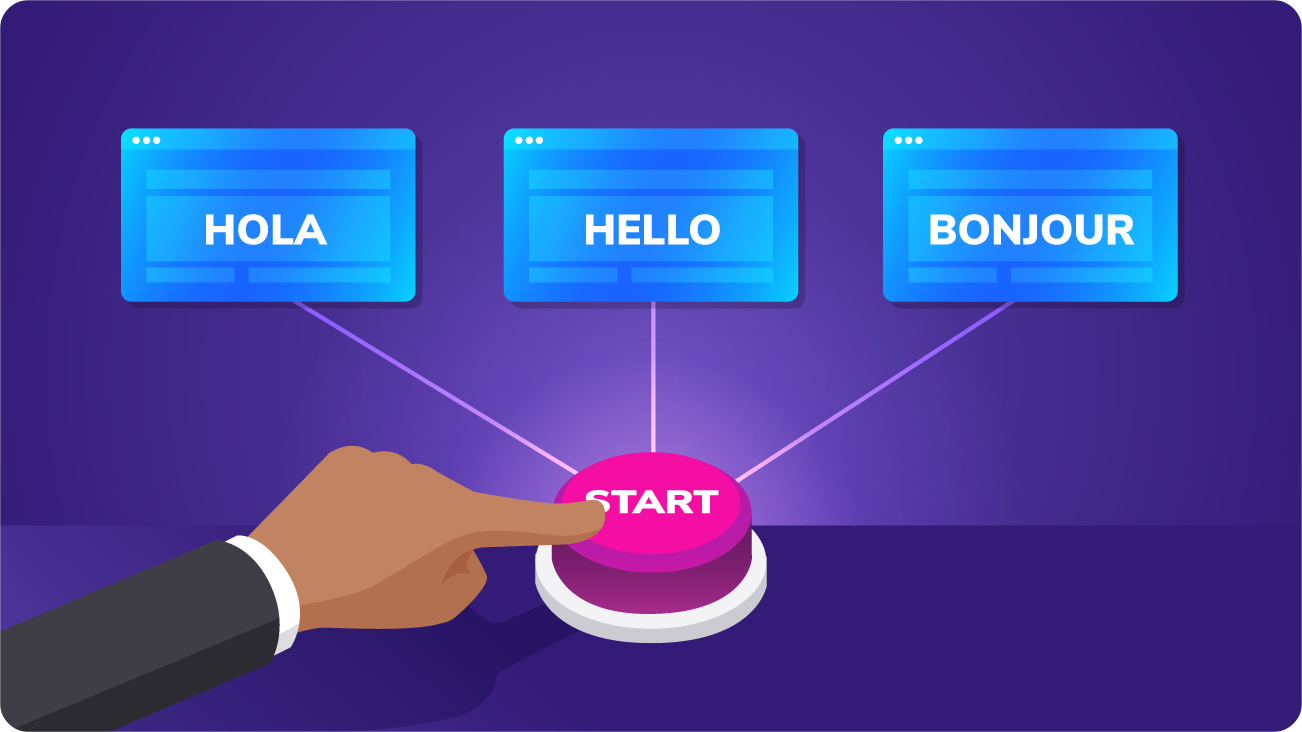
- Inconsistent website content across different countries
- Low content update efficiency
- Inconsistent brand messaging
- Slow response to local market needs
Therefore, establishing an efficient multi-region content management system is a critical foundation for digital globalization.
2. Core Challenges in Multi-Region Content Management
In actual operations, enterprises often face multiple challenges when managing multi-region content.
2.1. Conflict Between Brand Consistency and Localization
Companies want to maintain a unified brand image across their global websites, but different markets require different content. For example:
Different product portfolios
Different marketing messages
Different legal and compliance requirements
Balancing unified branding with localization needs is a key challenge in multi-region content management.
2.2. Content Update Efficiency
When companies operate websites across multiple countries, content updates often involve multiple teams. Without a unified system, the update process can become extremely complex. For example:
Headquarters publishes new product information
Regional teams make localized modifications
Each country website goes live separately
This workflow significantly increases the complexity of multi-region content management.
3. How Enterprise CMS Supports Global Content Architecture
To address these challenges, more and more companies are adopting enterprise CMS platforms to manage global content. An enterprise CMS provides the following capabilities:
-
Centralized content management platform
-
Modular content structure
-
Multilingual and localization support
-
Permission and workflow management
Through these features, companies can establish a unified multi-region content architecture, enabling headquarters and regional teams to collaboratively manage global website content.
4. AEM’s Practical Advantages in Multi-Region Content Management
Adobe Experience Manager (AEM) is one of the enterprise CMS platforms adopted by many large enterprises, offering significant advantages in multi-region content management.
AEM provides Multi-Site Manager (MSM) functionality, enabling companies to manage their global website structure through Blueprint and Live Copy mechanisms. For example:
-
Establish globally unified content templates
-
Synchronize core brand content after configuring MSM rules
-
Support regional teams in making localized adjustments based on global content
Through this approach, companies can maintain global brand consistency while achieving flexible multi-region content operations. Additionally, AEM supports integration with marketing automation and data analytics systems, enabling enterprises to optimize customer experiences globally.
5. How Magnolia CMS Supports Flexible Localization
Beyond AEM, Magnolia CMS is also a commonly used content management platform by many international enterprises. Magnolia’s modular architecture helps companies rapidly build flexible website structures, suitable for fast-iteration multi-region content scenarios.
Its main advantages include:
-
Compatibility between Headless and traditional CMS
-
Flexible content modules
-
Powerful multilingual support
-
Easy-to-extend integration capabilities
Through Magnolia, companies can enable regional teams to quickly create local content based on market needs while maintaining overall brand framework consistency.
6. Key Strategies for Multi-Region Content Architecture Design
To achieve efficient multi-region content management, companies need to consider global operational requirements during the website architecture design phase. Here are common strategies.
6.1. Layered Global and Local Content
Companies can categorize content into two types:
Globally unified content (brand information, core products)
Local market content (promotions, cases, news)
This layered structure helps simplify multi-region content management workflows.
6.2. Modular Content Design
Through modular components, companies can reuse content modules across different regional websites, for example:
Product introduction modules
Customer case modules
Industry solution modules
This approach improves multi-region content management efficiency.
7. Multilingual and Localized Content Management Workflow
In global operations, multilingual content management is a critical component. Companies typically need to establish clear content workflows, for example:
-
Headquarters creates original content
-
Translation team performs linguistic localization
-
Regional teams make market adjustments
-
Content publishing and review
Through standardized workflows and approval mechanisms, companies can ensure that multi-region content maintains quality and consistency across different countries.
8. Building a Scalable Global Content Management System
As company business expands, website count and content volume will continue to grow. Therefore, companies need to build a scalable multi-region content management system (typically implemented alongside workflows and permission models). Key capabilities include:
-
Scalable CMS architecture
-
Automated content workflows
-
Cross-team collaboration mechanisms
-
Data analytics and content optimization
These capabilities help companies manage complex global content systems over the long term.
9. Conclusion: Balancing Brand Consistency with Local Market Needs
For companies expanding into global markets, corporate websites are not only information display platforms but also important channels for brand-customer interaction. By establishing a comprehensive multi-region content management system and leveraging enterprise CMS platforms like AEM or Magnolia, companies can:
- Maintain global brand consistency
- Improve content operations efficiency
- Quickly respond to local market demands
- Continuously optimize global customer experiences (based on content and data analytics)
In future digital competition, content management capability will become a critical foundation for enterprise global operations.
Contact Us: Get Expert Guidance on Enterprise CMS and Global Website Solutions
Products: Explore AEM and Magnolia CMS Solutions
Related Articles
Related Articles
Enterprise AI MarTech Trends Analysis 2024-2029 Outlook Report
From AI content productivity tools to a core engine for revenue growth and marketing transformation
*The PDF will be sent directly to your inbox.
Email Error
Please enter a valid email address.
Thank You!
The whitepaper has been sent to your inbox. If you don’t see it, please check your spam or promotions folder.