
Global Website Development Is More Than a Site: How CMS Powers Growth
AEM Sites, Content Management System (CMS), Magnolia CMS
11 April 2026
- Why Global Website Development Is More Than “Building a Website”
- Real Challenges of Multilingual and Multi-Country Operations
- Why Standard Website Builders Fall Short for Global Operations
- What Is a Professional CMS? Key Differences from Website Builders
- How a Professional CMS Supports Multilingual and Global Operations
- The Role of AEM and Magnolia in Global Content Management
- CMS Selection Recommendations by Business Stage
- Conclusion: A Global Website Is a Long-Term Content Operation
- Further Reading and References
- Why Global Website Development Is More Than “Building a Website”
- Real Challenges of Multilingual and Multi-Country Operations
- Why Standard Website Builders Fall Short for Global Operations
- What Is a Professional CMS? Key Differences from Website Builders
- How a Professional CMS Supports Multilingual and Global Operations
- The Role of AEM and Magnolia in Global Content Management
- CMS Selection Recommendations by Business Stage
- Conclusion: A Global Website Is a Long-Term Content Operation
- Further Reading and References
1. Why Global Website Development Is More Than “Building a Website”
In many organizations, global website development is still treated as a one-time project:
- Hire a web development agency
- Design a few pages
- Translate them into English
- Launch the site
However, in real global expansion scenarios, a corporate website plays a much more complex and long-term role:
- Deliver consistent yet localized brand messaging across different countries
- Support overseas sales in generating leads and building trust
- Continuously publish content to drive search engine traffic
- Expand into new languages, markets, and sites over time
This means a global website is not a “project,” but a long-term operational platform.
And the key to enabling this is not design, but the CMS (Content Management System).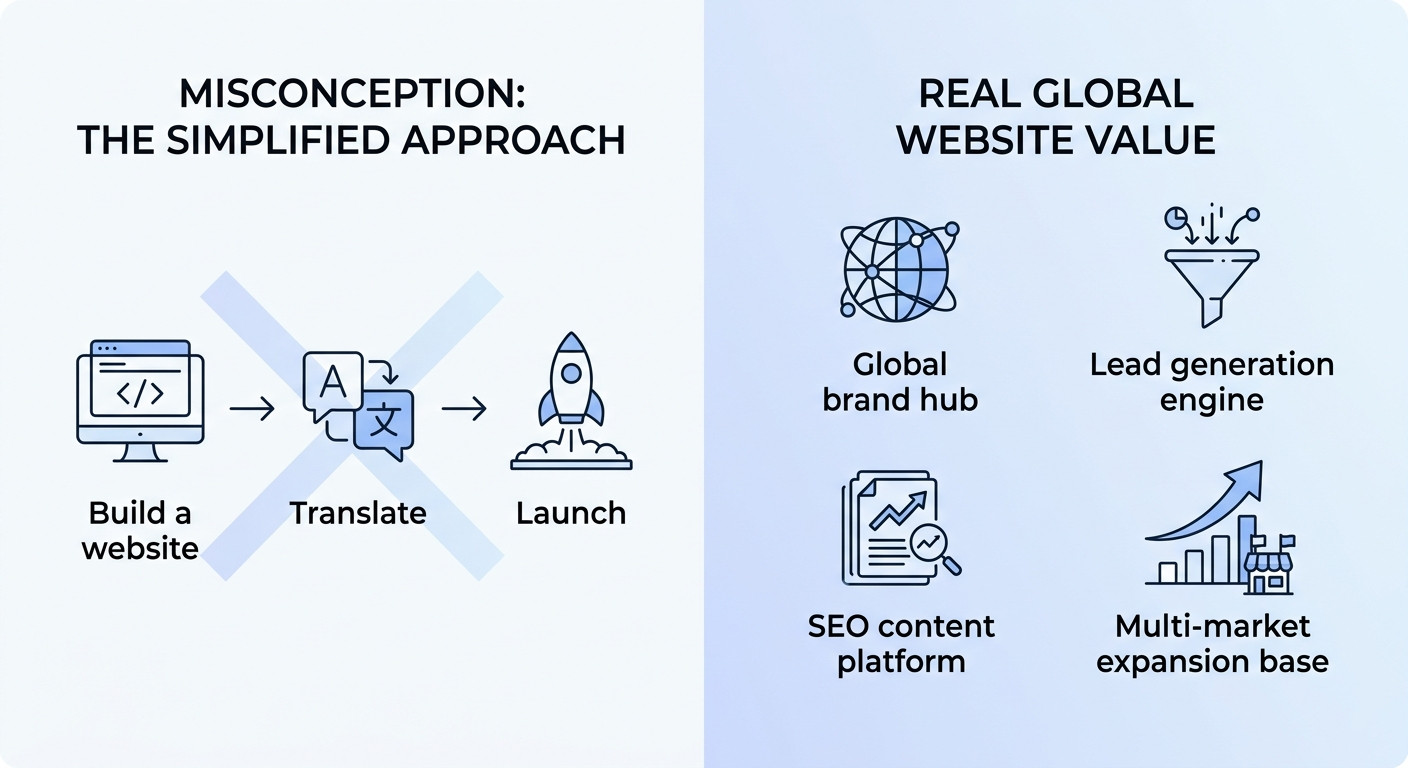
2. Real Challenges of Multilingual and Multi-Country Operations
As companies scale into multiple markets, challenges often emerge rapidly.
2.1 Multilingual Is More Than Translation
A common misconception is treating multilingual as simply “multiple translated versions,” but real challenges include:
- Maintaining one-to-one alignment across language versions
- Synchronizing updates across languages
- Allowing localized variations for different markets
Without structured content management, things quickly become chaotic.
2.2 Content Differences Across Markets
Different countries often require:
- Different product offerings
- Different regulatory and compliance requirements
- Different marketing priorities
This requires a CMS that supports a “global framework with local flexibility.”
2.3 Increasing Complexity in Team Collaboration
In multi-country operations, content typically involves:
- Headquarters marketing teams
- Regional managers
- External agencies
Without proper permissions and workflows, both quality and efficiency decline quickly.
3. Why Standard Website Builders Fall Short for Global Operations
Many companies start their global journey using:
- Template-based website builders
- Lightweight CMS platforms
- Overseas SaaS website platforms
While these tools are effective early on, they often fall short in multilingual and multi-country scenarios:
- Content duplication instead of structured management
- High maintenance costs for multiple sites
- Limited SEO and internationalization capabilities
- Lack of support for cross-team workflows and permissions
As companies grow globally, they often realize: the problem isn’t content—it’s the platform’s limitations.
4. What Is a Professional CMS? Key Differences from Website Builders
The biggest difference between a professional CMS and a website builder lies in their design purpose.
Website builders focus on:
- Fast deployment
- Ease of use
- Single-site management
A professional CMS is designed for:
- Treating content as a long-term asset
- Scalable management of multilingual and multi-site environments
- Supporting complex organizations and workflows
- Allowing future integrations and expansion
In short, a professional CMS is built for continuous operations—not one-time website launches.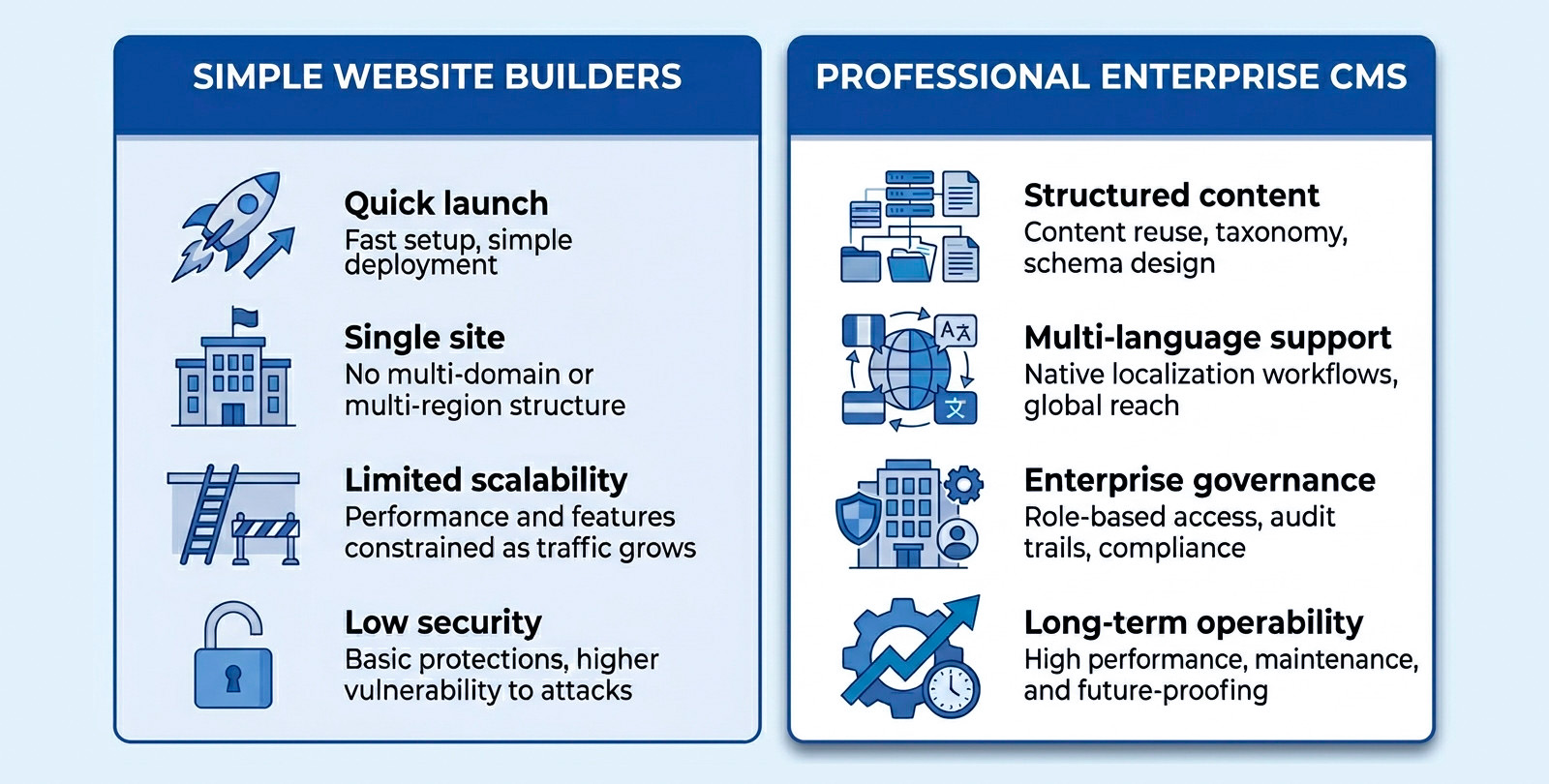
5. How a Professional CMS Supports Multilingual and Global Operations
5.1 Structured Content and Language Relationships
A professional CMS enables modular and structured content, with clear relationships across languages:
- Trackable multilingual versions of the same content
- Options for inheritance or local customization
- Clear visibility into update status
5.2 Multi-Site and Multi-Market Architecture
With a multi-site architecture, companies can:
- Manage multiple country websites on a single platform
- Share components and design systems
- Maintain independence at the market level
This significantly reduces the cost of managing global website ecosystems.
5.3 Enterprise-Grade Permissions and Workflow Governance
Professional CMS platforms typically include:
- Role-based access control
- Content review and publishing workflows
- Version history and rollback capabilities
These ensure consistency and compliance at scale.
5.4 Built-in SEO and Internationalization Capabilities
For global operations, the following CMS capabilities are critical:
- Hreflang management
- International site structures
- Flexible URL rules
- High performance and scalability
These capabilities often determine long-term organic traffic potential.
6. The Role of AEM and Magnolia in Global Content Management
6.1 AEM: A Global Content and Experience Platform for Enterprises
AEM Sites is particularly suitable for:
- Multi-brand, multi-country websites
- Organizations emphasizing brand consistency and governance
- Deep integration with data, marketing, and AI
Its strengths include:
- Advanced multilingual and multi-site management
- Enterprise-grade permissions and workflows
- A strong foundation as a digital experience platform core
6.2 Magnolia: A Flexible and Pragmatic Enterprise CMS
Magnolia is often used by:
- Companies upgrading from mid-market CMS platforms
- Organizations needing flexible integration rather than a full DXP
- Teams balancing cost and enterprise capabilities
It performs strongly in headless and hybrid architectures, as well as multilingual content management.
7. CMS Selection Recommendations by Business Stage
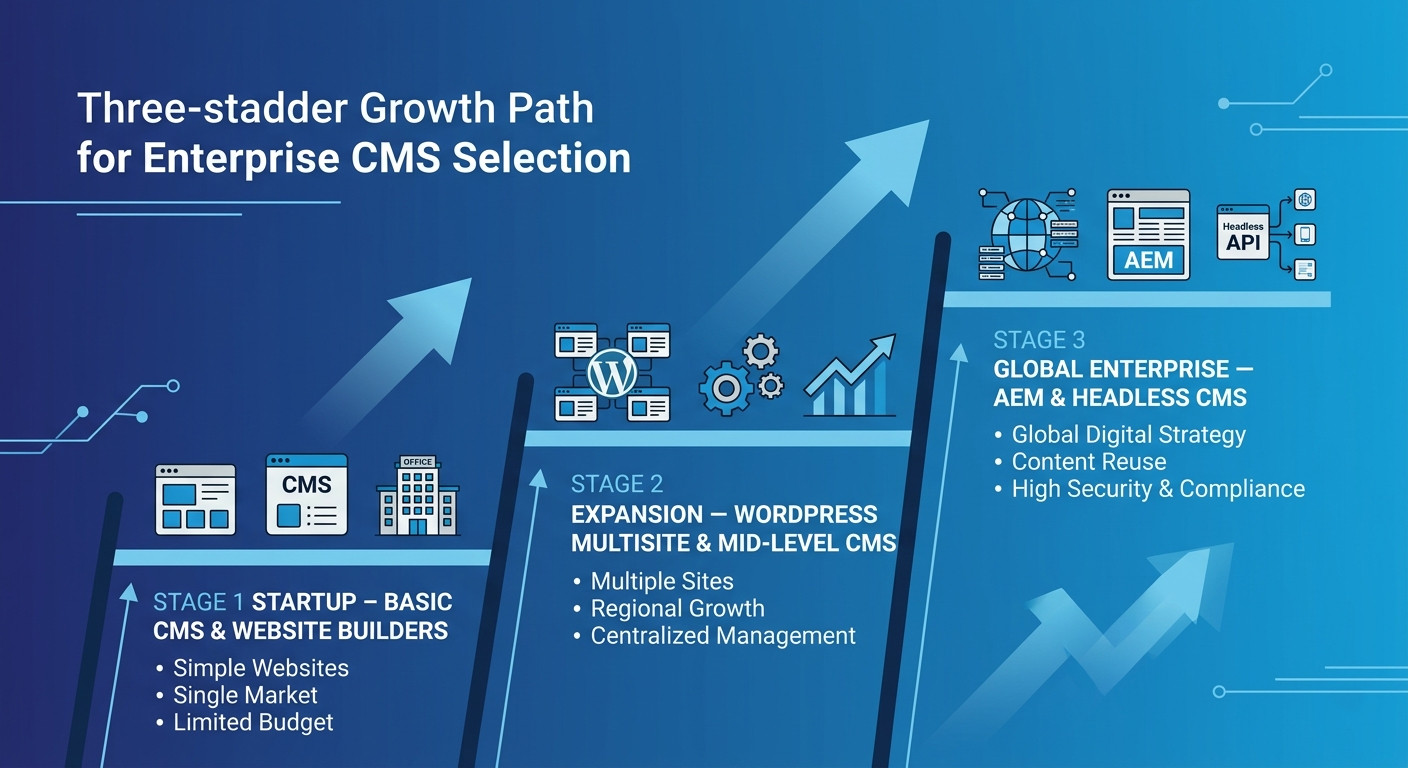
Stage 1: Single Market or Early Expansion
- Use basic CMS or website builders
- Focus on rapid market validation
Stage 2: Multilingual and Multi-Country Expansion
- Consider WordPress Multisite or Magnolia
- Start focusing on content governance and SEO
Stage 3: Global Brand and Scaled Operations
- Adopt AEM Sites or enterprise CMS platforms
- Treat the website as a long-term digital asset
8. Conclusion: A Global Website Is a Long-Term Content Operation
Global website development is never just about “building a website.” It is about:
- Establishing global content management capabilities
- Supporting long-term multi-market operations
- Building a foundation for brand, SEO, and future growth
As companies scale globally, having a professional CMS often determines both operational efficiency and growth potential.
Final Thoughts: Start by Evaluating Your CMS Capabilities
If you find that:
- Multilingual content is becoming difficult to manage
- Country-specific sites lack coordination
- Your current CMS is becoming a bottleneck
Then now is the right time to reassess your CMS and global website architecture.
Feel free to contact us to evaluate whether AEM, Magnolia, or other enterprise CMS solutions fit your global strategy.
Contact Us: Discuss your global website and CMS strategy with our consultants
Services: Explore enterprise CMS and multilingual website solutions
Further Reading and References
Further Reading
- How to Choose a CMS for Global B2B Websites: A Comprehensive Comparison
- Custom Website vs Overseas Website Builders: A Strategic Comparison
- What Is AEM as a Cloud Service? A Key Step Toward Cloud-Based Content Platforms
References