
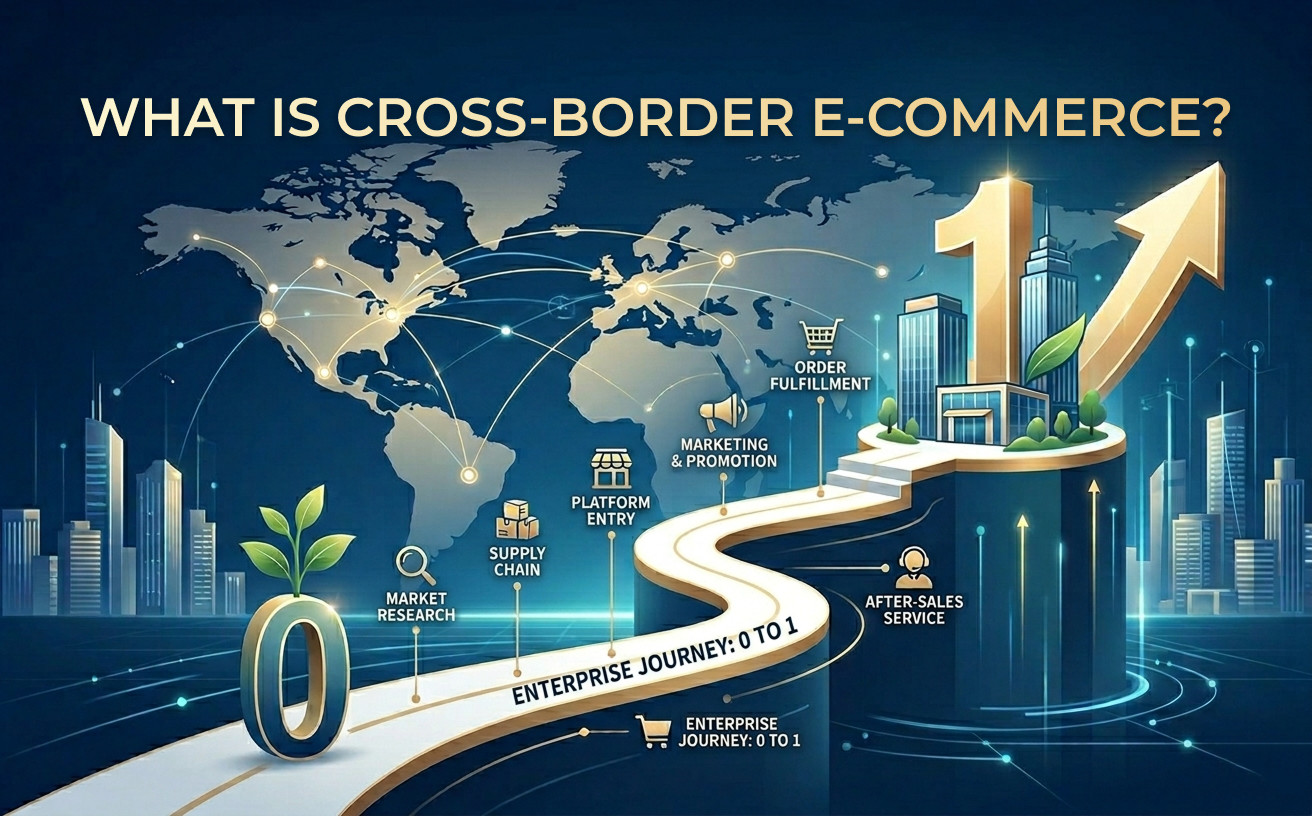
What Is Cross-Border E-Commerce? A Complete 0–1 Guide for Businesses
e-commerce Platforms
23 March 2026
1. Introduction: What Does “Cross-Border E-Commerce” Mean in a Business Context?
In many discussions, “cross-border e-commerce” is often simplified to one sentence:
Selling products overseas.
However, from a business perspective, this definition is too narrow and can easily lead to poor decision-making.
For companies, cross-border e-commerce is not just about sales—it is a comprehensive business system built around overseas markets, including:
- Market entry strategies
- Brand and content presentation
- Transactions and fulfillment
- Customer relationships and data accumulation
- System and organizational coordination
If treated merely as “adding another sales channel,” companies will likely face bottlenecks as they scale.
Successful businesses typically view cross-border e-commerce as long-term capability building for operating in global markets.
2. Key Differences Between Cross-Border and Domestic E-Commerce
One of the most common mistakes companies make is applying domestic e-commerce experience directly to overseas markets.
However, there are fundamental differences:
Market and User Differences
Domestic e-commerce is more platform-driven, while overseas markets rely more on search, content, and brand trust.
Operational Complexity
Cross-border e-commerce involves multiple languages, currencies, tax systems, and logistics models.
Systems and Processes
Domestic platforms provide many capabilities, while cross-border businesses must handle more system integration themselves.
Time Horizon
Domestic e-commerce emphasizes short-term conversion, while cross-border requires long-term investment and operation.
These differences mean success cannot rely solely on “quick launch” strategies.
3. From 0 to 1: Stages of Cross-Border E-Commerce Development
Cross-border e-commerce evolves gradually:
Stage 1: Testing and Validation
Companies validate demand through third-party platforms or agents.
Focus:
- Market feedback
- Fulfillment feasibility
- Basic operations
Brand, data, and systems are usually not yet established.
Stage 2: Growth and Scaling
As orders grow:
- Operational efficiency issues arise
- Market differences become apparent
- Cost and margin pressures increase
Companies begin building independent sites, brand content, and systems.
Stage 3: Operation and Accumulation
Focus shifts to:
- Customer relationship management
- Brand and content asset building
- Creating scalable business models
This stage determines long-term success.
4. Platform, System, and Team Requirements at Each Stage
Early Stage
- Focus on speed and cost
- Rely on platform capabilities
- Lean teams
Growth Stage
- Independent sites and branding
- Basic system integration
- Specialized team roles
Mature Stage
- Multi-market operations
- Scalable systems
- Complex organizational structures
Platform choices impact the next 2–3 years significantly.
5. Core Capability Modules in Cross-Border E-Commerce

Content and Branding
Consistent messaging for search, communication, and trust.

Transaction and Fulfillment
Pricing, inventory, orders, payments, logistics.

Search and Traffic Acquisition
Long-term SEO and content strategy over one-time campaigns.

Data and Analytics
Integrated data enables long-term decision-making.
6. Common Mistakes and Risks
- Treating it as a short-term project
- Choosing solutions based only on cost
- Over-reliance on plugins
- Fragmented content
- Disconnected data
7. Why Early System Planning Matters
Many companies overlook system planning early on.
But long-term, architecture determines:
- Scalability across markets
- Integration of content, commerce, and data
- Avoiding costly rebuilds
Whether choosing Shopify Plus or Adobe Commerce, alignment with future needs is key.
8. Conclusion
Cross-border e-commerce is not about copying domestic models—it is a long-term strategic investment.
The real question is not:
“Can we sell quickly?”
But:
“Will this model still work in three years?”
Visit the Contact Us page to discuss your strategy.
Further Reading & References
Further Reading
- Enterprise Global Expansion: The Right Approach to Cross-Border DTC Websites
- Cross-Border E-Commerce System Architecture: An Enterprise-Level Guide
References