
- Introduction: Why Businesses Need an “Integrated” Cross-Border E-commerce Solution
- Core Components of an Enterprise Cross-Border E-commerce Solution
- From Website Content to Cross-Border Transactions: An Integrated Design
- Alignment Between System Architecture and Business Processes
- The Role of SEO and GEO in Enterprise Solutions
- Data, Analytics, and Continuous Optimization
- Implementation Roadmap and Phases of Enterprise Solutions
- Conclusion: Building Sustainable Cross-Border E-commerce Capabilities
- Introduction: Why Businesses Need an “Integrated” Cross-Border E-commerce Solution
- Core Components of an Enterprise Cross-Border E-commerce Solution
- From Website Content to Cross-Border Transactions: An Integrated Design
- Alignment Between System Architecture and Business Processes
- The Role of SEO and GEO in Enterprise Solutions
- Data, Analytics, and Continuous Optimization
- Implementation Roadmap and Phases of Enterprise Solutions
- Conclusion: Building Sustainable Cross-Border E-commerce Capabilities
1. Introduction: Why Businesses Need an “Integrated” Cross-Border E-commerce Solution
In the early stages of cross-border e-commerce, companies typically start from a single entry point:
- Start selling on marketplaces
- Add a standalone website later
- Integrate systems and plugins as needed
This approach works at the beginning. However, as companies expand into multiple markets, operate multiple sites, and coordinate across teams, problems begin to surface:
- Fragmented systems
- Content that cannot be reused
- Difficulty accumulating search visibility and brand assets
- Scattered data that cannot support decision-making
At this point, businesses realize:
The real bottleneck is not any single platform, but the lack of an integrated solution perspective.
An “enterprise-level cross-border e-commerce solution” is not a single system, but a set of evolving capabilities that can grow over time.
2. Core Components of an Enterprise Cross-Border E-commerce Solution
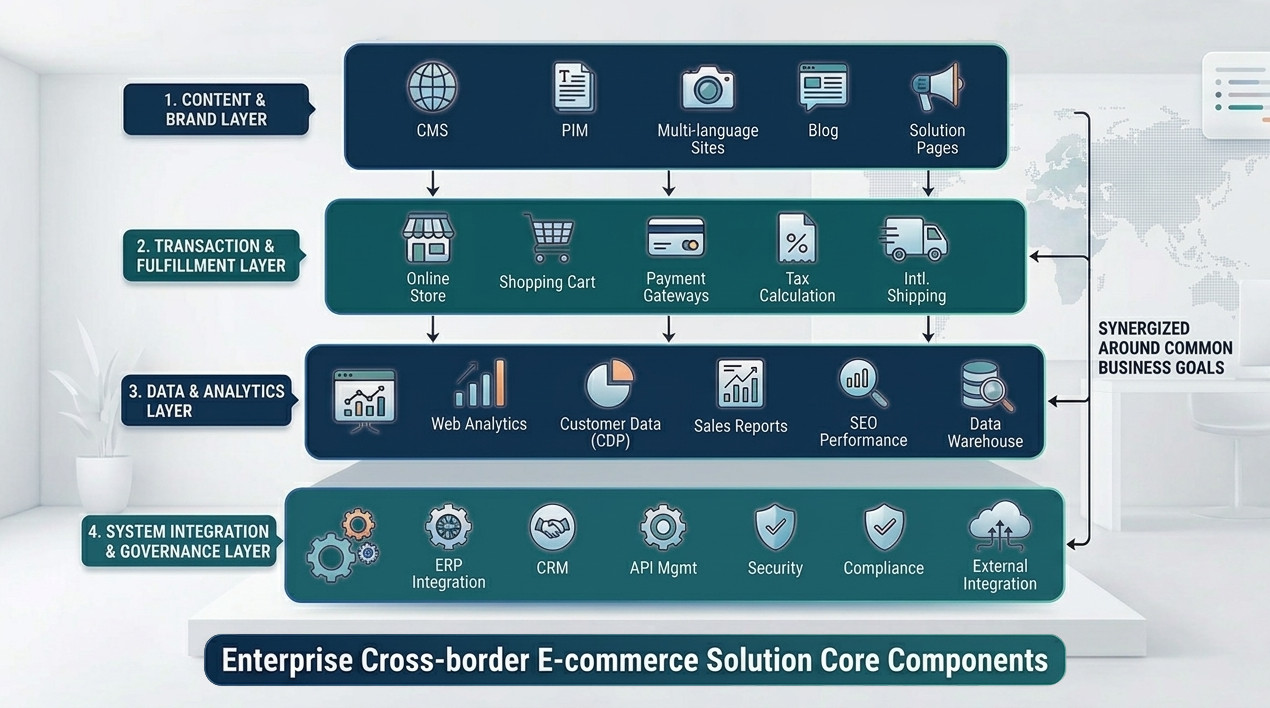
From a practical enterprise perspective, a complete cross-border e-commerce solution typically consists of the following modules:
- Content and branding layer
- Transaction and fulfillment layer
- Data and analytics layer
- System integration and governance layer
These components are not simply stacked together, but work in coordination around shared business objectives.
3. From Website Content to Cross-Border Transactions: An Integrated Design
Many companies still treat “corporate websites” and “e-commerce” as separate:
- The website handles branding
- E-commerce handles sales
However, in cross-border scenarios, this separation directly impacts long-term performance—especially in search and content.
Content is the starting point of cross-border e-commerce, not decoration
In overseas markets, users often rely on search to understand:
- Who the company is
- Whether it is professional
- Whether it is trustworthy
Therefore, website content, solution pages, product descriptions, and industry insights serve as the front-end entry points for cross-border e-commerce.
When content and transactions are disconnected, common issues include:
- Search traffic failing to convert
- Inconsistent updates between content and product information
- Fragmented brand messaging
A mature enterprise solution integrates content and transactions within the same framework, allowing content to support branding, conversion, and search simultaneously.
4. Alignment Between System Architecture and Business Processes
The key to an enterprise cross-border e-commerce solution is not the number of systems, but whether responsibilities are clearly defined and collaboration is seamless.
Clear Separation of Content, Transaction, and Data Layers

Content layer
branding, market communication, multilingual content, and the foundation for SEO and GEO

Transaction layer
products, pricing, inventory, orders, payments, taxation, and fulfillment

Data layer
unified data across user behavior, transactions, customers, and content
For example, many companies choose Adobe Commerce as the transaction core, combined with content systems and data platforms to form an integrated architecture.
The key is not which product you choose, but whether it supports long-term scalability and governance.
5. The Role of SEO and GEO in Enterprise Solutions
In enterprise cross-border e-commerce solutions, SEO and GEO are not “marketing add-ons,” but capabilities that must be embedded from the beginning of content and architecture design.
5.1 SEO: A Long-Term Accumulating Search Asset
For enterprises, the goal of SEO is not just traffic, but:
- Being consistently recognized as a trusted source by search systems
- Building content themes around core business areas
- Achieving long-term compounding returns instead of one-time rankings
This requires solutions to include from the outset:
- A clear content structure
- Stable URLs and site hierarchy
- SEO governance across multiple markets and languages
5.2 GEO: Whether Content Can Be “Understood and Referenced”
As search evolves, users increasingly see aggregated answers rather than individual web pages.
This raises a new question for businesses:
Is your content clear and well-structured enough to be understood and referenced by modern search systems?
In enterprise solutions, GEO focuses not on tactics, but on:
- Whether content provides clear conclusions
- Whether logical relationships exist between pages
- Whether brand and domain expertise are consistently communicated
If content is merely a collection of information without structured expression, it will struggle to gain visibility in modern search environments.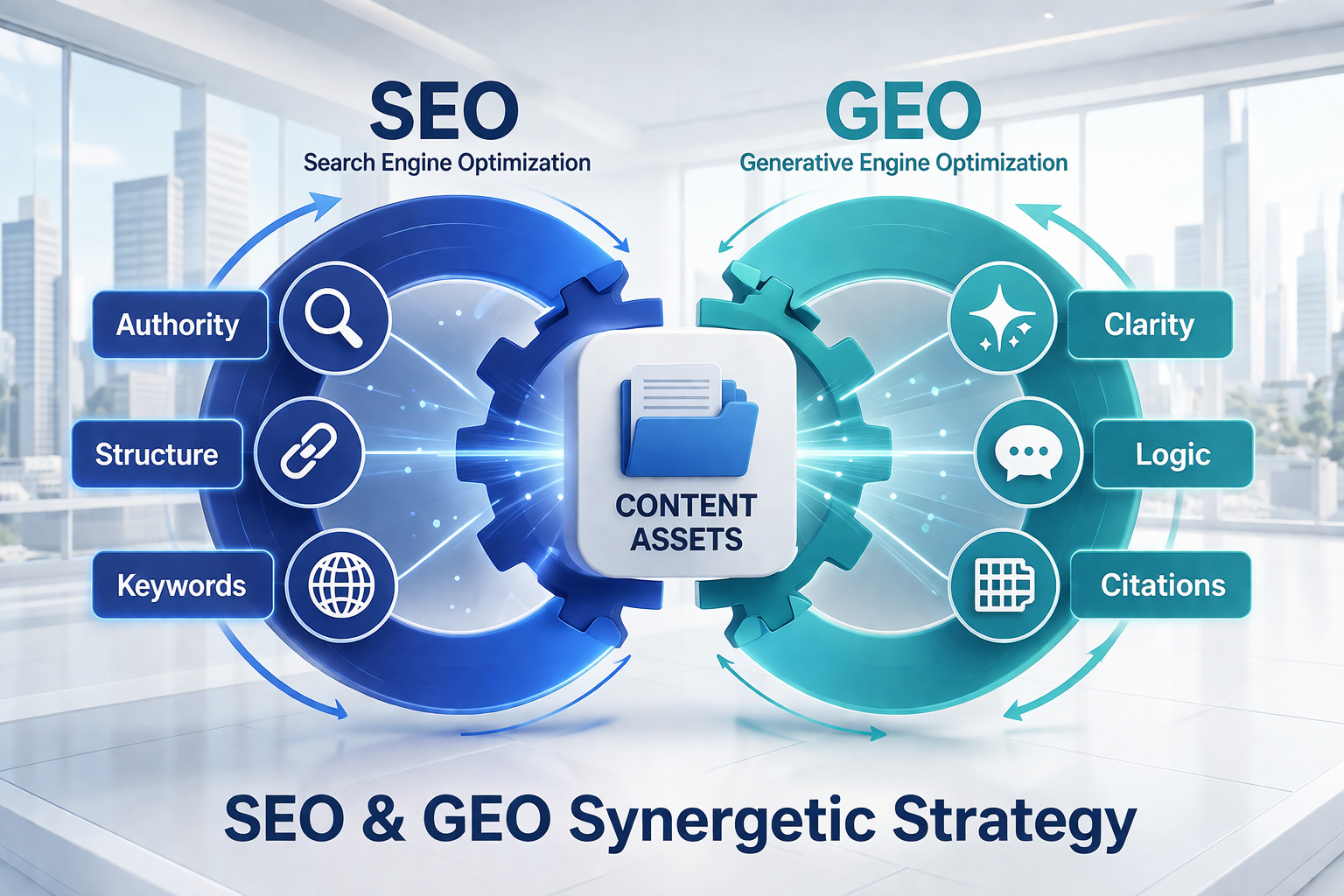
6. Data, Analytics, and Continuous Optimization
Data is the key to turning a “solution” from a concept into a real capability.
In enterprise cross-border e-commerce, the data layer needs to answer questions such as:
- Which content actually drives search traffic and conversions
- Behavioral differences across markets
- Whether SEO and content investments generate compounding returns
- Which pages are referenced—or ignored—in modern search environments
Only by integrating content, transaction, and behavioral data can businesses achieve continuous optimization, rather than relying on intuition.
7. Implementation Roadmap and Phases of Enterprise Solutions
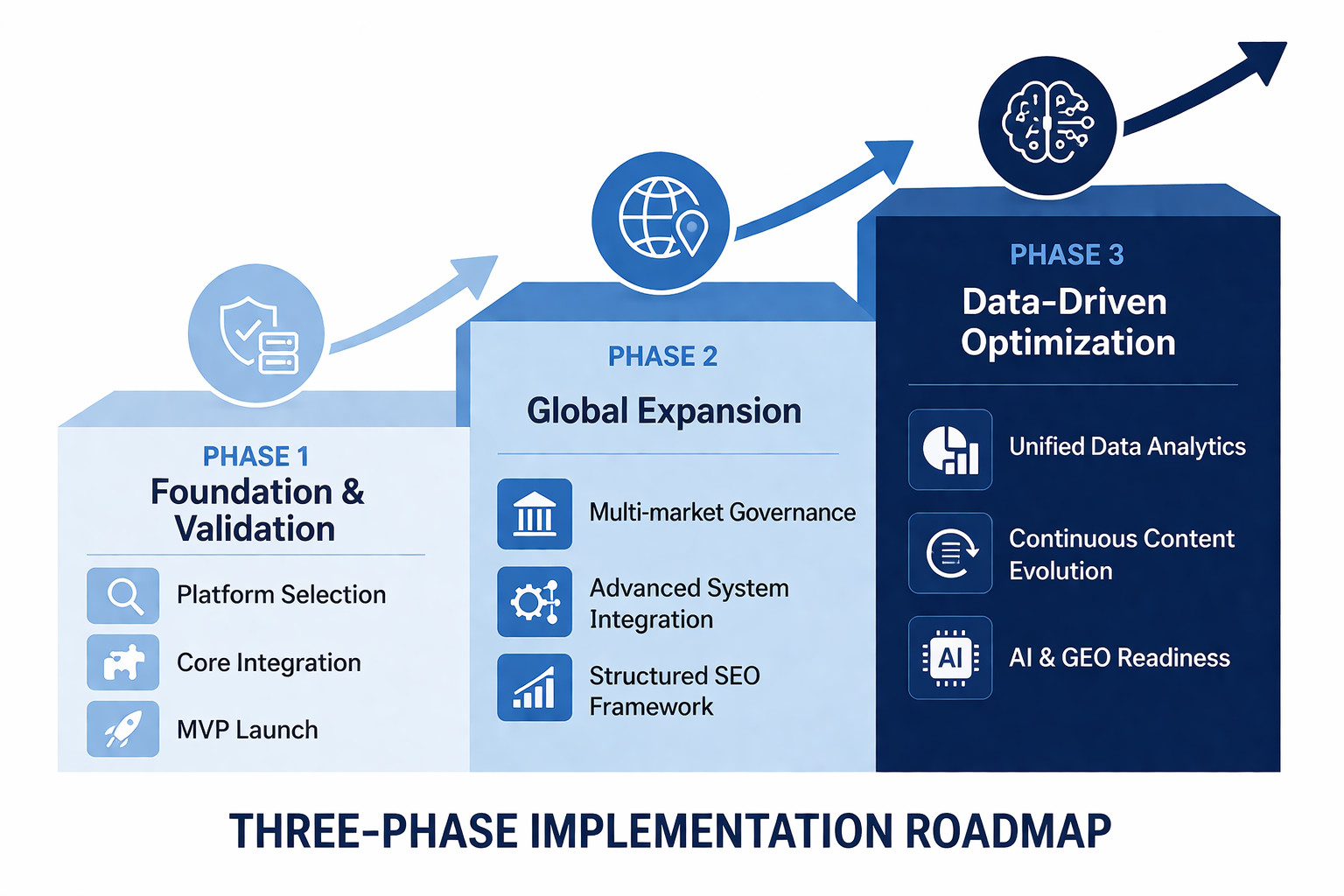
Enterprise cross-border e-commerce solutions are rarely implemented all at once—they are typically rolled out in phases.
Phase 1: Foundation and Market Validation
- Platform and core system selection
- Initial integration of content and transactions
- Establishing a minimum viable architecture
Phase 2: Multi-Market Expansion and Complexity Management
- Multi-site and multilingual governance
- Deeper system integration
- Establishing an SEO content framework
Phase 3: Data-Driven Growth and Continuous Optimization
- Data unification and analytics
- Continuous evolution of content and search strategies
- Preparation for GEO and emerging search paradigms
Successful companies continuously refine their architecture between phases rather than rebuilding from scratch.
8. Conclusion: Building Sustainable Cross-Border E-commerce Capabilities
The value of an enterprise cross-border e-commerce solution lies not in having “complete features,” but in:
- Supporting business complexity over the next 3–5 years
- Enabling content, search, and data to generate compounding value
- Reducing long-term restructuring and governance costs
In today’s landscape, cross-border e-commerce is no longer just about “selling overseas,” but about:
- How brands are discovered over time
- How content continues to be understood
- How systems support enterprise-level growth
If you are planning or upgrading your cross-border e-commerce strategy, visit the Contact Us page to work with our consulting team and map out a comprehensive cross-border e-commerce solution tailored to your business stage.
Further Reading and References
Further Reading
- “Going Global: The Right Approach to Cross-Border E-commerce Standalone Sites”
- “Cross-Border E-commerce System Architecture: Enterprise-Level Insights”
- “Why More Enterprises Choose Adobe Commerce for Cross-Border E-commerce”
- “7 Common Pitfalls in Enterprise Cross-Border E-commerce”
References
Related Articles

Enterprise AI MarTech Trends Analysis 2024-2029 Outlook Report
From AI content productivity tools to a core engine for revenue growth and marketing transformation
*The PDF will be sent directly to your inbox.
Email Error
Please enter a valid email address.
Thank You!
The whitepaper has been sent to your inbox. If you don’t see it, please check your spam or promotions folder.