
Cross-Border E-Commerce Platform Comparison: Shopify, Adobe Commerce (Magento) vs WooCommerce
Adobe Commerce (Magento), E-Commerce, e-commerce Platforms, Shopify
6 July 2026
1. Introduction: Choosing a Cross-Border E-Commerce Platform Goes Beyond Build Cost
Quick answer: Shopify is ideal for fast launch and standardized DTC operations; Adobe Commerce suits complex B2B/B2C, multi-market and deep system integration; WooCommerce fits teams with existing WordPress infrastructure who value content SEO and autonomy. After reading, you will be better equipped to decide whether your business should prioritize speed to market, deep customization, or content and autonomy.
Many companies start their platform evaluation by asking, “Which platform is cheapest?” But for cross-border e-commerce, platform selection is not just about website development cost — it directly impacts multi-market operations, payment and logistics integration, customer management, promotional strategies, back-office efficiency and long-term scalability.
If you only look at upfront build costs, you may overlook the real costs of ongoing operations. For example: How easy is multi-language management? Does the platform support multi-currency and tax compliance? Can it integrate with ERP, CRM, PIM, OMS or WMS? When your business expands from a single market to multiple regions, can the platform still support your needs?
2. Why Cross-Border E-Commerce Demands Stronger Platform Architecture
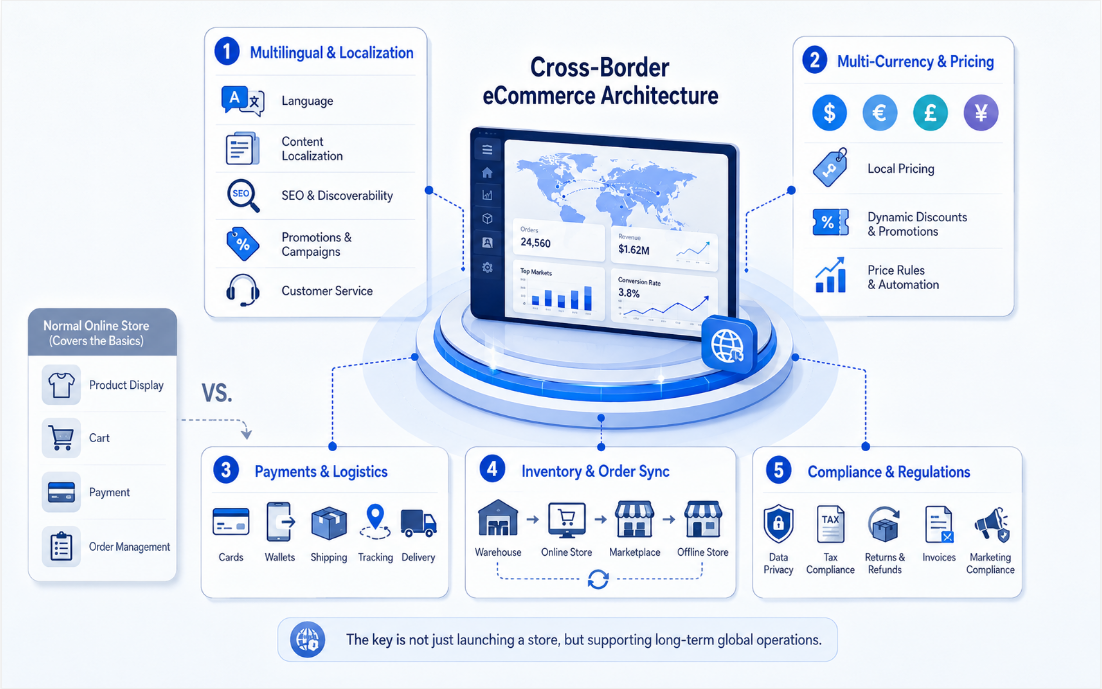
A typical online store mainly handles product display, shopping cart, payment and order management. Cross-border e-commerce, however, faces far more complex operational requirements. Different regional languages, currencies, payment methods, logistics rules, tax policies and consumer behaviors all amplify the importance of platform architecture.
Common core requirements for cross-border e-commerce include:

Multi-Language & Localization
Manage marketing copy, SEO content, promotional campaigns and customer service across different markets.

Multi-Currency & Pricing
Different markets require different pricing, discounts, tax display and checkout currencies.

Cross-Border Payment & Logistics
Support credit cards, e-wallets, local payment methods, third-party logistics and tracking systems.

Inventory & Order Sync
When operating across DTC, marketplaces and offline channels, back-end data must be consistent.

Regulatory & Data Compliance
Different markets have different requirements for personal data, taxation, returns, invoicing and marketing tracking.
Therefore, the key question is not “Can we open a store?” but “Can the platform sustainably support cross-border operations?”
3. Shopify: For Brands Needing Fast Launch and Standardized Operations
Shopify is a SaaS e-commerce platform whose biggest advantages are fast time-to-market, low infrastructure and security maintenance burden, making it ideal for standardized DTC operations and rapid cross-border testing. Companies do not need to manage servers, security updates or infrastructure maintenance, freeing resources for products, brand, marketing and conversion optimization.
For cross-border brands, Shopify is particularly suited to those who want to quickly test markets, build DTC brand storefronts, or run multi-market sales with standardized processes. Through Shopify Markets, the App ecosystem and third-party integrations, companies can quickly configure multi-market, multi-language, multi-currency, payment, logistics and marketing tools. However, some multi-currency, tax, B2B or advanced market features may be limited by plan tier, Shopify Payments availability and regional support.
Shopify is suitable for the following scenarios:
Rapid Cross-Border Sales Launch
You want to build a brand storefront and start selling in a short timeframe.
Limited Technical Team Resources
You prefer not to invest heavily in IT operations and server management.
Standardized Products and Promotions
Your product structure, membership rules and order flows are not highly complex.
Marketing and Advertising Focus
You need quick integration with social ads, email, CRM, analytics and retargeting tools.
DTC or Brand Direct Model
You drive sales through brand stories, product pages, campaign pages, social ads and customer engagement.
However, Shopify’s limitations are also clear. When companies need extensive back-office customization, complex B2B quoting processes, multi-tier customer permissions, or deep ERP, PIM and OMS integration, they may need to rely on third-party apps, API development or upgrade to Shopify Plus. Over the long term, app subscription costs and platform constraints should be factored into total cost of ownership.
4. Adobe Commerce (Magento): For Complex Business and Enterprise Scalability
Adobe Commerce, derived from Magento Commerce, is positioned as an enterprise-grade, customizable and scalable e-commerce platform. Magento Open Source remains the open-source version, with differences in licensing, enterprise features and support models. It is particularly suited for mid-to-large enterprises, multi-brand groups, B2B/B2C hybrid businesses, and cross-border e-commerce requiring deep system integration.
Compared to Shopify’s standardized SaaS model, Adobe Commerce offers greater architectural flexibility. Companies can design product structures, customer groups, pricing rules, promotional conditions, quoting processes, approval workflows and multi-site management based on their own business processes. For companies operating across multiple countries, brands, languages and currencies, this flexibility is critical.
Adobe Commerce is suitable for the following scenarios:
Complex Products & Pricing Rules
E.g., multi-variant products, bundle products, tiered pricing, member pricing and regional pricing.
B2B or B2B2C Business
You need company accounts, purchasing permissions, quotes, approvals, credit limits or bulk ordering.
Multi-Brand & Multi-Market Management
You want to manage multiple storefronts, markets and languages under one architecture.
Deep System Integration
You need to connect with ERP, CRM, PIM, OMS, WMS, CDP, AEM or analytics platforms.
Long-Term Enterprise Scaling
You want the platform to serve as core digital commerce infrastructure, not just an online store.
The main challenge of Adobe Commerce is its higher implementation cost and technical requirements. Companies typically need more comprehensive requirements analysis, architecture design, development testing, operations management and professional team support. It may not suit small teams looking to quickly test a market, but for businesses with complex operations, larger revenue scale and long-term expansion needs, Adobe Commerce often provides greater control.
5. WooCommerce: For Content-Driven, Highly Autonomous WordPress Teams
WooCommerce is an open-source e-commerce platform built on WordPress. Its core strengths are content and commerce integration, plugin flexibility and data autonomy. However, companies must self-manage hosting, performance, security, backups and plugin compatibility. For businesses already using WordPress for content, SEO or brand websites, WooCommerce can naturally integrate content and sales in one system.
WooCommerce’s other advantage is its open-source ecosystem. Companies can choose their own hosting, themes, plugins, payment methods and development approach without being locked into a single SaaS platform. For brands with WordPress technical capabilities who value content marketing and SEO, WooCommerce is quite attractive.
WooCommerce is suitable for the following scenarios:
Existing WordPress Website
You want to add e-commerce functionality to your current site.
Content & SEO Driven
Blogs, knowledge bases, product education and content marketing are your main traffic sources.
Budget Sensitive
You want to control platform licensing costs and choose hosting and plugins as needed.
High Autonomy Required
You want full control over website data, code, hosting and scaling methods.
Small to Mid-Size Cross-Border Store
Your product catalog and operational processes are not overly complex.
However, WooCommerce’s freedom also means companies bear more technical responsibility. Hosting performance, plugin compatibility, security updates, backups, speed optimization, payment and logistics integration all need proper management. When plugin count grows or custom development lacks planning, site performance and maintenance costs can rise quickly.
6. Core Comparison: Cost, Flexibility, Integration and Operations
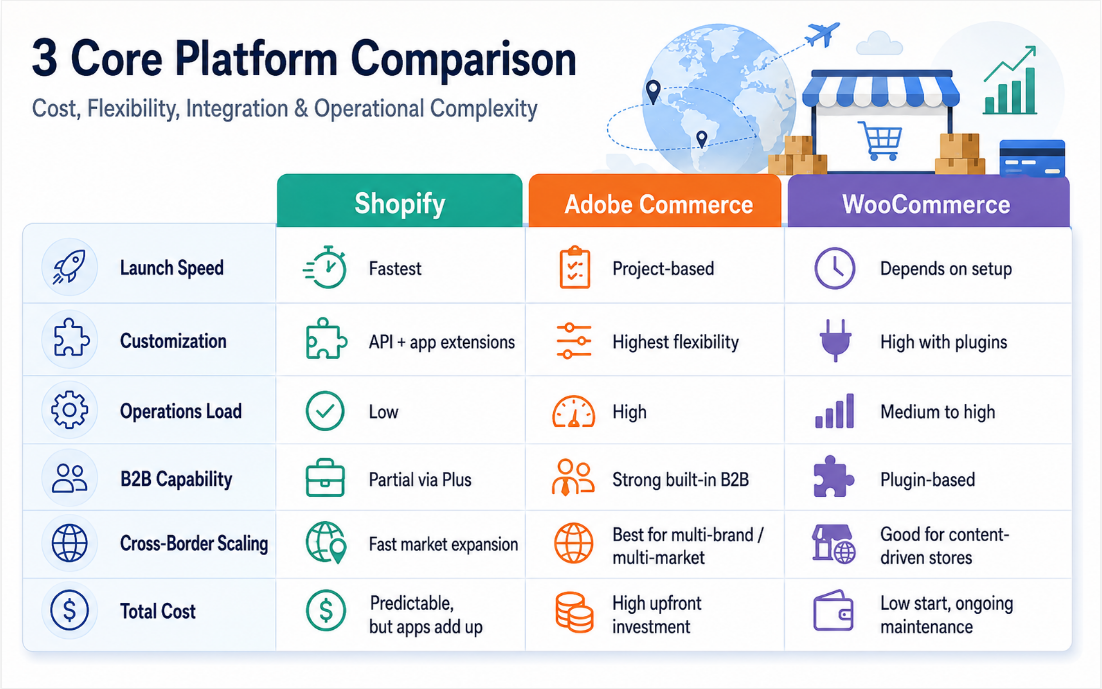
From a cross-border e-commerce perspective, comparing Shopify, Adobe Commerce and WooCommerce across these dimensions:
- Speed to market: Shopify is typically fastest; WooCommerce depends on WordPress foundation and plugin configuration; Adobe Commerce requires a more complete project implementation.
- Customization flexibility: Adobe Commerce is highest, WooCommerce next, while Shopify offers extensions and API customization within its standard framework.
- Operations burden: Shopify is lowest since infrastructure is managed by the platform; WooCommerce requires self-managed hosting and plugins; Adobe Commerce needs professional technical and operations teams.
- B2B capabilities: Adobe Commerce has the most complete built-in B2B features such as company accounts, shared catalogs, quick order and negotiable quotes; Shopify Plus supports some B2B scenarios; WooCommerce relies on plugins and custom development.
- Cross-border scaling: All three support cross-border, but Adobe Commerce is better for multi-brand, multi-market and complex integration; Shopify for rapid expansion; WooCommerce for content-driven cross-border stores.
- Total cost: Shopify subscription and app costs are easier to estimate, but transaction, app and advanced plan fees add up; WooCommerce core is free and open-source, but hosting, plugin, security and maintenance costs accumulate; Adobe Commerce has higher upfront investment and implementation costs, suited for enterprise-scale and complex integration needs.
7. Which Platform Should You Choose for Your Business Scenario?
Platform selection should not be driven by IT or marketing alone. It should evaluate business model, product structure, B2B/B2C processes, cross-border operations, system integration, data governance and long-term TCO. The best approach is to work backwards from your current stage and 3-5 year operational goals.
If your company is still validating overseas markets with a relatively simple product structure and wants to quickly build a brand storefront and start advertising, Shopify is usually the pragmatic choice. It lowers the technical barrier, enabling rapid market testing before gradually expanding features.
If your company has stable revenue, multi-region teams, multi-brand or B2B operations, and needs deep integration with internal systems, Adobe Commerce is worth evaluating. Its implementation cycle is longer, but it can support more complex business processes and long-term architecture.
If your company centers on content marketing, SEO and brand education, and already has a WordPress foundation, WooCommerce may offer cost flexibility and content advantages. However, this requires sufficient technical maintenance capability or a reliable development and operations partner.
8. Common Pitfalls in Platform Selection
Many companies fall into these common pitfalls when choosing an e-commerce platform:
1. Comparing Only Monthly Fees, Not Total Cost of Ownership
Platform monthly fees are only part of the cost. Themes, apps, plugins, development, hosting, maintenance, integration, upgrades and operational staffing all affect long-term costs.
2. Focusing on Front-End Design, Ignoring Back-End Processes
Cross-border e-commerce success depends not just on a beautiful website, but on smooth product, inventory, order, payment, logistics and customer service processes.
3. Underestimating System Integration Complexity
When connecting ERP, CRM, PIM, OMS or WMS, the platform’s API, data model and integration flexibility become critical.
4. Ignoring Future Market Expansion
Operating in one market today doesn’t mean you won’t expand tomorrow. Whether the platform supports multi-language, multi-currency, multi-brand and multi-site should be evaluated early.
5. Treating the Platform as a One-Time Build Project
An e-commerce platform is never “done.” It requires continuous optimization of SEO, GEO, site speed, conversion paths, data tracking, product content, checkout experience and customer operations.
| Platform | Best Suited For | Strengths | Main Limitations |
|---|---|---|---|
| Shopify / Shopify Plus | Fast launch, DTC, standardized cross-border operations | Low SaaS ops, App ecosystem, Shopify Markets, multi-language/multi-currency support | Deep customization, complex B2B, special checkout and deep integration need plan/API evaluation |
| Adobe Commerce | Mid-to-large enterprise, B2B/B2C hybrid, multi-market, multi-system integration | High customization, B2B features, shared catalogs, negotiable quotes, multi-site and enterprise scaling | High implementation cost and technical requirements, needs professional team |
| WooCommerce | WordPress teams, content SEO, small to mid-size cross-border stores | Open-source, autonomous control, content-commerce integration, plugin flexibility | Higher hosting, performance, security, plugin compatibility and ops responsibility |
9. Conclusion: Choosing a Platform Means Choosing Your Future E-Commerce Operating Model
Shopify, Adobe Commerce and WooCommerce each have no absolute superiority. The real key is whether your business model, cross-border strategy, system complexity, technical resources and growth goals align with the platform’s characteristics.
Shopify suits companies wanting fast launch, lower technical operations burden, and sales driven by brand, content and marketing. Adobe Commerce suits mid-to-large enterprises needing high customization, B2B processes, multi-market management and deep system integration. WooCommerce suits teams that value content, SEO, autonomy and the WordPress ecosystem.
For cross-border e-commerce, platform selection is not merely a technical decision — it is the starting point of your digital commerce architecture. Companies should first clarify their business processes, target markets, system integration needs and long-term expansion direction, then choose the platform that best supports future growth.
If you are evaluating Shopify, Adobe Commerce (Magento) or WooCommerce for your cross-border e-commerce business, visit LeadsTech’s Contact Us page to connect with our consulting team. We can help you assess platform selection from business model, technical architecture, cross-border operations and total cost perspectives.
You can also explore our Enterprise E-Commerce Website Development Services, Adobe Commerce (Magento) Product Page and Shopify Product Page to learn how LeadsTech helps companies with e-commerce platform planning, implementation, system integration, SEO/GEO optimization and long-term operations.
Further Reading
Related Articles

Enterprise AI MarTech Trends Analysis 2024-2029 Outlook Report
From AI content productivity tools to a core engine for revenue growth and marketing transformation
*The PDF will be sent directly to your inbox.